
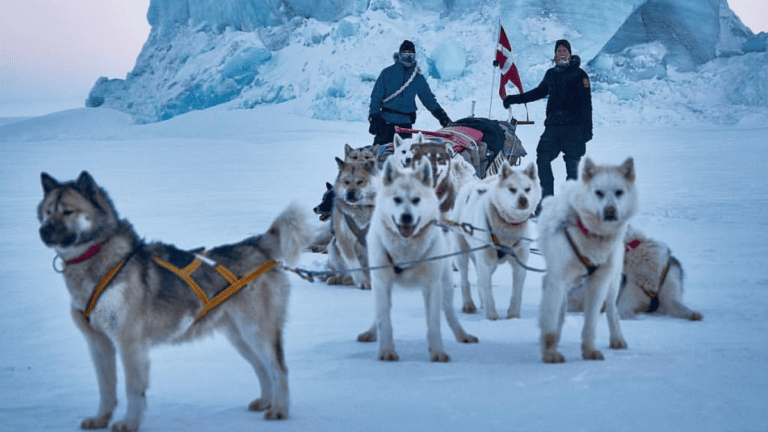
With the largest territory in the Arctic out of any of the Arctic Council’s members, Denmark is in a unique position to shape Arctic policy relative to its size. Continued possession of Greenland, friction with Russia and growing Chinese interest in the region weigh heavily on Copenhagen’s Arctic agenda. In our previous report on Denmark’s Arctic outlook, we identified several hot points for Denmark’s Arctic outlook. We revisit and assess those hot points one year on.
Denmark’s Acting Minister of Defense Troels Lund Poulsen
Key Judgement 1. It is likely that Denmark will bolster defence cooperation and security ties with its Arctic neighbors in the next 12 months.
Key Judgement 2. It is highly likely that Denmark will heavily invest in military capabilities in order to project force into the Arctic region in the next 12 months.
Key Judgement 3. It is unlikely that China will increase the scope of its economic involvement in Greenland, allowing for more investment in Russian Arctic infrastructure in the next 12 months.
Key Judgement-1: It is likely that Denmark will bolster defence cooperation and security ties with its Arctic neighbours in the next 12 months.
a) On 19 December, Denmark signed a ten-year basing agreement with the United States. The deal allows for the permanent basing of U.S. forces on Danish soil during the term of the arrangement [source].
b) On 3 May, Danish Defence Minister Troels Poulsen told a Danish newspaper that Denmark’s strategic priority is the Arctic region. The Baltic Sea is a second priority. Poulsen’s comments are a departure from his predecessor’s comments last year that the Baltic Sea is Denmark’s first priority [source, source].
b) In February, the Danish Minister of Foreign Affairs completed a 3-day trip to Greenland and the Faroe Islands in which he highlighted deeper security cooperation. The Danish military will construct a new early warning radar station in the Faroe Islands by the Danish military. With a range between 3-400 km, the station will watch the approaches to the North Sea from Russia [source].
c) on 24 March Denmark agreed in March at Rammstein AFB to establish a combined Nordic air fleet Alongside Sweden, Norway and Finland [source].

Key Judgement-2: It is highly likely that Denmark will heavily invest in military capabilities in order to project force into the Arctic region in the next 12 months.
a) On 30 June Denmark’s political parties reached an agreement to boost defence spending by $20 billion USD over the next ten years. Denmark plans to reach the NATO target of 2 per cent of GDP on defence spending by 2030 [source].
b) The Danish Navy plans to introduce multifunctional patrol vessels towards the beginning of 2025 to replace the older Thetis Class Patrol Ship. The new vessels will use containerized storage to make loading and off-loading of the vessel far easier, allowing for ease of use in non-permissive environments [source].
c) In 2022, the Danish Defence Ministry put out a tender for a new ISR-capable UAV which should be fulfilled by the end of 2024 [source].
d) The Joint Arctic Command Denmark (JACO) headquartered in Denmark is actively being upgraded with new command and control (C2) capabilities. This upgrade includes the TERMA JIMAPS C4ISR system [source].
e) In addition, a new ground station will be constructed in Greenland in order to better link surveillance satellites with ground assets [source].
f) In late 2023, the Danish military launched a new Arctic basic training programme for residents of Greenland. The training focuses on developing military skills in arctic conditions [source].
Key Judgement-3: It is unlikely that China will increase the scope of its economic involvement in Greenland in the next 12 months.
a) In November, Greenlandic politicians expressed that there are opportunities for economic engagement with China, but mostly in the realm of fishing and tourism [source].
b) On 23 October, Greenland’s Foreign Minister visited China and opened official Representation in Beijing. The visit did not include a discussion of economic investment in Greenland [source, source].
b) Since last year, China’s direct presence in Greenland only amounted to several dozen migrant workers in factories. Chinese projects in Uranium and Iron ore mining were outright cancelled or indefinitely put on hold [source].
c) The US Government blocked Chinese efforts to purchase an abandoned Danish naval station [source].
d) China itself cancelled its bid to construct 2 airports on Greenland, reportedly through efforts of US diplomacy [source].
e) A group of local political representatives in Denmark expressed concerns over Chinese mining interests in Greenland due to environmental concerns [source].
Analytical Summary
We have high confidence in our assessment that Denmark will deepen security ties with its Arctic neighbours. We base this assessment on international press reporting, local press reporting, think tank reporting and official statements from the Danish government. We assume that Denmark will capitalize on efforts underway since 2020. Should this assumption prove incorrect, we would expect to see a cancellation of cornerstone agreements such as combining air fleets with other Nordic countries. We considered the alternative that Denmark will prioritize its NATO alliances with central European states but dismissed it due to the higher rate of diplomacy observed amongst Nordic states.
Power Projection
We have high confidence in our assessment that Denmark will heavily invest in military capabilities to project power into the Arctic. We base this assessment on international press reporting, think tank reporting and official statements from the Danish government. We assume that Denmark’s commitments to Ukraine will detract from its naval modernization efforts. Should this assumption prove incorrect, we would expect to see delays in the introduction of new patrol craft. We considered the alternative that the Danish government will shift its policy as it did last year but dismissed it due to the strong progress made in shifting strategic priorities to the Arctic.
Chinese Encroachment
We have medium confidence in our assessment that China will fail to establish strong roots in Greenland. We base this assessment on international press reporting, local press reporting and think tank reporting. We assume that China will divert resources to its Russian Arctic projects instead. Should this assumption prove incorrect, we would expect to see Chinese investment and infrastructure development in Greenland that materializes in the next 12 months. We considered the alternative that China will reorganize its efforts in Greenland but dismissed it due to the lack of Chinese government statements to that effect.
Intelligence Cut-off Date: 29 December 2023
The post Denmark’s Arctic Strategy 2024: A 12-Month Assessment appeared first on Grey Dynamics.