news analysis
There is little sign that public exhaustion, economic headwinds or increased Ukrainian strikes are changing the Russian leader’s view that he will eventually achieve victory.
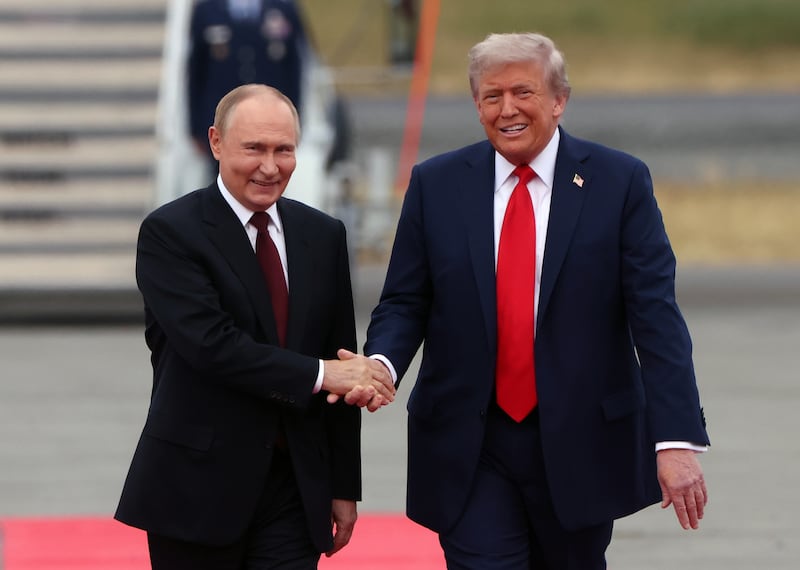
Russian President Vladimir Putin has suggested that despite Moscow’s challenges, he believes Kyiv’s situation is worse.Credit…Pool photo by Alexander Zemlianichenko
In his fifth year of war, difficulties are mounting for President Vladimir V. Putin of Russia.
His troops have slowed on the battlefield. His spending on the war has ballooned beyond expectations. His population is increasingly fearful of what’s next. And his ability to project control has been undercut by Ukrainian strikes across Russia, with e-commerce warehouses, oil refineries and other facilities going up in flames on a near daily basis.
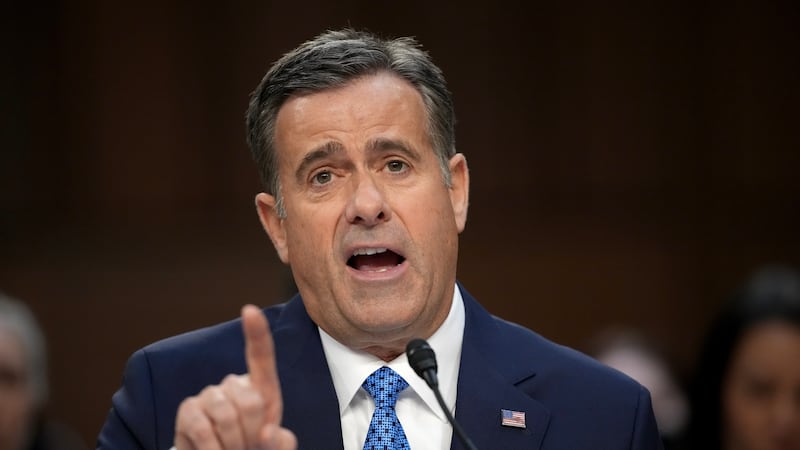
The situation has deteriorated to the point that the C.I.A. director, John Ratcliffe, made a rare visit this week to Moscow, where he laid out a bleak military and economic reality for Mr. Putin’s intelligence officials and urged the Russian government to cut a peace deal.
But Mr. Putin has shown little indication that he intends to stop fighting or believes his predicament is too gloomy to bear.
Smoke rises following a Ukrainian drone attack on a warehouse for online retailer Wildberries in St. Petersburg, Russia, earlier this year.Credit…Associated Press
Instead, the Russian leader has suggested that despite Moscow’s challenges, he believes Kyiv’s situation is worse. He has warned that Ukraine “let the genie out of the bottle” by targeting Russia’s civilian economy and will get its due with a Russian escalation already underway.
“In his assessment, Russia needs to do just better than Ukraine,” believing that Kyiv “is going to crumble” eventually if he just holds on, said Alexander Gabuev, director of the Carnegie Russia Eurasia Center in Berlin.
Mr. Putin has consistently underestimated Ukrainian resilience, Mr. Gabuev said. But Kyiv is indeed facing new perils.
Beyond its dwindling reserves of soldiers and military funds, Ukraine is experiencing severe air-defense shortages that leave Ukrainian territory increasingly vulnerable to Russia’s ballistic missiles. As the war in Iran has depleted interceptor stockpiles, Western allies have become far more constrained in their ability or willingness to help.
Moscow each month is churning out dozens of ballistic missiles, formidable weapons that Ukraine lacks. According to Ukrainian military intelligence, Russia is also turning to North Korea for added ballistic missile power.
Mr. Gabuev said the imbalance may be convincing Mr. Putin that he is gaining a critical advantage, despite his increasing challenges at home. The Russian leader, he said, will seek to “break” Ukraine this winter by decimating its civilian infrastructure and military production facilities.
Ukrainians take shelter in underground spaces during air raids, like these residents in Arsenalna metro station in Kyiv, Ukraine, earlier this year.Credit…Jędrzej Nowicki for The New York Times
But as he presses on in the war, Mr. Putin is moving to contain a situation at home that looks markedly worse than last year.
For much of 2025, the Russian military was taking dozens of square miles of Ukrainian land each month. The Kremlin’s engagement with the Trump administration buoyed hopes within Russian society that the war could soon end. Russia’s technocrats were keeping the wartime economy humming; the Russian internet was consistently operational; gasoline was uniformly available; and strikes on Russian territory outside border regions were relatively contained.
Want to stay updated on what’s happening in Russia and Ukraine? , and we’ll send our latest coverage to your inbox.
All of that has now changed.
“The biggest challenge for Putin right now is that expectations are shifting,” said Janis Kluge, a Russia analyst at the German Institute for International and Security Affairs. “The situation is just very different from a year ago. If you look into the future, if you’re Moscow elites, and you think about where this is going, you will notice it is going in the wrong direction.”
On the battlefield, the Russian military’s net territorial gain has amounted to just 68 square miles since June 1, as it focuses on the most fortified part of the Ukrainian front in the eastern Donetsk region, according to statistics from the Black Bird Group, a Finland-based security analysis firm.
Despite Mr. Ratcliffe’s visit to Moscow, there is little indication that peace talks will be fully revived soon, dashing hopes among many Russians for a resolution to the conflict.
“Regarding the issue of peace talks, that topic is currently firmly on hold,” the Kremlin spokesman, Dmitri S. Peskov, said on Friday, after the visit. “There are no new ideas.”
Ukraine’s long-range strikes have led Russians to question what might come next. Kyiv is rushing to develop ballistic missiles of its own, with President Volodymyr Zelensky saying this month that he hoped to have “concrete results” by the end of the year.
On top of the anxieties about further destruction on Russian territory, many in Russia are worried about a possible new draft to replenish the military once a parliamentary election concludes next month.
Fuel shortages in Russia have made for long lines for gas, as at a Lukoil station in Moscow last month.Credit…Igor Ivanko/Agence France-Presse — Getty Images
Russia is still scrambling to solve shortages at gas stations across the country and is reeling from repeated attacks on the warehouses of its two e-commerce giants, Wildberries and Ozon.
All the while, the mood in the country has shifted. The percentage of Russians expressing support for the actions of the Russian military in Ukraine has dropped to its lowest level since the start of the invasion, according to a poll last month by the independent Levada Center.
Feelings about the country’s economic prospects have also soured, particularly after higher taxes came into effect to help cover runaway spending on the war. Russians have begun withdrawing more cash from banks, as regular internet outages stymie digital payments and some people look to avoid the new tax burden by transacting in cash.
Russian elites have sent some muted signals of discontent.
In June, Herman O. Gref, the head of the state-owned Sberbank, said Russians wanted the war to end as soon as possible. Sergei S. Sobyanin, the mayor of Moscow, warned that attempting to put the Russian economy entirely on a military footing, as some hard-liners have called for, would “kill the country altogether.”
Andrei Klepach, the chief economist at the Russian state development bank, Vnesheconombank, known as VEB, was fired after telling fellow economists in a speech that Russia was falling behind technologically and economically as a result of the war.
He warned that Russians were under the illusion that Ukraine would collapse, but “it hasn’t and it won’t,” according to remarks first reported by The Moscow Times.
While Mr. Putin’s apparatus is busy orchestrating the nationwide political theater of a parliamentary election, the first since the 2022 invasion, political dissent has been met with repression. The Russian authorities were sufficiently concerned that discontent could boil over in the coming parliamentary election that the country’s Supreme Court barred a marginal party, Yabloko, from the ballot as its antiwar stance gained traction beyond expectations.
Nikolay Rybakov, leader of the opposition Yabloko party, talks to the media outside the Supreme Court in Moscow earlier this month, after his party was barred from competing in parliamentary elections.Credit…Igor Ivanko/Agence France-Presse — Getty Images
Thomas Graham, a Russia expert in the administration of George W. Bush, said that the escalatory cycle in the war and the strains being felt by both sides should prompt the United States to lead a new, sustained push to end the conflict.
Even if Mr. Putin plans to fight through the winter, Mr. Graham said, the groundwork must be laid with Russian officials now for a final agreement to be reached in the spring.
“There is a substantial element of the political elite that would like to end this conflict sooner as opposed to later,” Mr. Graham said.
Mr. Putin, for his part, has spent much of the past month saying that Russians must dig in and rally against the foreign adversaries he says are bent on destroying the nation.
He visited a faraway disputed island claimed by Japan to underscore Russia’s assertion of its sovereignty and territorial claims.
He inspected the crypt and remains of Dmitri Donskoy, a 14th-century Russian Orthodox saint whom many Russians know for his crusading against Mongol-Tatar overlords.
And Mr. Putin appeared at the congress of the ruling United Russia party to offer his endorsement, presenting the situation at home as worsening because of Russia’s success, which has pushed Ukraine to lash out.
“The more difficult the situation on the front lines becomes for the enemy, the more brutal and barbaric are the attacks carried out by the Kyiv regime,” Mr. Putin said, comparing the Ukrainian authorities to the Nazis. “Now, a lot depends on our unity, on the courage of Russian soldiers and officers, on everyone who works assiduously in their own role to contribute to victory.”
Paul Sonne is the Moscow bureau chief, leading coverage of Russia, the Caucasus and Central Asia. He is based in Berlin.
Related Content


 The Daily Beast Latest Articles.