Categories
Selected Articles

Ukraine will stop Putin, Biden tells NATO in forceful speech


QRWZNXA64RM4TAZJVGRL52PX4A.jpg?auth=eb5d

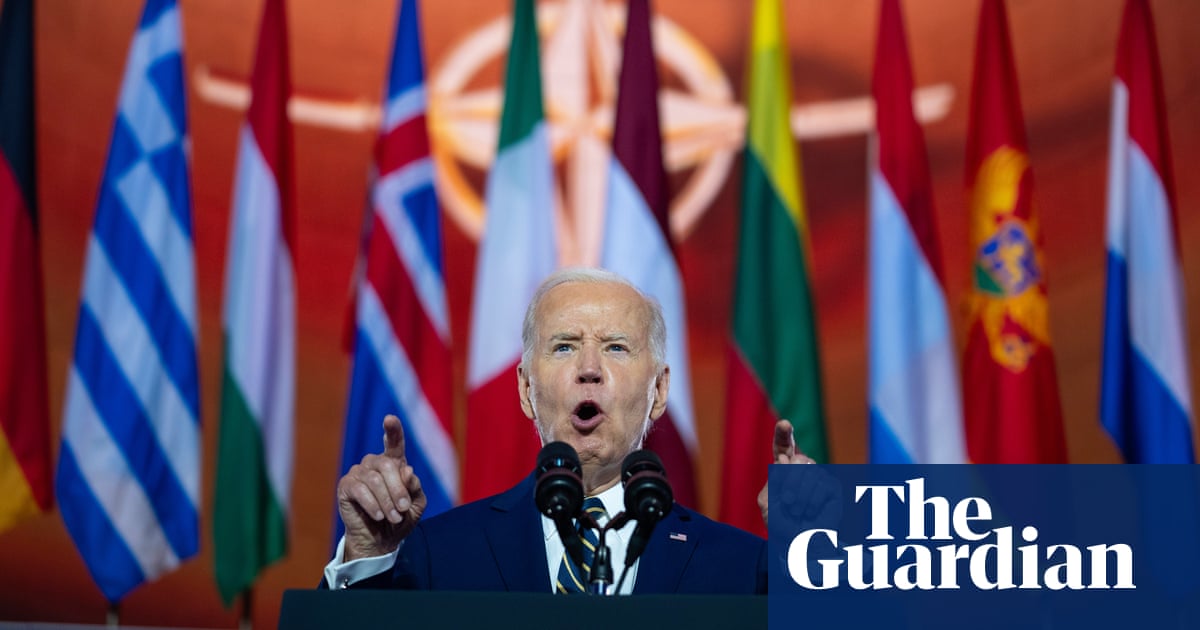
WASHINGTON, July 9 (Reuters) – U.S. President Joe Biden pledged to forcefully defend Ukraine against Russia’s invasion at the NATO summit in Washington on Tuesday, using the global stage to try to show allies at home and abroad that he can still lead.

Biden, 81, has endured 12 days of withering questions about his fitness for office as some of his fellow Democrats on Capitol Hill and campaign donors fear that he will lose the Nov. 5 election after a halting debate performance on June 27.

“(Vladimir) Putin wants nothing less, nothing less, than Ukraine’s total subjugation … and to wipe Ukraine off the map,” Biden said in his welcome to NATO member states to the summit, referring to the Russian president. “Ukraine can and will stop Putin.”

The White House is hoping he can turn the page on a difficult period in his presidency with his highest profile policy speech since the debate, although some diplomats at the summit said the damage was hard to erase.

On Tuesday, Biden spoke off of a teleprompter with a strong and confident voice and largely avoided the verbal flubs and signs of confusion that marked his debate performance.

Biden was framed by the gilded walls of the federal hall where the treaty creating NATO was signed, his speech bookended by stirring musical performances by the U.S. Marine Corp band.

“Today NATO is stronger than it’s ever been in its history,” he said.

Biden has rebuffed calls to step aside in his race against Republican Donald Trump, 78, vowing to beat him in November. So far, he has maintained the public support of most of his party’s elite.

The U.S. president has made restoring traditional alliances abroad the centerpiece of his foreign policy after Trump challenged allies as part of an “America First” approach. The election winner in November could have a substantial impact on the future of NATO, Europe and the rest of the world.

“We don’t see how he can come back after the debate,” said one European diplomat, who dismissed Tuesday’s speech as evidence of Biden’s endurance because it was scripted. “I can’t imagine him being at helm of the U.S. and NATO for four more years.”

Trump has suggested that, given a second term, he would not defend NATO members if they came under military attack and did not meet the alliance’s defense spending target of 2% of their annual GDP. He has also questioned the amount of aid given to Ukraine in its battle against Russia’s invasion.

Biden closed his remarks by surprising NATO Secretary-General Jens Stoltenberg with the Presidential Medal of Freedom, clasping the highest U.S. civilian award around the Norwegian politician’s neck and crediting him with reviving the 32-member alliance.

The centerpiece of the NATO summit is set to be new commitments of military and humanitarian aid to Ukraine. U.S. Secretary of State Antony Blinken said the summit would “further strengthen” the war-torn country’s path to NATO membership.

Biden and the leaders of Germany, Italy, the Netherlands and Romania issued a joint statement with Ukrainian President Volodymyr Zelenskiy announcing the delivery of five additional Patriot and other strategic air defense systems to protect Ukrainian cities, civilians and soldiers.

Item 1 of 9 U.S. President Joe Biden delivers remarks at a NATO event to commemorate the 75th anniversary of the alliance, in Washington, U.S., July 9, 2024. REUTERS/Leah Millis

[1/9]U.S. President Joe Biden delivers remarks at a NATO event to commemorate the 75th anniversary of the alliance, in Washington, U.S., July 9, 2024. REUTERS/Leah Millis Purchase Licensing Rights, opens new tab

They said additional strategic air defense systems would be announced this year.

Zelenskiy, who arrived in Washington on Tuesday and is due to meet with Biden on Thursday, has said Ukraine needs a minimum of seven Patriot systems, a goal met by the fresh deliveries announced on Tuesday.

“We are fighting for additional security guarantees for Ukraine – and these are weapons and finances, political support,” he said on social media.

Ukraine ultimately wants to join NATO to ward against further future attacks by Russia but candidates have to be approved by all of the alliance’s members, some of which are wary of provoking a direct conflict with Russia.

Some members want the alliance to make clear Ukraine is moving toward NATO “irreversibly” and are keen for language in a summit statement beyond the alliance’s pledge last year that “Ukraine’s future is in NATO.”
NATO, celebrating its 75th anniversary, has found new purpose in opposing Putin’s Ukraine invasion and the grinding war will dominate private conversations between the leaders of the countries.
Those leaders, already anxious about the prospect of Trump’s return, came to Washington with fresh concern about Biden’s staying power, according to diplomats from their countries.

Biden will hold a rare solo press conference on Thursday, also aimed at quieting concerns.

As Biden tried to rally allies and domestic support, several high-ranking European officials met with a top foreign policy adviser to Trump during the summit.
NATO leaders face political uncertainty in Europe, with paralysis looming in France after gains for left and far right parties and German Chancellor Olaf Scholz’s coalition weakened after a poor showing in European Parliament elections.
A U.S. intelligence official said on Tuesday said that Russia prefers that Trump win the upcoming election.
New British Prime Minister Keir Starmer said as he headed to his first NATO summit that he would fulfill a campaign commitment to increase UK defense spending to 2.5% of GDP but underlined he would only do so when the country could afford it and after a review of defense strategy.
A senior NATO official said on Tuesday Russia lacks the munitions and troops to start a major offensive in Ukraine and needs to secure significant ammunition supplies from other countries beyond what it already has.

But he estimated Russia would be able to sustain its war economy for three to four more years and also said “it will be some time” before Ukraine has amassed the munitions and personnel it needs to mount its own large-scale offensive operations.

Sign up here.

Reporting by Trevor Hunnicutt, Patricia Zengerle, Steve Holland and Sabine Siebold; Additional reporting by Andrea Shalal, David Brunnstrom, Humeyra Pamuk, Jonathan Landay, Elizabeth Piper, John Irish, Jeff Mason, Daphne Psaledakis, and Doina Chiacu; Editing by Heather Timmons and Deepa Babington

Our Standards: The Thomson Reuters Trust Principles., opens new tab


Categories
Selected Articles

How US strike curbs for Ukraine morphed from caveats to ‘common sense’


NK2ZPP7NJBAXHLDRNFR6CB5FHQ.jpg

BRUSSELS — In late May, the Biden administration announced a major policy change: Washington would now let Ukrainian forces fire American-provided weapons into Russia — though only around one region in the northeast.

This had long been a bright red line in the administration’s support for Kyiv, fearing an expanded war.

It took only a few days for Ukraine to say it wasn’t enough.

“Is that sufficient? No,” said President Volodymyr Zelenskyy, speaking at a news conference in Singapore hours after meeting with U.S. Defense Secretary Lloyd Austin.

The comment was a microcosm of a much longer-term challenge for Washington. In an effort to avoid escalation, the administration has withheld certain weapons requested by Ukraine, only to later change course. The result is an ever-shifting policy that often leaves Kyiv dissatisfied — why accept one change to the rules when pushing for another could loosen them more?

The latest and perhaps most significant example of this situation has been cross-border strikes. The limited authority the White House gave Ukraine to fire into Russia is already expanding. And if this continues, analysts say, it may make a real impact in the fight.

“It could really change the war,” said George Barros, who leads the Russia and geospatial intelligence teams at the Institute for the Study of War, a public policy research outfit.

Two weeks after Zelenskyy’s comments, a senior U.S. official defense official said the policy may just be moving in that direction. On the sidelines of a June meeting at NATO headquarters in Brussels, the official listed examples of things Ukraine has wanted that America has changed its mind on: fighter jets, long-range missiles, shooting into Russia.

“If you look back over the course of a conflict, you can find a number of areas where we were reluctant to do something and then we did it,” the official said, speaking on the condition of anonymity, per Pentagon policy. “So never say never.”

The path to the late-May policy change began weeks before Zelenskyy’s comments in Singapore.

Earlier in May, Russia launched a new offensive near Kharkiv, Ukraine’s second-largest city. Unlike other major urban areas in the country, Kharkiv sits near the Russian border — about 20 miles away. Largely due to limitations on how Ukraine could use Western-provided weapons, Russia was able to fire from its side of the border without significant retaliation.

“You could just look at the maps … showing the Russians amassing just across the border and using that to strike into Ukraine,” the U.S. defense official said.

Ukraine asked for the ability to fire into Russia, which Washington granted after some European partners publicly supported the request. But it would be limited: Ukraine could fire U.S. weapons — like the High Mobility Artillery Rocket System, with a range of nearly 50 miles — across the border to defend itself around Kharkiv. It still couldn’t fire long-range American weapons — such as the ATACMS missile with a reach of about 186 miles — at targets deeper into Russia.

Within weeks U.S. officials were crediting the change, in part, to a more stable front line. When Austin visited NATO headquarters in June, members of the U.S. delegation called the mood “upbeat.”

“What I see is a slowing of the Russian’s advance and a stabilizing of that particular piece of the front,” Austin said.

Some analysts were skeptical of that account.

Michael Kofman, who studies the Ukraine war at the Carnegie Endowment for International Peace think tank, said that by the time America’s policy changed, Russia had already started to lose momentum.

“The Russian offensive had already culminated before the policy change went into effect,” he said.

That isn’t to say the approval to fire into Russia was useless. The point is to create dilemmas, according to Barros. Under the current policy Russian forces will have to spread farther apart, lest they become easy targets. That will make it harder to launch new offensives.

But that’s a limited benefit, Barros told Defense News.

“It’s not going to make a massive difference in the long run, as it stands,” he said.

Hence, a bevy of officials in the U.S. and abroad have pushed to end the remaining restrictions. Among this group is NATO’s secretary general.

Shortly before the June meeting in Brussels, Jens Stoltenberg stepped into the headquarters lobby to speak with reporters. On strikes into Russia, he made two points: Because the border and the front lines are so close near Kharkiv, Ukraine would struggle to defend itself if it couldn’t fire into Russia. And the burden shouldn’t be on Ukraine to avoid escalation.

“Ukraine has the right to strike military targets on Russian territory — part of the right to self-defense — and we have the right to support them in defending themselves,” he said.

Members of Congress, prominent Democrats among them, have urged the Biden administration to loosen restrictions for Ukraine. Many European partners have joined them.

“Russia is organizing the attacks from Russian territory, and we put restrictions on Ukraine,” Lithuanian Defence Minister Laurynas Kasčiūnas said in an interview with Defense News. “It’s nonsense.”

But based on several recent statements from American officials, it’s unclear what those restrictions are.

When asked to clarify America’s policy on strikes into Russia, the U.S. defense official speaking in Brussels paused and opened a binder of prepared notes. Reading them, the official listed several of the talking points the administration has used when discussing the policy: “limited,” “military targets,” “just across the border.”

“That’s not much more detail,” the official said, as reporters in the room laughed.

In a news conference later that day, Austin answered questions about the policy, framing it around Ukraine’s northeast. “The ability to conduct counterfire in this close fight in Kharkiv region is what this is all about,” he said.

But several days later in an interview with PBS, U.S. national security adviser Jake Sullivan said the permission to strike “extends to anywhere that Russian forces are coming across the border from the Russian side to the Ukrainian side to try to take additional territory.”

“This is not about geography,” Sullivan added. “It’s about common sense.”

From Ukraine’s perspective, the policy is “quite clear,” according to Dmytro Klimenkov, the deputy minister of defense for procurement. He declined to comment on whether the policy should be looser.

When it comes to long-range fires, specifically the ATACMS, the Biden administration has drawn a red line. But there are reasons for the limit.

The U.S. wants Ukraine to concentrate its responses to Russia’s invasion as much as possible — the difference between one uppercut and multiple jabs in a boxing match. Preventing Ukraine from firing even farther into Russia forces the embattled nation to focus on what U.S. officials call “the close fight” around Kharkiv and other parts of the front line.

There’s also the escalation factor: Russia is a nuclear-armed country and has threatened to use those weapons multiple times during the war, although that hasn’t happened. The Russian government can also harass the U.S. and other allies elsewhere: supporting militant groups targeting American forces or staging limited attacks in European cities.

Concern over a deeper or wider war has influenced the Biden administration’s policies since the full-scale invasion two years ago. But that concern has changed as the Pentagon gets a better sense for Russia’s actual willingness to escalate.

“The risk of escalation is not as high as maybe it was at the beginning of the process,” Gen. CQ Brown, the U.S. military’s top uniformed officer, said during a March roundtable with reporters. “You understand a bit more over time.”

And over time, with the threat of escalation unrealized, Ukraine has received more capable weapons and greater authority to use them.

It wasn’t until March when the Biden administration sent Ukraine the long-range ATACMS missiles. The country is already using them by, for example, hitting air defense batteries stationed in Crimea, a peninsula Russia seized in 2014.

Ukraine’s ability to hit Russian assets on Crimea has made Moscow restructure its forces there, shifting much of its naval fleet farther away. One could imagine a similar move elsewhere if the ban on long-range strikes into Russia were lifted, said Barros, the analyst at the Institute for the Study of War. For example, Russia would likely be forced to spread its air defense and electronic warfare assets farther apart.

It might also struggle to launch as many raids on Ukrainian cities, threatened by Russian bombers that sit on airfields that are out of reach under the current policy.

“Russia is permanently firing in calm, knowing that Ukraine will not fire back,” Zelenskyy said at the news conference in Singapore.

But Ukraine has fired back. Throughout this year, its military struck oil refineries across Russia in an attempt to damage one of the government’s core sources of revenue.

The strikes proved controversial in Washington.

During a hearing before the House Armed Services Committee in April, the assistant secretary for defense for international security affairs said the Pentagon doesn’t want Ukraine attacking civilian infrastructure.

“So far the strikes that we have seen against Russian energy sources have not significantly altered Russia’s ability to prosecute the war,” Celeste Wallander said.

But Ukraine wasn’t using American-provided weapons for those strikes, which meant they didn’t apply to existing restrictions.

“This is Ukraine’s sovereign decision,” Wallander noted.

A senior Ukrainian official, who spoke on the condition of anonymity due to the sensitivity of the topic, told Defense News his country has two sets of long-range weapons: drones that can fire up to 900 miles and missiles that can reach 430 miles. The limiting factor for these capabilities, the official said, is scale.

In other words, the official claimed, Ukraine knows how to build them and could increase production, but it lacks the funding to do so.

Klimenkov, the Ukrainian defense procurement official, was more cautious.

“We don’t have enough capacity” to build the required amount of long-range weapons alone, he said.

That means for now, Ukraine will need to keep using other countries’ weapons and conforming to their rules. But building its own long-range fires remains a top priority, he added.

“That is not easy,” he said. “It takes time.”

Noah Robertson is the Pentagon reporter at Defense News. He previously covered national security for the Christian Science Monitor. He holds a bachelor’s degree in English and government from the College of William & Mary in his hometown of Williamsburg, Virginia.


Categories
Selected Articles

US teams up with NATO to seize control of Kremlin-backed bot farm


Published: 13:12 BST, 10 July 2024 | Updated: 14:46 BST, 10 July 2024

The Justice Department is claiming a win after announcing the shutting down of a Kremlin-backed bot farm that was set up in order to spread discord across the US regarding Russia‘s foreign policy. 

According to a press release from the DOJ, the bot farm ran close 1,000 accounts on Elon Musk‘s X social media platform. 

The South African billionaire has made dozens of posts in recent days regarding election integrity but has not so far mentioned the presence of politically active bot accounts on X.  

‘Today’s actions represent a first in disrupting a Russian-sponsored Generative AI-enhanced social media bot farm,’ FBI Director Christopher Wray said in a statement. 

‘Russia intended to use this bot farm to disseminate AI-generated foreign disinformation, scaling their work with the assistance of AI to undermine our partners in Ukraine and influence geopolitical narratives favorable to the Russian government.’

The person behind the scheme is believed to be a Russian national who is registered a foreign agent with the State Department. He was formerly the editor-in-chief of the state-controlled Russia Today.  

Russian President Vladimir Putin has long maintained that his government does not meddle in other country’s affairs 

An example of a fake social media post that was created by the bot farm, according to the DOJ 

An example of a fake account that the Justice Department says was created to post pro-Russia content

‘Since at least 2022, RT leadership sought the development of alternative means for distributing information beyond RT’s standard television news broadcasts,’ the DOJ’s statement read. 

‘In response, Individual A led the development of software that was able to create and to operate a social media bot farm.’

Russia’s FSB security service agents also accessed the bot farm which saw accounts posing as Americans posting pro-Kremlin content. 

The advisory said that as of last June, the software – known as Meliorator – only worked on X but that its functionality probably could be expanded to other social media networks. 

A joint cybersecurity advisory from the countries involved in the operation, including Canada and Israel, is calling on the tech giants behind social media sites to do better in terms of security against nefarious foreign agents. 

‘We support all civic engagement, civil dialogue, and a robust exchange of ideas. But those ideas should be generated by Americans, for Americans. The disruption announced today protects us from those who use unlawful means to seek to mislead our citizens and our communities,’ prosecutor Gary Restaino said Tuesday. 

The disruption of the bot farm comes as U.S. officials have raised alarms about the potential for AI technology to impact this year’s elections and amid ongoing concerns that foreign influence campaigns by adversaries.

Another fake account in which the ‘user’ encouraged followers to ‘question everything’

Russia’s FSB security service agents also accessed the bot farm which saw accounts posing as Americans posting pro-Kremlin content

Officials said that the Russian operatives intended for the bot farm to spread beyond X and on to other platforms

 Officials are concerned that bot farms could sway opinions of unsuspecting voters, as happened during the 2016 presidential campaign when Russians launched a huge but hidden social media trolling campaign aimed in part at helping Republican Donald Trump defeat Democrat Hillary Clinton.

Among the fake posts, according to the Justice Department, was a video that was posted by a purported Minneapolis, Minnesota resident that showed Russian President Vladimir Putin saying that areas of Ukraine, Poland and Lithuania were ‘gifts’ to those countries from liberating Russian forces during World War II.

In another instance, the Justice Department said, someone posing as a U.S. constituent responded to a federal candidate’s social media posts about the war in Ukraine with a video of Putin justifying Russia’s actions.

At the same time the farm was taken down, security officials in the US said they had not seen Russia shift on its preference from previous presidential elections on who it prefers to win this year, a U.S. intelligence official said on Tuesday, indicating that Moscow again favors Trump.

The official, briefing reporters on U.S. election security, did not name the former president and presumptive Republican nominee when asked who Moscow wants as the next U.S. president. 

But he indicated that Russia favored Trump, saying the U.S. intelligence community had not changed its assessments from previous elections.

Those assessments had found that Moscow tried through influence campaigns to help Trump win in 2016, opens new tab against Hillary Clinton and in 2020 against President Joe Biden.

This week, security officials in the US said that the Kremlin still wants Donald Trump in the Oval Office 

‘We have not observed a shift in Russia’s preferences for the presidential race from past elections, given the role the U.S. is playing with regard to Ukraine and broader policy toward Russia,’ said the official from the Office of the Director of National Intelligence (ODNI).

The Trump campaign responded to this allegation by saying Biden was weak on Russia, as evidenced by the Russian invasion of Ukraine.

‘When President Trump was in the Oval Office, Russia and all of America’s adversaries were deterred, because they feared how the United States would respond,’ Karoline Leavitt, the Trump campaign’s press secretary, said in a statement. 

Trump frequently has criticized the scale of U.S. military support for Ukraine – some $60 billion since Russia’s full-scale invasion in 2022 – and called Ukrainian President Volodymyr Zelenskiy ‘the greatest salesman ever.’

Two of Trump’s national security advisers have presented him with a plan to end U.S. military aid to Ukraine unless it opened talks with Russia to end the conflict.

On policy toward NATO, Trump has said he would ‘encourage’ Russia to do ‘whatever the hell they want’ to any alliance member that did not spend enough on defense and he would not defend them. 

The NATO charter obliges members to come to the defense of members that are attacked.

The ODNI official conducted the briefing on condition of anonymity with ODNI colleagues and officials from the FBI and the National Coordinator for Critical Infrastructure Security and Resilience, an agency that conducts cyber defense for the government and works with private industry.

Russian-run bot farms were behind Hillary Clinton’s defeat in the 2016 presidential election, experts believe 

He defined election influence as efforts to shape the outcome of polls or undermine democratic processes, while interference constitutes efforts to disrupt the ability of the U.S. to hold a free and fair vote.

The U.S. has not monitored plans by any country to “degrade or disrupt” the country’s ability to hold the November elections, he said.

But Russia, he continued, through social media and other means has begun trying to influence specific groups of U.S. voters in battleground states, “promote divisive narratives and denigrate specific politicians,” whom he did not identify.

“Russia is undertaking a whole of government approach to influence the election, including the presidential, Congress, and public opinion,” he said.

Moscow “determines which candidates they’re willing to support or oppose largely based on their stance toward further U.S. aid to Ukraine and related issues,” said the official. “It’s all the tactics we’ve seen before, primarily through social media efforts” and “using U.S. voices to amplify their narratives.”

A new intelligence community assessment published this week on the ODNI website said Russia “remains the primary threat to our elections” and that unidentified “Russian influence actors” secretly plan to “sway public opinion” in swing states and “diminish U.S. support for Ukraine.”

Russia recently has been seeking to influence U.S. audiences through “encrypted direct messaging channels,” said the official. He did not elaborate.

China is assessed as currently not planning “to influence the outcome of the presidential race,” the official said.

The U.S. views China as its leading geostrategic rival. Beijing and Washington have been working to ease strains. The Chinese embassy did not immediately respond to a request for comment.

Beijing is trying to expand its ability to collect and monitor data from social media platforms “probably to better understand and eventually manipulate public opinion,” the official said.

The official called generative artificial intelligence a “malign influence accelerant” being increasingly used to “more convincingly tailor” video and other content ahead of the November vote.


Categories
Selected Articles

US doesn’t change policy on Ukrainian strikes inside Russia after attack on children’s hospital


gettyimages-1249025066-1679492490evazd-1

This audio is created with AI assistance

Support independent journalism in Ukraine. Join us in this fight.

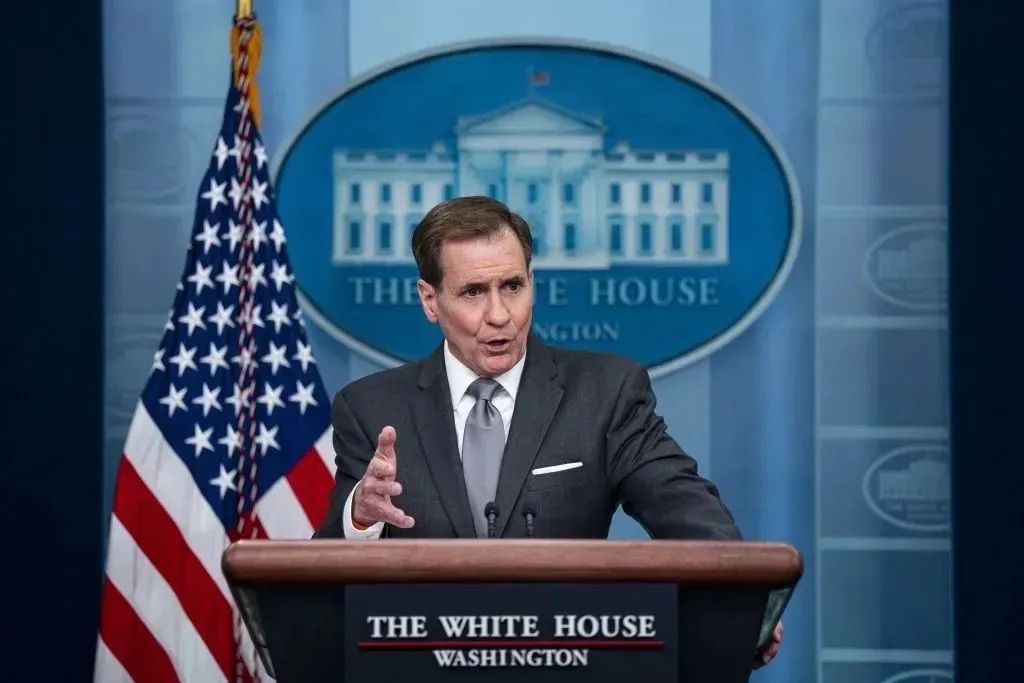
The U.S. will not permit Ukraine to strike deeper inside Russian territory following the deadly July 8 attack, National Security Council spokesperson John Kirby said during a press briefing.

“There’s been no change in our policy. You saw the president several weeks ago gave guidance to Ukraine that they can use U.S.-supplied weapons to strike targets just over the border. That’s still the case,” Kirby told reporters on July 8.

U.S. National Security Adviser Jake Sullivan told PBS News in June that Ukraine was allowed to strike “anywhere that Russian forces are coming across the border from the Russian side to the Ukrainian side to try to take additional Ukrainian territory.”

The Russian military struck the Okhmatdyt hospital, Ukraine’s largest children’s medical center, with a Kh-101 cruise missile, according to the preliminary data obtained by the State Security Service (SBU). At least two people were killed and 50 injured, including seven children, according to local authorities.

Kirby added that it is part of the course for “Putin to hit civilian infrastructure” and he “doesn’t care if people are in hospitals or residential buildings.”

Across the country, over 170 people were injured, while at least 37 were confirmed killed due to the July 8 Russian attack, President Volodymyr Zelensky said.

As the NATO summit officially begins on July 9 at the Mellon Auditorium in Washington, Kirby said there will be “a very strong set of signals and messages to Mr. Putin that he cannot wait out NATO, he cannot wait out the United States. We are going to continue to support Ukraine.”


Categories
Selected Articles

My Opinion: Mr. Biden does not have to demonstrate that he has a 100% of mental or cognitive acuity; no one single person has it all of the time. However, his team and his aides as the “collective Presidency” have this acuity.


Biden delivers Memorial Day address at Arlington National CemeteryBiden delivers Memorial Day address at Arlington National Cemetery

My Opinion: Mr. Biden does not have to demonstrate that he has a 100% of mental or cognitive acuity; no one single person has it all of the time. However, his team and his aides as the “collective Presidency” have this acuity. They did an excellent job this first term, and there should not be any doubts that the same skills will be in the play the second term.  

Joe Biden one year: How is he doing so far?Joe Biden one year: How is he doing so far?

Images may be subject to copyright. Learn More

Mr. Biden is the symbol and the banner for America and the World. His political instincts are always and 100% correct, they are the embodiment of the American spirit and the Idea, and that what counts. 

Furthermore, if the hostile attempt was made, possibly with the use of the Directed Energy Weapon during or prior to the Debates, to affect the state of his cognitive functioning and performance, as it reasonably suspected, these suspicions and concerns become the real front and center issue, which is the obvious and the very real threat to the American Democracy and to the democratic systems of governing worldwide.

Michael Novakhov | 7.10.24 


Categories
Selected Articles

Путин заключил Моди в “ядерные объятия”. Запад просчитывает последствия


Видео, на котором Владимир Путин катает премьер-министра Индии Нарендру Моди по своей резиденции за рулем мини-электромобиля, как нельзя лучше иллюстрирует близкую дружбу этих двух лидеров.

Спорный визит Моди в Москву — признак того, что санкции Запада и попытки изолировать Путина из-за его войны возымели лишь весьма скромный эффект.

Но выбор электромобиля для поездки по богатой нефтью России таит в себе и иной подтекст: отношения Моди и Путина, окрепшие из-за санкций США и Европы против российской нефти и газа, теперь “позеленели”. Мало того — они стали еще и ядерными.

Моди, глава крупнейшей в мире демократии, поддержал Путина, сделав Индию одним из немногих верных потребителей российской нефти и газа на протяжении двухлетнего конфликта на Украине. Во вторник в ходе визита Моди российские СМИ сообщили, что страны ведут переговоры о строительстве в Индии шести новых мощных ядерных реакторов, а также малых атомных электростанций нового поколения.

При всех разногласиях вокруг ядерной энергетики, благодаря нулевому выбросу углерода для многих странах она становится главным ответом на климатический кризис. Развернулась глобальная гонка за строительство атомных электростанций и поставками топлива в разные части света, и Россия по многим показателям выигрывает.

“С коммерческой точки зрения у России не очень ладится с производством целого ряда вещей, но у нее есть обширные природные ресурсы и мощные ядерные традиции, восходящие еще к советским временам, и именно этим она сейчас и пользуется, — объяснила старший научный сотрудник Инициативы трансатлантической безопасности при Атлантическом совете Элизабет Бро. — Очевидно, что Кремль решил, что это хорошая идея, и многие страны стремятся расширить выработку ядерной энергии. И, как и в случае с экспортом нефти, в их числе оказалась Индия”.

Господство в области ядерной энергетики помогает Путину сохранить позиции на мировой арене, даже при том, что США и Европа дистанцировались от него из-за спецоперации на Украине. Моди же явно придерживается давней индийской традиции неприсоединения, которая позволяет ей торговать с Россией и оставаться при этом другом Запада.

Складывается ощущение, что эта дружба — надолго. Углубление ядерного сотрудничества путем постройки шести новых АЭС свяжет страны на десятилетия вперед. На строительство самих станций уйдут годы, и к тому же они потребуют регулярного обслуживания, технологических нововведений и постоянной заправки ураном, которого в России предостаточно.

Запрет США на российский уран

Россия проиграла Китаю гонку за возобновляемые технологии и сильно отстает от США в энергетическом переходе: ветровых и солнечных мощностей у нее довольно мало. Вместо этого Москва сделала ставку на экспорт атомных технологий ради дохода и влияния, предлагая обширную линейку: от обычных ядерных реакторов до небольших модульных реакторов следующего поколения и урана повышенного обогащения, оставаясь его единственным мировым производителем в промышленных масштабах.

США осознают всю серьезность этой проблемы. Администрация Байдена пытается соперничать с Россией в продаже ядерных технологий за границу, однако поначалу не включала уран в антироссийские санкции, поскольку США сами сильно зависели от него в выработке собственной ядерной энергии. Вашингтон сменил курс лишь в мае, запретив импорт российского урана, и стремится как можно быстрее развивать собственные мощности для производства урана повышенного обогащения для реакторов следующего поколения.

“Россия — мировой лидер по проектам строительства атомных электростанций в других странах, и российское правительство очень активно привлекает международных партнеров к сотрудничеству в области гражданской атомной энергетики, — сказал Алан Ан, заместитель директора программы по ядерной энергии, климату и энергетике исследовательской организации “Третий путь” со штаб-квартирой в Вашингтоне.

“Другим странам сложно взять и оторваться от мощной рыночной позиции, которую Россия выстраивала десятилетиями”, — сказал он, добавив, что для уменьшения глобального влияния России в области ядерной энергетики США необходимо “разрабатывать коммерчески конкурентоспособную продукцию”.

Однако ни поездка на электромобиле, ни сделка по развитию “экологически чистой” ядерной энергетики еще не говорят о том, что Россия и Индия в ближайшее время планируют отказаться от ископаемого топлива или станут климатическими лидерами.

Индия — третий в мире источник выбросов парниковых газов, разоревающих планету, а Россия — четвертый. Вероятно, страны не только продолжат торговлю нефтью и газом, но и попытаются извлечь выгоду из стремительного таяния льдов Арктики, ситуация в которой ухудшается из-за глобального потепления.

Российские и индийские делегаты во вторник обсудили возможности использования Северного морского пути — все более перспективного из-за таяния арктических льдов. Это более быстрый способ добраться из западной части России в Индию, чем через южные моря, и, по прогнозам, к 2050 году весь его фарватер будет свободен ото льда. По иронии судьбы, ископаемое топливо, один из основных грузов на маршруте — основная причина перемены климата.

“Индия ведет себя очень прагматично и, честно говоря, даже немного оппортунистски, — сказала Бро. — Если предоставляется возможность улучшить отношения с Россией в области, где вам за это ничего не будет, то в этом нет никакого вреда. Участие же Индии в более тесном сотрудничестве в Арктике пойдет лишь на пользу”.

Она добавила, что Индия также извлекает значительную выгоду из переработки российской сырой нефти.

“Для Индии это хороший дополнительный доход, которым она раньше не располагала, — сказала Бро. — Поэтому индийский подход таков: почему бы и нет?”

Автор: Анджела Деван (Angela Dewan).


Categories
Selected Articles

Israeli forces destroy parts of occupied West Bank town in raid


vlcsnap-2024-07-10-19h46m00s833-17206081

Videos show how Israeli forces ripped up roads and bulldozed shops and homes in the occupied West Bank.


Categories
Selected Articles

Parkinson’s doctor suggests Biden has ‘classic features of neurodegeneration’ after revelation specialist visited White House 8 times


A New York-based neurologist who specializes in treating Parkinson’s disease suggested Monday that President Biden is exhibiting “classic features of neurodegeneration” as speculation swirls about his political future.

Dr. Tom Pitts made his assessment based on Biden’s public appearances, while the White House faced questions about why another Parkinson’s expert visited the executive mansion eight times in an eight-month stretch last year and early this year.

“I could have diagnosed him from across the mall,” Pitts told NBC News Now’s “Top Story with Tom Llamas.”

President Biden got a fairly clean bill of health from his doctor, but critics are calling for more information. Getty Images

“I’m a Democrat, it’s just like — this guy is not a hard case,” he added.

“I see him 20 times a day in clinic.”

“He has the classic features of neurodegeneration, word-finding difficulties, and that’s not, ‘Oh, I couldn’t find the word,’ that’s from degeneration of the word retrieval area,” Pitts explained, referring to Biden.

The doctor also noted the president’s “shuffling gait … so little steps. Loss of arm swing from the rigidity…and end-block turning, meaning he kind of pivots around his foot.”

Pitts caveated that he has never been in the “same room” with the president, who has insisted he will carry on with his re-election campaign, and could not judge whether Biden’s cognitive abilities had diminished.

Over the weekend, The Post scooped that Biden physician Dr. Kevin O’Connor met with Dr. Kevin Cannard, the White House medical unit’s neurology consultant, back in January.

A subsequent check of visitor logs revealed Cannard had visited the executive mansion eight times between July of last year and March of this year.

Dr. Tom Pitts caveated that he hasn’t diagnosed President Biden in person. NBC News

Late Monday, O’Connor acknowledged that Cannard had examined Biden as part of his annual physicals, but claimed the doctor had not seen the president outside of those occasions.

White House press secretary Karine Jean-Pierre claimed Tuesday that the January meeting involving Cannard and O’Connor “was not” about Biden’s health.

Pitts called on both Biden, 81, and former President Donald Trump, 78, to take a four-hour neurological test, which he called the “hallmark test for cognitive performance.”

President Biden insists that he is mentally fit for the job. AP

Despite his party preference, Pitts conceded that he was frustrated with the situation, likening the Biden administration to regimes of North Korea and Russia in terms of denying obviously realities.

The White House did not immediately respond to a request for comment.


Categories
Selected Articles

Biden promises new air defenses for Ukraine in forceful Nato speech


6000.jpg?width=1200&height=630&quality=8

Joe Biden has announced that Nato countries will provide Ukraine with five new strategic air defense systems as leaders began a summit in Washington where the alliance was expected to declare Ukraine’s path toward Nato to be “irreversible”.

The promise of weapons deliveries, including anti-air defenses sought after by Ukrainian president Volodymyr Zelenskiy, came just a day after a deadly missile strike against a paediatric cancer hospital and other civilian targets in Ukraine that Biden called a “horrific reminder of Russia’s brutality”.

“All told, Ukraine will receive hundreds of additional interceptors over the next year, helping protect Ukrainian cities against Russian missiles and Ukrainian troops facing their attacks on the frontlines,” said Biden.

The headline speech was a critical step to convincing foreign leaders that Biden, 81, remains up to the task of leading the 32-member military alliance. It was also a key test in saving his presidential campaign following a disastrous debate against Donald Trump that led many in his own party to question his mental acuity.

In forceful tones, Biden said: “Before this war, Putin thought Nato would break. Today, Nato is stronger than it’s ever been in its history. When this senseless war began, Ukraine was a free country. Today it’s still a free country and the war will end with Ukraine remaining a free and independent country.”

“Russia will not prevail,” he said to rising applause. “Ukraine will prevail.”

In a speech later in the night, Zelenskiy urged US political leaders not to wait for the outcome of November’s presidential election to move forcefully to aid his country.

“Everyone is waiting for November. Americans are waiting for November, in Europe, Middle East, in the Pacific, the whole world is looking towards November and, truly speaking, Putin awaits November too.

“It is time to step out of the shadows, to make strong decisions … to act and not to wait for November or any other month,” Zelenskiy said.

It was announced on Tuesday that the US and its European allies would act to bolster Ukraine’s air defences at a time when the country is under constant heavy bombardment from Russia.

The US, Germany and Romania would send additional batteries of the Patriot air defence system while Patriot components donated by the Netherlands would enable another battery to operate, according to a statement by the leaders of the US, the Netherlands, Germany, Italy and Romania.

The Italian prime minister, Giorgia Meloni, approved the donation of a Italian-French-made equivalent of the Patriot interceptor, the SAMP/T air defence system.

“These five strategic air defence systems will help to protect Ukrainian cities, civilians, and soldiers, and we are coordinating closely with the Ukrainian government so that these systems can be utilised rapidly,” the statement said. “We are working on a further announcement this year of additional strategic air defence systems for Ukraine.”

As well the medium range Patriot and SAMP/T systems, the US and its allies said they would provide Ukraine with dozens of shorter-range tactical systems, including the US-Norwegian made NASAMS, US-made Hawks, Iris systems made by a European consortium and German Gepard missiles.

Britain’s new prime minister, Keir Starmer, and Zelenskiy, were among those arriving at the US capital amid a warning that Russia could step up missile strikes on Ukraine this week, repeating a barrage that killed at least 38 on Monday.

Diplomats said that a final communique would probably declare Ukraine’s path to Nato to be “irreversible” and to move control of the Ukraine Defense Contact Group, the main conduit for delivering military aid and training to Ukraine, under Nato control.

Those steps are widely seen as an attempt to “Trump-proof” Nato policies from the potential for a new Republican administration to cut aid to Ukraine, or possibly to make it contingent on holding direct negotiations with Russia.

skip past newsletter promotion

Sign up to First Thing

Our US morning briefing breaks down the key stories of the day, telling you what’s happening and why it matters

Privacy Notice: Newsletters may contain info about charities, online ads, and content funded by outside parties. For more information see our Privacy Policy. We use Google reCaptcha to protect our website and the Google Privacy Policy and Terms of Service apply.

after newsletter promotion

Despite the communique, there will be no meaningful progress on Ukraine joining Nato in Washington, although alliance members will seek to dress up the latest package of support as part of what is described as “a bridge to membership”.

Holdouts including the US, Hungary, Germany and Italy are concerned that allowing Ukraine to join Nato while the war with Russia continues would be considered an escalation that could bring the alliance into direct conflict with Moscow. Even a more limited form of what could be considered direct military intervention in support of Kyiv attracts similar concerns.

On Tuesday, Zelenskiy said he hoped Trump would not quit Nato and would keep supporting Ukraine, if he won in November, but he could not predict the former president’s actions.

“I can’t tell you what he will do, if he will be the president of the United States. I don’t know,” he said.

Jens Stoltenberg, Nato’s outgoing secretary general, speaking immediately before Biden, sought to justify continued US and western support for Ukraine by arguing that “the biggest cost and the greatest risk will be if Russia wins in Ukraine”. Authoritarian leaders in China, North Korea and Iran would all feel emboldened if Russia conquered its neighbour, he added, describing the war as a struggle over values.

“They all support Russia’s brutal war. They all want Nato to fail. So the outcome of this war will shape global security for decades to come. The time to stand for freedom and democracy is now the place is Ukraine,” the Nato chief added. Biden subsequently awarded Stoltenberg, the presidential medal of freedom, the highest civilian honour in the US.

In remarks to the Guardian, Ruslan Stefanchuk, Chairman of the Verkhovna Rada of Ukraine, said that the strike on the Okhmatdyt children’s hospital should be a “turning point” in the war and lead to great supplies of anti-air weapons to Ukraine.

“I believe that what happened today must be a turning point to change everyone’s attitude to what is happening in Ukraine, and I believe that without the F-16 fighter jets, without the new air defence systems, without the ammunition for those systems, we won’t be able to cover the skies to defend Ukraine,” he said.

Elsewhere at the summit, several high-ranking European officials have met with a top foreign policy adviser to Donald Trump.

Keith Kellogg, a retired lieutenant general who served as the chief of staff to Trump’s national security council, told Reuters he had met several European officials in recent days, including foreign ministers, but did not disclose their identities.

Kellogg, who is in regular contact with Trump, has emphasised that he does not speak for the former president nor his campaign.


Categories
Selected Articles

The Kremlin’s crimes will continue to escalate until Russia is defeated


Almost two and a half years since the start of Russia’s full-scale invasion, the Kremlin still retains the ability to shock with the scale of its crimes. On June 8, the targets were Ukrainian children. Not just any children, but kids being treated for cancer, whose daily lives were already full of fear and pain.

The exact number of dead and wounded as a result of Russia’s targeted missile strike on the Okhmatdyt Children’s Hospital in central Kyiv has not yet been confirmed. Nor is it possible to calculate the death and suffering that will result from lack of treatment due to the partial destruction of what is Ukraine’s biggest pediatric clinic.

In the immediate aftermath of the attack, large numbers of distressed and in some cases injured children lined the pavement around the ruins of the wrecked hospital, many still attached to drips. Providing them with the specialized medical support they so urgently require will now be extremely difficult.

Doctors were also among the victims. Those killed in Monday’s missile strikes included thirty year old Svitlana Lukyanchuk, a nephrologist from Lviv. Svitlana was an orphan who overcame challenging personal circumstances to qualify as a doctor. She dedicated herself to saving children’s lives, but will never now experience the joy of motherhood herself.

Okhmatdyt Children’s Hospital was one of three separate Ukrainian medical facilities to be struck by Russian missiles on July 8. One such attack could potentially be attributed to human error or explained as a tragic mistake. Three targeted attacks on the same day suggests a deliberate Russian strategy to destroy Ukraine’s healthcare infrastructure, just as the Kremlin has already targeted and destroyed much of Ukraine’s civilian energy infrastructure. Moscow appears intent on making large parts of the country unlivable.

Stay updated

As the world watches the Russian invasion of Ukraine unfold, UkraineAlert delivers the best Atlantic Council expert insight and analysis on Ukraine twice a week directly to your inbox.

It is no doubt hard for many outside observers to fully appreciate that such horrors are taking place in the heart of twenty-first century Europe. After all, just three years ago, it would also have been difficult for most Ukrainians to believe such things were possible. Sadly, that is no longer the case.

As a result of Russia’s February 2022 invasion, Ukrainians have been confronted by an astonishing array of war crimes that recall the worst excesses of bygone eras. Entire cities have been reduced to rubble. Hundreds of thousands have been killed, abducted, or subjected to forced deportation. Large numbers of vulnerable children have been sent to Russian indoctrination camps and robbed of their Ukrainian heritage. In regions of Ukraine under Kremlin control, all traces of Ukrainian identity have been ruthlessly erased.

The evidence of Russian war crimes is now so overwhelming that the International Criminal Court in The Hague has issued arrest warrants for Vladimir Putin himself and many of his most senior officials. Nevertheless, the nightmare continues. A genocide is being live-streamed to the watching world, but Western leaders choose not to call it by its name for fear of being obliged to act.

Today’s Russia did not become a rogue regime overnight. On the contrary, the crimes we are now witnessing reflect unresolved historic issues that have been allowed to fester since the early days of Putin’s reign. Unlike all other European empires, post-Soviet Russia never rejected imperialism and was not forced to confront the crimes of the imperial era. This has allowed for a revival of Russia’s imperial identity and has helped fuel a sense of impunity that directly paved the way for the invasion of Ukraine.

Rather than address the growing threat posed by Putin’s Russia, the Western world has consistently sought to avoid confrontation. When a newly anointed Putin crushed Chechnya, Western leaders chose to look the other way. After he invaded Georgia, they scrambled to reset relations and return to business as usual.

Inevitably, this approach only emboldened the Kremlin. The West’s weak response to the 2014 seizure of Crimea led directly to Russian military intervention in eastern Ukraine. When this, too, failed to produce a decisive reaction, the stage was set for today’s full-scale invasion.

Even now, Western policy remains defined by a reluctance to provoke Putin, with Western leaders hopelessly preoccupied by fears of escalation. This has left Ukraine unable to adequately defend itself, while encouraging Russia to escalate further. As a result, we are now closer to a major global war than at any time for a generation.

It is delusional to think Russia can be stopped by appeasement, concessions, or compromise. Any ceasefire would merely provide the Kremlin with a pause to rearm before resuming the campaign to wipe Ukraine off the map entirely.

Nor are Putin’s imperial ambitions limited to Ukraine alone. He has repeatedly portrayed the invasion of Ukraine as part of a sacred mission to correct the historical injustice of the Soviet collapse and “return” historically Russian lands. If Putin achieves his goals in Ukraine, he will inevitably look to press home his advantage and “reclaim” other countries that were once part of the Russian Empire. The list of potential targets is long and includes Finland, Poland, the Baltic States, Belarus, and Moldova. The only way to guarantee their security is by defeating Russia in Ukraine.

Western leaders now have a simple choice: They can provide Ukraine with the support necessary to defeat Russia, or they can prepare to face the Russians themselves in the near future. With every day of delay, the cost of stopping Putin grows. At the moment, it is the Ukrainians alone who are paying this terrible price. However, until Russia is beaten, nobody in the West can take their security for granted. Instead, the threat will only increase.

Ten years ago when the Russian invasion of Ukraine first began, a cautious Putin deployed Russian soldiers without identifying insignia in an attempt to mask his aggressive actions. A decade later, he is now bombing children’s hospitals in the center of a European capital city while his priests and propagandists preach holy war against the West. Clearly, he will not stop until he is stopped.

Vladimir Putin represents the greatest threat to European peace since Adolf Hitler. Today’s generation of Western leaders should recall the lessons of that earlier era before it is too late. They must reject the appeasement of the 1930s and embrace the mantra of “never again” that rose from the ashes of World War II. Until that happens, the Kremlin’s crimes will continue to escalate.

Serhiy Prytula is a Ukrainian volunteer fundraiser and founder of the Prytula Charity Foundation.

Further reading

The views expressed in UkraineAlert are solely those of the authors and do not necessarily reflect the views of the Atlantic Council, its staff, or its supporters.

The Eurasia Center’s mission is to enhance transatlantic cooperation in promoting stability, democratic values and prosperity in Eurasia, from Eastern Europe and Turkey in the West to the Caucasus, Russia and Central Asia in the East.

Follow us on social media
and support our work

The post The Kremlin’s crimes will continue to escalate until Russia is defeated appeared first on Atlantic Council.