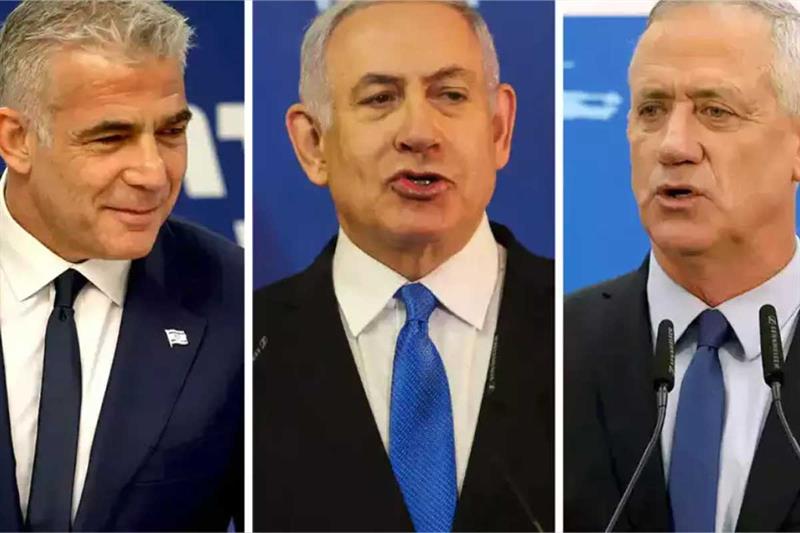
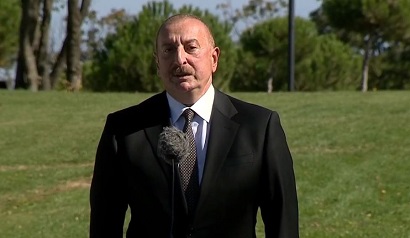
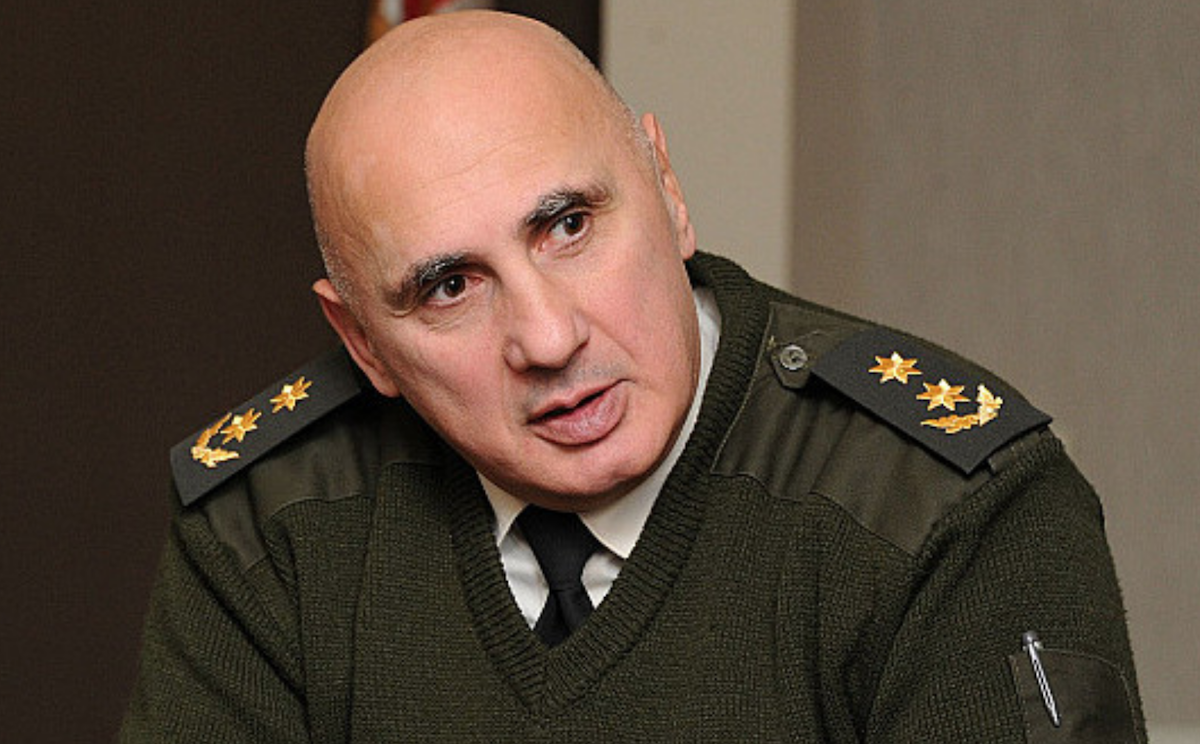
Israeli opposition leaders Yair Lapid and Benny Gantz expressed their willingness to join Netanyahu’s government, with Lapid demanding that far-right leaders and ministers Bezalel Smotrich and Itamar Ben-Gvir be removed and Gantz agreeing to join alongside the two, The Times of Israel said on Sunday.
Israeli Prime Minister Benjamin Netanyahu and opposition heads discussed on Saturday evening the possibility of joining Netanyahu’s government because of what they call “the emergency created by the day’s infiltration and rocket attacks from Gaza,” according to The Times of Israel.
Netanyahu said that he proposed to the two of them to enter into a broad emergency government, citing the joining of former Likud leader Menachem Begin to the government of then Prime Minister Levi Eshkol, on the eve of the 1967 war, the Israeli newspaper Haaretz said on Sunday.
Gantz said that he looks positively at joining a government that focuses on the security situation, even in the presence of right-wing ministers, Haaretz said.
Lapid explained in a statement that Netanyahu was aware that his “extremist and non-functional” government could not manage the war and stressed that he had no doubt that former Defense Minister Benny Gantz would also participate in such a government, Haaretz said.
He added that the emergency government “will make clear to our enemies that the overwhelming majority of Israeli citizens stand behind the Israeli army and defense agencies,” according to the Israeli newspaper.
The Times of Israel also said that secret negotiations took place during the past months to alleviate the judicial crisis in Israel and the struggle over the division of power “that has captured the collective national consciousness over the past ten months.”
Lapid and Gantz will meet on Saturday evening, according to the Times of Israel.
The two had previously criticized Netanyahu for forming a government with “extremists” and avoided the idea of forming a unity government that included them, the Israeli newspaper said.
Israel was caught completely off-guard and took long hours to transport its forces to the field to defend the locales under attack. These are six main failures that dictated the developments in combat
The incursion of Hamas terrorists into Israel, which began on Saturday at 6:30 A.M., caught the security establishment unprepared. The failures of the military and security agencies pertain both to preparations for the attack and the response to it.
Hamas’s surprise attack on Israel, on the 50th anniversary of the Yom Kippur war, will be remembered as an intelligence failure for the ages.
In the space of several hours, dozens of Gaza militants broke through the border fence into southern Israel, surprising local military positions.
Gunmen kidnapped and murdered Israelis in the southern border communities, filming their assault as they advanced in numerous locations. In one instance, a Gaza television journalist delivered a standup report about one attack from inside Israel, an almost unthinkable moment.
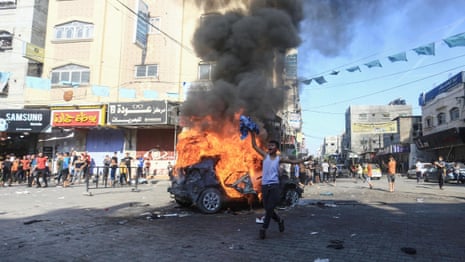
While the images of several thousand rockets sectoring the sky has become familiar over the years during the periodic upticks in fighting around Gaza, the footage of Hamas assault teams moving through the streets in communities such as Sderot, blowing the gates off a kibbutz and firing on passing cars and pedestrians, showed scenes not witnessed by most Israelis, for whom short-lived attacks in cities have become a fact of life.
If it is surprising it is because Israel’s surveillance of Palestinian society is both highly sophisticated and highly invasive, with monitoring of Hamas’s activity in particular one of the most important tasks for the security establishment.
As whistleblowers from the Israeli defence forces cyberwarfare 8200 Unit revealed to the Guardian and other media in 2014, the net for developing sources is almost all-encompassing in their task to identify potential informers in the occupied Palestinian territories.
They were told to seek individuals with financial and health problems, those vulnerable because of sexual impropriety, efforts duplicated in entry and exit interviews for those Palestinians allowed to leave the coastal strip.
Members of militant groups inside Israeli prisons have also historically been targeted for intelligence efforts, all of which makes Israel’s being unsighted on the planned Hamas attack all the more surprising.
Israel’s surveillance technology industry, as evidenced by the Pegasus spyware scandal, is among the most advanced in the world. Despite all of this, Hamas’s preparations were missed.
It is true that Hamas, while always determined and capable of long-term planning, has become much more skilful at adapting to the military challenges it faces, often expending large amounts of effort in its planning and in its identification of Israeli vulnerabilities, a fact very well-known to Israel’s defence forces.
Israel ‘at war’ as Hamas militants launch surprise attack – video
While it is known from previous rounds of fighting in Gaza that Hamas has worked to develop independent and redundant military communication networks, including their own battlefield rebroadcast systems, this suggests two things.
The first is that this was planned with a level of operational security, not just within Hamas but also rival Gaza factions, unprecedented in previous rounds of fighting where at least the broad shape if not the extent of Hamas’s building-up of stockpiles has been identified and broadcast by Israel.
Military analysts have already been quick to suggest that Hamas is likely to have employed significant deception as well as the shock of attacks from multiple domains – including rocket and infiltration – to create maximum chaos.
What is clear is that at several points in the buildup, potential preparations were missed: planning, stockpiling, but most crucially, in the immediate run-up to the Hamas offensive when its fighters were mustering and approaching border areas overseen by regular patrols, cameras, ground motion sensors and remote-controlled mini-cannon in places which in the past have proved effective against attempts to storm the border fence.
All of which suggests an operation which – like previous Hamas surprise infiltration attacks including those involving tunnels into Israel – required a huge amount of preparation.
Perhaps significant is the fact – as Israeli media has pointed out – that incidents involving Hamas in recent months were not identified by the Israeli defence forces and intelligence agencies as part of a buildup to war.
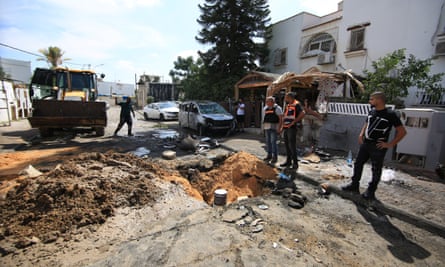
People look at the damage on their street in Ramla, Israel, after a rocket attack by Hamas. Photograph: Anadolu Agency/Getty Images
Even as firefights continued with Hamas infiltrators in Israeli communities in southern Israel, the Israeli media was asking the inevitable question: how this could have been allowed to happen on the 50th anniversary of the Yom Kippur war, itself regarded as a colossal intelligence failure when Israel was attacked by an Arab coalition.
“All of Israel is asking itself: Where is the IDF, where is the police, where is the security?” asked Eli Marom, the former head of the Israeli navy, on live television. “It’s a colossal failure; the hierarchies have simply failed, with vast consequences.”
On social media and elsewhere, Israeli leaders – including the prime minister, Benjamin Netanyahu – were being openly castigated for hours from officials as the attack unfolded, a silence that was only broken by the appearance of the defence minister, Yoav Gallant.
One thing is clear, however: this attack takes place in the midst of a period of profound social dislocation for Israel. Netanyahu’s far-right government, peopled with individuals in cabinet roles who should not hold public office, such as Itamar Ben Gvir, the minister for national security, have spent their time pouring petrol on what was an already highly combustible situation in the occupied territories.
Netanyahu’s pointless and self-serving conflict with large parts of Israeli society over his much-criticised plans to undermine the country’s supreme court, even as he is in the midst of legal proceedings for allegations of corruption, has overwhelmed public debate, prompting large numbers of reservists to threaten to withhold their service.
Even when Netanyahu did finally speak, it was to reflect an Israeli political and security establishment profoundly shaken. This was not an “operation” or a “round” of fighting he stated, but a state of war.
With Hamas unable to sustain its incursion for any length of time, it seems horribly clear that it will end with maximum horror. Shock was, and is, the point.
The major question is the scope of Israel’s response. Already framed as a war, Hamas’s attack will put pressure on Netanyahu from a far right that has long pushed for a definitive attack on Gaza, perhaps ending in full reoccupation. Messages from friends in Gaza and Israel show the fear over what comes next is overwhelming.
Peter Beaumont is a former Jerusalem correspondent for the Guardian and the Observer
As the death toll rises, and the security consequences multiply, Israel is pointing its finger of accusation at Tehran for orchestrating the attacks by Hamas. The attacks may have been born of anger, specifically at the months-long behaviour of the Netanyahu coalition, including the provocations at al-Aqsa mosque, but Iran and the forces it supports have a longer-term strategic goal: to thwart the US-led effort to achieve a normalisation of relations between Saudi Arabia and Israel, a move that would entrench the US in the Middle East – and in Iran’s eyes deprive the Palestinians of their last influential sponsor.
Iran’s goal is to denormalise the region, and make it near-impossible for Saudi Arabia to strike a deal. Israel, by contrast, wants to shrink the Palestinian conflict diplomatically so it gradually becomes an irrelevance, a historical curio such as the Yom Kippur war. The aid it drip-feeds to Gaza via Qatar is one leg of this strategy.
In a speech earlier this week, Iran’s supreme leader, Ayatollah Ali Khamenei, sent a thinly coded warning to Riyadh that any Gulf state that backed the US was backing the wrong horse. “The definitive stance of the Islamic Republic is that the governments which prioritise the gamble of normalisation with the Zionist regime will incur losses,” he said in remarks carried by Iran’s state-run and semi-official media. “As the Europeans say, they are betting on a losing horse. Today, the situation of the Zionist regime is not one that should motivate closeness to it; they shouldn’t make this mistake.”
He was joined on Friday by the head of Islamic Jihad, Ziad al-Nakhala, who said: “Those who rush towards normalisation with the Zionist project must know, and they do know, that this is their acknowledgment that Palestine is not ours, and that Jerusalem with its mosque is not ours.”
Saudi Arabia, its economy expected to shrink this year according to the World Bank due to oil production cutbacks, has been desperate for foreign investment and craves Israel’s technological dynamism. The United Arab Emirates’ trade with Israel doubled to $2.56bn in 2022 after striking a free trade deal with the country. But Riyadh, now a member of the growing transactional diplomatic tendency, also wants new US defence guarantees, similar if not better to those given to Bahrain in September, and access to civilian nuclear power. It also needs something tangible about the restart of Israeli-Palestinians talks. Antony Blinken, the US secretary of state, was due to discuss all this with Crown Prince Mohammed bin Salman in a regional tour next week.
Now with the start of what could become a regional war, the risk calculations have changed. Hamas has shown its firepower and extended its base beyond Gaza. Far from the conflict shrinking it has been broadened. Riyadh’s initial response to the Hamas assault, a group with which it has few contacts, was the first critical clue of how Riyadh viewed the diplomatic consequences. It was not encouraging for Israel, and nor, given the inflamed passions, could it afford to be.
The Saudi Arabian ministry of foreign affairs noted the unprecedented situation between certain Palestinian factions and the occupation forces and called for restraint on all sides. But it then recalled “its repeated warnings of the dangers of the explosion of the situation as a result of the continued occupation, the deprivation of the Palestinian people of their legitimate rights and the repetition of the systematic provocations against its sanctities [holy sites]”. It urged the international community to restart a credible peace process based on a two-state solution.
Qatar was even less equivocal, saying Israel was “solely responsible for the ongoing escalation due to its continuous violations of the rights of the Palestinian people, including the recent repeated incursions into the al-Aqsa Mosque under the protection of the Israeli police”.
Since then, the Saudi foreign minister has been speaking with Blinken, the EU high representative, Josep Borrell, and every counterpart in the Gulf. The fruits of those talks will be reflected when the UN security council meets in emergency session and hears repeated calls for restraint. But many diplomats privately acknowledge they are paying a price for allowing the Middle East crisis slip to the back of their agenda.
The real diplomatic work will be done in private. In the short term, Turkey and Egypt will act as the mediators. Egypt, itself facing elections in two months, cannot afford mayhem in Gaza. The initial Hamas aim will be to make Israel think twice about the scale of its retribution. The Hamas al-Qassam brigades spokesperson Abu Ubaida said: “The number of [Israeli] prisoners is many times greater than what Benjamin Netanyahu announced, and they are present in all axes in the Gaza Strip, and what happens to the people of the Gaza Strip will happen to them, and beware of miscalculation.”
Hezbollah has also sent a message via Egypt to Israel about the potential consequences of a full-blown assault on Gaza. The US for its part is urging Israel to de-escalate, hold off on a ground assault and rely on measures such as cutting the supply of Gaza’s electricity to force Hamas to negotiate. Inside Israel there are also voices calling for calm, saying that after such a security lapse a unity government is required that will allow Netanyahu to end his disastrous reliance on extremists to stay in power. With the lives of so many hostages at stake, retribution will have to be carefully calibrated.
Netanyahu’s political survival skills are well-known, but it will be hard to avoid blame for such a self-evident intelligence fiasco. Golda Meir was gone as prime minister within six months of the Yom Kippur war, giving way to Menachem Begin and eventually the Camp David agreement with Egypt’s Anwar Sadat in 1978. Right now, it is hard to envisage a repeat of such an optimistic chain of events.
Tehran (AFP) – President Ebrahim Raisi said on Sunday that Iran supports the Palestinians’ right to self-defence and warned Israel must be held accountable for endangering the region, a day after Hamas attacked Israel.
Issued on: 08/10/2023 – 16:28Modified: 08/10/2023 – 16:31
Palestinian militants from the Iran-backed Islamist group Hamas, which controls the Gaza strip, penetrated Israel at dawn on Saturday under the cover of a massive rocket barrage.
Almost 1,000 people have been killed in the conflict so far, with Israel reporting more than 600 lives lost and Gaza’s health ministry putting its toll at 370 dead.
“Iran supports the legitimate defence of the Palestinian nation,” Raisi said, quoted by state television.
“The Zionist regime (Israel) and its supporters are responsible for endangering the security of nations in the region, and they must be held accountable in this matter.”
He urged Muslim governments to “support the Palestinian nation” while praising “resistance” efforts by Hamas and Islamic Jihad as well as in countries including Syria, Lebanon, and Iraq.
Raisi had spoken earlier with leaders of Hamas and Islamic Jihad, official media said.
State news agency IRNA said he had “discussed the developments in Palestine” in separate phone calls with Islamic Jihad secretary general Ziyad al-Nakhalah and Hamas chief Ismail Haniyeh.
Pro-Palestinian gatherings
The Islamic republic hosted talks with leaders of Hamas and Islamic Jihad in June.
At the time, Raisi said Israel was seeking to normalise ties with more Arab and Muslim countries “to discourage young Palestinians from (seeking to) liberate the occupied territories”, according to the presidency.
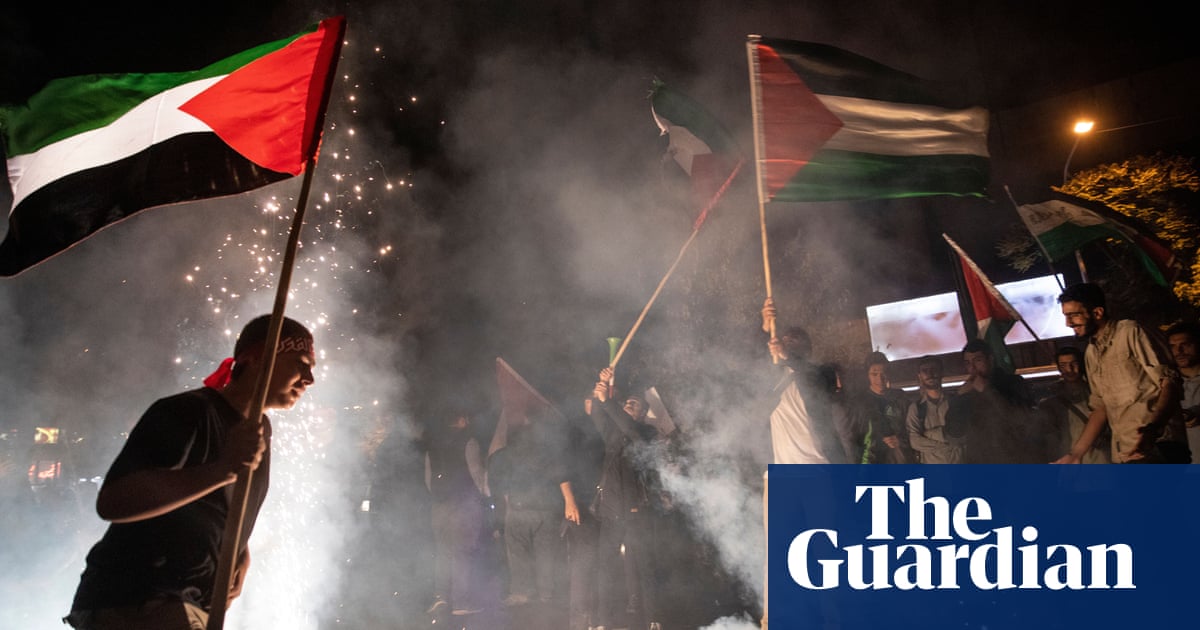
On Saturday, hundreds of people gathered in major cities of Iran, including in Tehran’s Palestine Square, carrying the Palestinian flag.
They also held pictures of Iranian general Qasem Soleimani, who was assassinated in a US drone attack in Baghdad in 2020 after overseeing the Revolutionary Guards’ foreign operations for more than a decade.
Billboards celebrating the offensive Hamas has dubbed “Al-Aqsa Flood” were installed in the capital, including one declaring: “The great liberation operation has begun”.
Crowds in some cities set off fireworks and torched Israeli flags.
Others marched in Palestinian colours while motorists honked their horns in jubilation, as seen in video footage from IRNA.
Iran does not recognise Israel and has made support for the Palestinian cause a centrepiece of its foreign policy since the 1979 Islamic Revolution.
The bitter rivals have engaged in a shadow war for years, with Iran accusing Israel of a series of sabotage attacks and assassinations targeting its nuclear programme.
The United States and Israel have previously accused Iran of using drones and missiles to attack US forces and Israel-linked ships in the Gulf.
Israeli ambassador Naor Gilon on Sunday accused Iran of having a hand in organising the deadly terror attacks that have killed hundreds of people and said the support of countries such as India is needed for Israel’s actions to prevent further atrocities.
Israel Ambassador to India Naor Gilon addresses a press conference in New Delhi on Sunday. (ANI)
The surprise attacks by Hamas militants from Gaza on Saturday, including rocket barrages and assaults on towns, killed around 600 Israelis and injured 2,000 more. More than 250 Palestinians were killed as Israeli defence forces targeted Hamas targets in Gaza.
“It’s clear to us that Iran is involved with it. We know for sure about the supplying of weapons, training, and I will not exclude even organising or helping organise this specific attack,” Gilon told a media briefing in Delhi. “Our evidence is very clear…we know of many attempts of Iran to supply weapons to Hamas.”
In an apparent reference to Israel’s efforts to normalise ties with Arab countries through the Abraham Accords, Gilon said the “huge and significant change” being made to West Asia by Israel could be one of the reasons why “countries like Iran and other extremists are trying to derail” this process.
Noting that Israel’s neighbours too perceive Hamas as a “terror organisation”, he said there is convergence of interests and all countries should continue working together against extremism.
Gilon emphasised the importance of support for Israel’s actions from countries such as India but made it clear his country hasn’t sought any specific assistance from the Indian side.
Israel, he said, will need the “very strong support of our Indian friends and India as a very influential country in the world, as a country that knows terrorism and understands the crisis”. He added: “It will be very important for us, to give us the ability to do what we need to do in order to make sure that Hamas will not be able to continue doing atrocities.”
Prime Minister Narendra Modi denounced the terror attacks on Saturday and said India stands in solidarity with Israel. “Deeply shocked by the news of terrorist attacks in Israel…We stand in solidarity with Israel at this difficult hour,” Modi posted on X.
The Israeli envoy ruled out the possibility of mediation at the current juncture, saying it was “time to take action against terror”. He added, “Mediation maybe will come, maybe will not come in future…now it’s time for action.”
Asked about countries such as China that have not specifically condemned the violence and instead highlighted the need for talks leading to the two-state solution, Gilon said Israel expects all countries to speak out against the attacks.
“We expect all countries in the world to, first and foremost, condemn the unprovoked murder and kidnapping of hundreds of Israeli civilians, women, men, elderly, children. This is unacceptable…Terror is terror is terror, anything else but condemnation is justifying the terrorism,” he said.
Gilon acknowledged that the situation has been complicated because the attackers have taken Israeli hostages. “The ability of Israel to inflict pain on an organisation like Hamas is endless. The only thing that is stopping us is not Hamas, it’s the human population that we try, in any way, not to hit,” he said.
Israeli authorities are compiling lists of foreigners and Israelis in areas that were attacked, and have also been contacted by different embassies about missing people, Gilon said. While the attackers had entered some 20 communities on Saturday, they are now present in only a few pockets, where they have been surrounded by Israeli troops.
Meanwhile, India’s representative office in Palestine has issued a public notice in view of the security situation and asked Indian nationals in the region to directly contact the office to address any emergency or assistance. It provided numbers for two 24-hour emergency helplines: Jawwal 0592-916418 and WhatsApp +970-59291641.
The Indian embassy in Israel had issued an advisory on Saturday, urging Indians to exercise caution and avoid movement. There were no immediate reports of any Indian casualties in the fighting. There are some 18,000 Indian citizens in Israel, including 900 students.
A group of 27 Indians from Meghalaya, caught in the conflict zone while on a pilgrimage, safely crossed the border into Egypt through the efforts of the external affairs ministry and the Indian mebassy, Meghalaya chief minister Conrad Sangma posted on X.
Air India suspended all flights between New Delhi and Tel Aviv till October 14 to ensure the safety of passengers and crew, an airline spokesperson said.
We have done and are doing everything to strengthen our friendship, our partnership between nations, these meetings serve to bring our countries closer and strengthen friendship, Azerbaijani President Ilham Aliyev said at a joint briefing with Georgian Prime Minister Irakli Garibashvili in Tbilisi, Georgian Channel One reports.
During their discussion, Aliyev and Garibashvili also emphasized the significance of peace in the South Caucasus.
“Challenges persist, and issues remain unresolved, peace has not yet been fully established in the South Caucasus, and today we discussed this matter during our conversation with Mr. Prime minister. The South Caucasus is in need of peace, and the time is now. As the Prime Minister has already stated, we consistently support Georgia’s territorial integrity and sovereignty, just as Georgia supports the sovereignty and territorial integrity of Azerbaijan. We consistently stand by each other in international organizations and on all other issues that serve the interests of our countries, our nations, and support each other. This is a fundamental principle of international law, violations of international law and infringements on territorial integrity are absolutely unacceptable, and we are in full agreement on this,” Aliyev stated.
It is worth reminding that during a recent telephone conversation with the head of the European Council, Aliyev discussed the need to “liberate eight Azerbaijani villages occupied by Armenia.”
With so much misinformation cavalierly and cynically tossed around, it is vitally important that the societies in the Caucasus benefit from journalism that is fact-checked and unbiased, balanced and sensitive. JAMnews has been giving them just that. A full-fledged newsroom presence in almost every part of the region – committed teams of editors and reporters, SMM managers and translators, experts and citizen contributors – has allowed it to always stay on top of national breaking news stories, while also keeping an eye on the not so obvious, but none the less important, issues and trends that are overlooked by others. Now, we all need your support if we are to keep the ball of what we do rolling. Every contribution you make, however small, means we can continue. Thank you