
Day: October 8, 2023
/cloudfront-eu-central-1.images.arcpublishing.com/prisa/H4MF2C35YBBKDJA3T5BHIVBUXM.jpg)
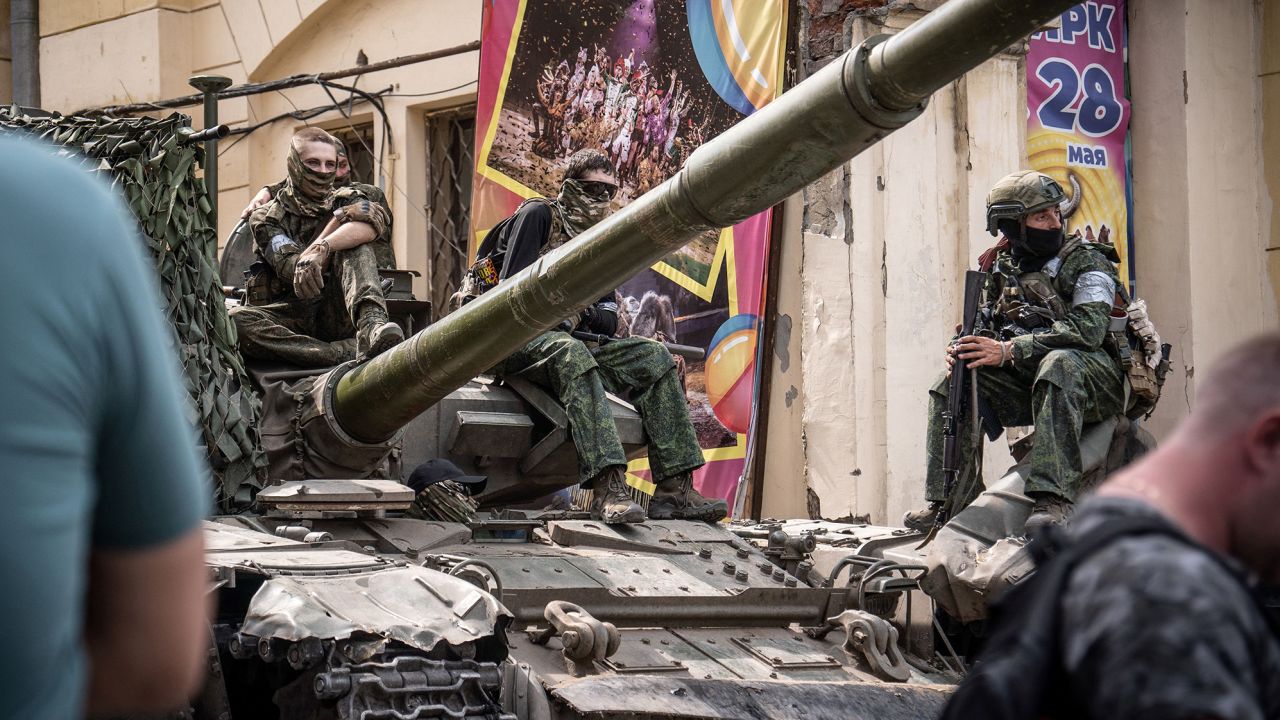
Russian President Vladimir Putin has proposed to Wagner Group fighters that a senior mercenary named Andrey Troshev now command the private military group, according to comments the Russian leader made to the Kommersant newspaper.
Putin appears to have created a split between senior fighters from the Wagner mercenary group and its leader Yevgeny Prigozhin since its failed uprising last month – at least in terms of the narrative emerging from his comments to the Kommersant.
The paper was reporting on a meeting held by the Russian president five days after the Wagner rebellion collapsed at the end of June – a meeting attended by Prigozhin and several dozen senior Wagner combatants.
According to Kommersant, Putin told dozens of Wagner mercenaries in the meeting that among the multiple employment choices he offered to them, one included them continuing to fight under their direct commander, a man who goes by the call sign, ‘Sedoy,’ meaning ‘grey hair.’
“They could have all gathered in one place and continued to serve,” Putin said, “and nothing would have changed for them. They would be led by the same person who has been their real commander all along.”
“And what happened then?” the Kommersant reporter said in reply to Putin. “Many people nodded [affirmatively] when I said that,” Putin replied.
Sedoy is the call sign of Andrey Troshev, a retired Russian colonel and a founding member and Executive Director of the Wagner Group, according to sanctions documents published by the European Union and France.
European Union sanctions concerning the situation in Syria detail Troshev’s position as the chief of staff of the Wagner Group operations in Syria, which supported the Syrian regime.
Troshev was born in April 1953 in Leningrad, in the former Soviet Union, according to the EU sanctions from December 2021.
“Andrey Troshev is directly involved in the military operations of the Wagner Group in Syria. He was particularly involved in the area of Deir ez-Zor,” it added. “As such, he provides a crucial contribution to Bashar al-Assad’s war effort and therefore supports and benefits from the Syrian regime.”
United Kingdom sanctions from June 2022 also say “Andrey Nikolaevich Troshev was the Chief Executive of the Wagner Group. Therefore, he has supported the Syrian regime, was a member of a militia, and has repressed the civilian population in Syria.”
His associates include Wagner Group founder Dimitriy Utkin, who is also a former Russian GRU military intelligence officer, according to EU sanctions. Troshev is also associated with Wagner group commanders Aleksandr Sergeevich Kuznetsov and Andrey Bogatov.
‘Grey hair’ is also a former employee of the special rapid response detachment of the Russian Interior Ministry’s Northwestern Federal District, according to Russian online news outlet Fontanka. He is also a veteran of the wars in Chechnya and Afghanistan.
For his service in Afghanistan, Troshev was awarded two Orders of the Red Star – a Soviet Union decoration for exceptional service. For service in the operation in Chechnya, he was awarded two Orders of Courage and a medal of the Order of Merit for the Fatherland, 2nd degree, according to Russian media.
Troshev was among those invited to a reception at the Kremlin in December 2016. A photograph, believed to be from that 2016 reception, emerged in Russian media in 2017 and shows Putin alongside Troshev and Utkin, who are both wearing several medals.
Ukraine imposed sanctions against Troshev on February 26, 2023.
Meanwhile, the fate of Wagner boss Prigozhin remains unclear. Prigozhin had reportedly traveled to Belarus as part of a deal brokered by Belarusian President Alexander Lukashenko following the failed uprising, but the Belarusian president told CNN last week the Wagner leader is now in Russia.
Footage purporting to show a police raid on Prigozhin’s premises in St. Petersburg has also raised questions about his status. Prigozhin has not been seen in public since June 2.
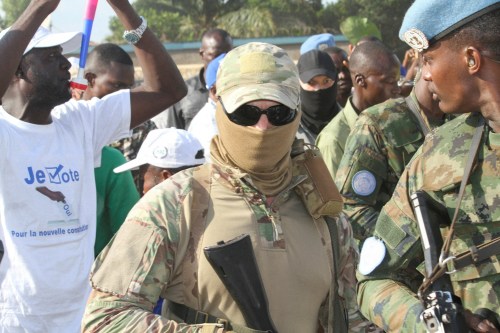
Predictions of the end of the Wagner Group’s operations in Africa and the Middle East in the aftermath of its ill-fated rebellion in Russia are premature. More likely, Wagner’s Middle East and Africa operations will persist: They still serve multiple interests of the Russian state and can be separated from Wagner’s Ukraine and Russia operations. Already, Russian Foreign Minister Sergei Lavrov has stated that Wagner’s operations in Africa will continue. But Wagner’s operations in Africa are likely to endure under a new leadership and structure.
Wagner’s footprint and Russian interests
Ukraine aside, the Wagner Group has sent mercenary deployments to Syria, Libya, Mozambique, Mali, the Central African Republic, and Sudan. Unconfirmed rumors have been swirling about Wagner’s presence in the Democratic Republic of the Congo. Wagner also maintains logistical, support, smuggling, and money laundering affiliates and subsidiaries in the United Arab Emirates. Through a vast network of intermediaries and shell companies, its business, commodity-extraction, and disinformation operations span even more countries.
There are several reasons why Wagner’s operations outside of Ukraine and Russia are unlikely to be liquidated even as the fate of Wagner’s disgraced boss, Yevgeny Prigozhin, remains far from resolved:
First, Wagner-Ukraine operations have been substantially separate from its Africa and Middle East operations. Early in the spring of 2022, the Wagner Group withdrew some of its forces from Syria and Libya and deployed them to Ukraine. But since the summer of 2022, Wagner has not significantly reduced its personnel or equipment in Africa or the Middle East.
Second, Wagner’s operations in Africa remain highly valuable for Russia, which uses them for extending its strategic influence and access to important raw commodities. The Wagner Group’s protection of gas and oil fields in Syria, on behalf of the Bashar al-Assad regime, for example, plays into Russia’s global energy coercion games. At least four Russian companies linked to Wagner have exploration permits for Syrian gas and oil fields.
Moreover, Wagner’s business schemes also establish smuggling networks that bring liquidity to the sanctioned Russian regime, such as through gold and diamond smuggling. The intensifying U.S. sanctions on Wagner in Africa and the Middle East have hampered Wagner’s operations but have not eviscerated them, especially as Wagner has long been involved in various clandestine and illegal economies as well, such as antiquities smuggling.
Third, there have been prior instances of the reshuffling of Russian private security companies in the Middle East when they fell afoul of various Russian intelligence services. In 2013, a Russian private security company, the Slavonic Corps, led by Dmitry Utkin, the notorious former Russian special operations forces officer, was sent to Syria to fight ISIS on behalf of the Assad regime. Yet in an inglorious retreat, they were not only chased out of Syria but also arrested in Moscow. Still, Utkin and various commanders and members of the Slavonic Corps were later allowed to form cadres under the Wagner Group. (Utkin, who hasn’t been heard from for several weeks, is now likely a prime target of the Kremlin’s ire.)
The Wagner Group has found itself frequently at odds with either the Russian Federal Security Service, known by its abbreviation FSB, or the Russian military during its deployment to Syria. Those long-running tensions reached a peak in 2018 when, despite the establishment of deconfliction mechanisms between the Russian and U.S. militaries, the United States bombed Wagner’s deployments, killing scores. Prigozhin, Utkin, and the Wagner Group blamed the Russian military for throwing them under the bus on purpose.
Yet however much the Russian military and intelligence services already wanted to cut Wagner to size, the Kremlin had no desire to remove its useful tool of influence.
Furthermore, both the FSB and the GRU, the Russian military intelligence agency, have had complex linkages and influence over Wagner’s overseas operations. Like the Kremlin, they also make money from Wagner’s business operations, whether these operations feed their pockets or parts of their institutional budgets. Prigozhin has used money from Russian state contracts, amounting to some $20 billion, to fund his mercenary, media, and business ventures abroad. The interconnected management of state funding and Prigozhin’s (semi-)private ventures also implies highly interconnected interests for a wide array of influential regime actors. Thus, like in Russia, some of Wagner’s businesses may be shut down, but others will be merely reshuffled. But neither the Kremlin nor the intelligence services want to lose the Wagner income and tool, even if they want to control it better.
Restructuring, not liquidation
Rather than fully liquidating Wagner in Africa and the Middle East, Russian intelligence services will purge Wagner’s structures to weaken affinities to Prigozhin and strengthen ties to the Kremlin. Such a restructuring would mimic the seeming preference of Russian President Vladimir Putin with respect to Wagner in Russia and Ukraine — rolling some cadres under the Russian military, disarming others, and allowing others yet to operate in the existing semi-independent format, but under a new leadership and with Prigozhin’s power minimized.
Such restructuring has started in Syria where Russian forces, assisted by the Assad regime, surrounded Wagner bases and interrogated and removed some Wagner operatives. That the Kremlin would prioritize reasserting control of Wagner in Syria is not surprising: That’s where Gen. Sergey Surovikin, who is close to Prigozhin and hasn’t been seen since the rebellion, led Russia’s brutal and indiscriminate air campaign on behalf of the Assad regime and had close connections with Wagner forces. Wagner’s forces in Syria could most augment the Wagner threat to the Kremlin. But it is noteworthy that the Assad regime did not hesitate in supporting the Russian state against Wagner.
Beyond purges, the Wagner Group in Africa may be renamed and broken up into multiple separate entities. Chopping up Wagner this way would give the Russian state better control over the proxy, even as the network’s murkiness would persist, and rival Kremlin and Russian intelligence and security services could clash with one another in mercenary and business ventures.
Under better control, Russia will likely tolerate and retain Russian private security companies operating abroad. Unlike in Syria, where the Russian military has had an official presence since 2017, sending official “military advisors” to African countries, instead of private proxies, poses various legal and diplomatic inconveniences for Russia and the African countries.
In Ukraine, since December 2022, far before Wagner’s June rebellion, the Russian military has had strong incentives to transfer Wagner forces to the control of the Russian military — to tighten command, eliminate an independent force, and neutralize an increasingly unrestrained and troublesome Prigozhin. Abroad, the Russian state wants tighter control over Wagner operations too, but without the official state label.
Buyer beware: No easy way out
Nor do the African and Middle Eastern countries that have signed up with Wagner have an easy capacity to fire it. Mali is a prime example. After succumbing to Russia and Wagner’s influence and having kicked the French military out of the country in 2022 and the U.N. peacekeeping mission in June 2023, Mali is dependent more than ever on Wagner’s forces. All the more so that the U.N. Security Council accepted Mali’s request and voted to end the mission.
Focused far more on securing access to Mali’s gold mines, the 1,000-2,000 Wagner contractors have not been particularly effective in suppressing the jihadis in Mali’s north. In fact, from counterinsurgency and counterterrorism perspectives, their brutality has backfired. But the junta has no immediate alternative.
Besides, Wagner’s principal sell in Africa has become its praetorian guard service for authoritarian regimes as well as elected governments — like in the Central African Republic (CAR). There, Wagner provides security to the president and trains the country’s army. Besides making money from mining, timber extraction, and a beer company, Wagner advisors have developed vast influence over the CAR state, furthering Wagner and Russian interests at the expense of the public good.
Similarly, in the context of ongoing intense fighting in Sudan, Gen. Mohamed Hamdan “Hemedti” Dagalo, the head of the Rapid Support Forces, a key opposition group, is unlikely to forgo Wagner’s intelligence and other support. The support may be limited in terms of weapons and ammunition, but it would still be costly for Hemedti to give it up.
Wagner’s rebellion in Russia likely shook the confidence of African regimes that the Wagner Group is a reliable partner. Yet even an African government as dependent and almost subservient to Wagner as that of the CAR has sided with Russia, not Wagner, in the rebellion’s fallout.
But Wagner’s revolt also showed its daring confidence in mounting an uprising as well as its linkages to various poles of power in the Russian military and intelligence services. Even as these connections are purged and reconfigured within Russia, Africa, and the Middle East, they can still be useful for African governments as they try to play Russia against the West and actors within Russia against each other.
Nonetheless, various African delegations heading to St. Petersburg at the end of July for the Russia-Africa Summit will likely have questions about the future of Wagner’s Africa operations and the extent of Russia’s backing, even as strengthening economic relations is the official billing of the conference.
PARIS, France (AFP) – Armenian separatists in Nagorno-Karabakh have, after three decades of struggle, agreed to disarm, dissolve their government and reintegrate with Azerbaijan after Baku seized back control in late September.
The collapse of the breakaway statelet could shift the balance of power in the region while leaving Yerevan facing a raft of geopolitical concerns.
Russian ‘double-deals’
Nearly all of Karabakh’s estimated 120,000 residents have now fled, with Yerevan accusing Azerbaijan of conducting a campaign of “ethnic cleansing” to clear the territory.
But Baku has denied the claim and publicly called on Karabakh’s ethnic Armenian population to stay and “reintegrate” into Azerbaijan.
Russia, a long-standing ally of Armenia, insisted those fleeing the territory had nothing to fear, with Kremlin spokesman Dmitry Peskov saying: “It’s difficult to say who is to blame [for the exodus]. There is no direct reason for such actions.”
Get The Times of Israel’s Daily Edition
by email and never miss our top stories
by email and never miss our top stories
By signing up, you agree to the terms
Armenian Prime Minister Nikol Pashinyan has criticized the Russian peacekeeping force in Nagorno-Karabakh for failing to intervene during Baku’s lightning offensive, which Moscow has denied.
Nearly 2,000 Russian peacekeepers were deployed to the mountainous region in 2020 as part of a ceasefire deal it brokered between Azerbaijan and Armenia that ended six weeks of fighting.
But Russia gave a lukewarm response to the announcement last week that the ethnic Armenian statelet of Karabakh would cease to exist at the end of the year.
“We have taken notice of this and are closely monitoring the situation. Our peacekeepers continue to assist people,” Peskov said.
Analysts say that Russia has chosen to side with the growing power of oil-rich Azerbaijan over its sparsely populated and diplomatically isolated historic ally Armenia.
Moscow also warned last week that Armenia’s decision to join the International Criminal Court (ICC), which has issued an arrest warrant for Russian President Vladimir Putin, would be “extremely hostile.”
But Russia could still have an upper hand in the region, experts have said.
“The only framework agreement still in place, even though most of its provisions lie in tatters, is the trilateral ceasefire deal brokered by Russia on November 9, 2020,” said Carnegie Europe expert Thomas de Waal.
“One of its provisions is for border guards from Russia’s FSB security service to protect the transport corridor across Armenia to Nakhchivan — a distasteful prospect given Russia’s war in Ukraine,” he added.
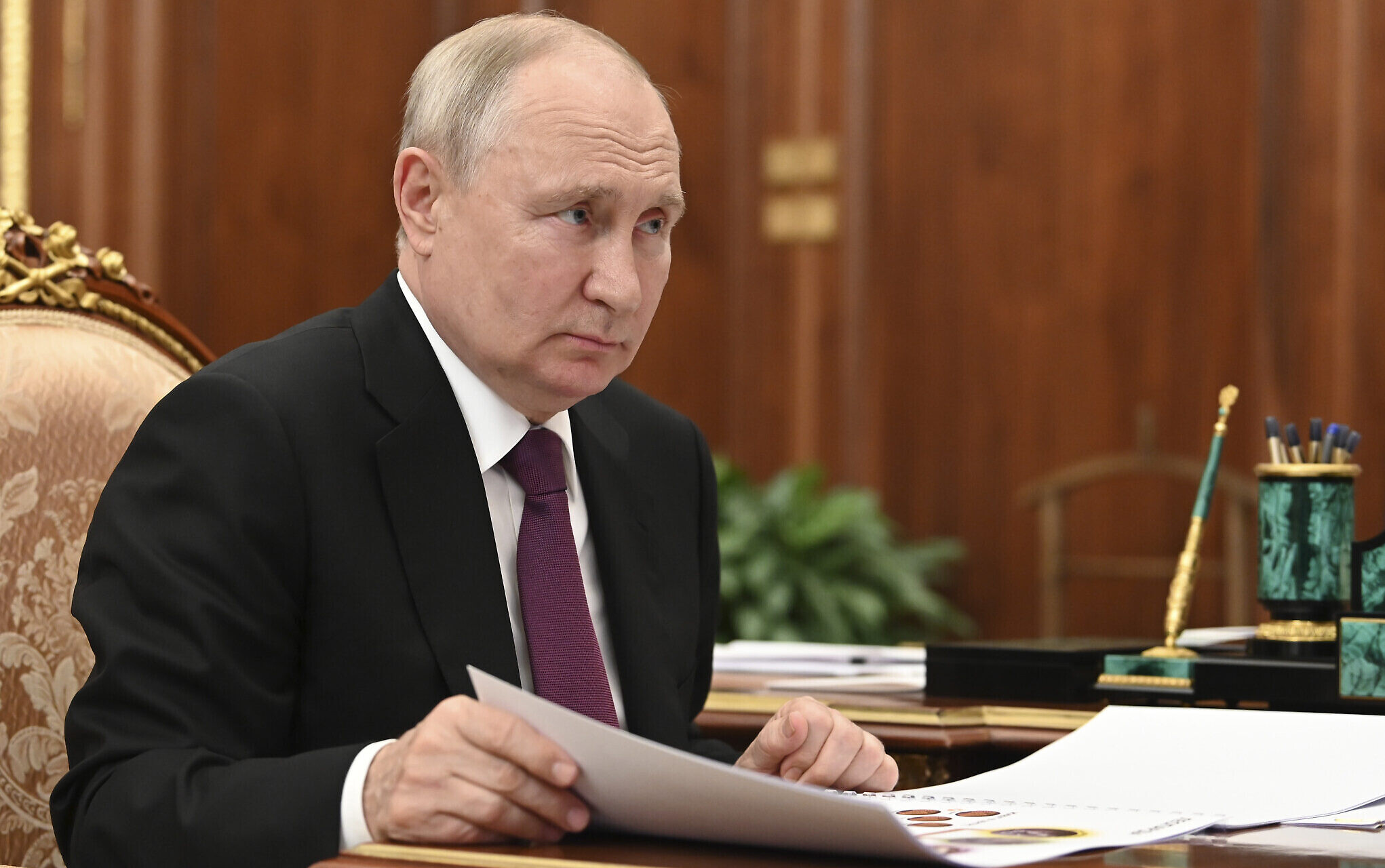
Russian President Vladimir Putin meets with Minister of Natural Resources and Environment Alexander Kozlov at the Kremlin in Moscow, Russia, September 6, 2023. (Mikhail Klimentyev/Sputnik, Kremlin Pool Photo via AP)
Turkey-Azerbaijan alliance
A complex hangover from the Soviet era, the Azerbaijani exclave of Nakhchivan, a landlocked autonomous republic, does not share a border with Azerbaijan but has been tied to Baku since the 1920s. It is located between Armenia, Turkey and Iran.
Some experts believe that Azerbaijani President Ilham Aliyev could now seek to launch operations in southern Armenia to create a territorial link with Nakhchivan.
Allies Turkey and Azerbaijan had said in June they wanted to step up efforts to open a land corridor linking Turkey to Azerbaijan’s main territory via Nakhchivan and Armenia, a longstanding and complex project.
A few days after Azerbaijan’s lightning offensive in Nagorno-Karabakh on September 19 and 20, Aliyev met his Turkish counterpart Recep Tayyip Erdogan in the exclave.
Aliyev recently referred to southern Armenia as “Western Azerbaijan” and in December said Azerbaijanis “must be able to return to their native lands.”
He went further in February 2018, when he told a press conference: “Yerevan is our historic land… We Azerbaijanis must return to our historic lands.”
The alliance between Turkey and Azerbaijan, both mainly Muslim, is fueled by a mutual mistrust of largely Christian Armenia.
The latter harbors hostility towards Ankara over the massacres of some 1.5 million Armenians by Turkey during the dying days of the Ottoman Empire.
More than 30 countries have recognized the killings as genocide, although Ankara fiercely disputes the term.

Turkish President Recep Tayyip Erdogan (L) and Azerbaijan’s President Ilham Aliyev, taking part in the opening ceremony of the Nakhchivan Reconstruction-Industrial Military Complex in the Nakhichevan enclave, a territory between Armenia and Iran on the border with Turkey, September 25, 2023. (Azerbaijani presidency handout/AFP)
Iran unknown
Another major geopolitical player in the region is Iran, which has commercial interests in Armenia’s future.
Iran sees Armenia as its commercial gateway to the Caucasus and therefore “does not want to see the border move” to favor Azerbaijan, said Taline Ter Minassian, a professor at France’s National Institute for Oriental Languages and Civilizations.
The reasons are also geostrategic, as Azerbaijan has for years been drawing nearer to Israel, Tehran’s arch-enemy.

Israeli Defense Minister Yoav Gallant (left) talks with Azerbaijan’s President Ilham Aliyev in Baku, Azerbaijan, July 13, 2023. (Ariel Hermoni/IMoD)
Israel accounted for almost 70 percent of arms sales to Azerbaijan between 2016 and 2020, according to the Stockholm International Peace Research Institute.
The French Centre for Intelligence Research has said that Israel has built “several electronic intelligence stations” in Azerbaijan.
Azerbaijan’s key ally Turkey is also a member of NATO, the US-led military alliance with which Iran is also at loggerheads.
In the absence of a convincing Western commitment to Armenia, its “only protection so far has been Iran,” said Jean-Louis Bourlanges, chair of the French Foreign Affairs Committee.
“It’s a very fragile and worrying guarantee,” he added.
You’re a dedicated reader

We’re really pleased that you’ve read X Times of Israel articles in the past month.
That’s why we started the Times of Israel eleven years ago – to provide discerning readers like you with must-read coverage of Israel and the Jewish world.
So now we have a request. Unlike other news outlets, we haven’t put up a paywall. But as the journalism we do is costly, we invite readers for whom The Times of Israel has become important to help support our work by joining The Times of Israel Community.
For as little as $6 a month you can help support our quality journalism while enjoying The Times of Israel AD-FREE, as well as accessing exclusive content available only to Times of Israel Community members.
Thank you,
David Horovitz, Founding Editor of The Times of Israel
Join Our Community
Join Our Community
Already a member? Sign in to stop seeing this

While the Western world reacted with horror to the heart-breaking scenes of Hamas gunmen preying on Israeli civilians on October 7, the reaction in Russia was markedly different.
Kremlin-endorsed propagandists celebrated the fighting as a distraction to tear the West’s eyes from Ukraine, produced new conspiracy theories to explain the news, and delighted in the discomfort and fear of Russian Jews who have emigrated to Israel.
There’s as yet no evidence that Russia knew of the impending attack, although it has fostered ties with Hamas. In March, Hamas reportedly sent a high-level delegation to Russia and held talks with Russian Foreign Minister Sergey Lavrov, warning the Kremlin that the group’s “patience” with Israel was “running out.” Senior Hamas figures also visited Russia in May and September 2022. The group has said its attack was supported by Iran and other countries but did not name them.
But while the Kremlin may not have been directly involved, many of its citizens are openly antisemitic, as are senior officials. Military correspondent Dmitry Steshin, known for his overtly genocidal statements about Ukrainians, posted on his Telegram channel Russky Tarantas that there should be “not a drop of pity or sympathy” for Israelis, including former Russian citizens. Steshin complained about people who left Russia for Israel, describing them as “relocants.”
He wrote: “We stayed here and are still standing knee-deep in blood. Let the ones responsible for our tears do that as well! Or let them run, to refresh their historical memory. Greetings to the relocants!”
Sergey Mardan, one of Russia’s best-known propagandists and host of the eponymous show on the state channel Solovyov Live, wrote on his Telegram channel that he was happy for the Russians who moved to Israel because they didn’t want to live in a country that is at war with its neighbors.
He added, “This mess is beneficial for Russia, because the globalist toad will be distracted from Ukraine and will get busy trying to put out the eternal Middle Eastern fire.” Mardan explained, “Iran is our real military ally. Israel is an ally of the United States. Therefore, choosing a side is easy!”
During his show, “Mardan,” the host made a bizarre comparison between Palestine and Russia, claiming that Russia “has been occupied since 1991” and is only now seeking to correct the situation. Russian propagandists frequently claim that Ukraine is “occupying” Russian lands, which Russia is fighting to reclaim.
Head of RT, Margarita Simonyan, wrote on her X/Twitter account, “The country that is not at war with its neighbors is again at war with its neighbors. We await the exodus of Russian pacifists. Then again, we won’t hold our breath.”
Host of the show “Morning Z” on Solovyov Live, Boris Yakemenko, blamed the violence on gender issues (presumably a reference to LGBT+ debates in the West), stating, “What is happening today in different corners of the world shows that the world has come to a dangerous point, beyond which lies the new world. Crossing into it will be preceded by horrendous casualties, because of a feeling of total injustice, insanity, a total lack of understanding of what is happening, with all of these genders, with all of these strange phenomena!”
Yakemenko read caustic messages from members of his audience, pondering which citizenship Russian relocants would choose this time. He addressed former Russian compatriots, telling them to “Go ahead and run, or hide in bomb shelters.”
During his show on October 7, Vladimir Solovyov, described the Hamas attack as a “loud slap” to Israel and its intelligence services, assigning all fault to America as a “guarantor of peace in the region” and baselessly blaming Ukraine for providing arms to Hamas. (Hamas’ main arms supplier is actually Iran).
Get the Latest
Sign up to receive regular emails and stay informed about CEPA’s work.
Such accusations were repeated across Russian state media, despite its military illogic, clear Ukrainian support for Israel, and the enormous difficulties of shipping arms to Gaza.
Military correspondent Alexander Kots discussed this preposterous talking point with Komsomolskaya Pravda and made it clear that he isn’t rooting either for Israel or for the Palestinians. Kots then went on to say: “In the event of a conflict, it’s anticipated that we must be on someone’s side. I don’t want to take either side. One helps Kyiv arm itself and fight against Russian troops, while the other side takes civilians hostage and abuses their corpses. And, judging by the footage that comes from there, they also rape female soldiers of the Israeli army. A plague on both your houses!”
Putin’s former advisor, Sergey Markov, added a supernatural claim by blaming Russian émigrés for bringing war to Israel by “jinxing” any country they run to. He said: “Russia is calling for peace, but understands that war is inevitable.
“The Soviet Union has been helping Palestinians for many years. The main ally of Israel is the United States, which is also Russia’s main enemy right now. Russia’s ally, Iran, is an ally of Hamas. Russia will benefit from the rising oil prices as a consequence of this war . . . Any conflicts on which the US and the EU have to expend resources are beneficial for Russia because this lessens the resources sent to the Russophobic regime in Ukraine.”
Marat Bulatov, who hosts “Day Z” on Solovyov Live, decided to start the show with more important news, congratulating Russian President Vladimir Putin on his 71st birthday. Bulatov proceeded to describe Putin as “our boss, our Commander-in-Chief, our president, and our sovereign.”
He told the audience, “We have to be with our president, with our country, or else we could experience something like what is happening in Israel.” Bulatov absurdly alleged that Prime Minister of Israel Benjamin Netanyahu “is calling for jihad” against Palestine and later read a message from a viewer that said, “We are calling on Palestine to keep it up!”
Nina from St. Petersburg sent a message that Bulatov read out loud: “It’s not like last year, when the Crimean bridge was destroyed for Putin’s birthday. We only have good news today!” The host replied, “Yes, I completely agree!”
Julia Davis is a columnist for The Daily Beast and the creator of the Russian Media Monitor. She is a member of the Academy of Television Arts and Sciences, the Screen Actors Guild, and Women In Film.
Europe’s Edge is CEPA’s online journal covering critical topics on the foreign policy docket across Europe and North America. All opinions are those of the author and do not necessarily represent the position or views of the institutions they represent or the Center for European Policy Analysis.
Europe’s Edge
CEPA’s online journal covering critical topics on the foreign policy docket across Europe and North America.
