Categories
Selected Articles

Why Republicans Are Wearing Fake Ear Bandages


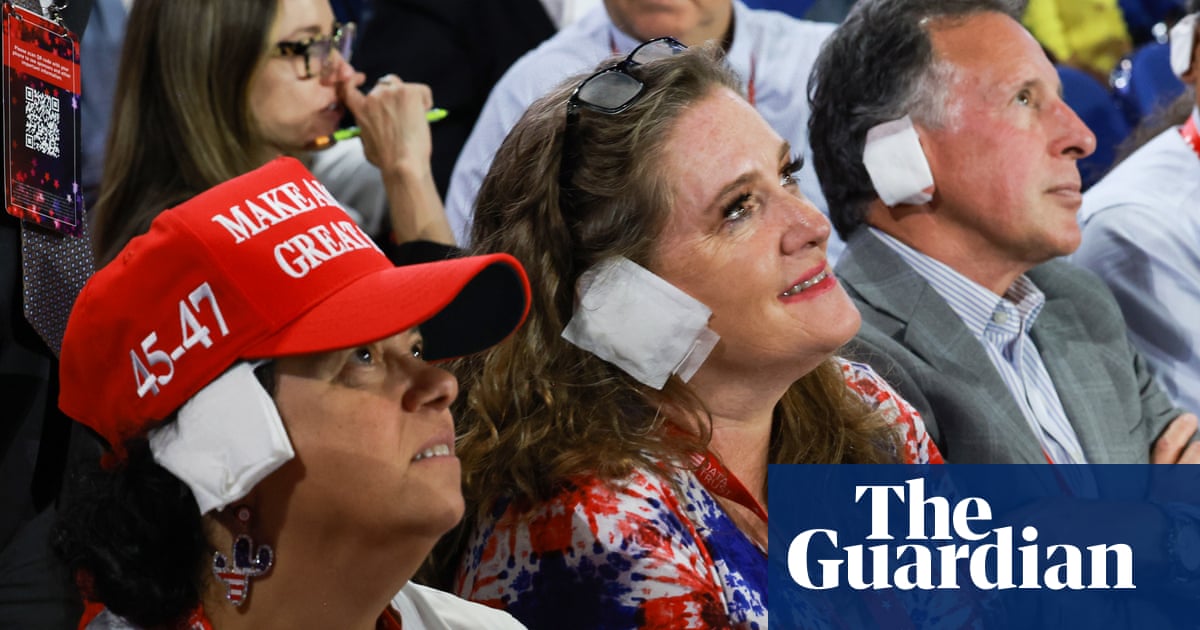
Donald Trump may be the only one who was actually shot in the ear, but at the Republican National Convention in Milwaukee, he is far from the only person sporting a bandage on the side of his face.

The unusual accessory is sweeping the convention hall, where delegates and supporters, in a tribute to the former President and party nominee, are showcasing their own versions of his wound dressing, ranging from cotton pads to tape to folded pieces of paper.

Collage of attendees with bandaged ears at the Republican National Convention.Attendees sporting bandaged ears at the Republican National Convention.Getty Images

Joe Neglia, a delegate from Tempe, Ariz., told Fox News on Tuesday that he had the idea of making his own ear bandage after being moved by Trump arriving at the RNC on Monday in his first public appearance since an attempted assassination at a Pennsylvania rally over the weekend. 

“I thought, ‘what can I do to honor the truth? What can I possibly do?’” Neglia said. “And then I saw the bandage and I thought, I can do that. So, I put it on simply to honor Trump and to express sympathy with him and unity with him.”

Neglia also told CBS News on Tuesday that the fake bandages were fast becoming “the newest fashion trend” at the RNC. “Everybody in the world’s going to be wearing these pretty soon,” he said. “I’m setting new fashion ground here.”

Stacey Goodman, another delegate from Arizona who joined in the patch-clad fad, told KSBW Action News on Wednesday that she was inspired to mimic Trump’s look after seeing another delegate with an ear bandage. And she said she saw more and more others following suit, all “in solidarity with President Trump.”

Ray Michaels, another Arizona delegate, told the Associated Press on Wednesday: “We realized that this was a tragedy that should never have happened, and we want [Trump] to know that we are going through this with him.”

“We need a symbol about political violence not being acceptable in America,” Texas delegate Jackson Carpenter told the Washington Post.

“For all the stylistic flourishes of the Trump era, from hats to sneakers, this one seems the most organic,” Republican strategist Liam Donovan told the Post. “It was truly a surreal moment that people are still processing, and this is a recognizable show of solidarity in a meme-ified political moment.”

While Trump supporter Corey Comperatore and gunman Thomas Matthew Crooks were killed at the scene of the shooting on Saturday and two other rallygoers were injured, Trump himself escaped largely unscathed, save for a small part of his ear. 

According to former White House physician Rep. Ronny Jackson, who inspected and dressed Trump’s graze, the bullet “just took the top of his ear off a little bit.” Eric Trump, the former President’s son, described his father as being “millimeters away from having his life expunged” and said he was dealing with “the greatest earache he’s ever had.”

While Trump was seen wearing a smaller bandage hours after the shooting, by the time he made his appearance at the RNC on Monday, his right ear was covered by a thick white pad which has sparked viral memes from all sides of the political spectrum. 

Jackson told the New York Times that “the dressing bulked up a bit because you need a bit of absorbent. You don’t want to be walking around with bloody gauze on his ear.”

Republican presidential candidate, former U.S. President Donald Trump points to the crowd during the second day of the Republican National Convention at the Fiserv Forum on July 16, 2024 in Milwaukee, Wisconsin.Donald Trump points to the crowd during the second day of the Republican National Convention at the Fiserv Forum in Milwaukee, Wis., on July 16, 2024.Andrew Harnik—Getty Images

The bandage has reinforced Trump’s image of infallibility among supporters—many of whom already see him as something of a messiah. Trump allies have repeatedly attributed his survival to “divine intervention,” and Trump himself said after the shooting that “it was God alone who prevented the unthinkable from happening.”

It’s also not the only trend to emerge from the former President’s close call with death. Raised fists and the chant “fight fight fight”—both gestures Trump made moments after the attack, memorialized by an iconic photograph that’s already been plastered on numerous Republican merchandise—have become popular symbols among Trump’s supporters at the convention and will likely remain ubiquitous through the November election and beyond.


Categories
Selected Articles

@visegrad24: President Bukele reduced El Salvador’s murder rate from 103 per 100,000 people in 2015 to just 2.4 per 100,000 in 2023. That is a staggering 97.6% drop in murders!Western leaders facing rising crime rates can learn a lot from him.As for Salvadoran criminals in the West,…


President Bukele reduced El Salvador’s murder rate from 103 per 100,000 people in 2015 to just 2.4 per 100,000 in 2023.

That is a staggering 97.6% drop in murders!

Western leaders facing rising crime rates can learn a lot from him.

As for Salvadoran criminals in the West,…

— Visegrád 24 (@visegrad24) July 19, 2024


Categories
Selected Articles

US journalist Evan Gershkovich jailed for 16 years by Russian court – The Independent


US journalist Evan Gershkovich jailed for 16 years by Russian court  The Independent

Categories
Selected Articles

Where’s the official report of Trump’s injuries?


Isn’t it odd that five days after a would-be assassin’s bullet apparently grazed the right ear of former President Donald Trump at a rally, we have had no official statement, release, press conference, medical report or whatever stating exactly what kind of injuries that Trump suffered?

To be clear, this isn’t to question that Trump was injured. He had lots of blood coming from his ear in the moments immediately after we all heard the popping sounds of a gun and saw Trump wincing in pain and surprise. There is no proof behind the conspiracy theories that Trump was injured by anything other than a bullet.

This also isn’t to question the media, which seems to be trying to find out exactly what physically happened to Trump.

Veteran media reporter Paul Farhi tweeted Wednesday, “Still don’t know the extent of Trump’s injury(ies) since Saturday’s shooting. No briefing in 3 1/2 days.”

The day after the shooting, Trump wrote on his Truth Social that a bullet “pierced the upper part” of his right ear.

Trump has been seen this week at the Republican National Convention wearing a large bandage on his ear. Trump’s son, Eric, told “CBS Mornings” co-host Tony Dokoupil from the RNC on Wednesday that Trump did not get stitches.

Eric told Dokoupil, “You know, he was millimeters away from having his life expunged. … I’m sure the ear doesn’t feel well.”

Eric also said Trump had a “nice flesh wound” and the “greatest earache he has ever had.”

The New York Times’ Jonathan Swan reported on Tuesday that he spoke with Texas GOP Congressman Ronny Jackson, who was Trump’s White House doctor as president. Jackson was on the plane with Trump to Milwaukee for the RNC and told Swan that he changed the dressing on Trump’s ear.

Jackson told Swan, “The bullet took a little bit off the top of his ear in an area that, just by nature, bleeds like crazy. The dressing’s bulked up a bit because you need a bit of absorbent. You don’t want to be walking around with bloody gauze on his ear.”

All in all, Trump appears fine physically. He’s at the convention. He’s moving around as normal, and seems normal, other than having that big bandage.

But USA Today’s Rex Huppke wonders in a column if there is a psychological toll from almost being killed.

Huppke wrote, “… Trump may well not yet know the mental impact this horrific shooting had on him. It’s difficult to be self-reflective in the wake of something life-altering like that, and because of the timing of this week’s Republican National Convention, Trump chose to put on a tough face and move forward with his campaign. He’s showing up at the convention in Milwaukee with a huge bandage on his ear, yet nobody knows his exact medical condition.”

So why does this all matter? Huppke asks some questions that at least should be considered of someone who is running for president of the United States:

  • What, specifically, was his injury, and how was it treated?
  • What is his current medical condition in the wake of the injury, and has he been prescribed medication? If so, what kind?
  • Will additional medical procedures be required?
  • Has the former president had a psychological evaluation in the wake of the shooting?
  • How is his medical team planning to address the possibility of PTSD or other psychological after-effects?
  • Is he planning ongoing mental health counseling?

Huppke concluded with “A 78-year-old man just went through a traumatizing event few of us can even imagine. Voters deserve to know exactly what happened, and how Trump is doing, in body and in mind.”

Biden has COVID

Speaking of medical updates, can the news cycle get any busier? On Wednesday evening, it was announced that President Joe Biden tested positive for COVID-19. He had to cancel a speech he was supposed to make at a conference in Las Vegas.

Almost immediately, there were official medical updates.

White House press secretary Karine Jean-Pierre said in a statement that Biden was experiencing “mild symptoms.” She said Biden would return to Delaware to self-isolate, but would continue to work.

Biden’s doctor also said in a statement that Biden’s “symptoms remain mild.” Those symptoms, according to the doctor’s statement, were a runny nose, a nonproductive cough and general malaise. The doctor said Biden was taking Paxlovid and that his respiratory rate, temperature and pulse oximetry were all normal.

The day had already been a bad one for Biden. Earlier, another prominent Democrat, California Rep. Adam Schiff, called for Biden to drop out of the presidential race.

Schiff said, “While the choice to withdraw from the campaign is President Biden’s alone, I believe it is time for him to pass the torch.”

The Washington Post’s Nicole Markus has more details about Schiff’s comments.

And then there’s more: There are reports that House Minority Leader Hakeem Jeffries and Senate Majority Leader Chuck Schumer both had meetings with Biden last week, telling the president that staying on the ballot could negatively impact races that could cost the Democrats in both the House and Senate.

The Washington Post’s Tyler Pager and Michael Scherer have more.

And CNN’s Jeff Zeleny reported: “A new moment for Biden? One Democratic adviser says: ‘He’s being receptive.’” A senior Democratic adviser reportedly told Zeleny that when it comes to Vice President Kamala Harris, “(Biden has) gone from saying, ‘Kamala can’t win,’ to ‘Do you think Kamala can win?’ It’s still unclear where he’s going to land but seems to be listening.”

Tweets of the day

Niall Stanage, White House columnist for The Hill, tweeted, “President Biden has COVID. (The script writers are really trying to cram too much into this series.)”

CNN senior reporter Edward-Isaac Dovere tweeted, “We are nearing the point in the presidential race where aliens could land and that would not be big enough to keep up with news developments.”

How did you hear?

Where were you when you heard that Trump had been shot?

It was early on a Saturday evening, a time when many might not have been near their TVs. It’s a time when many of you might have been out — to dinner or taking a walk at the park or puttering around the house.

My Poynter colleague, Kelly McBride, wrote this piece: “How news avoiders got information about Trump’s shooting.” McBride said she reached out with a survey to friends, family and social networks to ask how they consumed the news of the shooting and how satisfied they were with the coverage.

She wrote, “This was not at all scientific. Journalists and Gen Xers were overrepresented, as were liberals. Despite the lack of rigor, the results revealed some clear divides. A small portion of the 126 respondents were nimble news junkies, bouncing between brands, platforms and devices. They could describe the relative strengths and weaknesses of different newsrooms and even individual journalists. They kept at it for hours and even though the news was unpleasant, they found the coverage engaging. But a much larger portion of the people who filled out the survey described a clear set of strategies that would limit their exposure to ongoing reporting. They talked of protecting their time and their emotional well-being, of needing to be informed and wanting to avoid feeling manipulated or disrespected.”

McBride asked what people did as soon as they learned what had happened. It broke down like this:

  • One-third of the respondents went to a browser and mostly opened up a well-known news site, although some of them went to search.
  • A quarter of them went straight to a news app.
  • Fifteen percent went to a social media site. Several of the folks who opened up X pointed out that it used to be much better during breaking news.
  • Just over 10% turned on the TV.
  • Seven people did absolutely nothing to gather more information.
  • One person phoned a friend.

McBride delves into much more about how people did (and did not) consume the news. So check out her story.

Coming in hot

I link to this comment on CNN from Jonah Goldberg, editor-in-chief of The Dispatch and weekly columnist for the Los Angeles Times, because it’s so juicy and the exact kind of thing you want when watching hours long coverage of political conventions.

About businessman and failed GOP presidential wannabe Vivek Ramaswamy, Goldberg said, “I find Vivek Ramaswamy exhausting. Jesse Jackson once said of Bill Clinton that the problem with him is — he said, ‘I think I can work with him. But when you look into him, all you see is appetite.’ And I think that’s an unfair comparison to Bill Clinton compared to Vivek Ramaswamy, because Vivek Ramaswamy seems like appetite with a very large forehead to me. And I don’t believe his sincerity on anything. But he’s very good at telling people who want to like him what they want to hear. And he’s another one of these younger guys who is a very old person’s idea of what they want young people to be like. And he’s mastered that shtick. And I do think it’s shtick.”

Notable links surrounding the Republican National Convention …

A reporter says she was fired
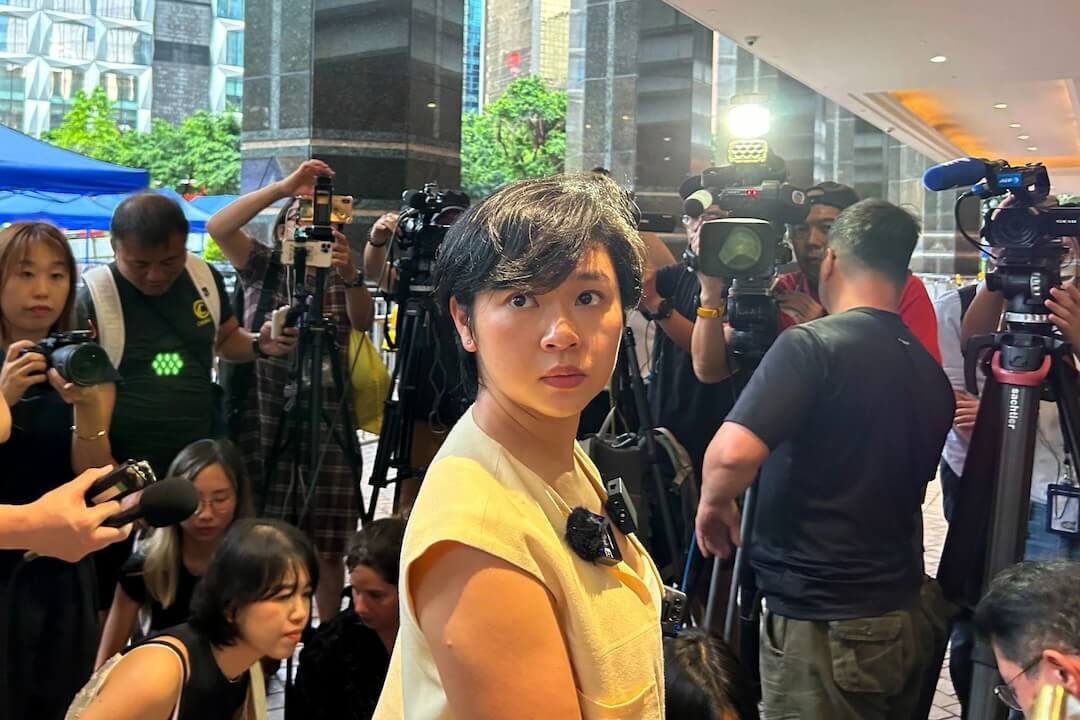
Selina Cheng, a former reporter at the Wall Street Journal, and newly elected chairperson of the Hong Kong Journalists Association, speaks to the media in Hong Kong on Wednesday. (AP Photo/Kanis Leung)

Hong Kong-based reporter Selina Cheng has lost her job at The Wall Street Journal. Cheng said a supervisor told her it was because the Journal was restructuring. But Cheng says she believes it’s because she refused her supervisor’s request to withdraw as chair of the Hong Kong Journalists Association.

The Washington Post’s Shibani Mahtani explained in a story, “The HKJA, a press advocacy association, has been accused in recent weeks by state-backed and state-run media outlets in Hong Kong and China of destabilizing the city.”

Cheng has been on the board of the HKJA since 2021, but was elected as chair just last month. The day before the election, Cheng said, her bosses told her to not run for chair and to withdraw from the board. She refused.

In a press conference, Cheng said, “I am appalled that the first press conference I’m giving as HKJA’s new chair is to announce that I was fired for taking up this position in a press union.”

The Associated Press’ Kanis Leung reported that Dow Jones, which owns the Journal, confirmed it made some personnel changes, but refused to comment on individuals, adding, “The Wall Street Journal has been and continues to be a fierce and vocal advocate for press freedom in Hong Kong and around the world.”

Mahtani wrote for the Post, “The termination, if linked to Cheng’s position at HKJA, would be the latest indication of how even large, well-resourced international media organizations are wary about the risks of operating in Hong Kong, a once-freewheeling city that has increasingly come to resemble mainland China in its suppression of civil liberties, including press freedom.”

Leung wrote, “The Hong Kong Journalists Association has been criticized by local authorities and pro-Beijing media outlets in recent years. In June, Secretary for Security Chris Tang said the association lacks legitimacy and accused it of having stood with the protesters in 2019. The Wall Street Journal also has faced pressure from the government. Last July, it received three complaint letters from Tang over its editorial or opinion pieces.”

Leung added, “After she refused to withdraw from the HKJA’s election last month, she said, her supervisor told her that Wall Street Journal’s workers should not be seen as advocating for press freedom in ‘a place like Hong Kong’ because such advocacy would create a conflict as the outlet reports on incidents about press freedom in the city.”

Media tidbits

Have feedback or a tip? Email Poynter senior media writer Tom Jones at tjones@poynter.org.

The Poynter Report is our daily media newsletter. To have it delivered to your inbox Monday-Friday, sign up here.


Categories
Selected Articles

Trump’s campaign has given no official info about his medical care following assassination attempt


shooting-1024x683.jpg

MILWAUKEE (AP) — Four days after a gunman’s attempt to assassinate former President Donald Trump at a Pennsylvania rally, the public is still in the dark over the extent of his injuries, what treatment the Republican presidential nominee received in the hospital, and whether there may be any long-term effects on his health.

WATCH: ‘I got lucky. God was with me,’ Trump tells supporters of assassination attempt

Trump’s campaign has refused to discuss his condition, release a medical report or records, or make the doctors who treated him available, leaving information to dribble out from Trump, his friends and family.

The first word on Trump’s condition came about half an hour after shots rang out and Trump dropped to the ground after reaching for his ear and then pumped his fist defiantly to the crowd with blood streaming down his face. The campaign issued a statement saying he was “fine” and “being checked out at a local medical facility.”

“More details will follow,” his spokesperson said.

READ MORE: Fact-checking the wild conspiracy theories related to the attempted Trump assassination

It wasn’t until 8:42 p.m., however, that Trump told the public he had been struck by a bullet as opposed to shrapnel or debris. In a post on his social media network, Trump wrote that he was “shot with a bullet that pierced the upper part” of his right ear.

“I knew immediately that something was wrong in that I heard a whizzing sound, shots, and immediately felt the bullet ripping through the skin,” he wrote.

Presidents and major-party candidates have long had to balance their right to doctor-patient confidentiality with the public’s expectations that they demonstrate they are healthy enough to serve, particularly when questions arise about their readiness. Trump, for example, has long pressed President Joe Biden to take a cognitive test as the Democrat faces doubts after his stumbling performance in last month’s debate.

After a would-be assassin shot and gravely wounded President Ronald Reagan in 1981, the Washington, D.C., hospital where he was treated gave regular, detailed public updates about his condition and treatment.

Trump has appeared at the Republican National Convention the past three days with a bandage over his right ear. But there has been no further word since Saturday from Trump’s campaign or other officials on his condition or treatment.

WATCH: How Trump’s assassination attempt compares to the attempt on Reagan in 1981

Instead, it has been allies and family members sharing news.

Rep. Ronny Jackson, R-Texas, who served as Trump’s White House doctor and traveled to be with him after the shooting, said in a podcast interview Monday that Trump was missing part of his ear — “a little bit at the top” — but that the wound would heal.

“He was lucky,” Jackson said on “The Benny Show,” a conservative podcast hosted by Benny Johnson. ”It was far enough away from his head that there was no concussive effects from the bullet. And it just took the top of his ear off, a little bit of the top of this ear off as it passed through.”

He said that the area would need to be treated with care to avoid further bleeding — “It’s not like a clean laceration like you would have with a knife or a blade, it’s a bullet track going by,” he said — but that Trump is “not going to need anything to be done with it. It’s going to be fine.”

The former president’s son Eric Trump said in an interview with CBS on Wednesday that his father had had “no stitches but certainly a nice flesh wound.”

The lack of information continues a pattern for Trump, who has released minimal medical information throughout his political career.

When he first ran in 2016, Trump declined to release full medical records, and instead released a note from his doctor that declared Trump would be “the healthiest individual ever elected to the presidency.”

Dr. Harold Bornstein later revealed that the glowing, four-paragraph assessment was written in 5 minutes as a car sent by Trump to collect it waited outside.

Jackson, after administering a physical to Trump in 2018, drew headlines for extolling the then-president’s “incredibly good genes” and suggesting that “if he had a healthier diet over the last 20 years he might live to be 200 years old.”

When Trump was infected with the coronavirus in the midst of his 2020 re-election campaign, his doctors and aides tried to downplay the severity of his condition and withheld information about how sick he was and key details of his treatment.

Former White House chief of staff Mark Meadows wrote in his book that Trump’s blood oxygen dropped to a “dangerously low level” and that there were concerns that Trump would not be able to walk on his own if he had waited longer to be transported to Walter Reed for treatment.


Categories
Selected Articles

Dr. Sanjay Gupta: There are still key questions about Trump’s injuries after attempted assassination


ap24195841316454.jpg?c=16x9&q=w_800,c_fi

It’s been five days since gunfire erupted at Republican presidential candidate Donald Trump’s rally in Butler, Pennsylvania, resulting in an injury to the former president, the death of one attendee, Corey Comperatore, and severe injuries to two others.

And although the images we’ve seen of Trump since his attempted assassination have been those of a person who was barely injured and is now in high spirits, what we’ve been told by the campaign offers very little insight into the former president’s condition, what kind of care he received or how his medical team will monitor him in the days and weeks ahead.

A full public assessment of Trump’s injuries is necessary, for both the former president’s own health and the clarity it can provide for voters about the recovery of the man who could become president of the United States once again. The concern is that gunshot blasts near the head can cause injuries that aren’t immediately noticeable, such as bleeding in or on the brain, damage to the inner ear or even psychological trauma. As a trauma neurosurgeon, I have seen how a thorough evaluation after any kind of gunshot wound can provide a complete picture and lead to a speedier recovery.

The first official communication about Trump’s health from his campaign came about 40 minutes after the shooting. It simply said Trump was “fine” and was “being checked out at a local medical facility.” It added that more details would follow.

However, the only other official details came about two hours later, in a post by Trump himself on Truth Social, where he wrote: “I was shot with a bullet that pierced the upper part of my right ear. I knew immediately that something was wrong in that I heard a whizzing sound, shots, and immediately felt the bullet ripping through the skin.”

Beyond that, most of what we know about his injury is based on what we’ve seen in pictures and video, and from secondhand accounts.

A source familiar with the matter told CNN on Sunday that Trump underwent a number of “routine” tests at the hospital, including a CT scan that came back normal.

CNN has repeatedly reached out to the Trump campaign and Butler Memorial Hospital, where Trump was treated, for more information but has not received further details about his condition or care. CNN reached out to the Trump campaign for comment again Thursday.

In the moments immediately following the sounds of gunfire on Saturday, we saw Trump raise his right hand to his ear and the side of his face. He did not collapse but seemed to duck to the ground of his own accord.

With US Secret Service surrounding him, he stood up about a minute later, raised his right arm and was able to walk and speak immediately. We saw him rouse the audience, telling them to “Fight!” as he pumped his fist in the air. From a medical standpoint, these are all very good signs and, despite the visible blood on his face, provided evidence that he wasn’t severely injured.

US Rep. Ronny Jackson, Trump’s former White House physician, said during an interview Monday on “The Benny Show” podcast, that he “checked out” the wound to Trump’s ear and bandaged it himself. He added that “there was no concussive effect from the bullet” because it was far enough from Trump’s head.

“It just took the top of his ear off, a little bit of the top of his ear off, as it passed through,” Jackson said. “It was bleeding like crazy.”  
 
Trump was transported to nearby Butler Memorial Hospital. Dr. David Rottinghaus, an emergency room physician there, said the hospital had been in contact with the Secret Service before Saturday’s rally. Rottinghaus, who did not treat Trump himself and would not comment on Trump’s treatment or condition, said he came to the hospital shortly after the shooting to help triage patients.

“We do prepare for incidents like this. We had had advanced visits in the past for rallies when Mr. Trump was here. The last was the end of 2020. We have worked with the Secret Service in the past and local and federal law enforcement to come up with plans about if an incident like this happened,” Rottinghaus told CNN.

Those plans included designating a bed in the ER in case it was needed, having clinical teams at the rally itself to treat patients on-site for minor medical issues, and avoiding overwhelming the hospital if there were a crisis.

When the unthinkable happened, Rottinghaus said, it took just minutes for Butler Memorial to put its plan into action, locking down the hospital and diverting patients to other health care facilities.

Although we were told that Trump had a CT scan and other routine exams, it is not clear when these tests were performed, who read the scans or whether his brain specifically was examined.

In the Monday interview, Jackson said Trump’s injury was “dressed up. He’ll be OK. … It’s going to granulate and heal in, and he’s not going to need anything to be done with it.” 
 
On Wednesday, in an interview with CBS News, Eric Trump said that his father had “no stitches but certainly, certainly a nice flesh wound.”

And Trump has been moving around the Republican National Convention in Milwaukee this week, talking and smiling through speeches with a bandage on his ear.

All of this points to a favorable prognosis. But it is still surprising that we have not heard more about the exact diagnosis and care of what may have been a catastrophic injury. And, while all the attention has been on his ear and right side of his head, that doesn’t mean other injuries may not be present. It’s not even clear that he was struck by a primary projectile from the rifle, a secondary projectile or a combination of both. Sometimes, it can be difficult to know without an in-depth evaluation.

We do know that the shooter used an AR-15-style weapon, and in my experience in the operating room, I’ve witnessed the kind of trauma this weapon can cause. The kinetic energy of it is significant: A rifle like the AR-15 can produce up to 1,300 foot-pounds of force. With that much power close to the head, there can be injuries beyond what’s visible.

For example, a fracture to the thin bone in that region of the skull, an epidural hematoma (or bleeding between the skull and the brain) and damage to the bones of the inner ear, which can result in hearing loss, vertigo or dizziness.

A CT scan can usually detect such injuries, but they aren’t always immediately apparent. As a result, sometimes patients are observed in the hospital and may even undergo a repeat CT scan.

The stress from a shooting can also have psychological effects.

“In the chaos that immediately follows being shot, these psychological impacts don’t always manifest,” said Dr. Kenji Inaba, a trauma surgeon with the Keck School of Medicine at the University of Southern California. “It can come up later on, and it’s something that we always need to be acutely aware of.”

The good news is that most physical symptoms of an injury would probably have revealed themselves over the past few days. At this point, however, the Trump campaign hasn’t yet shared whether a full workup was done at the time or if there has been any follow-up since.

Presidents and presidential candidates are not required to share their medical histories with the public, but voters have said that the health conditions of their leaders matter to them in this election. More information helps everyone make better decisions.

Rottinghaus, the Butler Memorial physician, told CNN that after all the preparation for the unthinkable, “the unexpected happened” on Saturday. Still, the hospital considers it a successful day: Staff juggled the arrival of a former president with care for their other patients. What made it work, he said, was communication, clear planning and preparation to act.

In an intense political season for the country, that kind of collaboration and communication may be a lesson for the candidates, too.

CNN’s Nadia Kounang, Deidre McPhillips, Maya Davis and Jamie Gumbrecht contributed to this report.


Categories
Selected Articles

Trump’s White House doctor gives medical update after shooting


Donald Trump‘s former White House physician said that there was “no concussive effect” from the bullet that grazed the former president’s right ear during the assassination attempt at a campaign rally on Saturday.

Representative Ronny Jackson of Texas, who served as Trump’s doctor during the former president’s term in the Oval Office, spoke with conservative podcast host Benny Johnson on Monday before the start of the Republican National Convention (RNC), where Trump was formally nominated as the GOP’s pick for the 2024 presidential election.

The convention has arrived in the wake of the assassination attempt on Trump in Butler, Pennsylvania, over the weekend. The gunman, identified by the FBI as 20-year-old Thomas Matthew Crooks, shot several rounds from a .22 caliber-fitted AR-15-style weapon at the former president. Crooks grazed Trump’s ear in the shooting. One rally- goer was killed and two others were injured. The assailant was shot dead by Secret Service counter-snipers soon after firing at Trump.

Trump's White House Doctor Gives Medical Update

Republican presidential candidate and former President Donald Trump on Monday attends the first day of the Republican National Convention at the Fiserv Forum in Milwaukee, Wisconsin. Trump’s former White House physician, Representative Ronny Jackson, provided…
Republican presidential candidate and former President Donald Trump on Monday attends the first day of the Republican National Convention at the Fiserv Forum in Milwaukee, Wisconsin. Trump’s former White House physician, Representative Ronny Jackson, provided an update on the former president’s right ear that was grazed by a bullet during Saturday’s assassination attempt. Joe Raedle/Getty Images

Jackson said Monday that he checked out Trump’s ear the morning before the first day of the RNC, adding that the bullet “just took the top of his ear off” as it whizzed past the former president. Trump was seen with a large bandage over his ear during the convention on Monday.

“He was lucky,” Jackson said on The Benny Show. “I mean, it was far enough away from his head that there was no concussive effect from the bullet, and it just took the top of his ear off.”

Jackson added that the wound was “bleeding like crazy” when he checked in on the former president Monday morning but that Trump “will be OK” and that the injury would “granulate” and “heal in.” Granulation is the process of new connective tissue forming on the surface of a wound while it heals.

Johnson also asked the physician if Trump would have “a bite out of his ear for the rest of his life.” Jackson responded that the wound “is not going to be that noticeable” when healed.

Newsweek reached out to Trump’s campaign via email for further comment Tuesday afternoon.

Jackson added during his discussion with Johnson that he believes “divine intervention” played a role in keeping Trump from being further hurt in the shooting. The former president has previously said that his life was spared because he moved his head at “the exact right time” to pivot toward a chart that he was speaking about during the rally.

“He [Trump] realizes how close he came to that,” Jackson said. “And he realizes that if he hadn’t started making that movement where he turned his head, pulled back a little bit and looked up, if he hadn’t done it at the exact millisecond that he started, that bullet would have entered his head.”

“I think there was divine intervention there,” the congressman added.

Newsweek is committed to challenging conventional wisdom and finding connections in the search for common ground.

Newsweek is committed to challenging conventional wisdom and finding connections in the search for common ground.


Categories
Selected Articles

Trump fans wear bandages on ears to show support – in pictures


4263.jpg?width=1200&height=630&quality=8


Categories
Selected Articles

Physicians weigh in on potential impact of Trump’s ear wound: ‘It’s a matter of inches’


GettyImages-2162187053-1024x576.jpg

Four days after former president Donald Trump was shot in the ear at a rally in Pennsylvania, his medical team has yet to release detailed records of his condition or treatment. And while his campaign has pronounced him to be in good health, numerous experts on gunshot trauma and emergency medicine interviewed by STAT said there could still be outstanding questions.

All emphasized that they could not comment specifically about Trump’s injury, having not examined him themselves, and added that it did appear that the injury was minor. But they also said that in cases like Trump’s, it would be important to rule out any injury to the brain or neck.

“It may appear like only a graze to Trump’s ear, but a ballistic injury that close to the head/brain isn’t trivial,” Baylor University Medical Center emergency physician Amy Faith Ho posted on X shortly after the shooting on July 13.

Here’s how experts said they would respond to injuries like Trump’s — and their thoughts on the lingering questions that have not been publicly addressed.

How emergency doctors approach gunshot wounds like Trump’s

In an interview with STAT, Ho elaborated on how gunshot wounds close to the head are typically treated. “Initially, our concern would be things like brain bleeds, arterial bleeds, or other vascular injuries, like something called a dissection. We would also be concerned about bony injuries, so fractures and specifically a skull fracture or a cervical spine fracture if it hit the neck.”

“Besides the obvious inner and external ear injuries possible, the force of ballistics at that proximity make both skull fractures and head bleeds a very real risk,” Ho said. Injuries of this kind would require CT scans of the head and the neck, allowing evaluation of the arteries in both, Ho said. She said she’d also check for hearing loss, vertigo, and dizziness.

Nicholas Namias, chief of the division of trauma and acute care surgery at the University of Miami Miller School of Medicine, also noted that the biggest concern with gunshot wounds close to the head is always a brain injury.

“These weapons are very high velocity, and you actually can get a brain injury with what looks like a graze, without even a fracture to the skull,” Namias said.

Following initial treatment of the local wound and a CT scan to detect potential brain damage, Namias added that he would refer the patient for psychological testing.

“Most people don’t have it filmed,” Namias said of traumatic events like this. “He can see it over and over and over, so this has got to be harrowing and so you would screen someone like that for post-traumatic stress disorder.”

Any gunshot wound to the head is treated seriously, said Matthew Mostofi, associate chief of emergency medicine at Tufts Medical Center.

Most gunshot victims, he said, are rapidly assessed to make sure their airway is open, their neck is stabilized, and that they are breathing. “A quick way to do this is to ask their name. If they say, ‘My name is Donald,’ you say, ‘Great, you’re breathing.’”

“Then we examine you,” he said. “We’d look at the ear last.”

Mostofi emphasized that he could not diagnose Trump from a distance but said that the information he had heard suggested Trump had only sustained an injury to the pinna, or outer ear. “That’s not a life-threatening injury,” he said.

Ear injuries do have specific potential complications that Trump’s medical team would likely be on the lookout for, according to Mostofi, such as “cauliflower ear” — a malady often seen in wrestlers that occurs when the skin and cartilage of the ear become separated by a hematoma and the cartilage does not receive enough oxygen as the wound heals. One remedy is to use a pressure bandage after the injury to make sure the skin and cartilage stay in contact.

“The ear is an interesting little appendage,” he said. “It’s skin over cartilage and there’s not a lot of blood supply.”

He also said perichondritis — an infection of the ear cartilage — remained a risk and could be more serious than infection of the skin.

Mostofi said patients who had fallen or experienced tenderness in their neck would be sent for further imaging to rule out issues to the head, neck, or spine, especially if they were older, but said “if you hadn’t fallen or had any tenderness we might not do any imaging.” He said he did not think concussion was a potential issue because the bullet had been fired from so far away. While “barotrauma,” or damage to the eardrum by a pressure change when a gun is fired in a closed car, can be a risk, that was not the case here.

Kenji Inaba, a professor and vice chair of surgery at Keck Medicine of USC and chief of trauma and surgical critical care there, also said there was a low likelihood of brain injury or hearing loss from a ballistic injury to the outer ear, but that close examination was important to look for errant bullet fragments or anything that may have hit the ear and continued into the face or brain.

“When we’re talking about ballistic injuries or gunshot injuries, we want to make sure we discuss all the potential injuries,” said Inaba, who is also the medical director for the Los Angeles Police Department.

Inaba said the apparent minimal nature of a gunshot injury that could have been far worse was something he sees often in his own trauma center. “We see this all the time, where the head or the body happens to be in a particular space completely impacts the consequences of that bullet,” he said.

Open questions about Trump’s injury

So far, there has been no release of official medical reports from those who treated Trump and no release of test results or imaging following the shooting. What is known is that after the shooting early Saturday evening, Trump was taken to Butler Memorial Hospital in Pennsylvania, where staff treated his injuries. He was released the same day within a few hours. Trump said Saturday in a post on his social media platform, Truth Social, that he had been “shot with a bullet that pierced the upper part of my right ear.”

The most detailed medical information yet has come from Trump’s former White House doctor, Rep. Ronny Jackson of Texas, who said he examined Trump shortly before the start of the Republican National Convention and said on a podcast that the bullet had taken off a chunk of Trump’s ear.

“He was lucky,” Jackson said on The Benny Show. “I mean, it was far enough away from his head that there was no concussive effect from the bullet, and it just took the top of his ear off.” Jackson said Trump’s wound was initially bleeding heavily but that he “will be OK.”

Jackson told The New York Times he had changed the bandage on Trump’s ear and that it was large “because you need a bit of absorbent” and “you don’t want to be walking around with bloody gauze.”

Trump told Jackson that had he not pulled his head back just a microsecond before the shooting to gesture toward a graphic behind him, “that bullet would have entered his head,” according to Jackson. He added that Trump told him: “That chart that I was going over saved my life.”

Trump’s son Eric told CBS News this morning that his father did not receive stitches but “had a nice flesh wound” and was doing well.

In the aftermath of the attempted assassination, more detailed information from official medical sources has yet to be released — a cause of concern for some observers.

Nick Mark, an intensivist in Seattle, said that he was frustrated more information was not being released or reported by the media.

“Did he have a head CT? What did it show? Did he have stitches? Tetanus shot?,” Mark asked Tuesday in a post on X.

Speaking with STAT, Mark said that he didn’t want to fearmonger and that the wound could be minimal. That said, “I’d want to know as a doctor that the person running for the highest office hasn’t been cognitively impaired by a high velocity bullet.”

“There’s been so much attention rightfully given to President Biden’s health, and almost nothing about this,” Mark said. “It’s frustrating.”

Steven Beschloss, who wrote a book about presidential assassin Lee Harvey Oswald, said he was concerned about the information vacuum surrounding the shooting. “I find it stunning Trump is the only source—did a bullet hit him, graze him, or was it something else,” he posted.

“It’s been three days going on four since this horrific event occurred […] yet we have not received a medical report from the hospital nor have we received a medical report from the campaign or the Trump organization about the damage to his ear,” said former Republican National Committee chair Michael Steele in an interview with MSNBC. “There are a lot of questions about that ear.”

The consensus, however, is that Trump got lucky.

“It certainly would seem former President Trump should make a full recovery,” said Thomas Scalea, the physician-in-chief of the R Adams Cowley Shock Trauma Center at the University of Maryland Medical Center. “In terms of his ability to function and recover, it seems it won’t be a problem.”

Scalea said his thoughts went beyond the medical issues involved. “The real story to me is you can’t run for president without someone trying to kill you,” he said.

“It was close — three or four inches away and this is a completely different story,” he said. “It’s a matter of inches.”


Categories
Selected Articles

A photo that appears to show Trump’s ear with no damage after the attempted assassination is actually from 2022


?url=https%3A%2F%2Fassets.apnews.com%2F7

CLAIM: A photo taken on Monday shows former President Donald Trump with no damage to his right ear, contrary to reports that it was injured in an attempted assassination on Saturday.

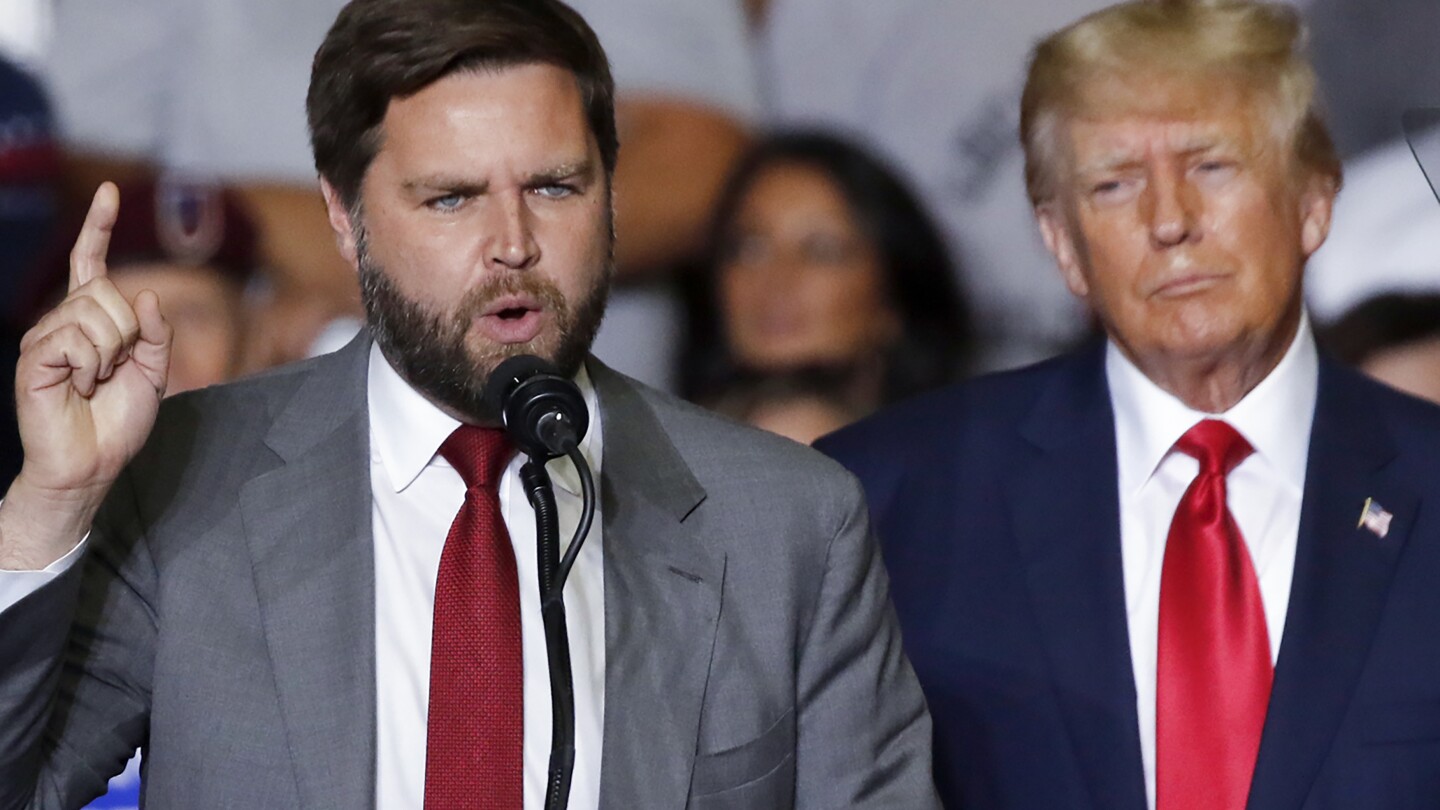
AP’S ASSESSMENT: False. The photo was taken on Sept. 17, 2022, at a rally in Youngstown, Ohio, for then-U.S. Senate candidate JD Vance. Trump appeared at the Republican National Convention Monday night with a large, white bandage on his right ear. Myriad photos show his ear bloodied after a shooter opened fire at his rally in Butler, Pennsylvania, over the weekend.

THE FACTS: Social media users are sharing the old photo as new, with some falsely presenting it as evidence that Trump was not injured by the gunfire.

“The top part of his ear grew back,” reads one X post from Monday night that had received approximately 40,000 likes and 13,200 shares as of Tuesday. “(Yes. This is from today)”

Another X post from Monday night states: “This image of Trump was taken today. There is absolutely nothing wrong with his ear, and it has zero damage, FROM A BULLET. Everything about Trump is a con or a grift.” It received approximately 26,000 likes and 8,600 shares.

But the photo was taken nearly two years ago.

It is from a Sept. 17, 2022, rally in Youngstown, Ohio, for Vance during his Senate campaign. The image appeared in multiple articles published around that time. Trump chose Vance, now a U.S. senator, as his running mate on Monday.

The version spreading online is cropped to show only Trump and is zoomed in to show the former president’s ear more clearly. In the original, Vance can be seen speaking at a podium while Trump stands behind him.

Trump appeared at the Republican National Convention in Milwaukee on Monday night with a large, white bandage on his right ear. Numerous photos from the aftermath of the shooting show the same ear bloodied.

Thomas Matthew Crooks, a 20-year-old nursing-home employee from suburban Pittsburgh, fired multiple shots at Trump with an AR-style rifle from a nearby roof at a rally for the Republican nominee on Saturday. He was killed by Secret Service personnel, officials said.

The attempted assassination left Trump and two other men wounded. Corey Comperatore, a 50-year-old fire chief, was killed while protecting his family. The FBI said it was investigating the attack as a potential act of domestic terrorism, but has not identified a clear ideological motive, The Associated Press has reported.___

This is part of the AP’s effort to address widely shared false and misleading information that is circulating online. Learn more about fact-checking at AP.