
4/8🧵Sometimes institutional, at others factional.
Influence in #Ukraine🇺🇦🌻?
Competitive #Russian Intelligence model.
“3 briefing books”📚 #FSB, #GRU, #SVR#NikolaiPatrushev, #SergeiShoigu
M pic.twitter.com/GKTFL2GgYB— Truth & Social Justice (@truthjustice61) November 7, 2023
Day: November 7, 2023
Categories
Putin’s war on the West
HE IS ridiculed for his mendacity and ostracised by his peers. He presides over a free-falling currency and a rapidly shrinking economy. International sanctions stop his kleptocratic friends from holidaying in their ill-gotten Mediterranean villas. Judged against the objectives Vladimir Putin purported to set on inheriting Russia’s presidency 15 years ago—prosperity, the rule of law, westward integration—regarding him as a success might seem bleakly comical.
But those are no longer his goals, if they ever really were. Look at the world from his perspective, and Mr Putin is winning. For all his enemies’ machinations, he remains the Kremlin’s undisputed master. He has a throttlehold on Ukraine, a grip this week’s brittle agreement in Minsk has not eased. Domesticating Ukraine through his routine tactics of threats and bribery was his first preference, but the invasion has had side benefits. It has demonstrated the costs of insubordination to Russians; and, since he thinks Ukraine’s government is merely a puppet of the West (the supposed will of its people being, to his ultracynical mind, merely a cover for Western intrigues), the conflict has usefully shown who is boss in Russia’s backyard. Best of all, it has sown discord among Mr Putin’s adversaries: among Europeans, and between them and America.
His overarching aim is to divide and neuter that alliance, fracture its collective approach to security, and resist and roll back its advances. From his tantrums over the Middle East to his invasion of Georgia and multiple misadventures in Ukraine, Mr Putin has sometimes seemed to stumble into accidental disputes with the West, driven by a paranoid fear of encirclement. In hindsight it seems that, given his outlook, confrontation may have been inevitable. Either way, the contest he insists on can no longer be dodged. It did not begin in poor Ukraine and will not end there. Prevailing will require far more resolve than Western leaders have so far mustered.
What the Kremlin wants
Last year Mr Putin lopped off Crimea, redrawing Europe’s map by force. The war he hallucinated into reality in eastern Ukraine has killed thousands. Even if the ceasefire scheduled for February 15th holds (unlikely, on past form), he seems certain to get what he wants there: a wretched little quasi-state in the Donbas, which he can use to stall and warp Ukraine’s development. Yet these incursions are only his latest bid to bludgeon former Soviet states into submission, whether through energy blackmail, trade embargoes or war. For Mr Putin the only good neighbour is a weak one; vassals are better than allies. Only the wilfully blind would think his revanchism has been sated. Sooner or later it may encompass the Baltic states—members of both the European Union and NATO, and home to Russian minorities of the kind he pledges to “protect”.
The EU and NATO are Mr Putin’s ultimate targets. To him, Western institutions and values are more threatening than armies. He wants to halt their spread, corrode them from within and, at least on the West’s fragile periphery, supplant them with his own model of governance. In that model, nation-states trump alliances, states are dominated by elites, and those elites can be bought. Here, too, he has enjoyed some success. From France to Greece to Hungary he is cultivating parties on Europe’s far right and left: anyone who might lobby for Russian interests in the EU, or even help to prise the union apart (see article). The biggest target is NATO’s commitment to mutual self-defence. Discredit that—by, for example, staging a pro-Russian uprising in Estonia or Latvia, which other NATO members decline to help quell—and the alliance crumbles.
Mr Putin’s stranglehold on his own country means he has time and freedom for this campaign. As he has amply demonstrated, he has no qualms about sacrificing Russians’ well-being to satisfy his coterie’s greed or to further his geopolitical schemes. He persecutes those who protest. And in the echo chamber his propaganda creates, the nationalism he peddles as a consolation for domestic woes is flourishing.
What is to be done?
The first task for the West is to recognise the problem. Barack Obama has blithely regarded Russia as an awkward regional power, prone to post-imperial spasms but essentially declining. Historians will be amazed that, with Ukraine aflame, the West was still debating whether to eject Russia from the G8. To paraphrase Trotsky, Western leaders may not have been interested in Mr Putin, but Mr Putin was interested in them.
The next step is to craft a response as supple as the onslaught. Part of the trouble is that Mr Putin plays by different rules; indeed, for him, there are no inviolable rules, nor universal values, nor even cast-iron facts (such as who shot down flight MH17). There are only interests. His Russia has graduated from harassing ambassadors and assassinating critics to invasions. This is one of his assets: a readiness to stoop to methods the West cannot emulate without sullying itself.
 Russian timeline: The road to 2015
The current version of this quandary is whether, if the latest ceasefire fails, to arm Ukraine. Proponents think defensive weapons would inflict a cost on Mr Putin for fighting on. But anyone who doubts his tolerance of mass casualties should recall his war in Chechnya. If arms really are to deter him, the West must be united and ready to match his inevitable escalation with still more powerful weapons (along, eventually, with personnel to operate them). Yet the alliance is split over the idea. Mr Putin portrays the war as a Western provocation: arming Ukraine would turn that from fantasy to something like fact, while letting him expose the limits of Western unity and its lack of resolve—prizes he cherishes. If fresh Russian aggression galvanises the alliance, arming Ukraine will become a more potent threat. Until that point, it would backfire.
A better strategy is to eschew his methods and rely on an asset that he, in turn, cannot match: a way of life that people covet. If that seems wishy-washy beside his tanks, remember that the crisis began with Ukrainians’ desire to tilt towards the EU—and Mr Putin’s determination to stop them. Better than arms, the West must urgently give Ukraine as much aid as it needs to build a state and realise that dream (and as much advice as it takes to ensure the cash is not misspent or stolen). The IMF deal announced on February 12th should be only a start. Mr Putin wants Ukraine to be a lesson in the perils of leaning West. It should instead be an exemplar of the rewards.
Just as urgently, those former Soviet countries that have joined Western institutions must be buttressed and reassured. If the case for sending arms to the Donbas is doubtful, that for basing NATO troops in the Baltics is overwhelming, however loudly Mr Putin squeals. Western leaders must make it clear, to him and their own people, that they will defend their allies, and the alliance—even if the struggle is covert and murky.
And it isn’t only its allies who appreciate the West’s virtues. So do many Russians, including shameless Putinists who denounce the West’s decadence but exploit its schools and stockmarkets. It is long past time for every Russian parliamentarian and senior official to join the sanctions list. Far from being relaxed as, after Minsk, fellow-travellers may suggest, sanctions must be tightened—and sanctions-busting curtailed (see article). In the end, they will prove a stronger lever than weapons.
At the same time, the West should use every available means to help ordinary Russians, including Russian-sympathisers in the Baltics and Ukraine, learn the bloody, venal truth about Mr Putin. It should let them know that Russia, a great nation dragged down a terrible path, will be embraced when it has rulers who treat the world, and their own people, with respect not contempt, however long that takes.
NEW DELHI (AP) — Indian Prime Minister Narendra Modi says his country is “becoming the voice of the Global South,” and that at the upcoming Group of 20 meetings being held in New Delhi, that voice will be heard.
At the August summit of the BRICS nations — Brazil, Russia, India, China and South Africa — current chair South Africa declared its goal was to “advance the agenda of the Global South.” And ahead of this May’s summit of the Group of Seven wealthy democracies in Hiroshima, Japanese Prime Minister Fumio Kishida stressed that the guest nations he had invited reflected the importance of the Global South.
The United Nations, the World Bank, U.S. President Joe Biden — everyone seems to be talking about the Global South these days. But what, exactly, is it?
What constitutes the Global South?
Despite how it sounds, it’s not really a geographical term. Many countries included in the Global South are in the northern hemisphere, such as India, China and all of those in the northern half of Africa. Australia and New Zealand, both in the southern hemisphere, are not in the Global South.
Most cite the so-called Brandt Line as the border; a squiggle across the globe running from the north of Mexico, across the top of Africa and the Middle East, looping around India and China before dropping down to encompass most of East Asia while avoiding Japan, Australia and New Zealand. The line was proposed by former German Chancellor Willy Brandt in the 1980s as a visual depiction of the north-south divide based upon per-capita GDP.
“The Global South is a geographical, geopolitical, historical and developmental concept, all at the same time — with exceptions,” says Happymon Jacob, founder of the New Delhi-based Council for Strategic and Defense Research.
Which countries make up the Global South?
It’s complicated, and often depends upon who is using the phrase.
Most commonly the term refers to the countries belonging to the Group of 77 at the United Nations, which, confusingly, is today actually a coalition of 134 countries. They’re primarily considered developing countries, but also include China — about which there is some debate — and several wealthy Gulf states.
Though the G77 is a group at the U.N., the U.N. itself does not use that as its own definition, according to Rolf Traeger, who is with the U.N.’s trade and development office.
For the U.N., Global South is something of a shortcut to refer to developing countries in general, Traeger said. The U.N. currently lists 181 jurisdictions as developing countries or territories, and 67 jurisdictions as developed, he said.
In January, India’s Modi hosted a virtual “Voice of the Global South Summit.” It only included 125 countries, however, with India’s regional rivals China and Pakistan among the notable absentees.
Some use different criteria, such as whether a country was previously colonized or whether a nation’s per-capita GDP is above $15,000.
There is also a Global North, though the term is not regularly used. That is defined basically as not the Global South.
Should we use the term Global South?
The term Global South first appeared in the 1960s, but took time to gain traction.
Following the end of the Cold War, the terms First World, Second World and Third World started to fall out of favor, partly because with the fall of the Soviet Union the Second World ceased to exist, and also because the use of Third World came to be seen as derogatory.
No matter how you define it, the Global South accounts for such a vast majority of the world’s population and broad swath of territory that some argue it’s impossible and misleading to use the label.
How can countries like China and India, each with about 1.4 billion people and GDPs of about $18 trillion and $3.4 trillion respectively, be lumped together with the Pacific island nation of Vanuatu, with a population a little over 300,000 and a GDP of $984 million, or the southern African nation of Zambia with 19 million people and a GDP of $30 billion?
Some also fret that China, which is assertively seeking to expand its global influence, could misuse the grouping to push its own agenda while giving the impression that it speaks for the majority of the world.
It has been speculated that that was behind the decision in May of the G7 nations — all Global North countries — to refrain from using “Global South” in their final summit communique, even though Kishida himself favors it.
“There is every danger that the Global South will end up becoming a weapon in the hands of revisionist states, like China, who would want to use the voice of the Global South to promote their great power interests,” says Happymon Jacob.
For his part, Modi has stressed the commonality of many issues facing the Global South, such as emerging from the COVID-19 pandemic, rising debt, and food and energy security.
Ian Lesser, vice president of the German Marshall Fund and director of its Brussels office, notes that most discomfort with the term comes from Global North countries, and that “Global South” is widely used by the countries that make it up.
Even though the Global South is not a group with a monolithic view or widespread uniformity, he says what’s important is that it reflects how the group sees itself.
“There is embedded in it a notion that not all strategies need to be made in the West,” Lesser said.
“For some this is simply a way to assert a degree of historic independence and distance on key issues … and it is affecting the way Europe and the United States think about foreign policy, and the idea that we need to live in a world where not everyone will be on the same page with us on every issue.”
___
Krutika Pathi in New Delhi and Jamey Keaten in Geneva contributed to this story.
Categories
Opinion: It’s World War III
The Israel-Gaza and Ukraine-Russia conflicts are the result of a world war started in 1999 by Vladimir Putin to recreate the Soviet Union’s empire. Russia’s war machine operates in the shadows and is behind most of the world’s strife. It is not a goose-stepping monolith, but a hidden Hydra with thousands of tentacles that reach worldwide and have grown for decades. Putin prefers to wage hybrid warfare and deploys mercenaries, rogue nations, and non-state players such as terrorists or political extremists to foment unrest and revolts. He weaponizes food and fuel and sabotages economies, elections, reputations, and industries. Russian operatives corrupt nations; torture, poison, or bribe individuals; kidnap children; take hostages, and launch cyberattacks and disinformation campaigns on an industrial scale. Such tactics have culminated in the two major wars underway in Europe and the Middle East, and, despite ample evidence of Russia’s involvement, there is no global consensus that this is World War III and must be stopped. Instead, leaders haggle over next moves and whether to fund Ukraine as opposed to Israel, as though the same Evil wasn’t behind all conflicts. Only a global alliance will stop Russia’s war.
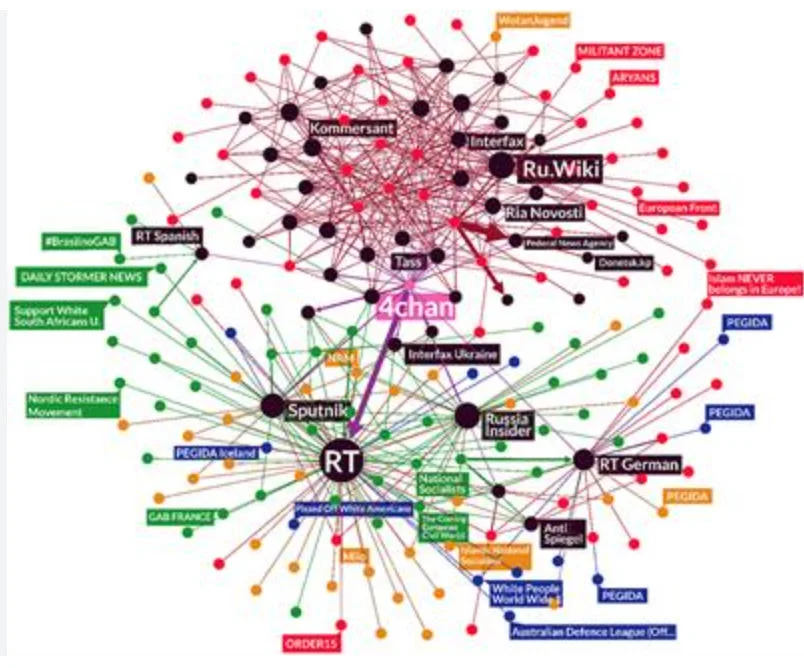
Russia’s Social Media Hate EcosystemIran-Russia grip on the Middle East. South European Council on Foreign Relations
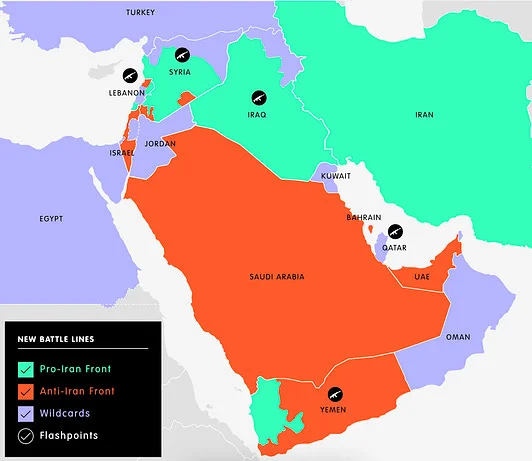
Iran-Russia grip on the Middle East. South European Council on Foreign Relations
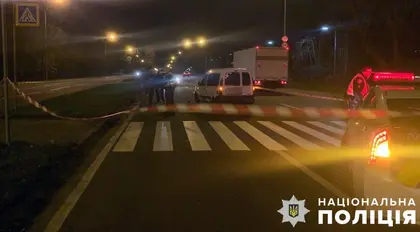
On Monday, November 6, in the evening, the driver of a Renault hit a Border Guard Service officer at a Kyiv checkpoint. The servicewoman was hospitalized.
If you examine the current geopolitical problems through the prism of a world war orchestrated by another ruthless leader, there is no room for appeasement, neutrality, avoidance, nor for dreams that negotiations, ceasefires, or peace talks will stop the mayhem. Only eradication of Russia’s network, in all its guises, will win the peace. Russia’s nation-state allies are Iran and North Korea, but Moscow has also financed and trained thousands of non-state actors that are embedded everywhere to cause trouble. Hamas and Hezbollah are well-known terrorist guerrilla armies on the payroll of Russia and Iran, but so is a roster of anti-West countries, political parties, terrorist sleeper cells, movements, and leaders. Finally, there is Russia’s huge conventional army as well as the Wagner Group mercenaries that have played an over-sized role in destabilizing Eastern Europe, the Middle East, Africa, and Venezuela. All must be defeated.
Instead, the world currently focuses on the killing fields of Israel and Ukraine, but should view them as tragedies that have happened because of the world’s strategic blindness to the existence of this insidious global war. The current Israeli situation, for instance, illustrates at least two mistakes: The failure by Israel and others to recognize and stop Putin’s behind-the-scenes maneuvres; and the reliance on conventional armed forces to provide security against elusive, hybrid warfare. The result was that on October 7 (Putin’s birthday) Hamas slaughtered 1,400 people despite Israel’s large military and Putin’s “friendship” with Benjamin Netanyahu. Then, in retaliation, Israel counter-attacked by conducting massive bombing raids and a ground invasion of Gaza to destroy Hamas as if it were a static nation-state and not a cunning mobile insurgency that had already “left town”.
By the time the tanks arrived, Hamas was gone or hiding behind Palestinian civilians as shields. Israel’s ferocious retaliation demolished half of Gaza, killed thousands of civilians, but eliminated only a few dozen terrorists. This outcome handed Russia and its global tentacles an opportunity to weaponize the air waves by amplifying the plight of Palestinian civilians at the hands of Israel. This has roiled world opinion and resulted in criticism of Israel even among its allies. Theoretically, if the world had realized what Putin was up to, an allied hybrid war capability might have detected and prevented the attack or, having failed to do so, could have conducted a surgical counterattack with fewer civilian casualties. But now the West and Israel have been undermined, American politicians divided, Arab and Muslim allies alienated, and the possibility of a two-state solution postponed indefinitely.
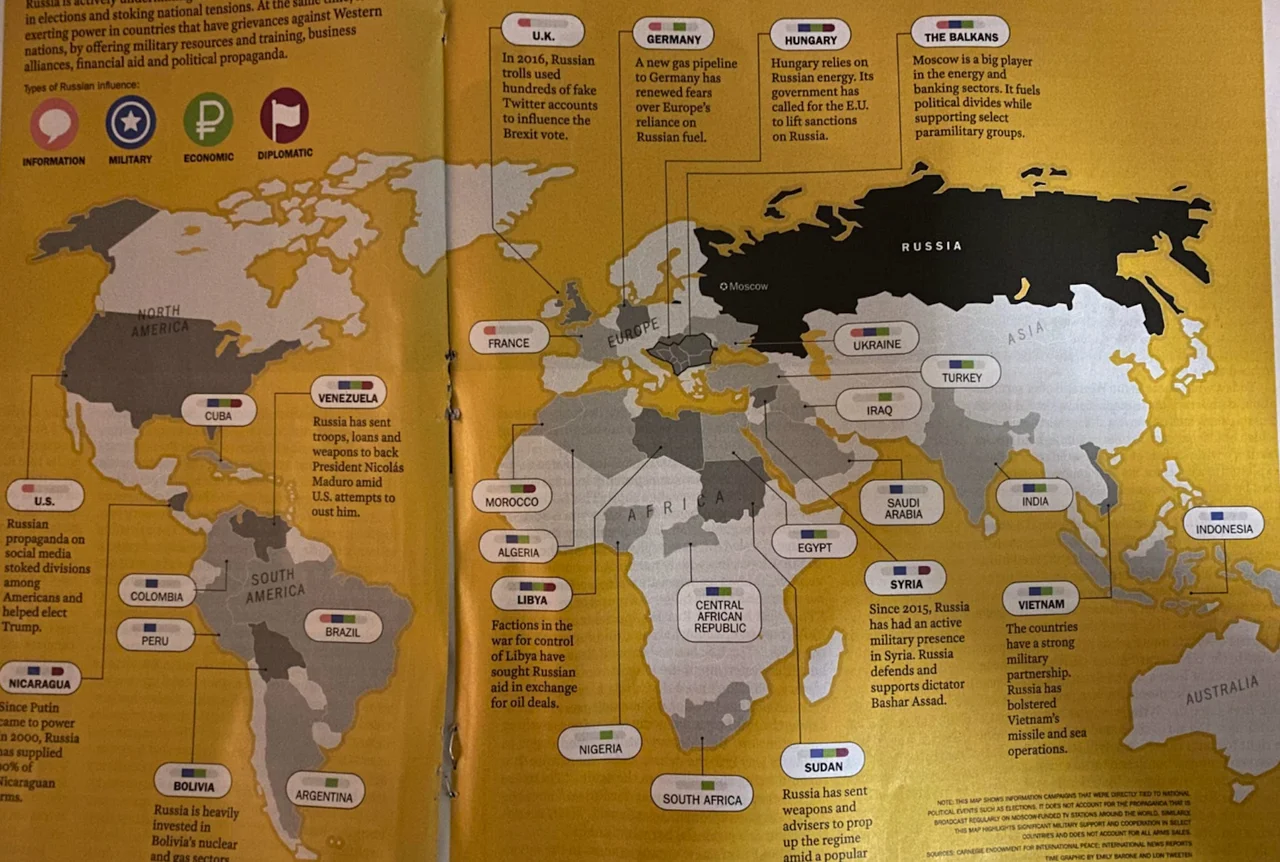
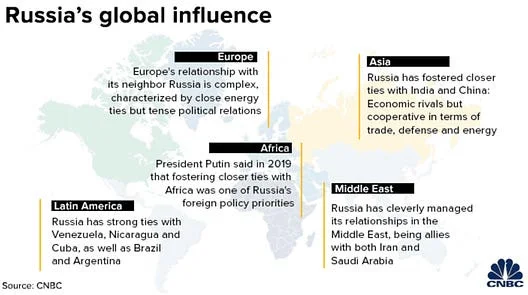
Russia’s Paths to Global Influence through Information, Military, Economic, Diplomatic channels. 2022.
Not surprisingly, Vladimir Putin granted a rare interview days later with Qatar-owned Al Jazeera where he expressed concern about the “catastrophic increase” in the number of civilians killed in Israel and the Gaza Strip. “The Russian leader also took aim at Washington’s policy in the Middle East which he said had failed by not taking the needs of Palestinians into account,” read the website.
The failure to take a global approach to Russia’s predations allows one ally to be pitted against another or to make a grave strategic error that damages all. Clearly, a unified alliance must create a hybrid war counter-offensive that can identify, track, anticipate, infiltrate, and destroy Russia, Iran and their malevolent non-state actors before they attack. The failure to muster a global force against Russia allows Putin to gain ground, geographically or politically, by dividing and conquering foes, isolating targets, and generating instability across the world.
Ukraine is another example of what happens when the civilized world fails to unite against Russia. In 2008, Putin invaded Georgia, then Ukraine in 2014 without much fuss by America, Europe, or others. The Obama regime opted to do a reset with Russia, a nonsensical strategy given the sociopathy of the Putin regime. That miscalculation, along with appeasements, led to the invasion of Ukraine on February 2022. But if the West had understood that Putin was salami-slicing the West on a quest to dominate Eastern Europe once more, other strategies would have been undertaken. For starters, Europe would have realized it could never become fully dependent on Russian oil and natural gas; NATO would have expanded into Scandinavia, Georgia, and Ukraine years ago, and the West would have invested billions in protecting the collective security, not forced to play catch up for the past 20 months.
Fresh from these two major triumphs, Russia will continue its “hybrid warfare” globally. It will fund any anti-American, anti-European Union, anti-Israel, or anti-NATO group, media, political party, and leader. Such efforts have already borne fruit. Putin’s tentacles have backed anti-European Union populists such as Marine LePen in France, Victor Orban in Hungary, Slovakian or Serbian politicians, Britain’s “Brexit” movement, white supremacists in America, and anti-Europe celebrities like Steve Bannon, Donald Trump, and Tucker Carlson in America — whether they know it or not.
Russia has also weaponized migration into Europe and America to destabilize both politically and socially. As many as 20 million refugees have landed in Europe following Russian military interventions in Syria and Ukraine. Neither jurisdiction has secured its borders or properly screened entrants. (Read my “Global Refugee Mess” published on October 2.) If one agrees with my assertion that World War III is already underway, it’s hardly a stretch to speculate that included, among the tens of thousands of Venezuelan and Central American men who enter the United States, are spies, criminals, drug mules, or terrorists. In addition, thousands more arrive from further afield, including Russia. And Europe is in worse shape because it lacks a continental navy and is inundated with refugee claimants, most recently arriving by boat from the Middle East, or countries in Africa where Russian influence is powerful.
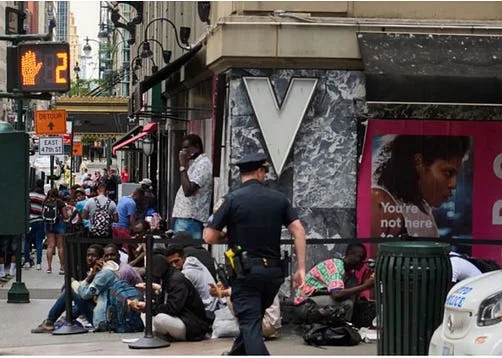
New York City, 140,000 unscreened migrants in weeks dumped into the city and sleeping on streets until housing is provided
China has stayed on the sidelines in this global war despite boasts by Putin about being “no limits friends”. Russia would love nothing better than to convince China to open a third theater in its world war by invading Taiwan. But this is a Kremlin distraction combined with wishful thinking. Since Ukraine’s invasion, China has distanced itself from Russia, and refused to provide military aid. Military conquest is not China’s style. Its foreign policy has been mercantilist, via its Belt and Road Initiative. Besides that, Beijing moves toward détente with the United States and Europe out of self-interest to shore up its exports and economy in future. And it too fears Russia, as it should. Russia, not China, initiated and backed the only post-war invasions in Asia — Korea and Vietnam. Both conflicts embroiled the United States for years as its alliance of conventional troops fought to stalemates against guerrilla armies.
Today Russia remains a global scourge and is winning its world war. This is why an alliance must stop and dismantle its deadly war machine.
The views expressed in this opinion article are the author’s and not necessarily those of Kyiv Post.
Reprinted from [email protected] – Diane Francis on America and the World
See the original here.