The Independent
 JOSSICA - jossica.com
RUSSIA’S INVASION of Ukraine in February 2022 provoked a global security crisis. The assault on democracy by a morally sick imperial power in the heart of Europe has tilted the balance of power in other parts of the world, including the Middle East and Asia-Pacific. The failure of multilateral bodies such as the UN and Organisation for Security and Cooperation in Europe to maintain order means that Ukraine can only restore its territorial integrity by military force.
Ukrainians have shown their willingness to lay down soul and body for their freedom. Ukraine not only halted an invasion by a far stronger enemy but liberated much of its territory. However, the war is now moving to a new stage: what we in the military call “positional” warfare of static and attritional fighting, as in the first world war, in contrast to the “manoeuvre” warfare of movement and speed. This will benefit Russia, allowing it to rebuild its military power, eventually threatening Ukraine’s armed forces and the state itself. What is the way out?
Basic weapons, such as missiles and shells, remain essential. But Ukraine’s armed forces need key military capabilities and technologies to break out of this kind of war. The most important one is air power. Control of the skies is essential to large-scale ground operations. At the start of the war we had 120 warplanes. Of these, only one-third were usable.
Russia’s air force has taken huge losses and we have destroyed over 550 of its air-defence systems, but it maintains a significant advantage over us and continues to build new attack squadrons. That advantage has made it harder for us to advance. Russia’s air-defence systems increasingly prevent our planes from flying. Our defences do the same to Russia. So Russian drones have taken over a large part of the role of manned aviation in terms of reconnaissance and air strikes.
Drones must be part of our answer, too. Ukraine needs to conduct massive strikes using decoy and attack drones to overload Russia’s air-defence systems. We need to hunt down Russian drones using our own hunter drones equipped with nets. We must use signal-emitting decoys to attract Russian glide bombs. And we need to blind Russian drones’ thermal cameras at night using stroboscopes.
This points to our second priority: electronic warfare (EW), such as jamming communication and navigation signals. EW is the key to victory in the drone war. Russia modernised its EW forces over the past decade, creating a new branch of its army and building 60 new types of equipment. It outdoes us in this area: 65% of our jamming platforms at the start of the war were produced in Soviet times.
We have already built many of our own electronic protection systems, which can prevent jamming. But we also need more access to electronic intelligence from our allies, including data from assets that collect signals intelligence, and expanded production lines for our anti-drone EW systems within Ukraine and abroad. We need to get better at conducting electronic warfare from our drones, across a wider range of the radio spectrum, while avoiding accidental suppression of our own drones.
The third task is counter-battery fire: defeating enemy artillery. In this war, as in most past wars, artillery, rocket and missile fire make up 60-80% of all the military tasks. When we first received Western guns last year, we were quite successful at locating and striking Russian artillery. But the effectiveness of weapons such as Excalibur, a GPS-guided American shell, has declined dramatically owing to improved Russian electronic warfare.
Meanwhile, Russia’s own counter-battery fire has improved. This is largely thanks to its use of Lancet loitering munitions, which work alongside reconnaissance drones, and its increasing production of precision-guided shells that can be aimed by ground spotters. Despite the dismissive view of some military analysts, we cannot belittle the effectiveness of Russian weapons and intelligence in this regard.
For now, we have managed to achieve parity with Russia through a smaller quantity of more accurate firepower. But this may not last. We need to build up our local GPS fields—using ground-based antennas rather than just satellites—to make our precision-guided shells more accurate in the face of Russian jamming. We need to make greater use of kamikaze drones to strike Russian artillery. And we need our partners to send us better artillery-reconnaissance equipment that can locate Russian guns.
The fourth task is mine-breaching technology. We had limited and outdated equipment for this at the start of the war. But even Western supplies, such as Norwegian mine-clearing tanks and rocket-powered mine-clearing devices, have proved insufficient given the scale of Russian minefields, which stretch back 20km in places. When we do breach minefields, Russia quickly replenishes them by firing new mines from a distance.
Technology is the answer. We need radar-like sensors that use invisible pulses of light to detect mines in the ground and smoke-projection systems to conceal the activities of our de-mining units. We can use jet engines from decommissioned aircraft, water cannons or cluster munitions to breach mine barriers without digging into the ground. New types of tunnel excavators, such as a robot which uses plasma torches to bore tunnels, can also help.
My fifth and final priority is to build up our reserves. Russia has failed to capitalise on its hefty manpower advantage because Vladimir Putin is worried that a general mobilisation might spark a political crisis, and because Russia cannot train and equip enough people. However, our capacity to train reserves on our own territory is also limited. We cannot easily spare soldiers who are deployed to the front. Moreover, Russia can strike training centres. And there are gaps in our legislation that allow citizens to evade their responsibilities.
We are trying to fix these problems. We are introducing a unified register of draftees, and we must expand the category of citizens who can be called up for training or mobilisation. We are also introducing a “combat internship”, which involves placing newly mobilised and trained personnel in experienced front-line units to prepare them.
Russia should not be underestimated. It has suffered heavy losses and expended a lot of ammunition. But it will have superiority in weapons, equipment, missiles and ammunition for a considerable time. Its defence industry is increasing its output, despite unprecedented sanctions. Our NATO partners are dramatically increasing their production capacity, too. But it takes at least a year to do this and, in some cases, such as aircraft and command-and-control systems, two years.
A positional war is a prolonged one that carries enormous risks to Ukraine’s armed forces and to its state. If Ukraine is to escape from that trap, we will need all these things: air superiority, much-improved electronic-warfare and counter-battery capabilities, new mine-breaching technology and the ability to mobilise and train more reserves. We also need to focus on modern command and control—so we can visualise the battlefield more effectively than Russia and make decisions more quickly—and on rationalising our logistics while disrupting Russia’s with longer-range missiles. New, innovative approaches can turn this war of position back into one of manoeuvre.■
General Valery Zaluzhny is commander-in-chief of Ukraine’s armed forces. He has held the position since July 2021.
Read a more detailed new essay by General Zaluzhny on this topic.
Is President Vladimir Putin a fascist, a neo-Nazi or is he simply misunderstood and bad-mouthed by the West? The West needs to answer these questions to successfully help Ukraine defend against Russia’s aggression. The Jews and the leadership of Israel, in particular, must not run away from these questions. They need to realize that “the great evil” does not always come for the Jews.
The world may not have learned the lessons from the Holocaust yet the Jews should have. If the moral clarity of who is right, who is wrong and what Putin stands for is not within reach to the nation that was almost completely wiped out by Hitler and the Nazi state less than 80 years ago, then the Jews lost their moral prerogative of the ultimate victims and have become accomplices themselves.
Putin started this war claiming the Nazis took over the government in Kyiv, the modern Ukrainian state is a Nazi state, the Ukrainians are not a nation and Ukraine is a province of Russia with its own dialect. It takes a special kind – the Russian kind – of ironic devilishness to claim the government where the president and many ministers have Jewish roots is Nazi. Nor can it be fascist by any acceptable definition of that political movement unless one adopts the one liked by the Kremlin, which declares anyone not agreeing with Russian designs is a fascist.
But does all of that really matter? The Jewish Diaspora and Israel seem to be very much into these academic discussions of who is a fascist and who is a Nazi. And the logic behind this interest is as simple as it is wrong and completely misguided.
It goes like the following. We are only up against absolute evil if the evil we are facing is Nazi-like. What is the Nazi-like evil? It is the one set to destroy all Jews. Why did the US, USSR and the rest of the allies fight Nazi Germany with all their might during the Second World War? They did because the Nazis were burning the Jews in the gas chambers of Auschwitz and Treblinka.
Yet there is a large historical problem with that narrative. The allies did not fight the Nazis to save the Jews. The war did not start to save the Jews. It started to defend Poland. The US and Soviet Union did not care much for the Jews, if at all. The Roosevelt administration refused to admit any refugees, sent many of the ones reaching its shores back and refused to bomb railway tracks leading to Auschwitz or talk at all about the ongoing Holocaust until the last days of the war. The reason was very simple: no pretext must be given to the German propaganda that the war was about Jews. And thus it was not. And if it went on for a little longer or had some other turns and twists in its early days no European Jew would see the dawn of the victory day.
ALMOST EVERYONE fighting the Nazis were fighting the unprovoked aggression, indiscriminate killings and mass murder. What escapes too many in the Jewish world is that the six years of World War II would not change at all had the Nazis decided to leave Jews alone. Not a single day of the conduct of the bloodiest war in human history would change. Thus, it is really irrelevant if Putin is friendly or hostile to Jews. In Ukraine, he is doing exactly what Hitler was doing in Poland, back in 1939.
Advertisement
Yet the question of Putin’s perceived or lack of antisemitism is at the center of the discussion as if it is the only hatred that makes the evil absolute. Only half a year into the war and already many useful idiots have traveled to Russia and come back to declare no evil to be found: the Jews live in peace. These people are like the intellectuals of the 1930s, who traveled to meet Stalin and found peace and tranquility in the socialist paradise.
They willingly serve the propaganda purposes of the most murderous European regime since the fall of the Soviet Union. For these people and many folks currently leading Israel, antisemitism is evil’s only litmus test. In their view, if the scourge of antisemitism is not found or found in tolerable amounts, the evil is not that dangerous.
The Kremlin is keeping the Jews attentive with his threats to close the local offices of the Jewish Agency but is leaving them alone, for now. That makes Putin a kosher tyrant in the eyes of many. Russia’s military presence provides another excuse to Israeli politicians to do nothing to help Ukraine. Yet even Turkey, finding itself in a position not too dissimilar, acts differently. Israel is afraid to even think of sending military aid to Ukraine, making Germany a champion of Ukraine’s resistance in comparison. What an irony.
Israel, sadly, is behaving in exactly the same way as the Jews of the exile did toward the evil rulers of the time. Zionism’s goal was to stop the Jews crawling on their knees in front of the Amaleks of this world. It takes more than a religious faith to separate the light from the darkness. It takes more than a state to shine light upon the rest of the world.
The writer lives and works in Silicon Valley, California. He is a founding member of San Francisco Voice for Israel.
Less than three weeks after Hamas’s brutal attack on Israel, leaders of the militant group showed up in Moscow for talks with Russian officials.
For many in the West, not least in Israel itself, the Hamas delegation’s visit was a pointed thumb in the eye of the relatives of the victims, most of them civilians, and of a reeling government. For close watchers of Russian policy, however, it wasn’t very surprising, a reflection of Moscow’s knotty approach to the messy snarl of Middle East politics.
And then there’s Russia’s own troubled history with anti-Semitism, which burst into the open on October 29 in the North Caucasus city of Makhachkala, where a violent mob tried to attack an airliner arriving from Tel Aviv, seeking out Jewish passengers.
Never great, the Kremlin’s relations with Israel now stand to get even more complicated in the wake of the October 7 attack and the unfolding Israeli ground war in Gaza, where the death toll among Palestinian civilians continues to rise.
It’s unlikely that the mob violence at the Makhachkala airport was state orchestrated, says Ian Lesser, executive director of the Brussels office of the German Marshall Fund and an expert on European and Middle Eastern security affairs. “That said, it’s clearly showed there’s a reservoir of deep ill-will and anti-Semitism in Russia, especially in those regions that are majority Muslim, though not just, and maybe right now Russia finds it convenient to allow a bit of that,” he said.
“Anti-Semitism was never gone in Russia,” said Anna Borshchevskaya, a senior fellow at the Washington Institute focusing on Russia’s policy toward the Middle East. “It always sort of periodically reared its ugly head. It’s been buried underneath the surface, but it’s not the first time Russia has seen an outburst of anti-Semitic activity, and not just in this region.”
Added to the wider context of roiling Middle East, what it means is that Russia’s ties with Israel are changing in what may be a dramatic fashion.
“Israel has a complicated relationship with Russia. That’s not a secret and it’s not new,” said Eylon Levy, a spokesman for the office of Israeli Prime Minister Benjamin Netanyahu.
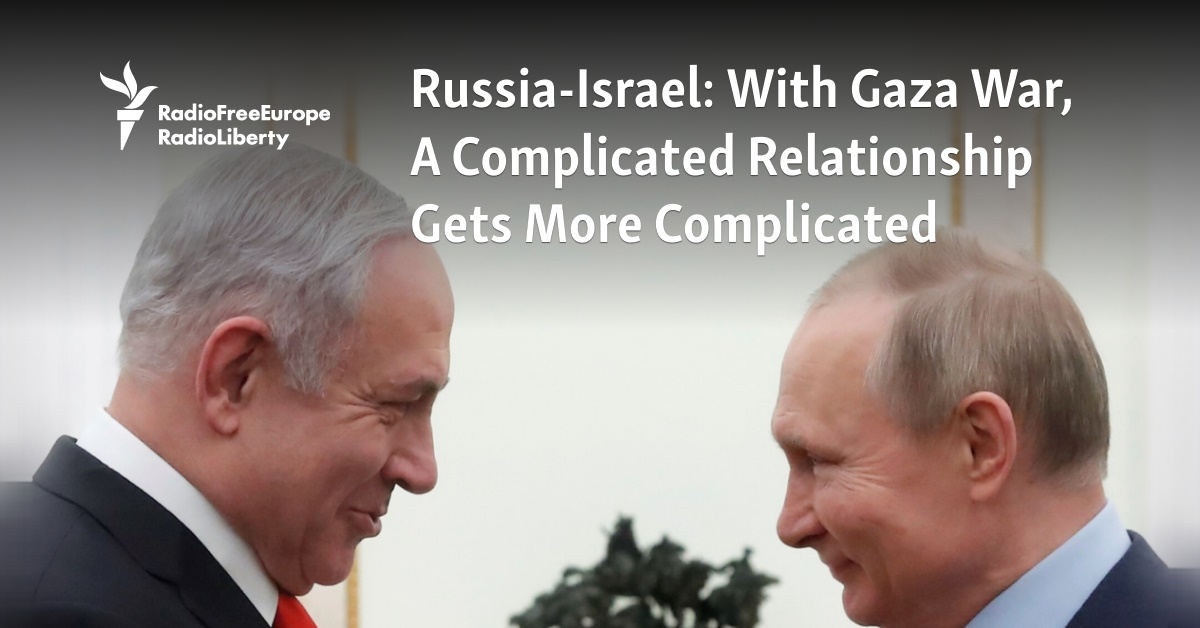
Netanyahu, Israel’s divisive and longest-serving prime minister, has cultivated closer ties with Vladimir Putin, Russia’s longest-serving president — and Putin has courted Israel in his efforts to increase Russia’s regional clout. In his 2022 memoir, Netanyahu praised Putin’s intellect, and thanked him for his policies in support of Jews.
But those relations have been vexed by Moscow’s growing economic and military ties with countries like Iran, which has vowed to destroy Israel, and Syria, which is known to harbor and facilitate groups that are hostile to Israel.
In Syria, Russia has a naval port and other military infrastructure that it has used not only to bolster Bashar al-Assad’s regime but also to maintain a naval presence in the Mediterranean and badger U.S. forces that are deployed in northeastern Syria, fighting alongside Kurdish militias.
Israel and Russia have managed to avoid conflict even as Israel’s air forces have routinely targeted Syrian sites, including Damascus’s airport, where weapons shipments and other supplies for the Iranian-backed Hizballah militia have been known to transit.
On October 30, Israeli warplanes bombed a Syrian base in the southern Daraa Province. And days earlier, Israeli jets struck an ammunition depot at another Syrian base, where Hizballah fighters and officers reported to be Iranian were working alongside Syrian troops.
“For many years, Israel had a mechanism of coordinating with the Russian military presence inside Syria as we attack targets inside that country, Iran trying to send advanced weapons to terrorists in the north. And it’s important not to get our wires crossed,” Levy said.
‘On The Israeli Side, I Think This Will Not Go Without Notice’
Moscow’s relationship with Tehran is even more problematic to Israel.
Russia has played a key role in helping Iran develop its nuclear capabilities, a lucrative source of revenue for the state-run atomic-energy corporation Rosatom. Both Moscow and Tehran say the efforts have been geared solely at peaceful uses of nuclear power — electricity generation — though that hasn’t allayed Israel’s fear, nor that of some in the United States.
The 2022 invasion of Ukraine, however, fundamentally changed the relationship, the European Council for Foreign Relations said in a report published in September. “The two countries have increased their efforts to jointly resist Western sanctions and political isolation. Iran also continues to expand its nuclear program at alarming levels, with no opposition from Moscow,” the report’s authors, Ellie Geranmayeh and Nicole Grajewski, wrote.
“Tehran’s military contribution to Russia’s war effort has made an enormous difference to Russia’s ability to persevere in a difficult conflict. Iran, once a secondary player, is now one of Russia’s most significant collaborators in the war in Ukraine,” they added.
Above all, Russia has leaned heavily on Iran to expand its drone capabilities, now deploying thousands of kamikaze or surveillance drones to target Ukrainian forces, something Ukraine’s top commander nodded to in an essay published last week in The Economist.
Unconfirmed Western intelligence reports that Hizballah could receive Russian antiaircraft systems add further fuel to the fire.
None of this has gone unnoticed in Israel.
“Over the last few years, we’ve been deeply concerned by what Iran has been supplying to Russia, for example, we have evidence that Iranian drones have been used to perpetrate atrocities on the innocent people of Ukraine, and that is a relationship that is clearly of very deep concern to us,” Levy told RFE/RL.
Still, Israel has been restrained in its criticism of Russia over the ongoing invasion of Ukraine, and has resisted sending weaponry or critical equipment to help Ukrainian forces.
To what extent the Daghestan airport incident reflects broader societal problems or negative attitudes toward Jews is unclear. But there has been an uptick in anti-Semitic rhetoric from Russian politicians in recent years, including some from Putin himself.
Russian authorities last year moved to shutter the Russian operations of the Jewish Agency, an official Israeli organization that helps Jews in Russia, and around the former Soviet Union, emigrate to the United States.
Some Israelis saw the shutdown as punishment for Israel’s stance on the Ukraine war and for criticism by then-Prime Minister Yair Lapid.
And Then There’s Hamas
The Palestinian militant group — designated a terrorist organization by the United States and European Union — has sent several delegations to Moscow over the years, including days after the October 7 attack on Israel as well as before that, in March.
The March meeting, as described in a Russian Foreign Ministry statement, touched on Russia’s “unchanged position in support of a just solution to the Palestinian problem.”
And Moscow has declined to designate Hamas a terrorist group.
For its part, Israel condemned Moscow for hosting the Hamas delegation and for a separate visit from an Iranian deputy foreign minister.
“The rapprochement with Hamas is consistent with a historical pattern,” Milan Czerny and Dan Storyev wrote in an analysis for the Carnegie Endowment for International Peace. “During the Cold War, Moscow armed and otherwise supported Palestinian militants, including those engaged in terrorism, continuing to do so even at the height of détente.”
Still, they said, Russia was unlikely to qualitatively increase its support for Hamas beyond mere rhetoric. “The reality is that, for Moscow, the crisis in the Middle East is an opportunity to pitch itself to the region and the wider Global South as a diplomatic partner,” they said.
After Hamas’s attack on Israel, Putin used his first public statement on the incident to lace into the United States, blaming Washington and asserting the attack was a “vivid example” of U.S. policy failures in the Middle East.
“I can only imagine that relations with Israel are going to worsen, because…as much as Russia may have had a certain ambiguity, ambivalence in its relationship with Israel in the past, and wish to preserve that relationship for many reasons…the highly symbolic nature of this event, plus this crisis in Gaza, I think it’s likely to be seen in Moscow as an opportunity to be exploited,” Lesser said.
“On the Israeli side, I think this will not go without notice,” he added.
“I think it has not been a cardinal break” in Russian-Israeli relations, Borshchevskaya told RFE/RL. “But there certainly has been a strain with far more intense criticism coming out of the Russian government than in the past, specifically against Israel’s military actions in Gaza, and also Israel’s air strikes in Syria.
“So what I think what we need to look for is: to what extent, how is Russia going to maintain a semblance of balance between relations with Israel and Hamas?” she said.
The wider question, experts say, is whether Russia will benefit from the turmoil in the Middle East, for example, by drawing attention away from the Kremlin’s No. 1 foreign policy priority now: the war in Ukraine.
“The present situation creates challenges for Russia. I agree that there are challenges for Russia as well, but the benefits are greater,” Borshchevskaya said. “I think Russia benefits precisely from chaos. And they are going to use the situation of chaos to further escalate with the United States and the West overall, whether directly or through proxies.”
“So, I tend to be of a view that the benefits outweigh the costs and risks” for Moscow, she said.
The turmoil is “an unmitigated positive from the point of view of Moscow,” Lesser said.
“There are very few negatives as far as Russia is concerned,” he said. “Now, obviously, if the conflict were to escalate into a broader war in the Middle East, perhaps involving Iran and the United States, that would begin to raise issues that may be problematic even for Russia.”

