
Day: October 25, 2023
WASHINGTON — The Pentagon plans to send Israel two Iron Dome missile defense systems as the country continues to fight the militant group Hamas, according to a U.S. Defense Department official.
The transfer will aid Israel’s air defense after Hamas on Oct. 7 launched a massive, coordinated attack — making it the deadliest day for Israel in 50 years. Some 1,400 Israelis have since been killed, and Hamas continues to fire rockets from the Gaza strip.
Is Israel’s Iron Dome missile defense system ironclad?
“As we’ve said previously, the U.S. will be flowing additional Iron Dome support to Israel,” the official said. “As a result, the Department of Defense is currently engaged in planning to support the provision of U.S. Iron Dome batteries to Israel.”
The U.S. Army bought the two Iron Dome systems — manufactured by Israeli defense company Rafael Advanced Defense Systems and co-developed by RTX — at the request of Congress several years ago. The purchase was meant to fill a gap in cruise missile defense while the Army developed a longer-term countermeasure for various air and missile threats. But the service doesn’t plan to purchase more Iron Domes or to integrate the system into its air defense architecture, Army officials have told Defense News.
It has scarcely used the two batteries it has. Army personnel trained with the Iron Dome systems at Fort Bliss, Texas, before one system deployed to Guam at the end of 2021 for a two-week exercise. Otherwise, the systems have sat with a unit at Joint Base Lewis-McChord in Washington state.
The official, speaking on background to discuss the transfer, did not specify under what arrangement the batteries will be provided, nor did the official say whether the batteries will be returned to the U.S. should they survive combat.
U.S. Defense Secretary Lloyd Austin recently announced the Defense Department is also deploying a Terminal High Altitude Area Defense battery and Patriot air defense battalions to the region.
By providing Iron Domes, the U.S. continues to widen the spigot of security aid entering Israel. In the week after Hamas’ attack, Pentagon and Israeli officials announced the arrival of American aircraft stocked with air defense supplies and munitions. It has since expanded this aid to include artillery rounds, armored vehicles and precision-guided munitions, according to Israeli and American officials.
The supply effort is just one stream in a larger outpouring of American support.
One carrier strike group — led by the U.S. Navy aircraft carrier Gerald R. Ford — has already deployed to the Eastern Mediterranean. Another is on its way to the Persian Gulf. Meanwhile, a Marine expeditionary unit and 2,000 troops are readying themselves to deploy within a day if given orders by the White House, said Pentagon spokeswoman Sabrina Singh.
Austin, Secretary of State Antony Blinken and President Joe Biden have all visited the country, pledging continued U.S. support. In a nighttime address from the Oval Office, the president asked Congress for more than $100 billion in supplemental security aid, including $14.3 billion for Israel. The aid so far has not come with conditions that Israel limit civilian casualties.
Still, U.S. officials in the last week have publicly called on its closest Middle Eastern ally to obey the laws of war. As Israel retaliates, some 5,000 people in Gaza have been killed so far, according to the Gaza Health Ministry, which is run by Hamas.
With more than 2,000 rockets intercepted, Iron Dome is among the most statistically successful air defense system in the world, said Tom Karako, director of the missile defense project at the Center for Strategic and International Studies think tank.
“This is a system that was built to defend [against] certain kinds of threats, especially the kinds of threats that Israel is facing,” Karako said.
Each battery consists of three main parts: a radar, a command-and-control system, and the launchers that fire interceptors. Each of these, Karako argued, will be useful for Israel, as extra radars will increase their ability to detect threats, while more launchers and command-and-control technology will help defend more Israeli territory from rocket fire.
Should the war widen beyond the Gaza strip, the Lebanese militant group Hezbollah has tens of thousands of rockets it could fire, said Karako.
This week, Israel’s military said its aircraft had struck two Hezbollah cells, which the country said were preparing to launch rockets across the border.
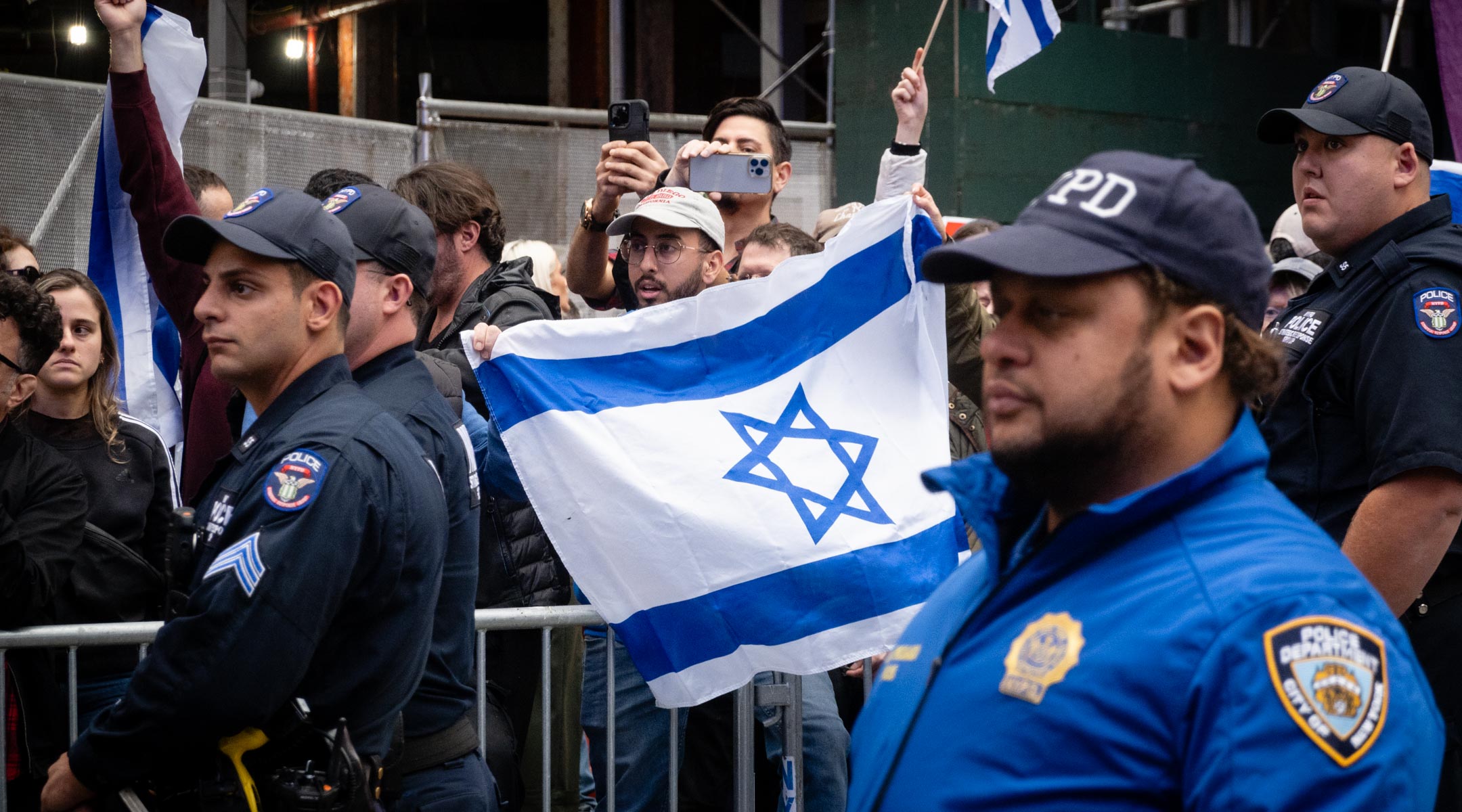
(New York Jewish Week) – The day Hamas attacked Israel, two young men shoved a Jewish boy to the ground in Brooklyn. In Rockland County, an assailant fired a BB gun at two women on their way to synagogue. The following day, three Jewish men were shot with a BB gun in Brooklyn.
Those attacks came amid what, according to the NYPD and a regional Jewish security agency, is a spike in antisemitic incidents since Hamas’ Oct. 7 invasion of Israel and Israel’s ensuing war against the terror group in Gaza. It parallels what the Anti-Defamation League says is a nationwide spike in antisemitism in the same period.
On Monday, NYPD data provided to the New York Jewish Week indicated there were 33 antisemitic hate crimes in the first three weeks of October, already surpassing the monthly average of 18 so far this year. Jewish security groups say many antisemitic incidents go unreported.
“The world is different from what it was on Oct. 6,” Mitch Silber, director of the Community Security Initiative, which coordinates security for Jewish institutions in the New York City area, told the New York Jewish Week. “Everyone should be concerned.”
Silber’s group tallied 23 antisemitic incidents in the greater New York area from Oct. 7 to 19. The total in that 12-day period is around double the rate compared to the same time last year, when the Community Security Initiative tallied 20 incidents throughout the entire month of October.
The incidents range from subway graffiti saying “kill the Jews” in Manhattan to violence and harassment. The group has tallied at least nine instances of reported assault. The Community Security Initiative receives reports from individuals, checks into news reports of attacks with law enforcement, and learns about some incidents from the ADL.
In some of the other attacks, an Israeli student was hit with a stick at Columbia University, an assailant shoved an identifiably Jewish woman in Manhattan while shouting, “This pig has got to go,” and a man punched a woman in a Manhattan subway station, saying it was because she was Jewish. A banner at the Stephen Wise Free Synagogue was vandalized with the words, “F—in k—s” and the 2nd Avenue Deli was defaced with a swastika. The targets include all manner of Jews and Israelis, Silber said.
Other incidents related directly to the war in Israel and Gaza, such as vandals scrawling “Globalize the intifada” on a pole in Brooklyn, or Jewish groups receiving threats related to Israel’s conduct. The attacks reported by the Community Security Initiative come alongside a spike in antisemitic rhetoric online and particularly on platforms favored by extremists, according to the ADL.
There have been 196 total antisemitic incidents reported to police since the start of the 2023, the NYPD said. Jews have been, by far, the most frequent target of hate crimes in the city this year.
This year’s total represents a slight decrease from the same period in 2022, following a surge in antisemitism in 2021 related to the Israel-Hamas conflict that year. But there have been fewer serious physical attacks during this conflict than there were during the 2021 fighting, Silber said. He credited the police with stringent enforcement during and after protests, which were a locus of violence in 2021.
Some pro-Palestinian activists who attacked Jews that year have also been sentenced to prison for hate crimes, which may have dissuaded other assailants. Court proceedings surrounding one of the most prominent 2021 attacks, the assault of Joey Borgen, are wrapping up this month, and may be fresh in the minds of would-be attackers, Silber said.
The Community Security Initiative has received hundreds of requests from schools, synagogues and other Jewish institutions for additional security, stretching the resources of security groups and police.
Richard Priem, the deputy national director of the Community Security Service, which trains volunteers to patrol synagogues, said his group has noticed an uptick in suspicious activity around synagogues, although the motive of that activity is not always clear. In the week after Oct. 7, the group received 40 reports of suspicious or antisemitic activity in the U.S., mostly in the New York region, more than double the normal rate.
He urged vigilance but said Jews should continue community activities.
“It could be that they’re planning something, it could be a coincidence,” he said. “It could be antisemitic.”
This article originally appeared on JTA.org.
The post Antisemitic incidents have spiked in New York since Hamas attack on Israel, NYPD says appeared first on The Forward.