
Categories
Selected Articles

Ukraine seeks to win over Israel as an ally against Russia


6ONBEY2AZBAO7I3B2M6IVHSZ6U.jpg

There are few Jewish leaders in the world outside of Israel. One of them is Volodymyr Zelenskiy, the president of Ukraine. He is not a practicing Jew and in an interview in 2019, shortly before being elected to office, he stated: “The fact that I am a Jew is about the 20th question among my characteristics.” But Zelenskiy has pointed to his “Jewish blood” as an example of Ukrainian diversity. Despite this, Ukraine’s relationship with the Israeli government has gone from bad to worse, marked by the ambivalence of Israeli Prime Minister Benjamin Netanyahu in the face of the Russian invasion. Kyiv believes that the Hamas terrorist attacks in Israel can reverse the situation and help it gain a powerful ally.

Zelenskiy has shared his unconditional support for Israel, and its military response in Gaza, which he considers legitimate defense. In an appearance on October 11 at NATO headquarters, the Ukrainian president said that Western democracies should support the Israeli military response in Gaza and not advocate negotiated solutions. “Sometimes we are thinking how to prevail or how to stop the war, how to manage something, dialogue with Iran or Russia. We have to think opposite,” Zelenskiy said. “We have to not give the possibility for aggressors even to think about the third world war, the new wave of aggression, the new big tragedy.”

On October 19, in his last public speech on the conflict in the Middle East, Zelenskiy opted for more nuance. His words came a few hours after a telephone call with U.S. President Joe Biden: “Ukrainians and Americans sympathize with all the victims of these tragic events. Ukraine is ready to work together with America and all partners to stabilize the situation and save as many lives as possible.”

Oleksiy Melnyk, co-director of the Razumkov Center, a Ukrainian research institution in international and security policy, told EL PAÍS by phone that it was still early to talk about Zelenskiy’s strategy, especially since the position of Israel’s Western allies may change given the high number of civilian victims in Gaza. “What is certain,” Melnik points out, “is that there is a willingness to take advantage of the situation to turn around bilateral relations that until October 7 [when Hamas carried out its terrorist attacks] were tense and full of misunderstandings.”

Multiple issues have caused tension, but the main one is Israel’s conciliatory approach to Russia. While Israel condemned the invasion of Ukraine, it has refused to support Western sanctions against Russia and has not provided Kyiv with any weapons. There are two compelling reasons that justify the position of the Netanyahu government. Firstly, 30% of Israelis are of Russian origin, according to the Statistics Office of Israel. And secondly, Moscow has maintained control over Syrian airspace since its intervention in support of the dictator Bashar al-Assad in the civil war that has divided the country. Russia’s military dominance in most of Syria has allowed Israel to bomb Syrian military positions or those of groups affiliated with Iran. And this despite the fact that Iran, which in turn supports Syria, is one of Russia’s main international backers.

The misunderstandings between the Ukrainian and Israeli governments have been constant. Israeli Foreign Minister Eli Cohen visited Kyiv in February 2023 and caused controversy after he expressly refused, when asked, to name Russian troops as perpetrators of war crimes in the north of the Ukrainian capital. Israeli and U.S. media reported this past week that Zelenskiy requested to visit Israel to show solidarity with Netanyahu, but the Israeli government rejected the offer, claiming that “now is not the time.”

Diplomatic conflicts have occurred in other areas. Ukraine has protested the deportations of Ukrainian refugees in Israel, who are not granted special visas. Kyiv even threatened to ban the thousands of Jewish pilgrims who annually visit the tombs of Hasidic masters, such as Rabbi Nachman of Breslov, from entering the country. The fact that the anti-Semitic far-right of World War II are remembered in Ukraine as national heroes is also a recurring source of Israeli protests. In fact, among the stalls of the busiest tourist spots in Kyiv, it is easy to find nationalist badges with fascist and even Nazi paraphernalia.

Russia, the common enemy

Kyiv is focusing its effort with Israel on underlining that Russia, as well as Iran, is behind Hamas. Iran has provided Moscow with components for its arms industry, in particular the Shahed drones, which Russia uses daily to target military objectives and Ukrainian cities. Kyrylo Budanov, the head of the Ukrainian Defense Ministry’s intelligence services, told Pravda newspaper on October 12 that he had evidence that Moscow had sent Hamas weapons captured in Ukraine.

Mykhailo Podolyak, Zelenskiy’s advisor, has accused Russia of being a “sponsor of global terrorism.” And Oleksiy Danilov, secretary of Ukraine’s National Security Council, stated in an article published in Pravda on October 9 that Russia leads “a global axis of evil.” “Russia, due to its inherent darkness and savagery, has become the benchmark for countries committed to authoritarian revenge, which is why it must suffer an exemplary punishment and must be defeated in a way that deters others who want to challenge democracy,” he wrote.

Russia has been noted for its harsh criticism of the Israeli bombings in Gaza. It has also accused Israel of “violating international law” with the October 12 bombings against the Syrian airports in Damascus and Aleppo. “This shows that all of Netanyahu’s attempts to reach an understanding with Russia have been useless,” says Melnik.

There is one more reason for Ukraine to support a quick resolution of the conflict in Gaza: the fear that a prolonged escalation will force the United States to allocate weapons to Israel that could have been sent to Ukraine to combat the Russian invasion. Biden has brought to Congress an unprecedented budget to arm Ukraine and Israel, but the U.S. arms industry is working at top speed, and is still not able to cover all the projectiles needed on the Ukrainian war front. If the White House decides to prioritize support for Israel, Ukraine will lose ground and with it, its chances of recovering territory from Russia before winter.

Sign up for our weekly newsletter to get more English-language news coverage from EL PAÍS USA Edition


Categories
Selected Articles

Volodymyr Zelenskyy seeks to shore up Ukraine support amid Israel-Hamas war


https%3A%2F%2Fwww.ft.com%2F__origami%2Fs

Stay informed with free updates

Simply sign up to the War in Ukraine myFT Digest — delivered directly to your inbox.

Volodymyr Zelenskyy urged Ukraine’s backers to keep lethal assistance flowing “without any pauses” as US Congressional dysfunction threatens future assistance and allies are preoccupied by Hamas’s assault on Israel.

“We are now in a special situation on the front line . . . where it is important to put pressure, and without any pauses,” the Ukrainian president said on Wednesday, adding that Russia must not be able to “rest, recover”.

Zelenskyy said he would use his visit to Nato’s headquarters to press for air defence, artillery and ammunition, which he described as critical to bringing about “a just end” to the war. His administration told the Financial Times that they expected to leave Brussels with new pledges of military support from their Nato allies.

Zelenskyy compared Hamas’s assault on Israel this weekend to Russia’s invasion of Ukraine, and said his people stood with Israel because they knew what it meant to suffer terror attacks. The Ukrainian president said it was important for Israel to know it was not alone.

“Go to Israel on the ground and support people there,” he said in a plea to other world leaders, as he stood next to Nato secretary-general Jens Stoltenberg.

Following Hamas’s surprise attack over the weekend, US president Joe Biden and his national security team have held marathon meetings on the crisis and have rushed ammunition and air defence to Israel.

The Biden administration has said that both Israel and Ukraine remain top priorities.

The US on Wednesday announced a new package of $200mn in new lethal assistance, including AIM-9M missiles for air defence, ammunition for Himars, 155mm and 105mm artillery rounds and other weaponry.

The UK also pledged more than £100mn in lethal aid, including systems to help Ukrainian armed forces clear minefields, maintain its vehicles and shore up defensive fortifications. Germany on Tuesday announced a $1.1bn winter package, including air defence systems such as an additional Patriot and an additional IRIS-T system and Gepard anti-aircraft gun tank.

The US has about $5bn left in funds to send new weapons to Ukraine after Congress has yet to appropriate more money for Kyiv. But officials point to another figure, $1.6bn in funds to replenish its stockpiles, as limiting the US from sending more than a few months’ worth of additional weapons and material.

The Biden administration has tried to reassure Ukraine and other allies that it remains committed to Kyiv after Republicans last month stripped financing for Ukraine from a bill to fund the US government, in an indication of Ukraine’s decreasing popularity among Republican voters.

Still, US officials point to generally widespread support among Republican and Democratic members of Congress for Ukraine as a sign that the aid will eventually be approved. Congressional Republicans are set to begin voting on Wednesday to elect a new Speaker of the House, but the process could drag on.

Recommended

Zelenskyy had said earlier on Telegram that continued support “will be critical to our resilience this winter”, when Ukraine expects a surge of Russian missile and drone attacks on energy infrastructure in an attempt to plunge the war-torn nation into darkness as it did last year.

Zelenskyy’s visit comes at a critical time in its counteroffensive. He acknowledged on Wednesday that the fighting is “difficult”.

Since he left Ukraine on Tuesday, Russian forces have stepped up attacks in the eastern Donetsk region, marking their first offensive actions in months. Launched in May with the goal of clawing back lost territory, Ukraine’s counteroffensive has so far struggled to gain momentum.

As Zelenskyy spoke in Brussels, Russian forces pushed ahead with an assault on the eastern industrial city of Avdiivka.

Oleksandr Shtupun, a military spokesperson for Ukraine’s southern front, said Russian forces were fighting with “all their might to show some kind of success and are trying to surround Avdiivka”.

The industrial city is home to Ukraine’s largest coking plant, which videos posted on social media and verified by the Financial Times showed was targeted by artillery attacks and air strikes on Tuesday. Some videos showed plumes of smoke rising from the battered city, while those posted by Ukrainian drone operators revealed a convoy of Russian armoured vehicles and infantry troops moving towards the frontline.

Of Avdiivka’s prewar population of 30,000, authorities say only a little more than 1,000 residents remain in the city, much of which has been reduced to rubble by relentless shelling.

Ukraine’s General Staff said that “up to three battalions” of Russian soldiers were involved in the offensive around Avdiivka.

“They are not succeeding, but they will try to gain some operational space,” Shtupun said of the Russian assault. “At the moment they are suffering losses, our soldiers are standing firm and defending Avdiivka and the neighbouring settlements.”

Russia also continued its air strikes on Ukraine’s Danube ports, used to export grains and by the country’s military for its seaborne operations, the General Staff said.


Categories
Selected Articles

Israel tries to balance backing for Ukrainians and not offending Russia


A week ago the sight was unthinkable: a memorial at the site of one of the worst massacres of the Holocaust, engulfed in smoke and flame from an airstrike.

Yet on Tuesday a Russian attack near the Babyn Yar memorial complex in the Ukrainian capital, Kyiv, achieved exactly that. Five people died in the strike targeting the television broadcast tower next door, while firefighters battled to extinguish a fire caused by the explosion in a building inside the Jewish cemetery.

Events in Ukraine since Vladimir Putin announced his invasion six days ago are grim echoes of the atrocities committed on European soil in the 20th century: desperate people squeezing on to trains out of cities; refugees lining up on the border; families separated as able-bodied men stay behind to fight.

But government officials in Israel – a country that rose from the ashes of the second world war – have not directly condemned Moscow for the attack on Babyn Yar, and criticism of the invasion itself has been muted.

Such is the balancing act Israel finds itself performing as war once again rages on the edge of Europe. On one hand it must stand with its western allies, support Ukraine’s Jewish president, Volodymyr Zelenskiy, and help the country’s Jewish population to escape new horrors. But on the other, Israel is loth to antagonise Russia, on which it relies to facilitate its military operations next door in Syria. Action of any kind could also stir up antisemitism against Ukraine and Russia’s large Jewish communities.

Yad Vashem, Israel’s Holocaust museum, has even found itself in the peculiar position of writing to the US ambassador to ask the US not to impose sanctions on the Israeli-Russian billionaire Roman Abramovich, who is a major donor to Jewish institutions – and a longtime supporter of Putin.

The former prime minister Ehud Olmert has suggested Israel’s position on Ukraine is implicitly compromised by its occupation of the Palestinian territories. And the country’s belated decision to vote in favour of a UN condemnation of Russia’s actions and to hold off on sanctions was met with disappointment from its US allies, coming “too little, too late,” according to a senior Israeli official who spoke to the Israeli daily Yedioth Ahronoth.

“Countries that have far more to lose have taken a clear stance. Only Israel, which is always good at reminding others about how they failed to stand by the Jewish people during dark times, has done everything not to do anything,” the source said.

Yedioth Ahronoth also reported that in a phone call with Zelenskiy on Friday, the current prime minister, Naftali Bennett, denied Kyiv’s request that Israel supply arms, adhering to a longstanding Israeli policy designed to avoid provoking Russia.

In the same call, Zelenskiy reportedly also asked Israel to mediate in the crisis – an appeal that appears to have borne more fruit, since Bennett made an offer to do so in a conversation with Putin two days later.

On Wednesday Putin and Bennett spoke by telephone in a call initiated by Israel’s government, the Kremlin said.

But even as Israelis with Ukrainian heritage sign up to defend Kyiv, for Israel’s security establishment, Europe’s new war is still a remote concern compared with dealing with the hostile forces on its own borders. Containing Iranian activity remains the country’s number one priority.

Russian intervention in Syria’s civil war in 2015 turned the tide of the conflict in Bashar al-Assad’s favour. Moscow is now the major power in Syria’s skies, dropping bombs on Syrian civilians in areas still outside the regime’s control, and allowing the Israeli air force to operate against Hezbollah and other Iranian-backed groups active in the conflict.

Michael Herzog, Israel’s ambassador to the US, said in a tweet on Wednesday: “While our moral position [on Ukraine] is clear, we are striving to pursue it in a way that will maintain our freedom of operations against Iran in the region, which is in everybody’s interest.”

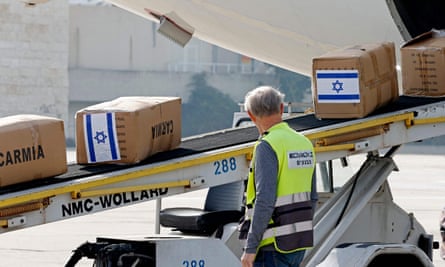
Aid for Ukraine is loaded on to an aircraft at Israel’s Ben Gurion airportAid for Ukraine is loaded on to an aircraft at Israel’s Ben Gurion airport. Photograph: Jack Guez/AFP/Getty Images

In the meantime, the first Israeli shipment of humanitarian aid has arrived on the Polish-Ukrainian border, which includes 17 tons of medical equipment and medicine as well as winter tents and sleeping bags for 3,000 people. About 200,000 Ukranians with Jewish ancestry are eligible for Israeli citizenship, and Tel Aviv is expecting an influx of between 10,000 and 15,000 people in the coming weeks.

Shmuel Shpack, the Ukraine director for the Jewish Agency, which brings Jewish immigrants to Israel, said: “I never imagined I would end up doing what I am doing today. I’ve seen things I never thought I would see in my life, it’s like world war II, people sitting in lines for two days.”

He has barely slept in the last week, fielding 200 phone calls a day from refugees at his new makeshift operations centre on the frontier with Poland. “Like everyone else, until the last moment we weren’t sure something was going to happen,” he said. “But now we have seen we have to prepare for full-scale war.”


Categories
Selected Articles

Ukraine seeks to win over Israel as an ally against Russia


6ONBEY2AZBAO7I3B2M6IVHSZ6U.jpg

There are few Jewish leaders in the world outside of Israel. One of them is Volodymyr Zelenskiy, the president of Ukraine. He is not a practicing Jew and in an interview in 2019, shortly before being elected to office, he stated: “The fact that I am a Jew is about the 20th question among my characteristics.” But Zelenskiy has pointed to his “Jewish blood” as an example of Ukrainian diversity. Despite this, Ukraine’s relationship with the Israeli government has gone from bad to worse, marked by the ambivalence of Israeli Prime Minister Benjamin Netanyahu in the face of the Russian invasion. Kyiv believes that the Hamas terrorist attacks in Israel can reverse the situation and help it gain a powerful ally.

Zelenskiy has shared his unconditional support for Israel, and its military response in Gaza, which he considers legitimate defense. In an appearance on October 11 at NATO headquarters, the Ukrainian president said that Western democracies should support the Israeli military response in Gaza and not advocate negotiated solutions. “Sometimes we are thinking how to prevail or how to stop the war, how to manage something, dialogue with Iran or Russia. We have to think opposite,” Zelenskiy said. “We have to not give the possibility for aggressors even to think about the third world war, the new wave of aggression, the new big tragedy.”

On October 19, in his last public speech on the conflict in the Middle East, Zelenskiy opted for more nuance. His words came a few hours after a telephone call with U.S. President Joe Biden: “Ukrainians and Americans sympathize with all the victims of these tragic events. Ukraine is ready to work together with America and all partners to stabilize the situation and save as many lives as possible.”

Oleksiy Melnyk, co-director of the Razumkov Center, a Ukrainian research institution in international and security policy, told EL PAÍS by phone that it was still early to talk about Zelenskiy’s strategy, especially since the position of Israel’s Western allies may change given the high number of civilian victims in Gaza. “What is certain,” Melnik points out, “is that there is a willingness to take advantage of the situation to turn around bilateral relations that until October 7 [when Hamas carried out its terrorist attacks] were tense and full of misunderstandings.”

Multiple issues have caused tension, but the main one is Israel’s conciliatory approach to Russia. While Israel condemned the invasion of Ukraine, it has refused to support Western sanctions against Russia and has not provided Kyiv with any weapons. There are two compelling reasons that justify the position of the Netanyahu government. Firstly, 30% of Israelis are of Russian origin, according to the Statistics Office of Israel. And secondly, Moscow has maintained control over Syrian airspace since its intervention in support of the dictator Bashar al-Assad in the civil war that has divided the country. Russia’s military dominance in most of Syria has allowed Israel to bomb Syrian military positions or those of groups affiliated with Iran. And this despite the fact that Iran, which in turn supports Syria, is one of Russia’s main international backers.

The misunderstandings between the Ukrainian and Israeli governments have been constant. Israeli Foreign Minister Eli Cohen visited Kyiv in February 2023 and caused controversy after he expressly refused, when asked, to name Russian troops as perpetrators of war crimes in the north of the Ukrainian capital. Israeli and U.S. media reported this past week that Zelenskiy requested to visit Israel to show solidarity with Netanyahu, but the Israeli government rejected the offer, claiming that “now is not the time.”

Diplomatic conflicts have occurred in other areas. Ukraine has protested the deportations of Ukrainian refugees in Israel, who are not granted special visas. Kyiv even threatened to ban the thousands of Jewish pilgrims who annually visit the tombs of Hasidic masters, such as Rabbi Nachman of Breslov, from entering the country. The fact that the anti-Semitic far-right of World War II are remembered in Ukraine as national heroes is also a recurring source of Israeli protests. In fact, among the stalls of the busiest tourist spots in Kyiv, it is easy to find nationalist badges with fascist and even Nazi paraphernalia.

Russia, the common enemy

Kyiv is focusing its effort with Israel on underlining that Russia, as well as Iran, is behind Hamas. Iran has provided Moscow with components for its arms industry, in particular the Shahed drones, which Russia uses daily to target military objectives and Ukrainian cities. Kyrylo Budanov, the head of the Ukrainian Defense Ministry’s intelligence services, told Pravda newspaper on October 12 that he had evidence that Moscow had sent Hamas weapons captured in Ukraine.

Mykhailo Podolyak, Zelenskiy’s advisor, has accused Russia of being a “sponsor of global terrorism.” And Oleksiy Danilov, secretary of Ukraine’s National Security Council, stated in an article published in Pravda on October 9 that Russia leads “a global axis of evil.” “Russia, due to its inherent darkness and savagery, has become the benchmark for countries committed to authoritarian revenge, which is why it must suffer an exemplary punishment and must be defeated in a way that deters others who want to challenge democracy,” he wrote.

Russia has been noted for its harsh criticism of the Israeli bombings in Gaza. It has also accused Israel of “violating international law” with the October 12 bombings against the Syrian airports in Damascus and Aleppo. “This shows that all of Netanyahu’s attempts to reach an understanding with Russia have been useless,” says Melnik.

There is one more reason for Ukraine to support a quick resolution of the conflict in Gaza: the fear that a prolonged escalation will force the United States to allocate weapons to Israel that could have been sent to Ukraine to combat the Russian invasion. Biden has brought to Congress an unprecedented budget to arm Ukraine and Israel, but the U.S. arms industry is working at top speed, and is still not able to cover all the projectiles needed on the Ukrainian war front. If the White House decides to prioritize support for Israel, Ukraine will lose ground and with it, its chances of recovering territory from Russia before winter.

Sign up for our weekly newsletter to get more English-language news coverage from EL PAÍS USA Edition


Categories
Selected Articles

Scholz Battered in German State Votes as Far-Right AfD Advances – Bloomberg


Scholz Battered in German State Votes as Far-Right AfD Advances  Bloomberg

Categories
Selected Articles

Mosca “ha speso 167 miliardi di dollari per la guerra” – Ticinonews


Mosca “ha speso 167 miliardi di dollari per la guerra”  Ticinonews

Categories
Selected Articles

Israeli army tank ‘accidentally’ hits Egypt border post – The New Arab


Israeli army tank ‘accidentally’ hits Egypt border post  The New Arab

Categories
Selected Articles

Egypt Agrees to Reopen Rafah Border-Crossing, Raghubar Das … – ABP Live


Egypt Agrees to Reopen Rafah Border-Crossing, Raghubar Das …  ABP Live

Categories
Selected Articles

Five Israelis indicted for supporting terror, bringing total to 17


534687


Categories
Selected Articles

Saudi analyst: Hamas will not free Palestine with its paragliders’


Abdulrahman al-Rashed writes that it is hard to understand why Hamas would launch an attack that would spell the end of the organization.