Categories
Selected Articles

Ethnic Armenians expected to flee Nagorno-Karabakh after Azeri victory


Tens of thousands of ethnic Armenians are likely to flee Nagorno-Karabakh, and Armenia says it is prepared to take them in after Azerbaijan’s military victory last week in a conflict dating to the fall of the Soviet Union.

About 120,000 civilians in the region in the South Caucasus will leave for Armenia because they do not want to live in part of Azerbaijan and fear “the danger of ethnic cleansing”, Prime Minister Nikol Pashinyan said on Sunday.

list of 4 itemslist 1 of 4list 2 of 4list 3 of 4list 4 of 4end of list

“The likelihood is increasing that the Armenians of Nagorno-Karabakh will see expulsion from their homeland as the only way out,” he said.

Armenia “will lovingly welcome our brothers and sisters from Nagorno-Karabakh”, Pashinyan added, according to Russia’s TASS news agency.

Armenia said more than 200 people were killed and 400 wounded in Azerbaijan’s military operation last week. The fate of the ethnic Armenian population, which make up the majority of Nagorno-Karabakh’s population, has raised concerns in Moscow, Washington and Brussels.

Separatist fighters from Nagorno-Karabakh – a territory internationally recognised as part of Azerbaijan but previously governed by the breakaway Republic of Artsakh – were forced to declare a ceasefire on Wednesday after a decisive 24-hour military operation by the much larger Azerbaijani military.

Azerbaijani President Ilham Aliyev declared victory over the enclave on Thursday, saying it was fully under Baku’s control and the idea of an independent Nagorno-Karabakh was finally confined to history.

He promised to guarantee the rights and security of Armenians living in the region, but years of hate speech and violence between the rivals have left deep scars. Azerbaijan, which is mainly Muslim, has said the Armenians, who are Christian, can leave if they want.

Nagorno-KarabakhVehicles seized from Nagorno-Karabakh forces are displayed at a position held by Azerbaijan’s military [Emmanuel Dunand/AFP]

‘Disgrace and a shame’

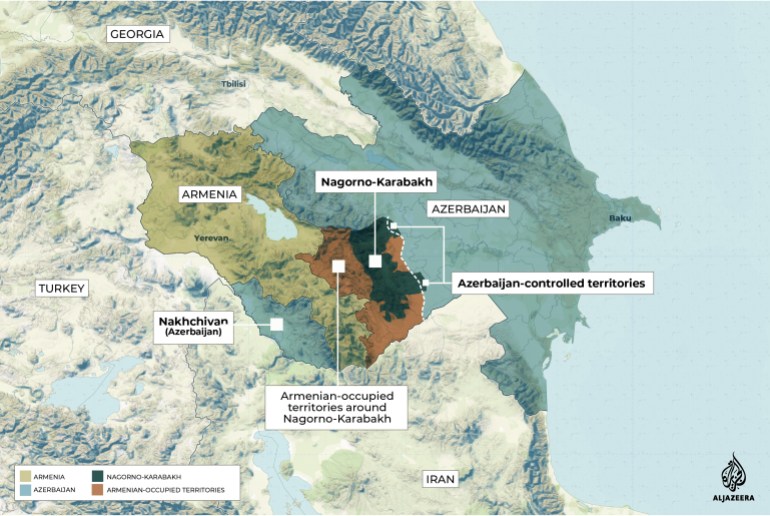
Nagorno-Karabakh, known as Artsakh by Armenians, lies in an area that, over the centuries, has come under the sway of Persians, Turks, Russians, Ottomans and the Soviets. It was claimed by both Azerbaijan and Armenia after the fall of the Russian Empire in 1917.

Azerbaijan has said it will guarantee rights and integrate the region, but the Armenians have said they fear repression.

“Our people do not want to live as part of Azerbaijan – 99.9 percent prefer to leave our historic lands,” said David Babayan, an adviser to the Karabakh leadership. “The fate of our poor people will go down in history as a disgrace and a shame for the Armenian people.”

Hikmet Hajiyev, foreign policy adviser to Azerbaijan’s president, told Al Jazeera that civilians in the region have been asked for a “direct dialogue” about their future, “including political integration [and] socioeconomic issues”.Nagorno-Karabakh - INTERACTIVE: Armenia-Azerbaijan control map ***USE THIS***
‘Very much in danger’

Sheila Paylan, an international human rights lawyer, said she does not believe ethnic Armenians will be treated fairly under Azerbaijani rule.

“There is a longstanding policy of hatred towards the Armenians that goes back decades. That just doesn’t stop overnight. There’s no reasonable basis to trust there will be any safety or security or rights protected for the Armenians of Karabakh. … They are very much in danger right now,” Paylan told Al Jazeera.  

Armenia has called for the immediate deployment of a UN mission to monitor human rights and security in Nagorno-Karabakh.

Armenian authorities said about 150 tonnes of humanitarian aid from Russia and another 65 tonnes of flour shipped by the International Committee of the Red Cross (ICRC) had arrived in the region.

“Given the scale of humanitarian needs, we are increasing our presence there with specialised personnel in health, forensics, protection, and weapons contamination,” the ICRC said in a statement.

Source: Al Jazeera and news agencies

Categories
Selected Articles

Pashinyan: Responsibility for Karabakh Armenians’ fate will fall entirely on Azerbaijan and Russian peacekeepers


default.jpg

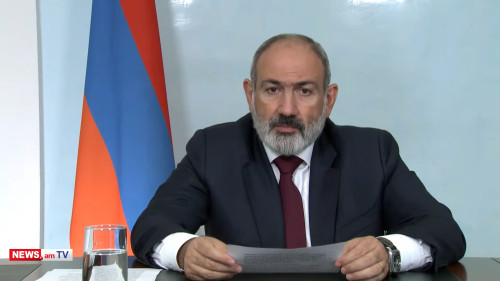
If no real living conditions are created for Armenians in Nagorno-Karabakh to live in their homes and if no effective mechanisms of their protection from ethnic cleansing are created, there will be an extremely high possibility that the they will see removal from their homeland as the only way to save their lives and identity, Armenia’s Prime Minister Nikol Pashinyan has said in a live address.  

He said that a series of events that took place in recent years have forced all of us to assess, re-evaluate the situation, and draw conclusions.

“What happened in Armenia?” What is happening and what should happen? These are the questions whose answers are strategic for the future. The latest attacks undertaken by Azerbaijan against the Republic of Armenia lead to an obvious conclusion that the external security systems in which we are involved are not effective from the point of view of the state interests and security of the Republic of Armenia. This was became clear both during the 44-day war, during the events of May and November 2021, and in September 2022, and the list can be continued.

The capture of Khtsaberd and Old Tagher villages of Nagorno-Karabakh in December 2020 and the capture of more than 60 Armenian servicemen, the events of Parukh, the numerous expressions of intimidation of the Armenian population of Nagorno-Karabakh, the illegal blocking of the Lachin corridor, the Azerbaijani attack on Nagorno-Karabakh on September 19 raise serious issues also about the goals and motives of the activities of the Russian peacekeeping troops in Nagorno-Karabakh. Contrary to the tripartite statement of November 9, 2020, the Armenians of Nagorno-Karabakh are still facing the threat of ethnic cleansing,” he said.

According to Nikol Pashinyan, in recent days humanitarian goods delivered to Nagorno-Karabakh, but this does not change the situation. “If no real living conditions are created for Armenians in Nagorno-Karabakh to live in their homes and if no effective mechanisms of their protection from ethnic cleansing are created, there will be an extremely high possibility that the they will see removal from their homeland as the only way to save their lives and identity,” he added.

“The responsibility for such a development of events will fall entirely on Azerbaijan, which has adopted the policy of ethnic cleansing, and the Russian peacekeeping force in Nagorno-Karabakh. Of course, the RA government is working with international partners on the formation of international mechanisms to ensure the rights and security of Nagorno-Karabakh Armenians, but if these efforts do not yield concrete results, the government will welcome our brothers and sisters of Nagorno-Karabakh to the Republic of Armenia with all care. With this, however, the above-mentioned issues will not only not be addressed, but will also be exacerbated.

The Republic of Armenia has never abandoned its obligations to its allies and has never betrayed its allies, but the analysis of events shows that the security systems and allies on which we have relied for many years have had a goal of demonstrating our vulnerabilities and justifying impossibility that the Armenian people can have an independent state,” he added.

!

This text available in   Հայերեն and Русский

Print


Categories
Selected Articles

PM Pashinyan’s spokesperson: All decisions about September 20 ceasefire were made by Nagorno-Karabakh


default.jpg

All decisions about the September 20 ceasefire were made by Nagorno-Karabakh. Prime Minister Nikol Pashinyan’s spokesperson Nazeli Baghdasaryan wrote on her Facebook page.

“We inform you again that all decisions about the September 20 ceasefire were made by Nagorno Karabakh.

The Republic of Armenia was not involved in decision-making. RA was generally aware that a process was taking place, but did not have specific information about the nuances.

The Republic of Armenia had no information about the mechanisms of discussion of documents, the format of decision-making. Nagorno-Karabakh has discussed and coordinated the issues with and/or through the Russian Federation peacekeeping force,” he wrote.

Earlier, Davit Ishkhanyan, Chairman of Artsakh National Assembly, announced that Nikol Pashinyan was familiar with the text of the statement of the Security Council of the Republic of Artsakh.

!

This text available in   Հայերեն

Print


Categories
Selected Articles

Armenia Signals Rift With Russia As Wounded Arrive From Karabakh


Furious relatives of ethnic Armenians trapped in Nagorno-Karabakh gathered at the Azerbaijan border to await a medical evacuation convoy on Sunday, as their country signalled a rift with traditional ally Russia.

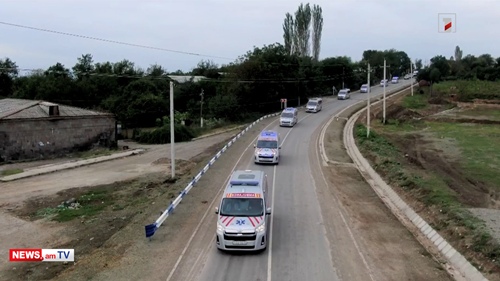
The Armenian health ministry said 23 ambulances carrying a first batch of “seriously and very seriously wounded citizens of Nagorno-Karabakh” were on their way to the border, accompanied by medics and Red Cross workers.

As the human drama unfolded, the sudden Azerbaijani victory in the three-decade old conflict also triggered a geopolitical shift, with Armenia’s Prime Minister Nikol Pashinyan taking a swipe at long-standing ally Russia.

In nationally televised comments, the Armenian leader — himself a target of protests over Karabakh’s defeat — said the Russian-led Collective Security Treaty Organisation (CSTO) and Moscow-Yerevan military-political cooperation were “insufficient” security guarantees.

Like a rival to NATO, the CSTO group pledges to protect other members that come under attack. But, bogged down in its own war in Ukraine, Russia refused to come to Armenia’s assistance in the latest Nagorno-Karabakh conflict, arguing that Yerevan itself recognised the disputed region as part of Azerbaijan.

Now, Russian peacekeepers are helping Azerbaijan disarm the Karabakh rebels.

Pashinyan added that Armenia should ratify the treaty which established the International Criminal Court (ICC), which has issued an arrest warrant for Russian President Vladimir Putin over the Ukraine war.

Meanwhile, tension was running high at Armenia’s Kornidzor border crossing, five kilometres from the Hakari bridge on the convoy’s route, where dozens of angry relatives had gathered to await news and one man was so frustrated he pulled out a knife.

Wild rumours spread through the agitated crowd and concern for missing relatives was mixed with fury over the lightning Azerbaijani offensive that this week seems to have defeated Karabakh’s separatist rebellion after decades of fighting.

“My son was in the army in Artsakh. He’s alive, but I’m worried for him,” said 43-year-old Alik Blbuyan, using the name Karabakh’s ethnic Armenian population gave their breakaway statelet.

“I came here to get news but I’m also hoping armed groups will cross the border. If they do, I’ll go with them to rescue my son.”

Vardan Kirakosyan comes from Machkalshen village in Nagorno-Karabakh, but was working in Russia when Azerbaijani forces imposed a blockade on the enclave nine months ago. Now the 22-year-old is on the border desperate for news about his family.

Emmanuel Dunand

If ethnic Armenian civilians are killed by Azerbaijani forces, he threatened, they he would take revenge by murdering any “Turk” he encounters outside the country. “They’ll call me a terrorist, but I don’t give a damn,” he declared.

On the other side of the border in the Azerbaijani town of Beylagan, just outside the breakaway region, local civilians had no sympathy for their Armenian neighbours and were celebrating their government’s victory over the rebels.

State television played patriotic music paying tribute to the nation and its army, and the roadside was lined with flags and portraits of dozens of local “martyrs”, fallen in the fighting during the previous 30 years.

Famil Zalov’s 18-year-old brother was among those killed, and he’s in no mood to forgive.

“I support the operation. Our beautiful land got liberated. I’m proud my brother was avenged,” the farmer, now in his early fifties, told AFP.

Asked whether he could imagine living alongside ethnic Armenians in peace now, he said he could not: “The president has shown them the way. The corridor is open. They can use it and go away.”

While some argue that Armenians have no future in Azerbaijan, others like Minaya Valiyeva, a smallholder in her seventies, go further and argue they have no past either.

“If you take a shovel and dig in the mountains you will find belongings; the wool jacket of our grandfather. You will find our grandmother’s combs. You’ll not find anything that belongings to Armenians or Russians,” she said.

ALAIN JOCARD

The bad blood between the communities will only fuel international concern that Azerbaijan’s sudden victory could trigger another round of persecution in a conflict that has seen abuses on both sides.

In a call on Saturday, US Secretary of State Antony Blinken told Armenian Prime Minister Pashinyan that Washington had “deep concern” for ethnic Armenians there, a spokesman said.

But, speaking for Baku, Foreign Minister Jeyhun Bayramov told the General Assembly: “Azerbaijan is determined to reintegrate ethnic Armenian residents of the Karabakh region of Azerbaijan as equal citizens.”

Baku will also secure further diplomatic backing from key ally Turkey, whose leader Recep Tayyip Erdogan will visit Azerbaijan’s Nakhchivan exclave on Monday.

As the first Red Cross aid convoy crossed into the disputed enclave since Azerbaijan launched last week’s offensive, government forces there said rebel “demilitarisation” had begun.

Ethnic Armenian separatist fighters began surrendering weapons under a Russian-mediated agreement on Friday, said Moscow.

On Saturday, the Azerbaijan forces showed off part of the captured rebel arsenal: sniper rifles, Kalashnikov rifles, rocket-propelled grenades and four tanks painted with cross insignia.

In a sign the violence may not be over, Azerbaijan’s defence ministry on Saturday accused Karabakh Armenians of setting fire to their homes in one village to keep them from Baku’s advancing troops.

Some villagers also set fire to their homes before fleeing after Azerbaijan first began to re-establish control over parts of Nagorno-Karabakh in a six-week war in 2020.


Categories
Selected Articles

23 seriously injured citizens transported to Armenia


default.jpg

Twenty-three citizens who were seriously wounded because of the recent military operations by Azerbaijan in Nagorno-Karabakh were transported from the Republican Medical Center of Stepanakert to Armenia’s specialized medical institutions On September 24, the Ministry of Health of the Republic of Armenia reported.

The transportation of the wounded was carried out through the mediation of the International Committee of the Red Cross, in ambulances provided by the RA Ministry of Health, with the support of the relevant medical personnel.

The wounded people will soon be transported to Armenia’s medical facilities.

!

This text available in   Հայերեն

Print


Categories
Selected Articles

US Senator: International presence in Karabakh is necessary so world knows what is happening


Newsfeed

US Senator: International presence in Karabakh is necessary so world knows what is happening

The copyright for information published on this web site is owned exclusively by Armenian News-NEWS.am information-analytical agency. All information materials published on this website are intended solely for personal use. For full or partial reproduction of any material in other media it is required to acquire written permission from Armenian News-NEWS.am information-analytical agency. Those, who have committed copyright violations, will be prosecuted accordingly.


Categories
Selected Articles

Armenia PM signals foreign policy shift away from Russia


YEREVAN: Armenian Prime Minister Nikol Pashinyan

on Sunday took a veiled swipe at long-standing ally Russia, calling his country’s current foreign security systems “ineffective”.

Pashinyan’s nationally televised comments signalled a major foreign policy shift away from Moscow, where criticism of Armenia

has also grown.

“The systems of external security in which Armenia is involved are ineffective when it comes to the protection of our security and Armenia’s national interests,” Pashinyan

said days after Azerbaijan’s resounding victory in the disputed Nagorno-Karabakh region.

Armenia is a member of the Collective Security Treaty Organisation (CSTO), a Russian-dominated group comprised of six post-Soviet states.

Like Nato

, the group pledges to protect other members that come under attack.

But bogged down in its own war in Ukraine, Russia refused to come to Armenia’s assistance in the latest Nagorno-Karabakh conflict, arguing that Yerevan itself recognised the disputed region as part of Azerbaijan.

“It has become evident to all of us that the CSTO instruments and the instruments of the Armenian-Russian military-political cooperation are insufficient for protecting external security of Armenia,” he said.

“We must transform and supplement the instruments of Armenia’s external and domestic security, in cooperation with all the partners who are ready for mutually beneficial steps,” Pashinyan said.

He added that Armenia should ratify the so-called Rome Statute, a treaty which established the International Criminal Court, of which Russia is not a part.

The International Criminal Court (ICC) has issued an arrest warrant for Russian President Vladimir Putin

over his Ukraine policies.

“The decision is not directed against CSTO and the Russian Federation,” Pashinyan said of his desire to join the ICC.

“It comes from the interests of the country’s external security, and taking such a decision is our sovereign right.”


Categories
Selected Articles

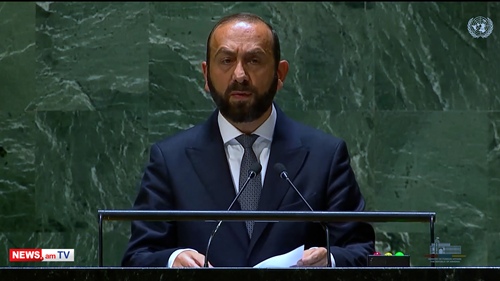
Ararat Mirzoyan։ Interdepartmental UN mission should be immediately deployed in Nagorno Karabakh


default.jpg

Newsfeed

Ararat Mirzoyan։ Interdepartmental UN mission should be immediately deployed in Nagorno Karabakh

The copyright for information published on this web site is owned exclusively by Armenian News-NEWS.am information-analytical agency. All information materials published on this website are intended solely for personal use. For full or partial reproduction of any material in other media it is required to acquire written permission from Armenian News-NEWS.am information-analytical agency. Those, who have committed copyright violations, will be prosecuted accordingly.


Categories
Selected Articles

Pashinyan: Responsibility for Karabakh Armenians’ fate will fall entirely on Azerbaijan and Russian peacekeepers


default.jpg

If no real living conditions are created for Armenians in Nagorno-Karabakh to live in their homes and if no effective mechanisms of their protection from ethnic cleansing are created, there will be an extremely high possibility that the they will see removal from their homeland as the only way to save their lives and identity, Armenia’s Prime Minister Nikol Pashinyan has said in a live address.  

He said that a series of events that took place in recent years have forced all of us to assess, re-evaluate the situation, and draw conclusions.

“What happened in Armenia?” What is happening and what should happen? These are the questions whose answers are strategic for the future. The latest attacks undertaken by Azerbaijan against the Republic of Armenia lead to an obvious conclusion that the external security systems in which we are involved are not effective from the point of view of the state interests and security of the Republic of Armenia. This was became clear both during the 44-day war, during the events of May and November 2021, and in September 2022, and the list can be continued.

The capture of Khtsaberd and Old Tagher villages of Nagorno-Karabakh in December 2020 and the capture of more than 60 Armenian servicemen, the events of Parukh, the numerous expressions of intimidation of the Armenian population of Nagorno-Karabakh, the illegal blocking of the Lachin corridor, the Azerbaijani attack on Nagorno-Karabakh on September 19 raise serious issues also about the goals and motives of the activities of the Russian peacekeeping troops in Nagorno-Karabakh. Contrary to the tripartite statement of November 9, 2020, the Armenians of Nagorno-Karabakh are still facing the threat of ethnic cleansing,” he said.

According to Nikol Pashinyan, in recent days humanitarian goods delivered to Nagorno-Karabakh, but this does not change the situation. “If no real living conditions are created for Armenians in Nagorno-Karabakh to live in their homes and if no effective mechanisms of their protection from ethnic cleansing are created, there will be an extremely high possibility that the they will see removal from their homeland as the only way to save their lives and identity,” he added.

“The responsibility for such a development of events will fall entirely on Azerbaijan, which has adopted the policy of ethnic cleansing, and the Russian peacekeeping force in Nagorno-Karabakh. Of course, the RA government is working with international partners on the formation of international mechanisms to ensure the rights and security of Nagorno-Karabakh Armenians, but if these efforts do not yield concrete results, the government will welcome our brothers and sisters of Nagorno-Karabakh to the Republic of Armenia with all care. With this, however, the above-mentioned issues will not only not be addressed, but will also be exacerbated.

The Republic of Armenia has never abandoned its obligations to its allies and has never betrayed its allies, but the analysis of events shows that the security systems and allies on which we have relied for many years have had a goal of demonstrating our vulnerabilities and justifying impossibility that the Armenian people can have an independent state,” he added.

!

This text available in   Հայերեն and Русский

Print


Categories
Selected Articles

PM Pashinyan’s spokesperson: All decisions about September 20 ceasefire were made by Nagorno-Karabakh


default.jpg

All decisions about the September 20 ceasefire were made by Nagorno-Karabakh. Prime Minister Nikol Pashinyan’s spokesperson Nazeli Baghdasaryan wrote on her Facebook page.

“We inform you again that all decisions about the September 20 ceasefire were made by Nagorno Karabakh.

The Republic of Armenia was not involved in decision-making. RA was generally aware that a process was taking place, but did not have specific information about the nuances.

The Republic of Armenia had no information about the mechanisms of discussion of documents, the format of decision-making. Nagorno-Karabakh has discussed and coordinated the issues with and/or through the Russian Federation peacekeeping force,” he wrote.

Earlier, Davit Ishkhanyan, Chairman of Artsakh National Assembly, announced that Nikol Pashinyan was familiar with the text of the statement of the Security Council of the Republic of Artsakh.

!

This text available in   Հայերեն

Print