Categories
Selected Articles

Azerbaijan thwarts attack against Israeli embassy in Baku – report


518086

An Afghani citizen planning a terrorist attack on the Israeli Embassy in Baku was arrested by Azerbaijani authorities recently, Azerbaijani media reported on Monday.

Azerbaijan’s State Security Service announced on Monday that it had arrested Fawzan Mosa Khan, an Afghani citizen, on suspicion of conspiring with additional individuals to conduct a terrorist attack on the embassy of a third country in Baku.

A video released by the State Security Service showed Khan discussing how he would monitor the target of the attack, as well as footage of Khan monitoring the location.

Khan was planning to use explosives and other weapons in an attack on the embassy, according to the State Security Service.

The State Security Service did not specify which country’s embassy was being targeted, although the Azerbaijani Turan news outlet noted that the video released by the State Security Service indicated that the suspect was conducting surveillance around the Hyatt Regency hotel complex, where the Israeli Embassy is located.

President Isaac Herzog and Azeri counterpart Ilham Aliyev in Baku, on May 29, 2023 (credit: HAIM ZACH/GPO)

Regional tensions surrounding Israel and Azerbaijan’s close ties

Azerbaijan and Israel have close ties, including arms sales by Israel to Azerbaijan. Earlier this year, Azerbaijan opened an embassy in Tel Aviv.

The ties between the two countries have drawn the ire of Iran in recent years, with Azerbaijan claiming repeatedly over the past year that it has caught Iran-backed cells planning attacks in the country, including cells planning coups to establish a state under Sharia law in Azerbaijan.

The announcement by the State Security Service on Monday did not link the arrested Afghani citizen to the recent tensions with Iran.


Categories
Selected Articles

Violations of religious freedom in Azerbaijan


Persecution of believers in Azerbaijan

How Azerbaijan ended up on a special watch list due to “serious violations” of religious freedom. JAMNews presents material prepared by Meydan TV.

“I don’t want to be a citizen of Azerbaijan. Because they do not consider me as a citizen, they trample on my rights, slander, and bully me. They call us spies, traitors to the motherland. Do you see what they are accusing us of?” Rena Aliyeva, a believing Muslim woman, says.

Since the beginning of 2023, believers in Azerbaijan have been subjected to mass arrests. This is happening against the background of the aggravation of the Azerbaijani-Iranian relations. They escalated after an armed attack on the Azerbaijani embassy in Iran, when the head of the security service of the embassy was killed and two of his subordinates were injured.

According to relatives of those arrested, they were all slandered and falsely accused of drug trafficking and spying for Iran.

Rena Aliyeva’s husband, Ruslan Aliyev, is a Shia Muslim. In April of this year, he was arrested on charges of drug trafficking, and subsequently the media presented him as an Iranian spy.

Rena Aliyeva claims that her husband was forced to confess to espionage, and he was arrested only because of his religious beliefs:

“They are pursuing such a policy. If the Ministry of Internal Affairs exposes these people as spies, then what does it have to do with drugs, because of which they were allegedly arrested? A spy has to have a passport, a lot of different IDs, a spy has to know a bunch of languages, he has to have an education. And my husband is a simple, uneducated person. They say that he is a traitor to the motherland, but what did he do that was so treacherous? He doesn’t have any position, he doesn’t work in the authorities, where does he get at least some information to pass it on to someone?”

“I decided, and the court does not order me”

On May 16, law enforcement agencies issued a joint statement saying that Rufulla Akhundzadeh and his son Almursal Akhundzadeh, who collaborated with the Iranian special services, developed a secret plan of action to organize an armed rebellion and assassinate officials in order to create a religious state of “Kerima” in the country.

According to the statement, part of this plan was the creation of secret groups on WhatsApp and Telegram. Ruslan Aliyev was detained as a member of one of these groups called “Qisas 313” (“Revenge 313”).

Rena Aliyeva says that her husband is a piano repairman and he joined that group solely to express his protest against the mass arrests of believers. He does not personally know Rufulla Akhundzade or his son Almursal.

“There has not yet been a trial, and the Ministry of Internal Affairs is already declaring him a spy. It turns out that the ministry makes it clear that we do not reckon with the people. Then let the court do not suit. How can such a mistake be made? And they allow it because they do not consider us. Thus, the ministry seems to be telling us: “Well, suppose you catch me in a mistake, and what will you do to me? I am the Ministry of Internal Affairs, I decided, and the court does not order me.”

According to estimates by independent human rights activists, more than 500 believers are currently under arrest, 34 of whom are members of the Muslim Unity Movement (DME) created in Azerbaijan in 2015, including the leader of the movement Taleh Bagirzade and his deputy Abbas Huseynov.

Aga-Ali Yahyaev, a board member of the DME, links the recent arrests to the aggravation of Azerbaijani-Iranian relations, and considers this to be targeted pressure on Muslims who profess Shiism.

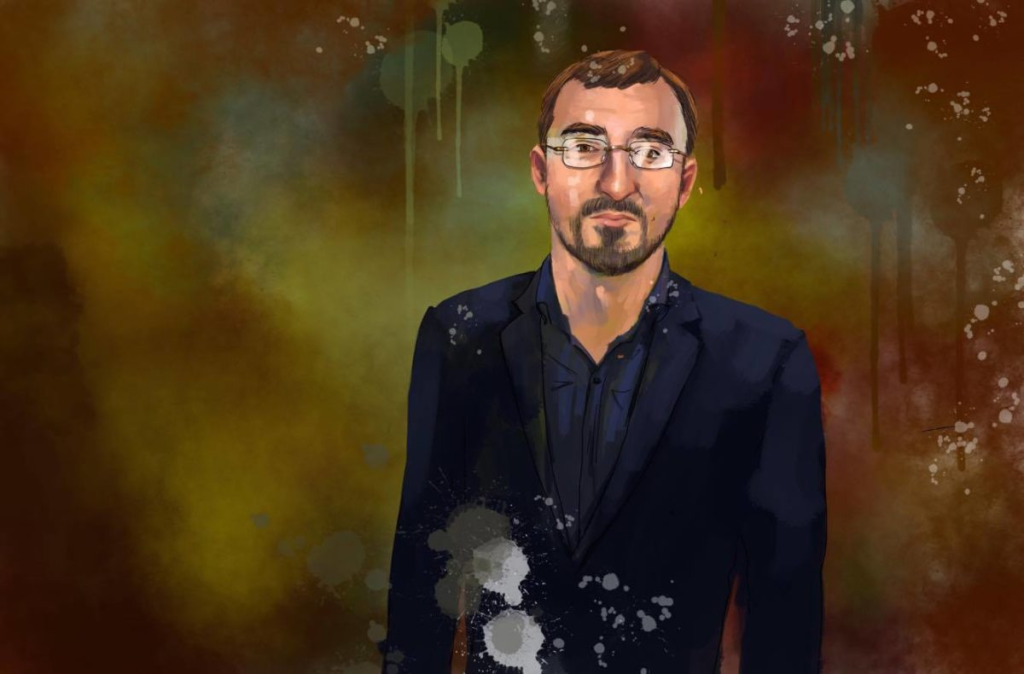
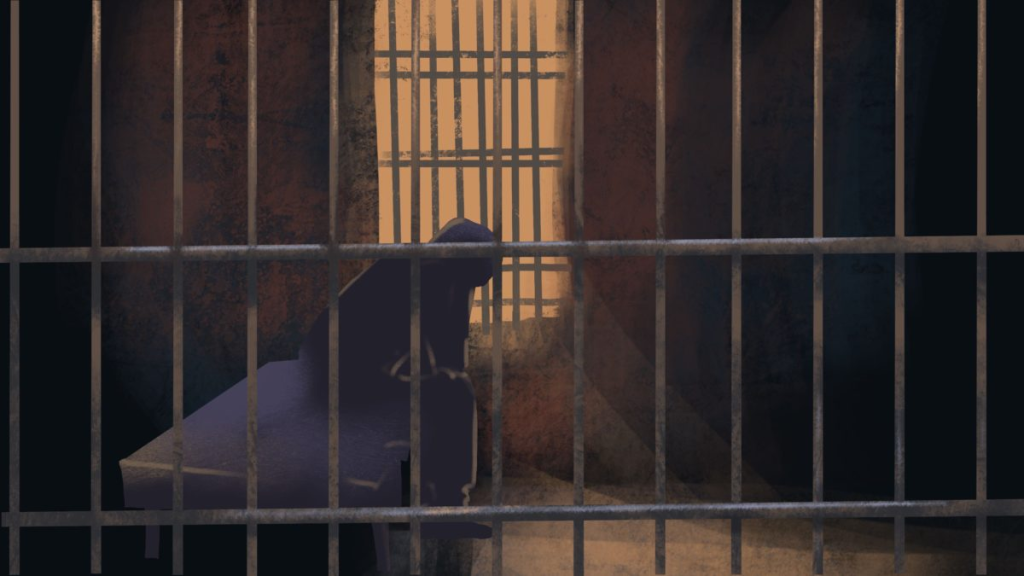
Meydan TV illustration

“We will fight in the legal plane, and at the moment, basically, we are trying to attract the attention of international organizations. Hundreds of believers are accused from scratch, for years we ourselves and our families have experienced all the bitterness and severity of these accusations,” says Yahyaev.

“He was threatened with rape with a club, a bottle”

Arrested last December on charges of drug trafficking, Mirtofig Huseynov is also a member of the Muslim Unity movement. According to his father Mirjalal Huseynov, before his arrest, he received a call from an unfamiliar number and began to ask questions about his son’s religious beliefs:

“They asked: are you the father of Mirtofig? I answered yes. Is your son a Shiite? Yes. Does he pray? Yes. These questions seemed suspicious to me, and then the son disappeared, and then I found out that he was arrested.”

Mirjalal Huseynov claims that violence was used against his son during the arrest, that he was threatened with rape and thus forced to sign a confession:

“When I saw my son, he was in a bad state. I asked what happened. At first he was ashamed, but later he said that he was threatened with rape with a club, a bottle, and therefore he was forced to sign a confession.”

In a comment to Meidan TV, interior ministry spokesman Elshad Hajiyev denies the allegations made by the detainee’s father, saying they are defensive in nature.

“If not only a drug, but even nicotine is found in my son’s blood, I will not stand up for him. Why do they do this? What have we done to this state? The laws of the jungle reign in the country. There is no question of constitutional rights here. Of course, we live in a state of law, we have rights, but our rights are violated. We were left completely alone, on our own, no one is protecting us,” says Mirjalal Huseynov.

Jeyhun Mammadov, a member of the parliamentary committee on public associations and religious institutions, states that the arrests of believers are carried out by law enforcement agencies solely for security purposes. He believes that for the time being there is no need to bring this issue to the discussion of Parliament.

On May 15, the US Department of State released the 2022 State of World Religious Freedom Report.

In this report, in accordance with the law on religious freedom, Azerbaijan, along with Turkey, Egypt, Indonesia, Iraq, Kazakhstan, Malaysia, Sri Lanka and Uzbekistan, is included in a special watch list due to “serious violations” in the field of religious freedom.

The section of the report on Azerbaijan states that the situation with religious freedom in the country is generally negative.

It is noted that the Azerbaijani government has strengthened its control over all types of religious activities.

The report also says that, according to non-governmental organizations, 19 people were arrested last year because of their religious activities, and most of them are members of the Muslim Unity movement.

“When relations between two states deteriorate, innocent people pay the price”

Rufat Safarov, a human rights activist who monitors the arrests of Shiite Muslims, says that recently the authorities have been pursuing a particularly aggressive, repressive policy towards believers:

Believers right and left are accused of drug trafficking, isolated from society, because they share photos of high-ranking figures from among the military, cultural and religious elite of Iran on social networks. Because they don’t agree with government policy. Unfortunately, when relations between two states deteriorate, innocent people pay the price.”

According to Safarov, the protection of believers in Azerbaijan also leaves much to be desired. Sometimes society even justifies such arrests.

“I am not saying that there have never been spy networks and potential traitors on the periphery of Azerbaijan. Were and are. All these years, Iran has been extremely interested in expanding its spy network in Azerbaijan. But Azerbaijan’s official and pro-government media label people accused of drug trafficking as Iranian spies. The question arises: if this person is a spy, show us this, let us evaluate, if he is a drug dealer, then what does espionage have to do with it?”

The human rights activist also talked about the general non-observance of religious freedom in the country:

“Article 18 of the Constitution of the Republic of Azerbaijan says that religion is separated from the state. Undoubtedly, we have always encouraged the secular model of the state. But today we see that political and legal structures, the central executive power interferes with religion. The appointment of imams and akhunds to communities and mosques is handled by the State Committee for Religious Affairs. And, looking at such practice, how can we say that the state does not interfere in religion?”

This is not the first mass arrest of believers in Azerbaijan. There were also sthe o-called “Nardaran” and “Ganja” cases.

“Nardaran case”

On November 26, 2015, law enforcement agencies conducted an operation in the village of Nardaran near Baku, the population of which consists mainly of religious people.

According to eyewitnesses, “people in black masks” burst into the house of the chairman of the Muslim Unity movement, Haji Taleh Bagirzade, during prayer. Two police officers and four local residents were killed, and more than 60 people were arrested.

Taleh Bagirzade. Meydan TV illustration

Law enforcement agencies made a joint statement that a lot of weapons and ammunition were seized from that house, but there were no operational footage confirming this fact.

Most of those detained during the operation claimed that they were forced under torture to sign pre-prepared protocols of confessions.

Lawyer Fazil Namazli, who defended some of the accused, says that he had never before seen such cruel torture as those suffered by the defendants in the Nardaran case.

According to him, Haji Taleh Bagirzade was arrested because he criticized the government.

International organizations recognized Bagirzade as a “prisoner of conscience”.

But the arrests did not end there – after November 26, some more DME members and other believers were arrested in Baku and the regions.

“Ganja case”

On July 3, 2018, an armed assassination attempt was made on the former head of the executive power of the city of Ganja, Elmar Veliyev, and one police sergeant. A local resident, Yunis Safarov, was arrested on suspicion of the attempt. The law enforcement agencies claimed that it was a terrorist act and the main goal of Y. Safarov was the creation of an Islamic state in Azerbaijan, governed by Sharia law.

A week later, on July 10, riots broke out in Ganja. The official information said that on that day a radical religious group of 150-200 people tried to hold a rally.

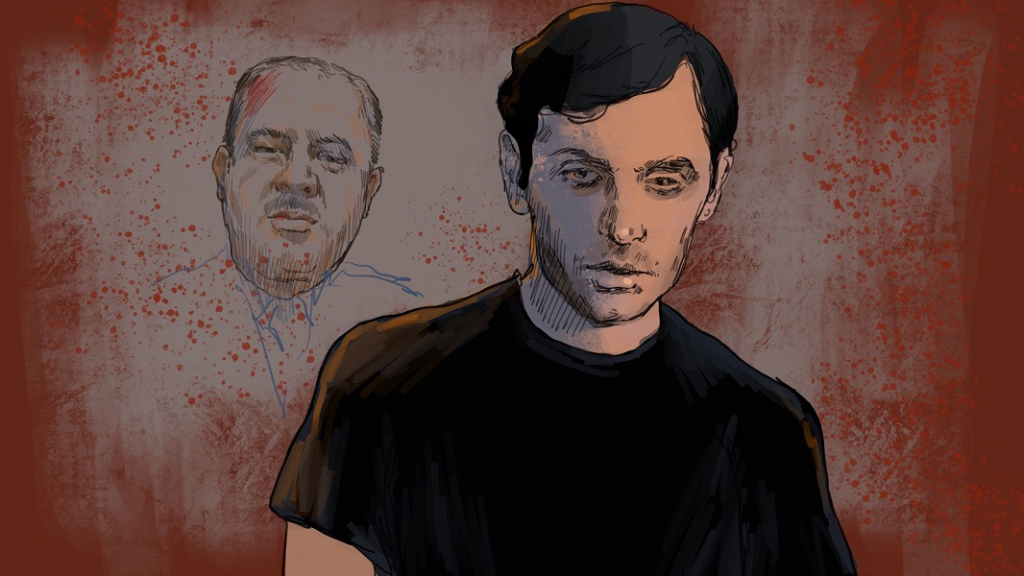
Yunis Safarov. Meydan TV illustration

More than 70 people were also reported to have been arrested.

The parents of those arrested claim that their children suffered innocently.

Some human rights activists point out that serious violations took place in the Ganja case.

Human rights activist Ogtay Gyulalyev, who investigated those events, called these arrests politically motivated.

Aggravation of Azerbaijani-Iranian relations

The latest mass arrests of believers in Azerbaijan began in January 2023 after an attack on the Azerbaijani embassy in Iran.

The attack took place on January 27th. The head of the security service of the embassy was killed, two of his subordinates were injured.

The President of Azerbaijan demanded an early investigation of the terrorist act and punishment of the terrorists.

The State Security Service of Azerbaijan, in turn, also announced the initiation of a criminal case into the attack on the embassy.

After that, the Ministry of Internal Affairs announced the detention of more than 45 “Iranian spies”, but no information about the details of this operation was made public. From the words of relatives and lawyers of the detainees, it became known that they were accused of drug trafficking.

On February 1, the Ministry of Internal Affairs again disseminated information abouta special operation in which 39 people were arrested, “under religious cover” carrying out subversive and subversive activities. But the public was not told who these people were, or under what articles they were accused.

Office made the first official statement about the operation against believers. It was reported that 32 people were arrested that day. They were charged with various charges, from espionage to drug trafficking, but the details are still not known.

Relatives of the arrested believers say they will fight to the end. But at the same time, they complain about the lack of a fair judicial system in the country, and therefore do not have much hope. From time to time they hold actions protesting against illegal arrests.

With the support of “Mediaset”

Follow us Twitter | Facebook | Instagram


Categories
Selected Articles

“Yerevan strengthens security ties with the US” – Secretary of the Security Council


1689141833.jpg

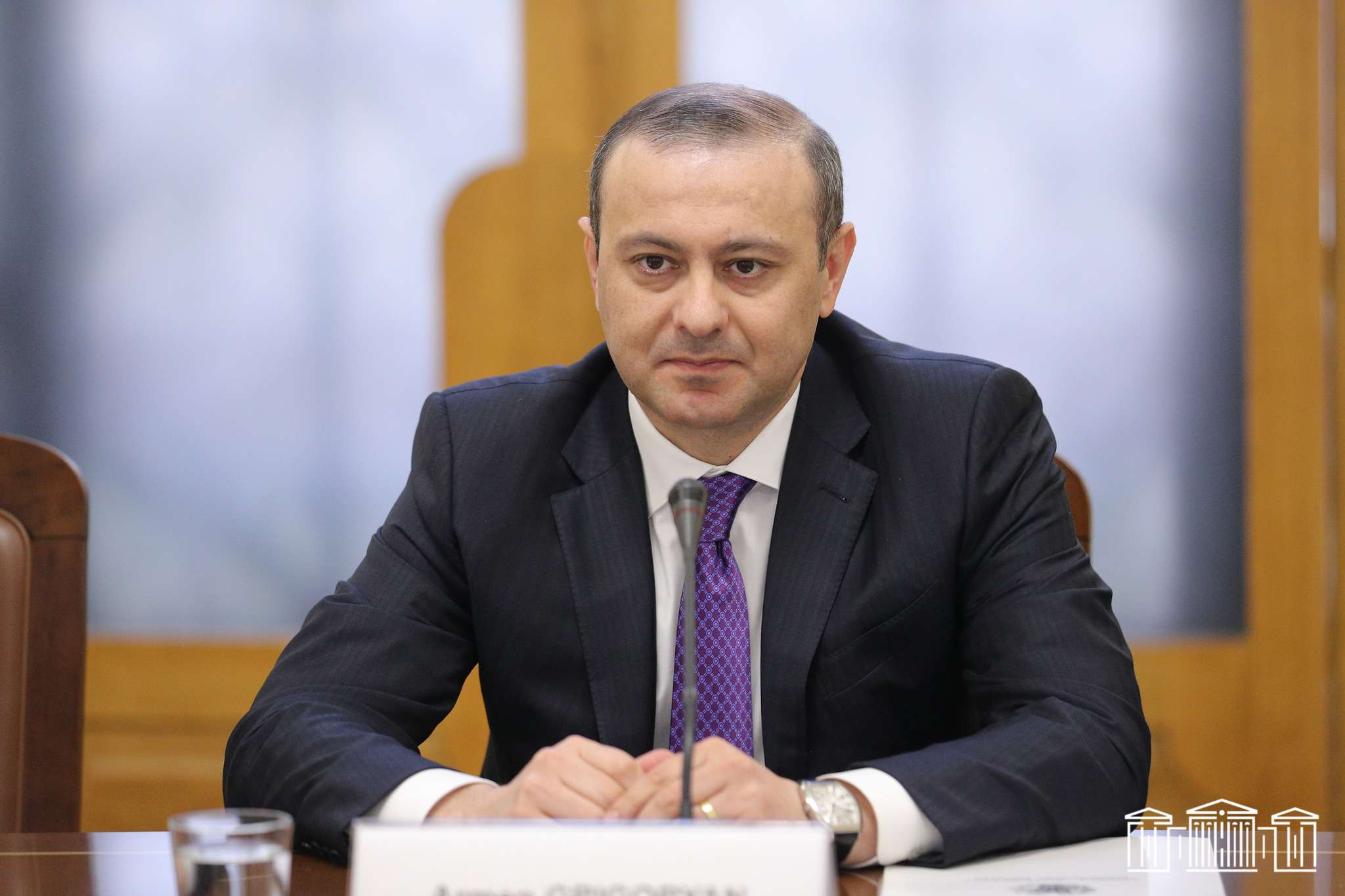
Armen Grigoryan’s interview with Voice of America

It is possible that the meeting between Pashinyan and Aliyev scheduled for July 21 in Brussels will take place earlier. Secretary of the Security Council of Armenia Armen Grigoryan stated this in an interview with the Armenian service of the Voice of America. However, the government has not yet received information about changing the date of the meeting.

Grigoryan, who is in the United States on a working visit, also talked about strengthening cooperation with the United States on security issues, the possibility of a new war, Armenian-Azerbaijani negotiations, the functions of Russian peacekeepers and Russia’s fulfillment of its obligations.

About cooperation with the USA. Does the alliance with Russia hinder Armenia?

The Secretary of the Security Council has been in the United States since July 4, obviously with a broad agenda for the visit. In an interview, he emphasized that Armenia uses “existing platforms” to expand cooperation with the United States in the field of security. Options are also being discussed on how to “open new doors”.

“We have made great progress. The results will be visible in the long run. Armenia is ready to move forward. Currently, Yerevan is seeking to deepen and expand the bilateral agenda with the United States,” he said.

When asked whether the fact that Armenia is a member of economic and military unions operating under the auspices of Russia hinders cooperation with the Americans, he replied that “at the moment there are no such problems.”

Grigoryan sees great potential for intensifying and strengthening the Armenian-American relations. Among the areas of cooperation, he singled out the economy and energy, while he assured that everything would be discussed – from minor issues to “broad cooperation in the field of security.”

On the CSTO and Russia: “We are waiting for the solution of the problems that have arisen”

Grigoryan said that Armenia openly discusses the problems that have arisen with the CSTO, a military alliance operating under the auspices of Russia, with the member countries of the structure. And to search for solutions, he uses the platforms of the organization itself.

The members of the CSTO are Russia, Armenia, Belarus, Kazakhstan, Kyrgyzstan and Tajikistan. The question of the effectiveness of the organization and the meaning of Armenia’s membership in it arose before the Pashinyan government in May 2021. Then the Armenian authorities for the first time announced the invasion of the Azerbaijani Armed Forces into its sovereign territory, but the organization did not respond to a request for military assistance to an ally. Then the situation repeated itself, which further deepened the crisis of relations. At the same time, Armenia tried to avoid talking about leaving the CSTO. But the country’s leadership has repeatedly suggested that “the CSTO is leaving Armenia.”

“We see that the CSTO member states in a certain way, at least publicly, declare the legitimacy of the problems raised by Armenia [the President of Belarus made such a statement – JAMnews]. It is very important that our partners understand the legitimacy of the issues we raise. And we expect these problems to be resolved,” Grigoryan said.

According to him, the issue of Russia’s unfulfilled obligation to supply weapons, for which it was paid, remains on the agenda of the Armenian-Russian relations:

“All problems must be openly and calmly discussed with our partners in order to find a solution. These problems are of strategic importance for Armenia. I hope that the partners have an understanding of how important these problems are for the Armenian side, and that they will be resolved.”

Armen Grigoryan’s interview with Voice of America

On a possible war: “All responsibility for the escalation lies with Azerbaijan”

According to Grigoryan, the ongoing war and geopolitical processes in Ukraine have a negative impact on the South Caucasus.

“These processes are superimposed by the maximalist policy of Azerbaijan, military rhetoric and steps taken in the form of various escalations. Azerbaijan follows this path and tries to destabilize the region. All responsibility for the escalation lies with Azerbaijan,” he said, answering a question about the likelihood of a new war.

On negotiations with Azerbaijan: “There are still unresolved issues”

During the interview, the Secretary of the Security Council touched upon key issues on the settlement of Armenian-Azerbaijani relations:

  • “There are issues that have not yet been resolved, but Yerevan is firmly committed to the peace agenda and is interested in the possibility of a peace agreement as soon as possible.”
  • “The security and rights of the Armenians living in Nagorno-Karabakh do not concern the territories, but the people, their rights and security.”
  • “It is necessary to create international mechanisms for Stepanakert and Baku to discuss the security and rights of the Armenians of Nagorno-Karabakh. There is an opportunity to create such a mechanism.”
  • “The international community must be involved in overcoming the conflict, because without an international mechanism it is very difficult to imagine this.”
  • “There are many unresolved problems in the negotiation process. One of the most important issues is the issue of border delimitation. Will it take place on the basis of the map of the General Staff of the USSR Armed Forces of 1975? There is no final agreement on the cards yet.”
  • “The unblocking of roads will mean the implementation of the concept of the “Armenian Crossroads”. This also includes the construction of the North-South highway. Armenia, as a country, will become a more active participant in the regional trade turnover, which will bring it additional income, and economic activity can create additional security guarantees.”

Armen Grigoryan’s interview with Voice of America

“Armenia did not deviate from its obligations”

Grigoryan was asked if his statement about Armenia’s control of its roads after the unblocking of regional communications is an attempt to amend the November 9 statement [the document that marked the end of the war in Karabakh in 2020]. He gave a negative answer, stressing that the specific functions of the Russian services were enshrined in a decree of the President of the Russian Federation of November 10.

According to a tripartite document signed by the leaders of Armenia, Russia and Azerbaijan, after the unblocking of regional communications, “transport communications are controlled by the border service of the FSB of Russia.” However, the Armenian authorities and personally Armen Grigoryan say that the roads provided by Armenia will be under its sovereign control.

The Secretary of the Security Council explains that the border service of Russia should only monitor whether Armenia is fulfilling its obligations or not.

“In other words, they have been given the function to make sure that the road is unblocked, that Armenia does not deviate from fulfilling its obligations. And this is subject to verification, for example, with the help of cameras,” he stressed.

“Russian peacekeepers must fulfill their function”

According to the same agreement, Grigoryan recalls, Russian peacekeepers must ensure the safety of the Armenians living in Nagorno-Karabakh. However, since December last year, the Lachin corridor has been blocked, the only road connecting Nagorno-Karabakh with the outside world has been closed. And this is a “serious problem”. The expectations of the Armenian side regarding the deployment of Russian peacekeepers in NK did not come true.

He stressed that according to the November 2020 statement, the “presence of Azerbaijan” was not supposed to be in the Lachin corridor, Russian peacekeepers were supposed to ensure free movement along the corridor:

“Today there is no such movement. And we expect that the peacekeepers will fulfill their mission in full, so that the people living in Nagorno-Karabakh would not experience a humanitarian crisis. The ongoing crisis is deepening.”

“Oskanyan had this opportunity for 10 years”

Commenting on the proposal of former Foreign Minister Vardan Oskanyan to form a group of diplomats and negotiate with Azerbaijan, Grigoryan stressed:

“Vardan Oskanyan had a corresponding opportunity during his ten years in office, but if he could not do it in ten years, how will he do it in three months? The attitude towards the state is also surprising, that is, it is proposed to create a second state or a state institution for such questions. This is very frivolous. I don’t think it should be a discussion point.”

The former foreign minister of Armenia, who for 10 years participated in the negotiations on the settlement of the Karabakh conflict, addressed the current authorities of the country: “Give me, a group of diplomats, a chance, keep quiet for two or three months, we will take responsibility. I assure you that there will be serious progress in the negotiations, a sharp turn in favor of Armenia.”

Follow us Twitter | Facebook | Instagram

Armen Grigoryan’s interview with Voice of America


Categories
Selected Articles

Yerevan Says Airport Fired On From Azerbaijan Hours After Prime Minister’s Visit


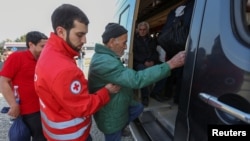
Refugees from Nagorno-Karabakh accompanied by medical workers board a bus at a temporary accommodation center in the village of Kornidzor on September 24.

Refugees from Nagorno-Karabakh accompanied by medical workers board a bus at a temporary accommodation center in the village of Kornidzor on September 24.

Armenian Prime Minister Nikol Pashinian has told his Caucasus nation on the heels of a bruising defeat for allies in a breakaway region of Azerbaijan that while Baku and Russian peacekeepers bear responsibility for protecting ethnic Armenians there, if necessary his government “will welcome our brothers and sisters of Nagorno-Karabakh to Armenia with all care.”

Yerevan reported on September 24 that the first several hundred refugees from the region had begun arriving in Armenia, with Nagorno-Karabakh leaders indicating that nearly all of the estimated 120,000 ethnic Armenians are likely to leave for the Caucasus nation’s territory as soon as possible, saying they did not want to live under Azerbaijani control.

Meanwhile, Armenia’s Security Council said Pashinian would conduct previously arranged talks with Azerbaijani President Ilham Aliyev in Grenada, Spain, on October 5, with French President Emmanuel Macron, German Chancellor Olaf Scholz, and EU chief Charles Michel also participating.

In a televised address to his nation of around 3 million, Pashinian also seemingly delivered a barb to Russia and Moscow-led efforts at regional security.

“The attacks carried out by Azerbaijan against the Republic of Armenia in recent years lead to an obvious conclusion that the external security systems in which we are involved are not effective from the point of view of the state interests and security of the Republic of Armenia,” Pashinian said.

Pashinian and many Armenians blame Russia — which traditionally has served as Armenia’s protector in the region — for failing to use its peacekeeping force to protect ethnic Armenians in Karabakh.

Armenia is a member of the Collective Security Treaty Organization (CSTO), which Russia has tried to position as a counterweight to NATO, although as recently as this month its armed forces were conducting exercises with U.S. forces.

Pashinian has been on rocky political footing since overwhelming Azerbaijani forces retook much of the territory in and around Nagorno-Karabakh held for decades by ethnic Armenians in a six-week war in late 2020 that led to a Russian-brokered cease-fire.

Then this week the breakaway leadership in Nagorno-Karabakh was thrashed by a lightning Azerbaijani offensive that led Baku to declare victory in returning its sovereignty to the territory.

Around the time Pashinian was addressing the nation on September 24, an adviser to the defeated leadership in Nagorno-Karabakh said virtually all of the territory’s ethnic Armenians will leave for Armenia in a bitter exodus from “our historic lands.”

Davit Babayan, an adviser for foreign policy to the separatist government’s de facto leader Samvel Shahramanian, told Reuters on September 24 that “Our people do not want to live as part of Azerbaijan. Ninety-nine point nine percent prefer to leave our historic lands.”

He said nothing of a time frame and there was otherwise no official position on a possible mass exodus.

Calls have increased in urgency for humanitarian help from the United Nations and the international community since the ethnic Armenian separatists agreed to a Russian-brokered cease-fire after a 24-hour blitz by Azerbaijani military forces on September 19-20.

Baku has repeatedly vowed to ensure the rights of what ethnic Armenians say is around 120,000 locals but the Azerbaijani side says is around half that figure.

“The fate of our poor people will go down in history as a disgrace and a shame for the Armenian people and for the whole civilized world,” Babayan said. “Those responsible for our fate will one day have to answer before God for their sins.”

Azerbaijan again signaled victory in Nagorno-Karabakh while Armenia urged international help to ensure the safety of the local ethnic Armenian population in competing speeches before the United Nations General Assembly, as evacuation and disarmament efforts continue.

Russia’s foreign minister, Sergei Lavrov, meanwhile used his UN appearance to say the two post-Soviet foes have “put things in order” and now it’s time to build “mutual trust.”

The trio of September 23 speeches came as the Yerevan-backed separatists said they were implementing the terms of the days-old cease-fire but concerns continued over the safety of tens of thousands of ethnic Armenians in the territory and with evacuations of the wounded under way.

Azerbaijan and Armenia’s foreign ministers struck opposing tones in their speeches to the UN forum.

Azerbaijani Foreign Minister Ceyhun Bayramov hailed the success of his country’s September 19-20 military campaign in Nagorno-Karabakh, which is internationally recognized as Azerbaijani territory, as achieving the “goals of anti-terrorist measures.”

“Armenia and its subordinate illegal regime were forced to agree to disarmament, liquidation of all so-called structures and withdrawal of forces from Azerbaijan,” Bayramov said.

In his speech to the UN General Assembly several hours later, Armenian Foreign Minister Ararat Mirzoyan lamented Yerevan’s repeated calls for greater UN activity to break a nine-month-long de facto Azerbaijani blockade of the region before the latest offensive.

Armenia’s government has distanced itself from the latest cease-fire mediated by Russia’s peacekeeping force in Nagorno-Karabakh on September 20, with daily protests targeting Pashinian and his government.

Mirzoyan accused much larger neighbor Azerbaijan of pursuing a “path of war” and disregarding accepted international principles.

He said the message from Azerbaijan has been that “you can talk about peace, but we can go on the path of war, and you will not be able to change anything.”

Mirzoyan said the latest casualty toll of this week’s Azerbaijani actions were “more than 200 confirmed dead and 400 wounded, including civilians, women, and children.” He said the fates of hundreds more remained “uncertain.”

He also repeated Yerevan’s “imperative” call for a UN mission in Nagorno-Karabakh “to monitor and assess the human rights, humanitarian and security situation on the ground, “with “unhindered access.”

Armenia’s Health Ministry announced on September 24 that ambulances were transporting 23 seriously injured individuals from Nagorno-Karabakh to Armenian territory.

RFE/RL reporters said the first refugees from Nagorno-Karabakh had arrived at a humanitarian aid facility in the border village of Kornidzor on September 24. Photos showed men, women, and children gathered around Red Cross tents and other receiving areas.

Separatist authorities said Russian peacekeepers would accompany those wishing to leave the region and go to Armenia. Russia’s Defense Ministry said peacekeepers had escorted 311 refugees to Armenia by midday on September 24.

In his speech to the General Assembly on September 23, Russia’s Lavrov said “the time has come for confidence-building measures between Armenia and Azerbaijan in Nagorno-Karabakh.”

He said Russia’s peacekeepers would assist, and he accused Western governments of inserting themselves unnecessarily in the Caucasus.

Lavrov said that “Yerevan and Baku actually put the situation in order.”

Nagorno-Karabakh‘s ethnic Armenian separatist leaders said on September 23 said they were implementing the cease-fire, including evacuations of injured civilians to Armenia with the help of Russian peacekeepers and the International Committee of the Red Cross (ICRC).

The separatists said that, as part of the September 20 agreement, aid was to be delivered from Armenia to Stepanakert — the de facto capital of the breakaway region under ethnic Armenian control — through the Lachin Corridor, for decades the main link between Karabakh and Armenia.

Also as part of the agreement, separatists said, talks would take place on “the political future” of the region, which is suffering from shortages of food, fuel, and electricity.

Russian peacekeeping forces in Nagorno-Karabakh reported that Karabakh separatists had already handed over more than 800 firearms, grenades, mortars, anti-tank guided missiles, and anti-tank missile systems, and the disarmament process would continue over the weekend.

U.S. Democratic Senator Gary Peters, who is leading a congressional delegation to the Armenia-Azerbaijan border, called for international observers needed to monitor the situation and said people in Karabakh were “very fearful.”

“I am certainly very concerned about what’s happening in Nagorno-Karabakh right now. I think there needs to be some visibility,” Peters told reporters.

Azerbaijan has vowed to protect the rights of civilians there.

The offensive was halted on September 20 after Karabakh’s ethnic Armenian leadership accepted a proposal by the Russian peacekeeping mission, although sporadic fighting has been reported.

Baku has said it envisages an amnesty for Karabakh Armenian fighters who give up their arms and seeks to reintegrate the territory’s ethnic Armenian population. Some separatist fighters have vowed to continue to resist Azerbaijani control.

U.S. Secretary of State Antony Blinken told Pashinian in a phone call on September 23 that Washington continues to support Armenia’s “sovereignty, independence, and territorial integrity” and that it has “deep concern for the ethnic Armenian population in Nagorno-Karabakh.”

During a special meeting of the UN Security Council after this week’s cease-fire, council members including the United States and Russia called for peace, while Armenian and Azerbaijani officials traded barbs.

During a short but bloody war in 2020, Azerbaijan recaptured much of Nagorno-Karabakh as well as seven surrounding districts that had been controlled since the 1990s by ethnic Armenians with Yerevan’s support.


Categories
Selected Articles

Head of State Security Service: We invite Armenian population of Azerbaijan to live together with us


Head of State Security Service: We invite Armenian population of Azerbaijan to live together with us

Baku, September 18, AZERTAC

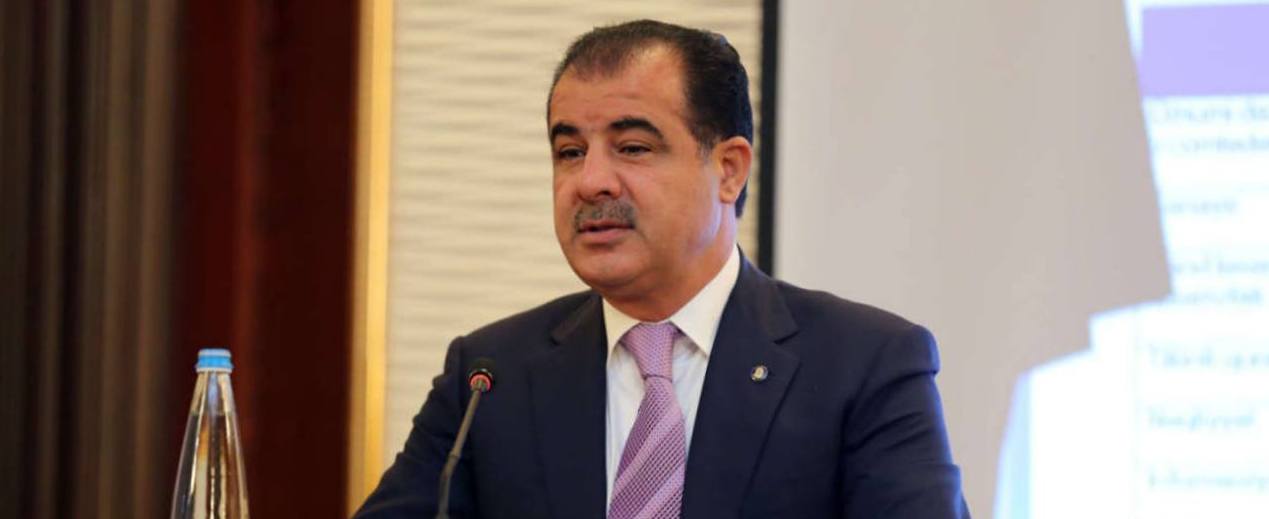
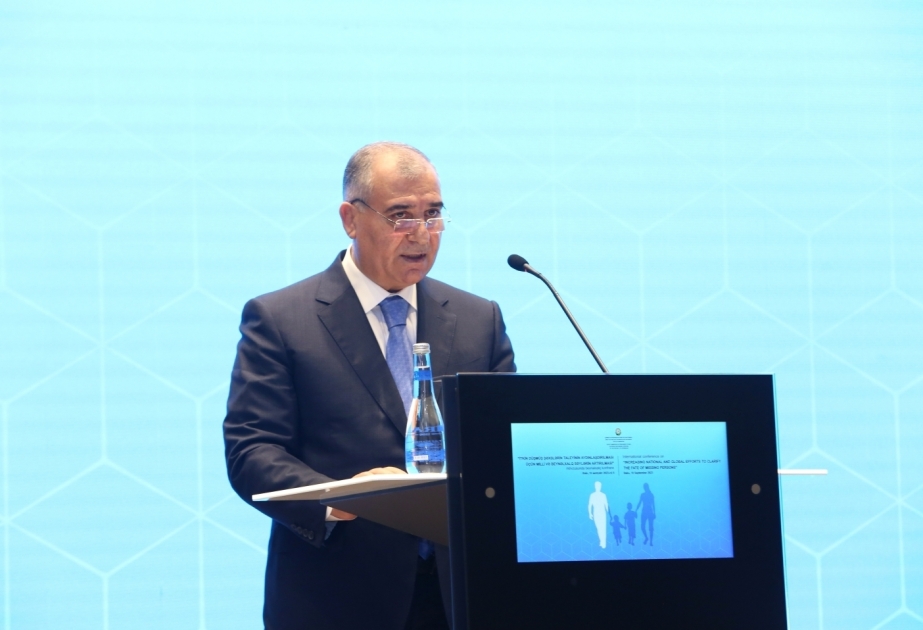
“Currently, the Armenian ideologists, referring to history, are raising the issue of impossibility of coexistence of Azerbaijanis and Armenians. Then, the question arises, how is it that before the start of the military conflict, the Armenian population have lived comfortably as respectable citizens in Baku and other parts of Azerbaijan, including Garabagh for a long time, having enough influence in the society,” said Head of the State Security Service of Azerbaijan, Chairman of the State Commission on Prisoners of War, Hostages and Missing Persons Ali Naghiyev as he addressed the international conference on “Increasing national and global efforts to clarify the fate of missing persons”.

Naghiyev noted that unlike the mono-ethnic Armenia, the Russian, Georgian, Jewish, and other peoples currently living in the country form the basis of the multinational and multi-confessional Azerbaijani state.

“We invite the Armenian population of Azerbaijan to live together with us. The Azerbaijani state and Azerbaijanis do not want war. Today, we are concerned about the rapid restoration of the Azerbaijani settlements destroyed as a result of military aggression, and return of the 750,000 IDPs to their homes as soon as possible,” Naghiyev added.


Categories
Selected Articles

Azerbaijan and Armenian forces reach a ceasefire deal: officials


an-ethnic-armenian-soldier-stands-1-6567

YEREVAN, Armenia –

Azerbaijan claimed full control of the breakaway Nagorno-Karabakh region Wednesday after local Armenian forces there agreed to lay down their weapons following the latest outbreak of fighting in the decades-long separatist conflict.

Authorities in the ethnic Armenian region that has run its affairs without international recognition since fighting broke out in the early 1990s declared around midday that local self-defense forces will disarm and disband under a Russia-mediated ceasefire.

They also said representatives of the region will start talks Thursday with the Baku government on Nagorno-Karabakh’s “reintegration” into Azerbaijan.

Azerbaijan President Ilham Aliyev trumpeted victory in a televised address to the nation, saying that “in just one day, Azerbaijan fulfilled all the tasks set as part of local anti-terrorist measures” and “restored its sovereignty.”

On Tuesday, the Azerbaijan army unleashed an artillery barrage and drone attacks against outnumbered and undersupplied pro-Armenian forces, which have been weakened by a blockade of the region in the southern Caucasus Mountains that is recognized internationally as being part of Azerbaijan.

Nagorno-Karabakh human rights ombudsman Gegham Stepanyan said at least 200 people, including 10 civilians, were killed and more than 400 others were wounded in the fighting. He said earlier that children were among the dead and wounded.

His casualty figures could not immediately be independently verified.

The hostilities worsened an already grim humanitarian situation for residents who have endured food and medicine shortages for months as Azerbaijan enforced a blockade of the road connecting Nagorno-Karabakh to Armenia.

Thousands of Nagorno-Karabakh residents flocked to a camp operated by Russian peacekeepers to avoid the fighting, while many others gathered at the airport of the regional capital, Stepanakert, hoping to flee the region.

Armenian Prime Minister Nikol Pashinyan said in a speech to the nation that fighting decreased following the truce, emphasizing that Russian peacekeepers in Nagorno-Karabakh are fully responsible for its residents security.

“If peacekeepers have proposed a peace deal, it means that they completely and without any reservations accepted the responsibility of ensuring the security of Nagorno-Karabakh Armenians, and provide the conditions and the rights for them to live on their land and in their homes safely,” he said.

Pashinyan, who has previously recognized Azerbaijan’s sovereignty over Nagorno-Karabakh, said Armenia wouldn’t be drawn into the fighting. He said his government didn’t take part in negotiating the deal, but “has taken note” of the decision made by the region’s separatist authorities.

He again denied any Armenian troops were in the region, even though separatist authorities said they were in Nagorno-Karabakh and would pull out as part of the truce.

Protesters rallied in the Armenian capital of Yerevan for a second straight day Wednesday, blocking streets and demanding that authorities defend Armenians in Nagorno-Karabakh.

White House national security spokesman John Kirby said the U.S. was “deeply concerned” about Azerbaijan’s military actions. “We have repeatedly emphasized the use of force is absolutely unacceptable,” he said, adding that the U.S. was closely watching the worsening humanitarian situation in Nagorno-Karabakh.

Azerbaijan’s move to reclaim control over Nagorno-Karabakh raised concerns that a full-scale war in the region could resume between the two neighbours, which have been locked in a struggle over Nagorno-Karabakh since a separatist war there ended in 1994.

During another war that lasted for six weeks in 2020, Azerbaijan reclaimed broad swaths of Nagorno-Karabakh and adjacent territories that were held for decades by Armenian forces. More than 6,700 people died in the fighting, which ended with a Russian-brokered peace agreement. Moscow deployed about 2,000 peacekeeping troops to the region.

The conflict has long drawn in powerful regional players, including Russia and Turkiye. While Russia took on the mediating role, Turkiye threw its weight behind longtime ally Azerbaijan.

Russia has been Armenia’s main economic partner and ally since the 1991 collapse of the Soviet Union and has a military base in the country.

Pashinyan, however, has been increasingly critical of Moscow’s role, emphasizing its failure to protect Nagorno-Karabakh and arguing that Armenia needs to turn to the West to ensure its security. Moscow, in turn, has expressed dismay about Pashinyan’s pro-Western tilt.

The Kremlin said Russian President Vladimir Putin spoke by phone with Pashinyan on Wednesday, welcoming the deal to end the hostilities and start talks between Azerbaijani officials and representatives of Nagorno-Karabakh.

Russia’s Defense Ministry said some of its peacekeepers were killed Wednesday, although it didn’t say how many and whether it happened before or after the start of the ceasefire. The ministry said the peacekeeping contingent had evacuated more than 3,100 civilians.

The separatists’ quick capitulation reflected their weakness following the Armenian forces’ defeat in the 2020 war and the loss of the only road linking the region to Armenia.

Thomas de Waal, a senior fellow at the Carnegie Europe think tank, said the separatist forces, which consisted of several thousand poorly supplied men, were “probably not a match for the Azerbaijani forces.”

While many in Armenia blamed Russia for the defeat of the separatists, Moscow pointed to Pashinyan’s own recognition of Nagorno-Karabakh as part of Azerbaijan.

“Undoubtedly, Karabakh is Azerbaijan’s internal business,” said Kremlin spokesman Dmitry Peskov. “Azerbaijan is acting on its own territory, which was recognized by the leadership of Armenia.”

He voiced hope that Azerbaijan would respect the rights of Nagorno-Karabakh’s ethnic Armenian population.

French President Emmanuel Macron spoke with Aliyev and “condemned Azerbaijan’s decision to use force … at the risk of worsening the humanitarian crisis in Nagorno-Karabakh and compromising ongoing efforts to achieve a fair and lasting peace,” the French presidential office said.

 Macron “stressed the need to respect” the ceasefire and “to provide guarantees on the rights and security of the people of Karabakh, in line with international law.”

Azerbaijan’s presidential aide Hikmet Hajiyev said Baku is “ready to listen to the Armenian population of Karabakh regarding their humanitarian needs.”

In announcing its military operation Tuesday, Azerbaijan aired a long list of grievances, accusing pro-Armenian forces of attacking its positions, planting land mines and engaging in sabotage.

Even though Aliyev insisted the Azerbaijani army struck only military facilities during the fighting, separatist officials in Nagorno-Karabakh said Stepanakert and other areas came under “intense shelling.”

Before the ceasefire, explosions reverberated around Stepanakert every few minutes on Wednesday — some in the distance and others closer to the city. Even after the truce was announced and the shelling could no longer be heard in Stepanakert, many residents decided to stay in shelters for the rest of the day.

Significant damage was visible in the city, with shop windows blown out and vehicles punctured, apparently by shrapnel.

The Azerbaijani Prosecutor General’s Office said Armenian forces fired at Shusha, a city in Nagorno-Karabakh under Azerbaijan’s control, killing one civilian.

——

Associated Press writers Jim Heintz and Dasha Litvinova in Tallinn, Estonia; Aida Sultanova in London; and Siranush Sargsyan in Stepanakert contributed.


Categories
Selected Articles

Electricity restored in Stepanakert


The electricity has been restored in Stepanakert, former State Minister of Artsakh Artak Beglaryan informs on Telegram.

The city was left without electricity from September 19.

Related Articles


Categories
Selected Articles

Russia’s ‘peacekeeper’ act crumbles as Azerbaijan overwhelms Nagorno-Karabakh


This audio is created with AI assistance

On Sept. 19, just under three years after the end of the last major war between Armenia and Azerbaijan over the mountainous region of Nagorno-Karabakh, Baku moved decisively to finish what it started in 2020.

Shortly after the announcement of the launching of “anti-terrorist” measures by the Azerbaijani Defense Ministry, videos emerged of military positions and equipment struck in the ethnically-Armenian breakaway Nagorno-Karabakh Republic (NKR), recognized internationally as part of Azerbaijan.

Soon after, reports and videos flowed in of artillery and small arms fire heard around Nagorno-Karabakh’s de facto capital of Stepanakert (Khankendi in Azerbaijani). As the day unfolded, local sources claimed that along with artillery fire, Azerbaijani forces had also made advances on the ground.

Representatives of western countries, including the U.S. and European Union, were quick to condemn the Azerbaijani attacks, with U.S. Secretary of State Antony Blinken urging Azerbaijani president Ilham Aliyev to halt the escalation by telephone.

On the ground, the reaction of Russia, which had maintained a force of “peacekeepers” in Nagorno-Karabakh as part of a Moscow-brokered ceasefire deal at the time, was nearly absent. Publicly, Moscow denied responsibility for stopping the fighting, pointing to Armenian Prime Minister Nikol Pashinyan’s public readiness to recognize Nagorno-Karabakh as Azerbaijani territory.

Ultimately, without prospects of viable military resistance and without military intervention from the military of Armenia, Nagorno-Karabakh’s authorities surrendered to Baku on Sept. 20, just under 24 hours after the offensive was launched.

The situation as of Sept. 21 continues to develop quickly, with early reports of Azerbaijani troops entering Armenian-populated settlements and a mass exodus of civilians seeking refuge in Stepanakert.

Under the terms of the new ceasefire, the NKR military is to be disarmed and disbanded, all but heralding the end of the NKR as a de facto state entity.

Azerbaijani and Armenian representatives met on Sept. 21 in the Azerbaijani city of Yevlash for talks moderated by Russian peacekeepers on the implementation of the ceasefire, and the “reintegration issues” facing the remaining population of Armenians in Nagorno-Karabakh.
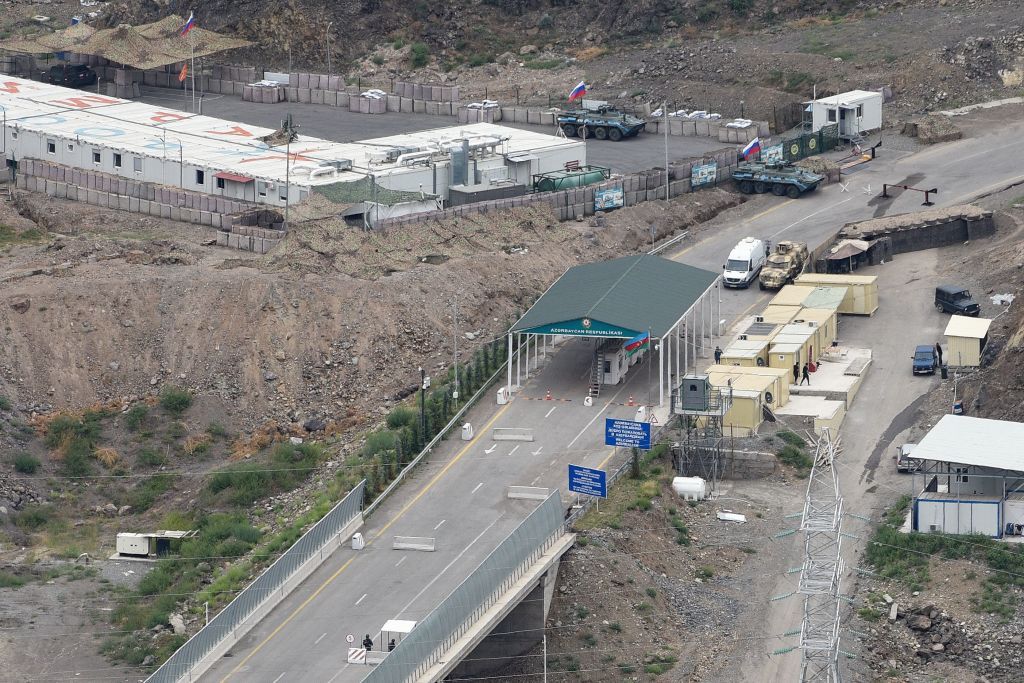
A view shows an Azerbaijani checkpoint at the entry of the Lachin corridor, the Armenian-populated breakaway Nagorno-Karabakh region’s only land link with Armenia, on July 30, 2023. (Photo by Karen Minasyan/AFP via Getty Images)

The events of Sept. 19-20 did not come out of the blue after regular flare-ups in violence between Armenians and Azerbaijani forces in the region, while Russia’s interest in and leverage over Nagorno-Karabakh decreased dramatically with the full-scale invasion of Ukraine.

Starting in autumn last year and with the tacit cooperation of Russian peacekeepers, Baku had initiated a blockade of the Lachin Corridor, the only road connecting Nagorno-Karabakh to Armenia, cutting off supplies and sparking a humanitarian crisis in the region.

Russia’s failure to fulfill its stated role of peacekeeper and enforce the terms of the 2020 ceasefire points both to Moscow’s abandonment of its traditional alliance with Armenia, but also of Russia’s rapid loss of influence in the South Caucasus as a whole.

“Russia tried to impose its hegemony over this whole conflict setting in November 2020,” said Caucasus expert and Associate Fellow at Chatham House Laurence Broers to the Kyiv Independent. “It brokered the ceasefire, it brought in peacekeepers.”

“Now, this notion of Russia as the indispensable Eurasian security actor has been proven completely false.”

Swift demise

Alarm bells about a new Azerbaijani offensive against Nagorno-Karabakh or Armenia were first set off earlier in September, when open-source intelligence showed a significant build-up of Azerbaijani forces along the borders of Armenian-controlled territory.

Photos of the military build-up posted to social media showed Azerbaijani military equipment painted with a symbol representing an upside-down letter A. In a fashion not unlike Russia’s adoption of the letters Z and V as public pro-war symbols, some Azerbaijani media outlets and Telegram channels began to incorporate the symbol in their logos.

In Baku’s version, the final decision to attack was triggered by the alleged deaths of two Azerbaijani road workers and four police officers from separate landmine explosions on the morning of Sept. 19.

Although Nagorno-Karabakh remains heavily mined after two major wars and Armenia’s alleged refusal to cooperate with demining has been a recurring sticking point for Azerbaijan, the claims were not independently verifiable.

Once the offensive began in earnest, Nagorno-Karabakh’s authorities and other sources on the ground in Armenian-controlled territory quickly reported both military and civilian casualties from alleged Azerbaijani attacks.

As of the evening of Sept. 20, the NKR’s Ombudsman reported “at least 200” deaths, of which 10 were civilians, including five children.

In its announcement of the ceasefire, Baku claimed to have taken over 90 Armenian military positions and captured several pieces of military equipment, but denied targeting or killing civilians.
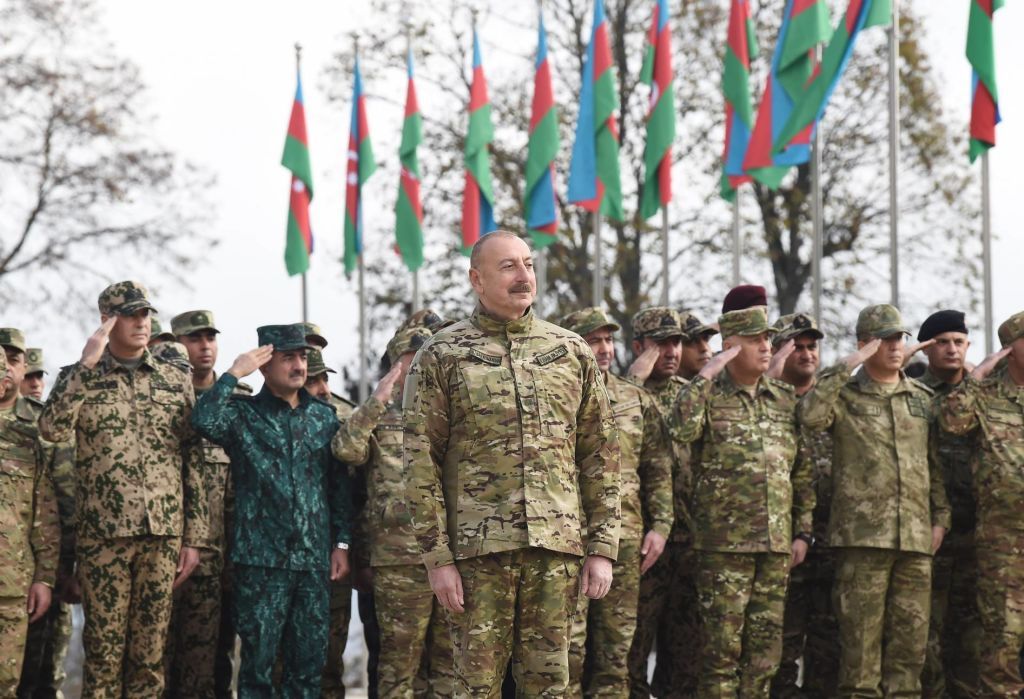
Azerbaijan President Ilham Aliyev attends the “Victory Day” event held on the occasion of the 2nd anniversary of the Karabakh Victory on Nov. 8, 2022 in Shusha, Azerbaijan. (Photo by Azerbaijani Presidency/Anadolu Agency via Getty Images)

Photos and videos posted by locals on social media showed extensive damage to residential areas and dozens of civilians taking shelter in dark basements, where, according to the NKR, electricity was cut off in the afternoon of Sept. 19.

With no access to the region for independent media or observers, neither side’s claims can be independently verified.

Meanwhile, according to local Armenian journalist Tigran Grigoryan, several Armenian villages had already been taken by Azerbaijani forces as of the morning of Sept. 20, while the Caspian Defense Studies Institute reported that the fourth-century Amaras Monastery had also been taken.

Unlike the war in 2020, this Azerbaijani offensive was over quickly, much in part to Pashinyan’s decision not to send the Armenian military into the fight, a move that was met with public praise from Aliyev.

Following the ceasefire, images emerged of thousands of local residents gathering at the airport in Stepanakert, where Russian peacekeepers are based. “The Russians don’t know what to do with them (the refugees at the airport)… they are angry at them,” said local journalist Marut Vanyan in an Open Democracy video report published on the evening of Sept. 20.

On Sept. 21, locals posted videos with the sounds of continued gunfire around Stepanakert, accompanied by unconfirmed reports in the early afternoon that Azerbaijani troops had entered Stepanakert.

Russian peacekeepers have, according to the country’s defense ministry, evacuated around 5,000 civilians from Nagorno-Karabakh. Meanwhile, Armenian social media has been flooded with posts seeking information about missing persons in the region.

History of violence

Nagorno-Karabakh lies entirely within the state borders of independent Azerbaijan, with no United Nations member state, not even Armenia, officially recognizing the independence of the NKR.

Though the Azeri and Armenian populations had clashed in the region before, the modern conflict in Nagorno-Karabakh has its roots in the Soviet occupation of the South Caucasus, when Joseph Stalin created the Armenian-majority Nagorno-Karabakh Autonomous Oblast (NKAO) within the borders of the Azerbaijani Soviet Socialist Republic in 1923.

When the Soviet Union began its road to collapse in the late 1980s, ethnic tension boiled over as Armenians in Nagorno-Karabakh demanded to unite with Armenia proper. Violent pogroms broke out in 1988 in both Armenia and Azerbaijan, and by the time the Soviet Union finally fell apart in 1991, the two newly-independent countries were already in a state of open armed conflict.

Armenian forces achieved a decisive victory in the resulting war, which was marked by numerous crimes against civilians including the Khojaly massacre, in which hundreds of Azerbaijani civilians were slain by Armenian soldiers.
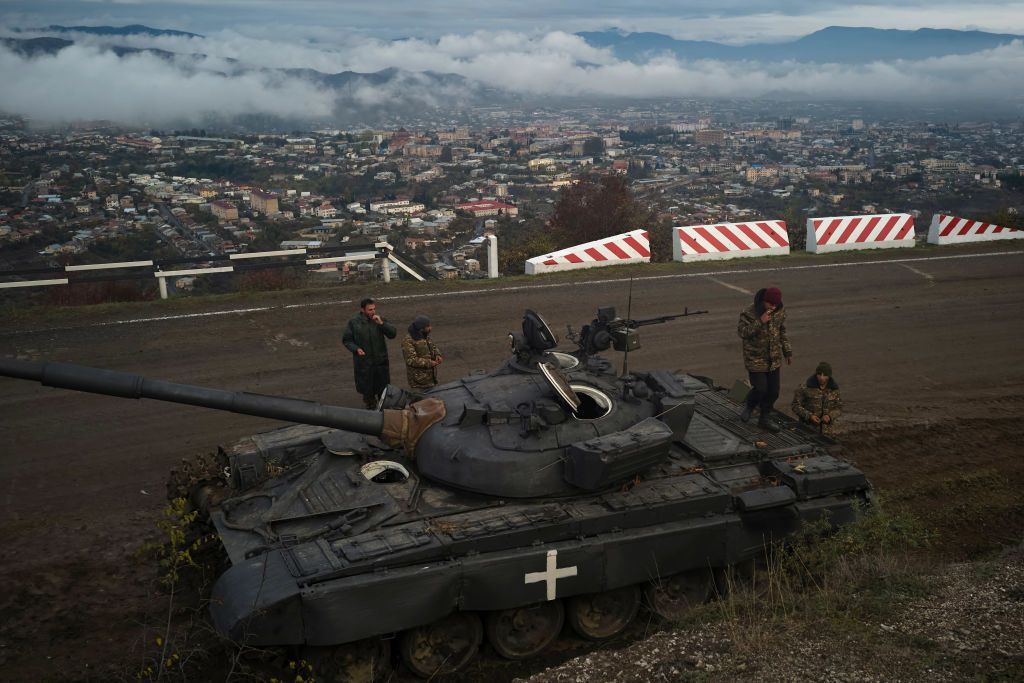
Soldiers keep guard by the side of the road where the final days of battle had occurred between Armenian forces and approaching Azeri forces several day before, on Nov. 13, 2020, in Stepanakert, Nagorno-Karabakh. (Photo by Alex McBride/Getty Images)

By the end of that war in 1994, Armenian forces had seized control not only over the former NKAO, but also over vast stretches of Azerbaijani-majority territory surrounding the enclave.

According to UN estimates, 684,000 ethnic Azerbaijanis were forced to abandon their homes in fear of violence, with their settlements largely left as empty ruins within the newly-formed NKR.

The expulsion of the Azerbaijani population from these areas, described by Baku and its partners as ethnic cleansing, has proved to be one of the main moral arguments used by Azerbaijan to justify its later offensives against Nagorno-Karabakh.

Having grown far stronger economically and militarily than Armenia in the post-Soviet period, Azerbaijan launched a full-scale invasion of Nagorno-Karabakh and the surrounding occupied territories within its borders in September 2020.

In 44 days of brutal fighting, Armenian forces were decisively defeated by the superior Azerbaijani military, before a Moscow-brokered ceasefire froze the contact lines and stipulated the handover to Azerbaijan of all remaining occupied areas outside the former NKAO. Control over the Lachin Corridor, the only road connecting Nagorno-Karabakh to Armenia, was passed, at the time exclusively to Russian peacekeepers.

Despite the Russian presence and most often ignored by it, violence in Nagorno-Karabakh erupted on numerous occasions in the years after the 2020 ceasefire, with frequent small-scale clashes between Armenian and Azerbaijani forces resulting in military and civilian casualties.

“I think this is part of a longer term, I should say, a mid term strategy from Azerbaijan to basically methodically deconstruct any basis for secessionism in Karabakh,” said Broers.

“The aim is that by May 2025, which is when Armenia and Azerbaijan have to agree or reject the renewal of the Russian peacekeepers mandate to get to the point where that question no longer stands, there is no reason for a Russian peacekeepers mission to continue.”
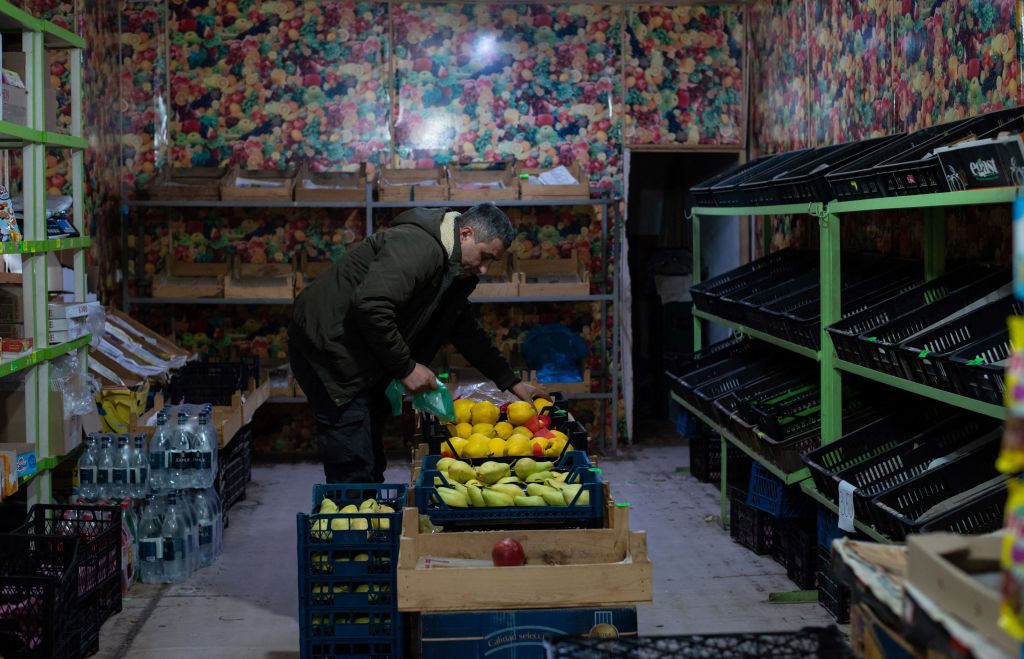
A man holds a fruit in an empty market in Stepanakert, capital of the self-proclaimed Nagorno-Karabakh region of Azerbaijan, on Dec. 23, 2022. (Davit Ghahramanyan/AFP via Getty Images)

In a widely-condemned escalation in September 2022, Baku launched attacks on positions inside sovereign Armenia, which Baku often refers to as “Western Azerbaijan.”

Then, Yerevan’s requests for assistance according to the terms of the Russia-led Collective Security Treaty Organization were rejected by Moscow, preoccupied with its war against Ukraine.

In December 2022, Baku’s blockade of the Lachin Corridor further raised the stakes, constricting the supply of food, fuel, and medical supplies into the NKR to the point that by summer 2023, widespread starvation among civilians was reported by independent media and international human rights organizations.

Condemned in rulings by the International Court of Justice and European Court of Human Rights, the blockade also highlighted the indifference of Russia, whose peacekeeping force did not take any noticeable action to reopen the road.

“The Ukraine war obviously weakened Russia’s hold,” said Broers, “both in material terms, in terms of the experience and quality of peacekeeping staff, but more importantly, reputationally.”

“That accelerated this pattern of (Azerbaijan’s) challenge to the ceasefire.”

Russia abandons Karabakh

Though Aliyev claimed on Sept. 20 that Nagorno-Karabakh’s Armenians can now “breathe easy” and that civilians will not be persecuted, the fate of the remaining population remains uncertain.

Ethnic hatred and mistrust between the two nations remains as high as ever, with the memory of several instances of civilians allegedly executed by Azerbaijani forces on video during the 2020 war, including one verified by a Bellingcat investigation, looming large.

“With a high degree of global attention focused on Karabakh, I think it would be unlikely that we would see overt massacres or something like that,” said Broers.

“But I think with Azerbaijan making life difficult and incentivising emigration, I find it quite hard to foresee a long term presence or continued presence (of Armenians in Nagorno-Karabakh).”

The threat also remains that an emboldened Azerbaijan, taking advantage of Russian and Western weakness in the region, could launch a new offensive against sovereign Armenia, in an effort to open what Baku calls the Zangezur Corridor to Azerbaijan’s western exclave of Nakhchivan. Late on Sept. 20, Yerevan accused Azerbaijan of shelling Armenian territory.
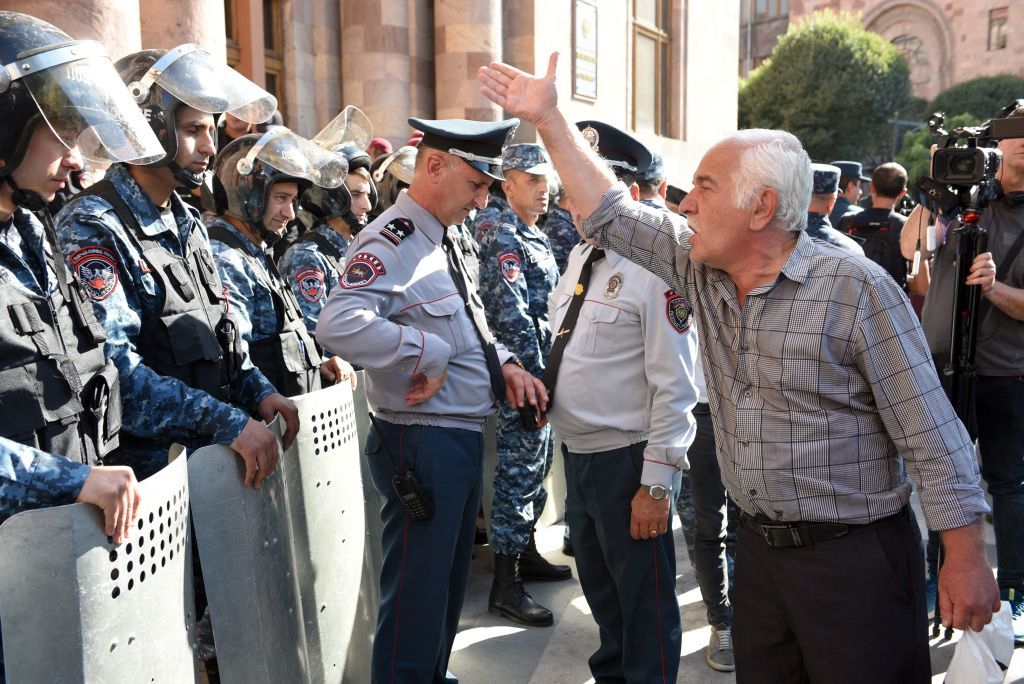
Protestors gather in downtown Yerevan on Sept. 20, 2023, as separatists in Nagorno-Karabakh and Azerbaijan’s authorities announced they would cease hostilities, signalling the end of an “anti-terror” operation launched just one day earlier by Azerbaijan’s forces in the breakaway region. (Photo by Karen Minasyan/AFP via Getty Images)

In behavior hardly befitting the image of a so-called ally, Russian officials and state media denied Moscow’s responsibility to intervene, laying blame squarely on Pashinyan, who had publicly criticized Armenia’s traditional strategic partnership with “indifferent” Russia earlier in September, and, for the first time since the full-scale war, sent humanitarian aid to Ukraine.

Published by opposition Russian outlet Meduza on Sept. 20, a leaked Kremlin directive instructed Russian state propaganda outlets to focus blame on Pashinyan, a former journalist who came to power at the head of a popular revolution that deposed pro-Russian leader Serzh Sargsyan in 2018.

According to Broers, Russia has now all but lost its leverage not only with Azerbaijan but in Armenia, where crowds marched on the Russian embassy in protest at Moscow’s failure to protect Armenians in Nagorno-Karabakh.

“I personally can’t see how a pro-Russian faction could keep power in Armenia,” he said. “The disappointment and anger with Russia is so great in Armenia now, that’s a long term phenomenon.”

Busy with its defense against Russia’s full-scale war, and with President Volodymyr Zelensky on a historic visit to the United Nations, Kyiv did not officially comment on the events in Nagorno-Karabakh.

Since independence, Ukraine has loosely aligned itself with Azerbaijan in the conflict, given the importance to Kyiv of territorial integrity as per the internationally-recognized borders of post-Soviet states.

Relations with Armenia, often seen in Ukraine through the lens of Yerevan’s partnership with Russia, soured significantly in 2014 when then-Armenian leader Sargsyan endorsed Russia’s illegal annexation of Crimea, a position which Pashinyan’s government refused to retract.

Commenting on the escalation in an interview to Ukrainska Pravda on Sept. 19, Oleksii Danilov, Secretary of Ukraine’s National Security and Defense Council, said that Armenia’s experience was a warning to other post-Soviet states still close to Russia.

Russia “is not a partner to any country,” Danilov said.

“This should be understood by all the Central Asian countries that still have direct relations with Russia. It simply abandons its partners, and it does not fulfill its commitments.”

Hi, this is Francis Farrell, cheers for reading this article. For once, a different war, but a war that features many of the themes of the one we see in Ukraine, and one common factor: Russia. We are always working to expand our coverage not only of Ukraine, but also of Eastern Europe and the Caucasus, where as in Ukraine, the legacy of Russian imperialism still looms. Please consider supporting our reporting.


Categories
Selected Articles

Armenian, Azerbaijani leaders to meet in Spain in October


This audio is created with AI assistance

Armenian Prime Minister Nikol Pashinyan and Azerbaijani President Ilham Aliyev will meet in Granada, Spain, with the leaders of France, Germany, and the European Council on Oct. 5, according to reports following an announcement from the Armenian Security Council.

French President Emmanuel Macron, German Chancellor Olaf Scholz, and European Council President Charles Michel will be present at the summit.

Ahead of the talks, officials from the four nations and the European Council plan to meet in Brussels on Sept. 26.

Armenian Security Secretary Armen Grigoryan will meet with Azerbaijani Presidential Advisor Hikmet Hajiyev will meet with advisers to Macron, Scholz, and Michel to prepare for the Oct. 5 summit.

Pashinyan and Aliyev last met in Brussels in July.

On Sept. 20, the breakaway region of Nagorno-Karabakh surrendered to the Azerbaijani military in exchange for a Russian-brokered ceasefire after one day of attacks by Azerbaijani forces.

Nagorno-Karabakh is recognized as Azerbaijani territory under international law. Its population of 120,000 is predominantly Armenian.

Abbey Fenbert

News Editor

Abbey Fenbert is a news editor at the Kyiv Independent. She is a freelance writer, editor, and playwright with an MFA from Boston University. Abbey served as a Peace Corps Volunteer in Ukraine from 2008-2011.

Support independent journalism in Ukraine. Join us in this fight.

Freedom can be costly. Both Ukraine and its journalists are paying a high price for their independence. Support independent journalism in its darkest hour. Support us for as little as $1, and it only takes a minute.

visa masterCard americanExpress


Categories
Selected Articles

Azerbaijani MP Ganira Pashayeva fell into a coma


650ff17196015650ff171960161695543665650f

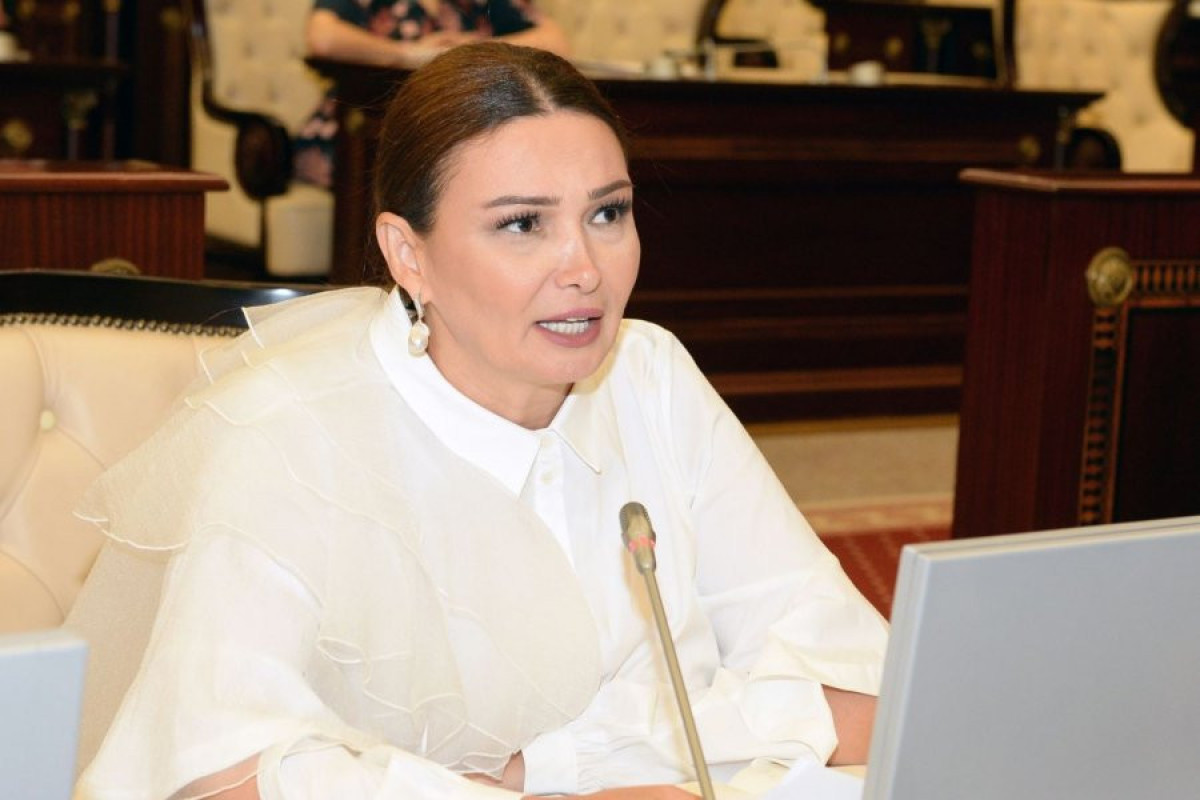
Member of Azerbaijani Parliament Ganira Pashayeva fell into a coma, APA reports.

She fell into a coma last night and was admitted to the Central Clinical Hospital.

She is currently being treated there.

It is reported that the deputy fell into a coma from the medicine.