An Azerbaijani soldier cries “Allahu Akbar” from atop the steeple of an Armenian church after breaking its cross off.
The thousand-year-old genocide of Armenians at the hands of Turkic peoples has reached a new level.
Several watchdog organizations—including the Association of Genocide Scholars, Genocide Watch, and the Lemkin Institute for Genocide Prevention—are accusing Azerbaijan of committing genocide against the 120,000 Armenians living in Nagorno-Karabakh. Historically known as Artsakh, this ancient Armenian region was annexed by and brought under Azerbaijani rule in 2020.
Modern day hostilities between Armenia, an ancient nation and the first to adopt Christianity, and Azerbaijan, a Muslim nation that was created in 1918, began in September 2020, when Azerbaijan launched a war to claim Artsakh (Nagorno-Karabakh). Although it had been Armenian for over two thousand years, and still remains 90% Armenian, after the dissolution of the USSR, the “border makers” granted it to Azerbaijan, hence the constant warring over this region. (See “15 Artsakh War Myths Perpetuated By Mainstream Media.”)
Once the September 2020 war began, Turkey quickly joined its Azerbaijani co-religionists against Armenia, though the dispute clearly did not concern it. It dispatched sharia-enforcing “jihadist groups” from Syria and Libya—including the pro-Muslim Brotherhood Hamza Division, which once kept naked women chained and imprisoned—to terrorize and slaughter the Armenians.
One of these captured mercenaries later confessed that he was “promised a monthly $2,000 payment for fighting against ‘kafirs’ in Artsakh, and an extra 100 dollar[s] for each beheaded kafir.” (Kafir, often translated as “infidel,” is Arabic for any non-Muslim who fails to submit to Islam, which makes them de facto enemies.)
All these Muslim groups committed massive atrocities (see here and here), including by raping an Armenian female soldier and mother of three, before hacking off all four of her limbs, gouging her eyes, and mockingly sticking one of her severed fingers inside her private parts.
The war ended in November 2020, with Azerbaijan claiming a significant portion of Artsakh.
Then, on December 12, 2022, Azerbaijan sealed off the humanitarian Lachin Corridor—the only route between Artsakh and the outside world. A recent report by Dutch journalist, Sonja Dahlmans, summarizes the situation since:
In the extreme southeastern part of Europe, known as the Caucasus, a silent genocide is looming. The Lachin Corridor that connects Armenia to Artsakh, the region in Azerbaijan where mainly Christian Armenians live, has been closed by the government for eight months. Supermarket shelves are empty; there is hardly any food, fuel, or medicines for the 120,000 Armenian Christians who live there, including 30,000 children and 20,000 seniors.
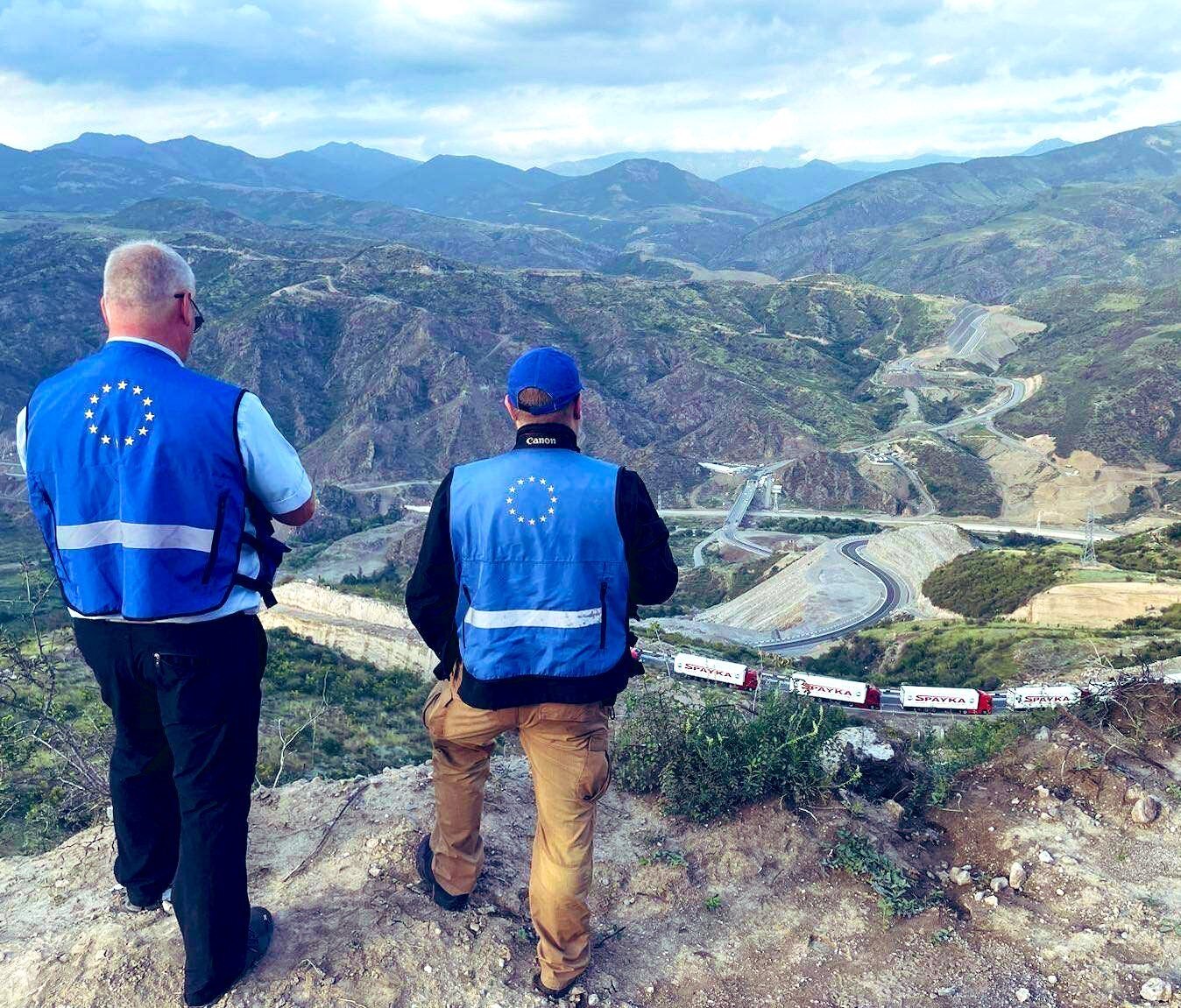
At the time of this writing [Aug. 24, 2023], a convoy of food and medicines has been standing in front of the border since July 25 [a month], but the International Red Cross is not allowed access to the inhabitants of Artsakh. According to journalists living in the area, most residents only get one meal a day. People in Artsakh queue for hours at night for bread, waiting for their daily rations. At the same time, sources within Artsakh report shooting at Armenians trying to harvest the land.
… [I]n all probability bread will also soon be unavailable due to the shortage of fuel… Bakers can no longer heat their ovens. Last week, a 40-year-old Armenian man died of malnutrition. A pregnant woman lost her child because there was no fuel for transport to the hospital.
Separate reports tell of, in one instance, 19 humanitarian trucks “loaded with some 360 tons of medicine and food supplies” that have been parked for weeks and prevented from crossing.
This, of course, would not be the first time Turks starve Armenians to death (as the following picture of a Turkish administrator taunting emaciated Armenian children with a piece of bread in 1915 makes clear).
On August 7, 2023, Luis Moreno Ocampo, the former Chief Prosecutor of the International Criminal Court, framed the situation well:
There is an ongoing Genocide against 120,000 Armenians living in Nagorno-Karabakh, also known as Artsakh.
The blockade of the Lachin Corridor by the Azerbaijani security forces impeding access to any food, medical supplies, and other essentials should be considered a Genocide under Article II, (c) of the Genocide Convention: ‘Deliberately inflicting on the group conditions of life calculated to bring about its physical destruction.’
There are no crematories, and there are no machete attacks. Starvation is the invisible Genocide weapon. Without immediate dramatic change, this group of Armenians will be destroyed in a few weeks.
Starvation as a method to destroy people was neglected by the entire international community when it was used against Armenians in 1915, Jews and Poles in 1939, Russians in Leningrad (now Saint Petersburg) in 1941, and Cambodians in 1975/1976.
Similarly, after going on a fact-finding mission to Armenia, former U.S. Ambassador-at-Large for International Religious Freedom, Sam Brownback referred to the blockade as the latest attempt at “religious cleansing” of Christian Armenia:
Azerbaijan, with Turkey’s backing, is really slowly strangling Nagorno-Karabakh. They’re working to make it unlivable so that the region’s Armenian-Christian population is forced to leave, that’s what’s happening on the ground.
Muslim regimes regularly make life intolerable for Christian minorities in an effort to get them to abandon their properties and leave. Just a few weeks ago, the president of Iraq revoked a decade-old decree that granted Chaldean Patriarch Cardinal Louis Raphael Sako powers over Christian endowment affairs. “This is a political maneuver to seize the remainder of what Christians have left in Iraq and Baghdad and to expel them,” said Diya Butrus Slewa, a human rights activist from Ainkawa. “Unfortunately, this is a blatant targeting of the Christians and a threat to their rights.”
In Artsakh, the situation seems to be worse: just as no one can get in, no one can apparently get out. Azerbaijan is holding those 120,000 Armenians captive, starving and abusing them at will.
In his testimony, Brownback said that this latest genocide is being “perpetrated with U.S.-supplied weaponry and backed by Turkey, a member of NATO.” If the U.S. does not act, “we will see again another ancient Christian population forced out of its homeland.”
Not only has U.S. diplomacy been ineffective for the besieged Armenians; it has actually exacerbated matters. According to one report,
[T]he only thing the Washington-backed talks appear to have produced is the emboldenment of Azerbaijan’s aggression….
For over eight months, the region’s 120,000 Indigenous Armenians—who declared their independence in the early 1990s following escalating violence and ethnic cleansing by Azerbaijan—have been deprived access to food, medicine, fuel, electricity, and water in what is nothing less than genocide by attrition….
The same week peace talks began in Washington, Baku [capital of Azerbaijan] tightened its blockade by establishing a military checkpoint at the Lachin Corridor. And when Washington-based talks resumed in June, Azerbaijan began shelling the region. In the months since, the International Committee of the Red Cross has been denied access to Karabakh—and later reported that an Armenian patient in its care had been abducted by Azerbaijani forces en route to Armenia for treatment.
This is the predictable consequence of Washington’s insistence on negotiations amid Azerbaijan’s blockade of Artsakh and occupation of Armenian territory. This has signaled to Baku that its strategy of coercive diplomacy is working, disincentivizing de-escalation, and forcing Armenia to negotiate with a gun to its head…
Washington has also actively strengthened Azerbaijan’s position by indicating support for Artsakh’s integration into Azerbaijan. Given Azerbaijan’s state-sponsored dehumanization of Armenians, the litany of human rights abuses perpetrated during and since the 2020 war, and its own disastrous domestic human rights record—it is impossible to imagine Armenians could ever live freely under Azerbaijan’s rule.
For Azerbaijan, this disingenuous participation in negotiations has allowed it to uphold the veneer of cooperation while engaging in conduct that has immeasurably set back the prospects of a durable peace.
Clearly, negotiating simply bought the Azerbaijanis more time in which to starve the Armenians, and possibly another way for the United States to pretend it was “doing something” without actually doing anything — apart from allowing more savagery.
Indeed, part of the façade of diplomacy is that Azerbaijan insists that the Christian Armenians of Artsakh are being treated no differently than Muslim Azerbaijanis—since all are citizens of Azerbaijan. One report sheds light on this farce:
Azerbaijani President Ilham Aliyev and other officials have declared that the Armenians of Nagorno-Karabakh are citizens of Azerbaijan, seeming to back prior statements of Azerbaijani authorities pledging to guarantee the rights and security of ethnic Armenians.
But actions speak much louder. The First Nagorno-Karabakh War three decades ago arose following waves of anti-Armenian pogroms. Azerbaijan is now one of the most repressive and autocratic countries in the world, scoring among the lowest in the world on freedom and democracy indexes—in stark contrast to Armenia and Nagorno-Karabakh.
Aliyev (who inherited his post from his father) has confessed to having started the Second Nagorno-Karabakh War in 2020, and proudly admitted that a generation of Azerbaijanis has been brought up to deeply despise Armenians (here and here).
He denies the Armenian Genocide (alongside Turkey) and negates the existence of Armenians as a nation, including their history, culture, and right to be present anywhere in the region.
No Armenian, not even a foreign national of ethnic Armenian descent or anyone with an Armenian sounding name, is allowed to enter Azerbaijan.
The results are clear: nearly every Armenian who fell into Azerbaijani captivity after the [Sept-Nov] 2020 war has been persecuted, imprisoned, tortured, mutilated, decapitated and/or murdered. None of these acts have ever been punished. To the contrary, those who kill Armenians receive medals and are glorified in Azerbaijan. It is no wonder that Armenians are petrified and cannot fathom living under Azerbaijan’s authority.
Aside from the Lachin corridor crisis, a recent 12-page report documents the systematic destruction of ancient churches, crosses, Christian cemeteries, and other cultural landmarks on land—Artsakh—that historically belonged to the world’s oldest Christian nation, Armenia.
One example is the Holy Savior Cathedral in Shushi, Artsakh. First, Azerbaijan bombed the church during the 2020 war, an act Human Rights Watch labeled a “possible war crime.” Then, after Azerbaijan seized the region, officials claimed to be “restoring” the church, when in fact its dome and cross were removed, making the building look less like a church. As one report notes,
The ‘case’ of Shushi is indicative of the well-documented history of Armenian cultural and religious destruction by Azerbaijan. From 1997 to 2006, Azerbaijan systematically obliterated almost all traces of Armenian culture in the Nakhichevan area, which included the destruction of medieval churches, thousands of carved stone crosses (“khachkars”), and historical tombstones.
Dahlmans also reports
on an Armenian church in Artsakh that disappeared after Azerbaijan’s victory in the second Nagorno-Karabakh war (2020). During the victory, Azerbaijani soldiers pose on top of the church shouting “Allahu Akhbar” [image above]… [T]he church has been completely wiped out and only a few stone remains remain as a reminder… The Western press rarely writes about the Nagorno-Karabakh conflict. Most reactions follow the line that it is not a religious conflict, but a claim by two countries over a disputed territory. Given the many examples that exist in which precisely religious buildings, tombs and inscriptions are systematically destroyed, it is difficult to maintain that this is the case.
One of the main reasons that Armenia finds itself standing alone against this genocidal onslaught is due to the West’s “desire to maintain favorable relations with Azerbaijan given its role as a European energy partner [and this] has outweighed any purported commitment to upholding human rights—bolstering Azerbaijan’s aggression.”
It is these same priorities that have made Russia, once the defender of all Orthodox Christian nations in the East, more apathetic than might be expected. According to another report,
Azerbaijan was able to impose this blockade because Russian peacekeepers allow them to do so. The Russians are there as part of a ceasefire agreement ending the Second Nagorno-Karabakh War. The same agreement, inked by Russia, Armenia and Azerbaijan in 2020, guarantees access along that now-blocked road. Although Russia is often portrayed as Armenia’s patron, the reality is more complicated. Russia’s largest oil company owns a 19.99% share of Azerbaijan’s largest natural gas field. It is not so surprising then that Armenians in Artsakh demonstrated against Russian inaction after the killings of their police officials.
Longtime Armenian-activist, Lucine Kasbarian, author of Armenia: A Rugged Land, an Enduring People, sums up the situation:
We who are Armenian, Assyrian, Greek and Coptic bitterly know just how this will end. It’s deja vu all over again. Again and again, we’ve seen the deceit and brutality, received the chilling reports, warnings, graphic videos, open letters and petitions from alarmed genocide scholars. But alas, NATO, Islamic supremacism, gas and oil are going to take precedence over life and liberty once again unless high-powered vigilantism can save the day.
Raymond Ibrahim, author of Defenders of the West and Sword and Scimitar is the Distinguished Senior Shillman Fellow at the Gatestone Institute and the Judith Rosen Friedman Fellow at the Middle East Forum.