On Sept. 19, just under three years after the end of the last major war between Armenia and Azerbaijan over the mountainous region of Nagorno-Karabakh, Baku moved decisively to finish what it started in 2020.
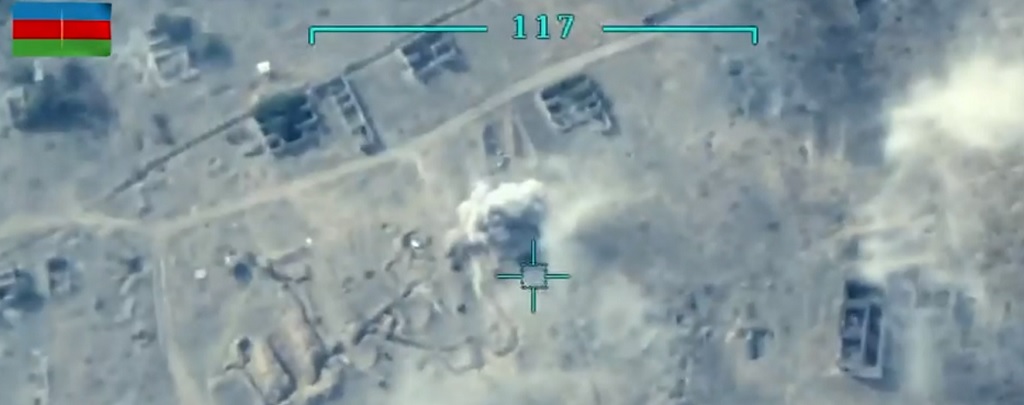
Shortly after the announcement of the launching of “anti-terrorist” measures by the Azerbaijani Defense Ministry, videos emerged of military positions and equipment struck in the ethnically-Armenian breakaway Nagorno-Karabakh Republic (NKR), recognized internationally as part of Azerbaijan.
Soon after, reports and videos flowed in of artillery and small arms fire heard around Nagorno-Karabakh’s de facto capital of Stepanakert (Khankendi in Azerbaijani). As the day unfolded, local sources claimed that along with artillery fire, Azerbaijani forces had also made advances on the ground.
Representatives of western countries, including the U.S. and European Union, were quick to condemn the Azerbaijani attacks, with U.S. Secretary of State Antony Blinken urging Azerbaijani president Ilham Aliyev to halt the escalation by telephone.
On the ground, the reaction of Russia, which had maintained a force of “peacekeepers” in Nagorno-Karabakh as part of a Moscow-brokered ceasefire deal at the time, was nearly absent. Publicly, Moscow denied responsibility for stopping the fighting, pointing to Armenian Prime Minister Nikol Pashinyan’s public readiness to recognize Nagorno-Karabakh as Azerbaijani territory.
Ultimately, without prospects of viable military resistance and without military intervention from the military of Armenia, Nagorno-Karabakh’s authorities surrendered to Baku on Sept. 20, just under 24 hours after the offensive was launched.
The situation as of Sept. 21 continues to develop quickly, with early reports of Azerbaijani troops entering Armenian-populated settlements and a mass exodus of civilians seeking refuge in Stepanakert.
Under the terms of the new ceasefire, the NKR military is to be disarmed and disbanded, all but heralding the end of the NKR as a de facto state entity.
Azerbaijani and Armenian representatives met on Sept. 21 in the Azerbaijani city of Yevlash for talks moderated by Russian peacekeepers on the implementation of the ceasefire, and the “reintegration issues” facing the remaining population of Armenians in Nagorno-Karabakh.
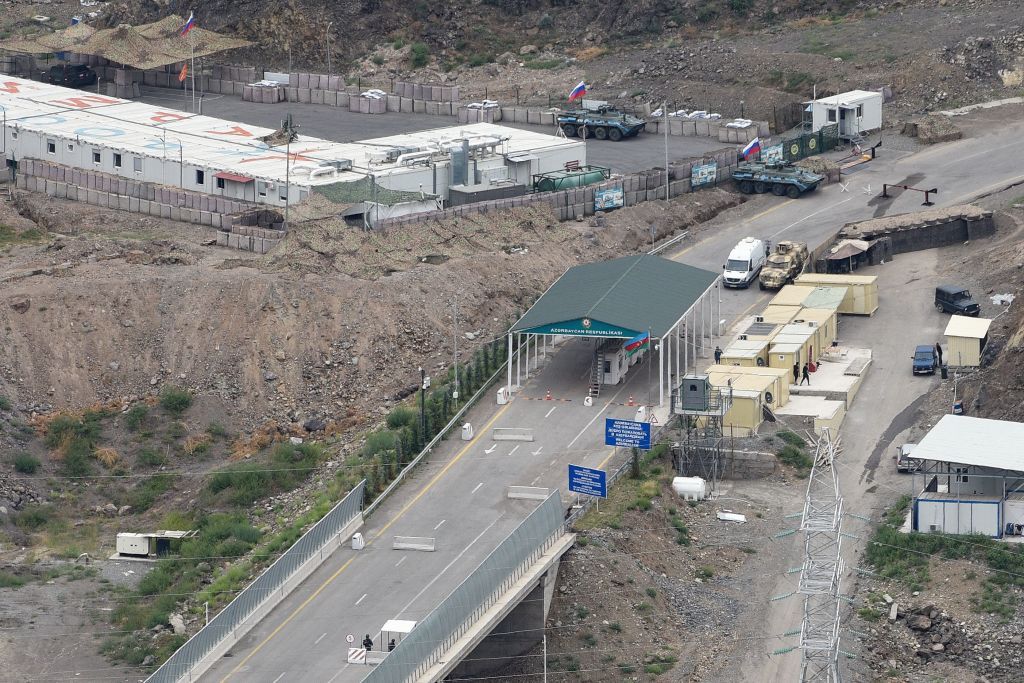 A view shows an Azerbaijani checkpoint at the entry of the Lachin corridor, the Armenian-populated breakaway Nagorno-Karabakh region’s only land link with Armenia, on July 30, 2023. (Photo by Karen Minasyan/AFP via Getty Images)
The events of Sept. 19-20 did not come out of the blue after regular flare-ups in violence between Armenians and Azerbaijani forces in the region, while Russia’s interest in and leverage over Nagorno-Karabakh decreased dramatically with the full-scale invasion of Ukraine.
Starting in autumn last year and with the tacit cooperation of Russian peacekeepers, Baku had initiated a blockade of the Lachin Corridor, the only road connecting Nagorno-Karabakh to Armenia, cutting off supplies and sparking a humanitarian crisis in the region.
Russia’s failure to fulfill its stated role of peacekeeper and enforce the terms of the 2020 ceasefire points both to Moscow’s abandonment of its traditional alliance with Armenia, but also of Russia’s rapid loss of influence in the South Caucasus as a whole.
“Russia tried to impose its hegemony over this whole conflict setting in November 2020,” said Caucasus expert and Associate Fellow at Chatham House Laurence Broers to the Kyiv Independent. “It brokered the ceasefire, it brought in peacekeepers.”
“Now, this notion of Russia as the indispensable Eurasian security actor has been proven completely false.”
Swift demise
Alarm bells about a new Azerbaijani offensive against Nagorno-Karabakh or Armenia were first set off earlier in September, when open-source intelligence showed a significant build-up of Azerbaijani forces along the borders of Armenian-controlled territory.
Photos of the military build-up posted to social media showed Azerbaijani military equipment painted with a symbol representing an upside-down letter A. In a fashion not unlike Russia’s adoption of the letters Z and V as public pro-war symbols, some Azerbaijani media outlets and Telegram channels began to incorporate the symbol in their logos.
In Baku’s version, the final decision to attack was triggered by the alleged deaths of two Azerbaijani road workers and four police officers from separate landmine explosions on the morning of Sept. 19.
Although Nagorno-Karabakh remains heavily mined after two major wars and Armenia’s alleged refusal to cooperate with demining has been a recurring sticking point for Azerbaijan, the claims were not independently verifiable.
Once the offensive began in earnest, Nagorno-Karabakh’s authorities and other sources on the ground in Armenian-controlled territory quickly reported both military and civilian casualties from alleged Azerbaijani attacks.
As of the evening of Sept. 20, the NKR’s Ombudsman reported “at least 200” deaths, of which 10 were civilians, including five children.
In its announcement of the ceasefire, Baku claimed to have taken over 90 Armenian military positions and captured several pieces of military equipment, but denied targeting or killing civilians.
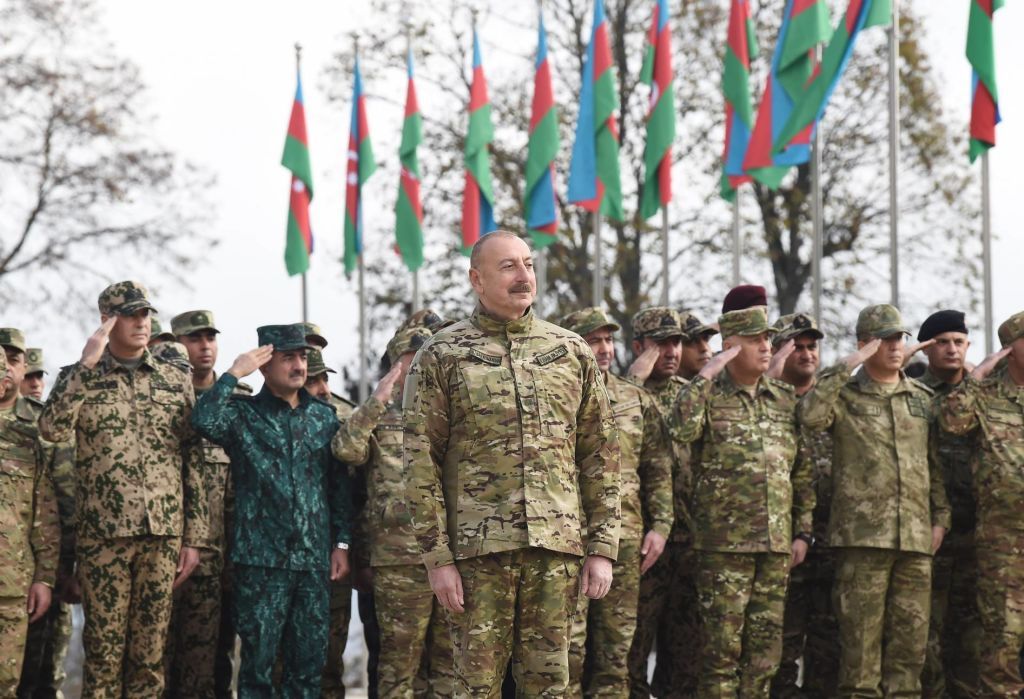 Azerbaijan President Ilham Aliyev attends the “Victory Day” event held on the occasion of the 2nd anniversary of the Karabakh Victory on Nov. 8, 2022 in Shusha, Azerbaijan. (Photo by Azerbaijani Presidency/Anadolu Agency via Getty Images)
Photos and videos posted by locals on social media showed extensive damage to residential areas and dozens of civilians taking shelter in dark basements, where, according to the NKR, electricity was cut off in the afternoon of Sept. 19.
With no access to the region for independent media or observers, neither side’s claims can be independently verified.
Meanwhile, according to local Armenian journalist Tigran Grigoryan, several Armenian villages had already been taken by Azerbaijani forces as of the morning of Sept. 20, while the Caspian Defense Studies Institute reported that the fourth-century Amaras Monastery had also been taken.
Unlike the war in 2020, this Azerbaijani offensive was over quickly, much in part to Pashinyan’s decision not to send the Armenian military into the fight, a move that was met with public praise from Aliyev.
Following the ceasefire, images emerged of thousands of local residents gathering at the airport in Stepanakert, where Russian peacekeepers are based. “The Russians don’t know what to do with them (the refugees at the airport)… they are angry at them,” said local journalist Marut Vanyan in an Open Democracy video report published on the evening of Sept. 20.
On Sept. 21, locals posted videos with the sounds of continued gunfire around Stepanakert, accompanied by unconfirmed reports in the early afternoon that Azerbaijani troops had entered Stepanakert.
Russian peacekeepers have, according to the country’s defense ministry, evacuated around 5,000 civilians from Nagorno-Karabakh. Meanwhile, Armenian social media has been flooded with posts seeking information about missing persons in the region.
History of violence
Nagorno-Karabakh lies entirely within the state borders of independent Azerbaijan, with no United Nations member state, not even Armenia, officially recognizing the independence of the NKR.
Though the Azeri and Armenian populations had clashed in the region before, the modern conflict in Nagorno-Karabakh has its roots in the Soviet occupation of the South Caucasus, when Joseph Stalin created the Armenian-majority Nagorno-Karabakh Autonomous Oblast (NKAO) within the borders of the Azerbaijani Soviet Socialist Republic in 1923.
When the Soviet Union began its road to collapse in the late 1980s, ethnic tension boiled over as Armenians in Nagorno-Karabakh demanded to unite with Armenia proper. Violent pogroms broke out in 1988 in both Armenia and Azerbaijan, and by the time the Soviet Union finally fell apart in 1991, the two newly-independent countries were already in a state of open armed conflict.
Armenian forces achieved a decisive victory in the resulting war, which was marked by numerous crimes against civilians including the Khojaly massacre, in which hundreds of Azerbaijani civilians were slain by Armenian soldiers.
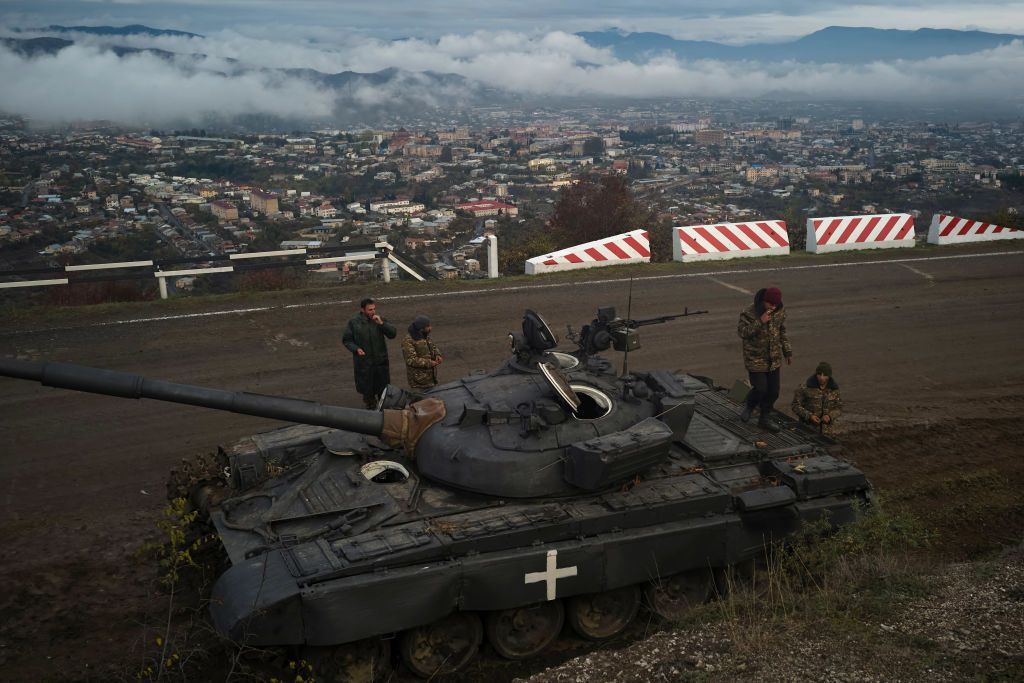 Soldiers keep guard by the side of the road where the final days of battle had occurred between Armenian forces and approaching Azeri forces several day before, on Nov. 13, 2020, in Stepanakert, Nagorno-Karabakh. (Photo by Alex McBride/Getty Images)
By the end of that war in 1994, Armenian forces had seized control not only over the former NKAO, but also over vast stretches of Azerbaijani-majority territory surrounding the enclave.
According to UN estimates, 684,000 ethnic Azerbaijanis were forced to abandon their homes in fear of violence, with their settlements largely left as empty ruins within the newly-formed NKR.
The expulsion of the Azerbaijani population from these areas, described by Baku and its partners as ethnic cleansing, has proved to be one of the main moral arguments used by Azerbaijan to justify its later offensives against Nagorno-Karabakh.
Having grown far stronger economically and militarily than Armenia in the post-Soviet period, Azerbaijan launched a full-scale invasion of Nagorno-Karabakh and the surrounding occupied territories within its borders in September 2020.
In 44 days of brutal fighting, Armenian forces were decisively defeated by the superior Azerbaijani military, before a Moscow-brokered ceasefire froze the contact lines and stipulated the handover to Azerbaijan of all remaining occupied areas outside the former NKAO. Control over the Lachin Corridor, the only road connecting Nagorno-Karabakh to Armenia, was passed, at the time exclusively to Russian peacekeepers.
Despite the Russian presence and most often ignored by it, violence in Nagorno-Karabakh erupted on numerous occasions in the years after the 2020 ceasefire, with frequent small-scale clashes between Armenian and Azerbaijani forces resulting in military and civilian casualties.
“I think this is part of a longer term, I should say, a mid term strategy from Azerbaijan to basically methodically deconstruct any basis for secessionism in Karabakh,” said Broers.
“The aim is that by May 2025, which is when Armenia and Azerbaijan have to agree or reject the renewal of the Russian peacekeepers mandate to get to the point where that question no longer stands, there is no reason for a Russian peacekeepers mission to continue.”
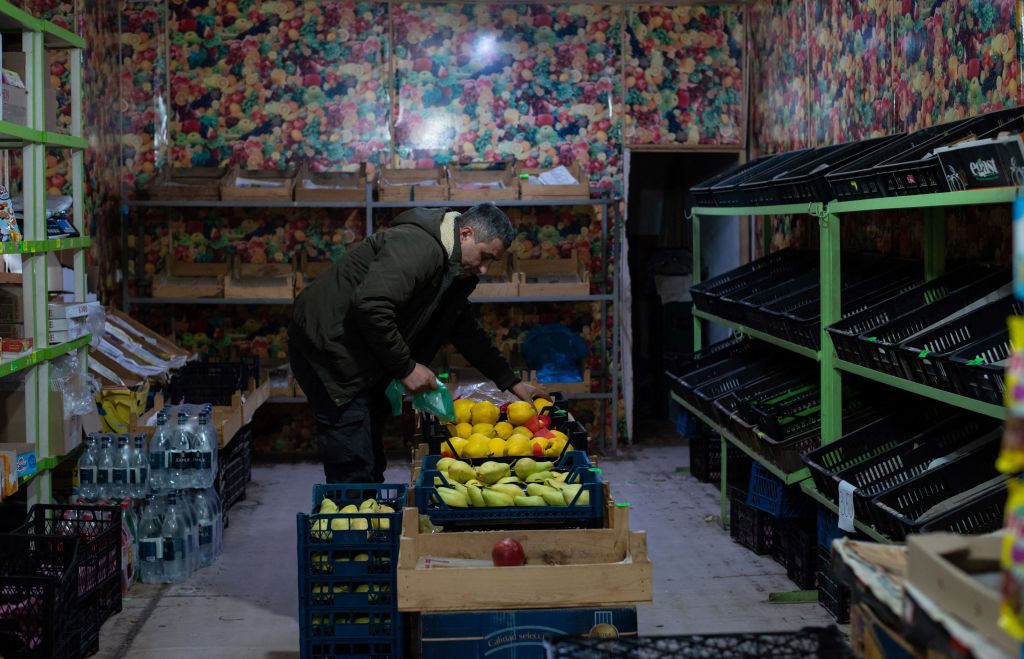 A man holds a fruit in an empty market in Stepanakert, capital of the self-proclaimed Nagorno-Karabakh region of Azerbaijan, on Dec. 23, 2022. (Davit Ghahramanyan/AFP via Getty Images)
In a widely-condemned escalation in September 2022, Baku launched attacks on positions inside sovereign Armenia, which Baku often refers to as “Western Azerbaijan.”
Then, Yerevan’s requests for assistance according to the terms of the Russia-led Collective Security Treaty Organization were rejected by Moscow, preoccupied with its war against Ukraine.
In December 2022, Baku’s blockade of the Lachin Corridor further raised the stakes, constricting the supply of food, fuel, and medical supplies into the NKR to the point that by summer 2023, widespread starvation among civilians was reported by independent media and international human rights organizations.
Condemned in rulings by the International Court of Justice and European Court of Human Rights, the blockade also highlighted the indifference of Russia, whose peacekeeping force did not take any noticeable action to reopen the road.
“The Ukraine war obviously weakened Russia’s hold,” said Broers, “both in material terms, in terms of the experience and quality of peacekeeping staff, but more importantly, reputationally.”
“That accelerated this pattern of (Azerbaijan’s) challenge to the ceasefire.”
Russia abandons Karabakh
Though Aliyev claimed on Sept. 20 that Nagorno-Karabakh’s Armenians can now “breathe easy” and that civilians will not be persecuted, the fate of the remaining population remains uncertain.
Ethnic hatred and mistrust between the two nations remains as high as ever, with the memory of several instances of civilians allegedly executed by Azerbaijani forces on video during the 2020 war, including one verified by a Bellingcat investigation, looming large.
“With a high degree of global attention focused on Karabakh, I think it would be unlikely that we would see overt massacres or something like that,” said Broers.
“But I think with Azerbaijan making life difficult and incentivising emigration, I find it quite hard to foresee a long term presence or continued presence (of Armenians in Nagorno-Karabakh).”
The threat also remains that an emboldened Azerbaijan, taking advantage of Russian and Western weakness in the region, could launch a new offensive against sovereign Armenia, in an effort to open what Baku calls the Zangezur Corridor to Azerbaijan’s western exclave of Nakhchivan. Late on Sept. 20, Yerevan accused Azerbaijan of shelling Armenian territory.
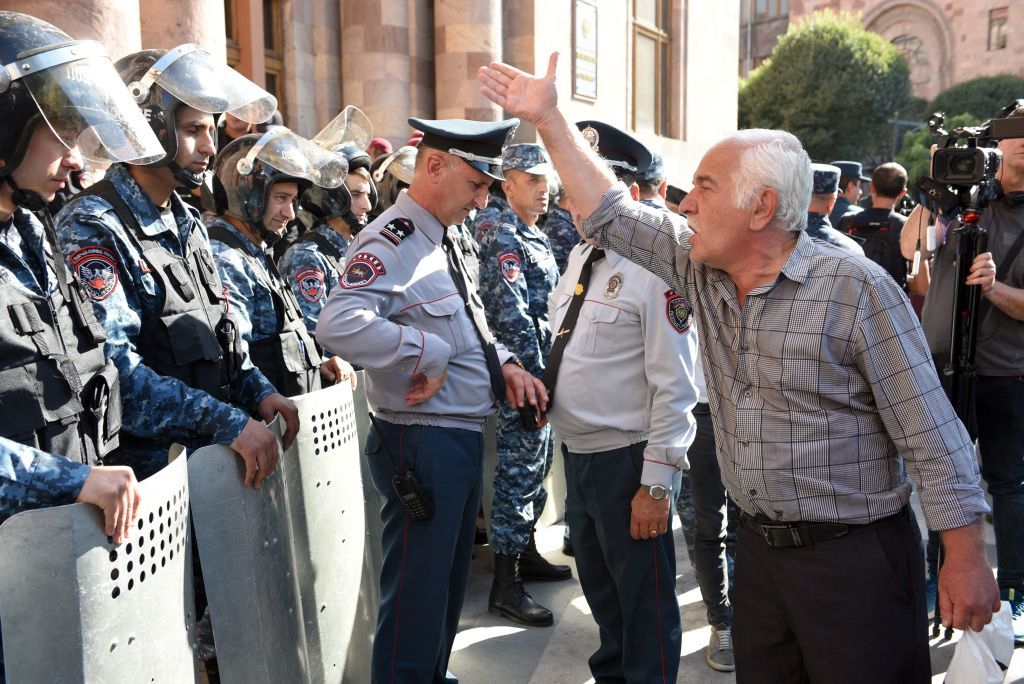 Protestors gather in downtown Yerevan on Sept. 20, 2023, as separatists in Nagorno-Karabakh and Azerbaijan’s authorities announced they would cease hostilities, signalling the end of an “anti-terror” operation launched just one day earlier by Azerbaijan’s forces in the breakaway region. (Photo by Karen Minasyan/AFP via Getty Images)
In behavior hardly befitting the image of a so-called ally, Russian officials and state media denied Moscow’s responsibility to intervene, laying blame squarely on Pashinyan, who had publicly criticized Armenia’s traditional strategic partnership with “indifferent” Russia earlier in September, and, for the first time since the full-scale war, sent humanitarian aid to Ukraine.
Published by opposition Russian outlet Meduza on Sept. 20, a leaked Kremlin directive instructed Russian state propaganda outlets to focus blame on Pashinyan, a former journalist who came to power at the head of a popular revolution that deposed pro-Russian leader Serzh Sargsyan in 2018.
According to Broers, Russia has now all but lost its leverage not only with Azerbaijan but in Armenia, where crowds marched on the Russian embassy in protest at Moscow’s failure to protect Armenians in Nagorno-Karabakh.
“I personally can’t see how a pro-Russian faction could keep power in Armenia,” he said. “The disappointment and anger with Russia is so great in Armenia now, that’s a long term phenomenon.”
Busy with its defense against Russia’s full-scale war, and with President Volodymyr Zelensky on a historic visit to the United Nations, Kyiv did not officially comment on the events in Nagorno-Karabakh.
Since independence, Ukraine has loosely aligned itself with Azerbaijan in the conflict, given the importance to Kyiv of territorial integrity as per the internationally-recognized borders of post-Soviet states.
Relations with Armenia, often seen in Ukraine through the lens of Yerevan’s partnership with Russia, soured significantly in 2014 when then-Armenian leader Sargsyan endorsed Russia’s illegal annexation of Crimea, a position which Pashinyan’s government refused to retract.
Commenting on the escalation in an interview to Ukrainska Pravda on Sept. 19, Oleksii Danilov, Secretary of Ukraine’s National Security and Defense Council, said that Armenia’s experience was a warning to other post-Soviet states still close to Russia.
Russia “is not a partner to any country,” Danilov said.
“This should be understood by all the Central Asian countries that still have direct relations with Russia. It simply abandons its partners, and it does not fulfill its commitments.”
Hi, this is Francis Farrell, cheers for reading this article. For once, a different war, but a war that features many of the themes of the one we see in Ukraine, and one common factor: Russia. We are always working to expand our coverage not only of Ukraine, but also of Eastern Europe and the Caucasus, where as in Ukraine, the legacy of Russian imperialism still looms. Please consider supporting our reporting.