
Day: September 23, 2023

Robert Ananyan
#Russia is currently waging a brutal war against Armenia’s independence, sovereignty, and democratic future. It’s doing this through open aggression and a false propaganda war. #Russia has handed over Nagorno #Karabakh to Azerbaijan, and now it’s trying to seize Armenia and deprive us of our sovereignty.
In the coming days, Russia will increase the volume of hybrid strikes against
#Armenia in order to cause internal civil conflict and bloodshed. Russia wants Armenians to kill #Armenians so that it can take away Armenia’s statehood.Russian spokesperson Maria Zakharova has revealed that Russia is also behind Azerbaijan’s
#military attack. In an interview with RT France, she said that many expectations about Nagorno-Karabakh were related to the mediation of #France and President Emmanuel Macron. “Look at what this has led to․ When Western ideology began to enter the situation, everything changed. This can be a lesson for anyone who was lean towards the West in mediation.”In other words,
#Moscow is openly saying that with Azerbaijan’s attack on September 19, it taught Armenia a lesson for lean towards the #West in mediation.Russia needed this war so that
#NagornoKarabakh and Azerbaijan could negotiate in the Russian format, not the Western one. Before this war, Nagorno #Karabakh Foreign Minister Sergey Ghazaryan was negotiating to meet with Azerbaijan in Western formats. Russia directly accused him of serving the #USA. Through the war, Russia forced Stepanakert to meet Azerbaijan in Yevlakh with the mediation of Russian peacekeepers.With this war, Russia and Azerbaijan deprived
#Stepanakert of negotiating with Baku through the mediation of the West. Days before Azerbaijan’s attack, Putin announced that he hoped that Azerbaijan would not subject Nagorno Karabakh to ethnic cleansing, and “that process” would be carried out in a soft way. At the time of Azerbaijan’s attack, Russia only expressed hope that the security of #RussianPeacekeepers would be ensured, while they themselves were obliged to provide security.According to Russia’s plan, Armenia should have intervened in Azerbaijan’s September 19 military attack against Nagorno Karabakh. Taking advantage of that fact, the
#Russian–#Azerbaijani alliance should have occupy Syunik and other territories of Armenia. And according to Russia’s plan, Armenia had to turn to Moscow for help, and as a rescue price, the #Kremlin planned to demand that Armenia pay with its independence.If Armenia resisted and didn’t ask for help from Moscow, the
#Russians had “PLAN B”. They would have already demanded that Azerbaijan be given the Zangezur corridor in #Syunik, on which Russian peacekeepers should be stationed. By the way, in the initial version of the statement of November 9, 2020, there was an idea of opening a corridor through the territory of Armenia, but Armenia refused to accept this compulsion of Putin and Aliyev.An attempt was made to capture the Russian-Azerbaijani corridor with the September 19 attack. But Armenia didn’t enter the war, and that plan wasn’t implemented. Under the pressure of Russia and Azerbaijan, the authorities of
#Artsakh / Nagorno Karabakh stated in the text of their statement that an agreement was reached to remove “the remaining units and military equipment of the Armed Forces of the Republic of Armenia” from Nagorno Karabakh.This is a testimony against Armenia, so that Azerbaijan continues its bellicose behavior already against Armenia. The next part of the Russian-Azerbaijani plan is that after the war unleashed by Azerbaijan and the occupation of Nagorno Karabakh, a large flow of people should begin from Nagorno Karabakh to Armenia. Armenia is ready to provide shelter for 40,000 families and take care of their needs.
However, I’m sure that Russia and the pro-Russian proxy forces of Armenia will try to use the emotions of people in this difficult situation to create chaos and destabilization.
Let’s hope that the people who will come to Armenia from Nagorno Karabakh in the near
#future will pay attention to this factor. I think Armenian society will accept these people very well, as they are our compatriots. But let’s hope that it will be possible to provide such an environment of security and protection of rights for the Armenians of Nagorno Karabakh that they will not be forced to undergo deportation or to leave their thousand-year-old homeland. Iwrote about this terrible scenario many times before, warning that Azerbaijan was planning a military attack against Nagorno Karabakh, but unfortunately, it was not possible to prevent this war.
Russia has handed over Nagorno Karabakh to Azerbaijan, and now it is trying to seize Armenia and deprive us of our sovereignty. By the way, the Russians talk openly about this. The vice-chairman of the Russian Security Council, Dmitry Medvedev, threatened the head of Armenia, accusing him of taking steps towards the West.
Yesterday, Yevgeny Feodorov, a deputy of
#Putin‘s “United Russia” party, announced that Armenia was weak and had lost.“Azerbaijan found allies in the form of Turkey, was able to neutralize Iran, and came to an agreement with Russia. I think Armenia will gradually cease to exist as an independent state, and before that, Russia will restore its control within the borders of 1945. We will also restore our control over that territory (Armenia). Yerevan will return to its previous position, when it was part of our historical reality. There will be a governorship or something else” said Feodorov.
This is a direct and open threat from Putin’s government to Armenia. The
#independence and #sovereignty of the Armenian state is at risk. Russia, the Russian peacekeepers of Nagorno Karabakh, and the pro-Russian forces of Armenia are also generating a large amount of #FakeNews for the purpose of causing chaos and destabilization.For example, on September 20,
#Russian peacekeepers invited thousands of Armenians who were displaced from their homes to #Stepanakert airport and promised to evacuate them to Armenia. But after some time, the Russian peacekeepers told them that Armenia refused to evacuate them from Nagorno Karabakh.My contacts with some Karabakh residents in Armenia show that they went to the streets of Yerevan for protests at the request of their relatives in Nagorno Karabakh. The residents of Nagorno Karabakh, who are still in a stressful situation under the threat of Azerbaijani occupation and death, tried to find solutions in
#Yerevan.But the Russians used the emotions of my compatriots living in Nagorno Karabakh to cause turmoil in Armenia. I will never forgive Russia for creating divisions between two parts of my nation.
Pro-Russian proxies also spread false news that
#Azerbaijanis entered Taghavard and other nearby villages and massacred them. That information was denied. Of course, Azerbaijan has committed many war crimes during this period, but the #news of mass massacres in Taghavard and nearby villages was a lie. Its purpose was to direct internal political upheavals to the people under war stress in Armenia.And of course, yesterday it turned out that the Ruply media led by Margarita Simonyan is covering Armenia’s protest actions live for Azerbaijan. This is a matter of national security. According to my information, the Russian technical team providing the live broadcast appeared at the NSS and was interrogated.
I don’t want to talk about the latest domestic political events in Armenia. Everything became more obvious when Kremlin propagandists Margarita Simonyan and Vladimir Solovyov called on Armenians to join the opposition rally in Republic Square. “Meduza” media also reported that the Kremlin instructed its media outlets to blame Armenia and the West for the September 19 war. These facts prove that Russia’s goal is to destroy Armenia’s independence.
As long as Russia does not carry out more aggressive and bloody actions against Armenia, the USA and the EU countries should provide military, security, intelligence, and economic support to Armenia. The plans of Russia and Azerbaijan to destroy the statehood of Armenia must fail. Armenia’s future is with the democratic and civilized world.
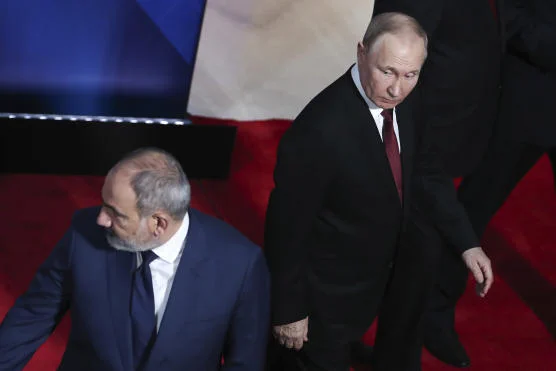
The News And Times Information Network – Blogs By Michael Novakhov – thenewsandtimes.blogspot.com
My Opinion: That’s right! That’s how you address the “ethnic minorities”, your neighbors: “brothers and sisters”. This is the correct tone, and that’s what Mr. Aliyev should say also. It takes time. He came closer to it. All ethnic groups of Caucasus are the “brothers and sisters” brought together by History. We started to understand this.

Georgian Prime Minister Irakli Garibashvili addressed Abkhazian and Ossetian “brothers and sisters” in his speech at the United Nations General Assembly on Friday and said only together with them Georgia could ensure lasting stability, attract increased investments and reach their full potential as a united nation.
Garibashvili noted it was their “common adversary” who opposed the unity of Georgians, Abkhazians and Ossetians.
We are an ingenious people, capable of incredible accomplishments, but only together can we ensure lasting stability, attract increased investments and reach our full potential as a united nation. We must not let this opportunity for a peaceful, stable and prosperous future together slip through our grasp”, the PM emphasised.
He also added that the progress that Georgia had made through the years clearly demonstrated the Government’s “efforts to create opportunities for all our citizens”, including those residing in the occupied territories of Georgia.
 image/jpeg 1120341.jpg image/jpeg 1120342.jpg image/jpeg 1120345.jpg image/jpeg 1120347.jpg
–

Georgian Prime Minister Irakli Garibashvili on Friday delivered a speech at the United Nations General Assembly in New York. Agenda.ge offers its readers the full speech of the Georgian official:
Mr. President, Secretary-General, Dear Colleagues, Dear Friends, It is an honour to address the United Nations General Assembly once again. I represent Georgia, a strong nation that values freedom, cherishes its rich heritage and embraces progress amid an ever-changing geopolitical landscape.
As you are aware, my country experienced a full-scale military aggression in 2008 and continues to endure its destructive consequences. This is still evident in the occupation of 20 percent of Georgian territory by the Russian Federation and the displacement of hundreds of thousands of people from their homes.
I confidently state that despite the devastation we’ve endured, we have not hesitated to pursue our ambitions. We have transformed Georgia into a dynamic society, fully committed to the realisation of the fundamental principles and values enshrined in the UN Charter.
Georgia understands the cost of war and recognizes the value of peace. Since 2012, our Government has built and maintained an uninterrupted decade of peace and stability.
I would like to take this opportunity to express our deep appreciation to the international community for the unwavering support to Georgia’s sovereignty and territorial integrity. To ensure our continued peaceful existence, I call on the international community to persuade the Russian Federation to engage with the “Geneva International Discussions” and fully implement the EU-mediated 2008 Ceasefire Agreement.
Thanks to our pragmatic foreign policy, we have sustained economic growth over the past decade. We continue to make critical investments to improve the quality of life for all Georgians. We have experienced double-digit economic growth for two consecutive years, with a GDP growth rate of over 10 percent in 2021 and 2022. This positive-growth trend has continued in 2023, with an average economic growth of 7 percent.
A substantial increase in GDP per capita is among my Government’s most significant achievements. Since 2012, GDP per capita has nearly doubled. We expect that this positive trend will continue. In addition, in July of this year, our official reserve assets reached a historic high, representing nearly a 90% growth in July 2023 compared to 2012. The unemployment and poverty rates are also at historical lows.
The World Justice Project’s 2022 Rule of Law Index places Georgia as the top ranking country in the Eastern Europe and Central Asia regions regarding the rule of law. According to the Fraser Institute’s report – Economic Freedom of the World 2022, Georgia is among the top 15 countries with the freest economies, while the Heritage Foundation Index of Economic Freedom 2023 places Georgia 21st in Europe, ahead of 11 EU member states. The [NUMBEO] Crime Index 2023 positions Georgia as one of the safest countries in the world, ranking 18th in the world and 8th in Europe.
My Government developed and approved “Vision 2030 – Development Strategy of Georgia” in 2022 — our country’s first long-term policy framework. The document outlines a comprehensive set of reforms, covering areas like economic functions, social progress, good governance, justice, and human rights protection, to implement by 2030.
While we work towards comprehensive, multifaceted progress, we also place significant emphasis on education and social welfare. The importance of robust education systems cannot be overstated, since they serve as the cornerstone for empowered, prosperous, and productive societies. We embrace education by allocating resources to enhance digital literacy and bridge the digital divide.
Our efforts extend to all levels of education. We have allocated up to 1 billion US Dollars to rehabilitate and construct schools and kindergartens across the country. We have increased investments in healthcare and social welfare. Currently, 95 percent of our population benefits from universal healthcare and we are continuously improving the quality of these services. We are determined to ensure the best possible care for all citizens.
Dear Friends, these successes are just a fraction of the progress my country has made, but they clearly demonstrate our efforts to create opportunities for all our citizens, including those residing in the occupied territories of Georgia.
To our Abkhazian and Ossetian brothers and sisters, it is our common adversary who opposes our unity. We are an ingenious people, capable of incredible accomplishments, but only together can we ensure lasting stability, attract increased investments and reach our full potential as a united nation. We must not let this opportunity for a peaceful, stable and prosperous future together slip through our grasp.
Each step we take seeks to bring Georgia back into the European family where it belongs. The remarkable achievements of our Government since 2012, including the EU Association Agreement (AA), the Deep and Comprehensive Free Trade Area (DCFTA) and the Visa-Free regime with the European Union, demonstrate our geopolitical priority to become an EU member state.
The recognition last June of Georgia’s European Perspective has opened a new chapter in our relationship with the European Union. Recent surveys show nearly 90 percent of Georgians support EU membership, and we have demonstrated unwavering commitment to address the 12 priorities set forth for EU Candidate Status. Through a rigorous, inclusive and transparent domestic implementation process involving all stakeholders, we are on-track to complete them this year.
Our achievements deserve a favourable decision from the EU. As a frontrunner among the so-called “Associated Trio” countries, Georgia has earned EU candidate status. We anticipate that Georgia’s performance and the current geopolitical context in the region will be fairly evaluated. Granting Georgia the candidate status is the only course of action.
Considering recent developments, I would like to emphasise the importance of the rules-based international order and the fundamental principles outlined in the UN Charter.
Georgia is a responsible member of the international community actively contributing to global peace. For more than two decades, we have made substantial contributions to NATO missions worldwide, making Georgia one of the largest per capita contributors to the NATO missions in Iraq and Afghanistan. 32 brave Georgian soldiers made the ultimate sacrifice in Afghanistan, while hundreds of others suffered injuries in the pursuit of freedom and peace. Georgia sacrificed greatly to protect our shared values and common interests.
We significantly contributed to the EU-led missions and honour that commitment.
Dear Friends, as we strive for peace, prosperity, progress, and sustainability for all, it is disheartening to witness aggression against a UN member state. The war in Ukraine reawakens the trauma of the 2008 war in Georgia.
We feel the pain and hardships that Ukraine currently faces and stand in full solidarity with the Ukrainian people.
We have sponsored, joined, and supported more than 500 resolutions, statements, joint statements and other initiatives by major international organisations and institutions to support Ukraine and Ukrainian people. Our Western partners, including the United States, EU, and UK, have repeatedly praised our compliance with all international financial sanctions.
My Government has been providing substantial humanitarian assistance to Ukraine and Ukrainian people since the beginning of the war, both in the country and to those currently residing in Georgia. Georgian schools have welcomed more than 2,200 Ukrainian students, ensuring that most of them receive education in the Ukrainian language while following the official Ukrainian curriculum.
Let me be clear – the fundamental philosophy of our Government is to avoid war and secure peace. Despite the challenges posed by our geographic location, we have managed to keep our people safe while supporting Ukraine and the international community through prudent policies and close coordination with our partners.
Through my Government’s Peaceful Neighbourhood initiative we are prepared to engage our neighbours and friends from Armenia and Azerbaijan to finally bring lasting peace to the South Caucasus.
Dear Friends, Georgia is emerging as a multi-dimensional regional hub. Our financial services sector has garnered global recognition and we are attracting international investors, infusing additional capital into our economy. We have also prioritised investments in our infrastructure to enhance connectivity, successfully harnessing logistics and energy sectors.
We are developing strategic transport corridors to establish crucial connections between Asia and Europe. Georgia’s participation in various international initiatives and infrastructure projects enhance connectivity, facilitating trade across the Black Sea region.
The Middle Corridor has emerged as a secure and reliable route connecting East with West. We signed comprehensive roadmaps with Azerbaijan and Kazakhstan, to eliminate bottlenecks and enhance the Middle Corridor from 2022 to 2027. These roadmaps provide for specific actions related to transport and logistics infrastructure development, operational optimization, the implementation of a unified tariff policy, corridor digitalization, and improvements to the regulatory framework.
In pursuit of enhancing East-West connectivity, Georgia established the Tbilisi Silk Road Forum in 2015 creating an international platform for dialogue among senior policymakers, businesses and community leaders. The upcoming Silk Road Forum is scheduled to take place in Tbilisi this year on October 26-27, bringing together approximately 2000 delegates, including high-ranking officials and business representatives from more than 60 countries.
Georgia has launched significant infrastructure projects, including the Railway Modernization Project. Upon its completion by the end of 2024, the throughput capacity of Georgian railways will double.
The construction of a new Anaklia Deep Sea Port, which is expected to start soon, is a top priority for my Government. This green-field PPP project will create a state-of-the-art deep-sea port on the Eastern coast of the Black Sea.
Our Government is improving air connectivity by building a new international airport in Tbilisi that will serve as a world-class transportation hub cementing Georgia’s status as a prominent player in global aviation.
Furthermore, the EU-flagship Black Sea Submarine Cable Project, initiated by Georgia, is currently underway. This Project involves the installation of a high-voltage submarine transmission grid to connect the South Caucasus region to Southeast Europe through the underwater cable. The implementation of the project will strengthen energy security in Europe and the South Caucasus region, will foster the development of renewable energy sources and create new opportunities for transit between these two regions.
While recognizing the increasing demand for energy, as well as the need to address climate change, we are actively pursuing new ventures in the field of renewable energy, including hydropower, wind, solar and other sustainable sources. Our objective is to attract investors and create a favourable environment for the establishment of innovative power plants, utilizing the Georgia’s abundant green energy potential.
All of these transformational projects will bring jobs, economic growth, and prosperity to our people and the region.
Dear Friends, Georgia has made significant progress since regaining independence. We remain dedicated to achieving even greater results for the Georgian people while making significant contributions to the global community. We stand ready to strengthen international partnerships and collaborations to ensure a more peaceful and sustainable future.
Our shared humanity binds us together and it is our collective responsibility to uplift one another and leave a lasting legacy for generations to come. Thank you very much!
The News And Times Information Network – Blogs By Michael Novakhov – thenewsandtimes.blogspot.com
Michael Novakhov’s favorite articles

The Azerbaijani government has begun arresting anti-war activists in the country following its offensive to take over Nagorno-Karabakh.
At least five people known for publicly criticizing the attack were arrested in the last few days, and one’s whereabouts is unknown.
In the weeks preceding the offensive, Azerbaijani state-run and government-aligned media had mounted a smear campaign against the country’s small community of anti-war voices that emerged after the Second Karabakh War in 2020.
The first reported detention was of former Azerbaijani diplomat Emin Shaig Ibrahimov. He was arrested on September 20 and placed in administrative custody for a month for “spreading prohibited information,” according to his lawyer Agil Layic.
Layic quoted his client as saying that he was taken from his home by plainclothes officers pretending to be utility workers, and that his house was raided without a warrant, with his laptop and cell phones confiscated.
“The real reason for his arrest is his use of social media for expressing his views and criticism,” Layic said, quoting his client.
Ibrahimov has long been known for his skeptical social media posts about Azerbaijan’s activities vis-a-vis Nagorno-Karabakh and Armenia. In his last Facebook post before his arrest, he reiterated his belief that Azerbaijan’s blockade of the only road connecting Nagorno-Karabakh to Armenia, its installation of a checkpoint on that road, and launch of the latest assault, were all agreed with Russia, which has peacekeeping contingent in the Armenian-populated region.
On the same day, another outspoken critic of Azerbaijan’s war efforts, Amrah Tahmazov, was put in jail for a month on the same charges. Tahmazov is known for his opposition to the 2020 war (in which Azerbaijan retook most of the territory it had lost in the first war in the 1990s) and the Azerbaijani government in general. In May too, he served a one-month administrative sentence after he wrote a Facebook post criticizing President Ilham Aliyev in defense of a fellow hunger-striking activist.
A day earlier, activist Javid Ahmadov was summoned to the State Security Service, and released after reportedly being interrogated for four hours about his anti-war stance.
Nemat Abbasov, another activist who is himself a veteran of the 2020 war, was detained on September 20 for a month on charges of disobeying the police. He had written on Facebook that “[a]ny mentality that legitimizes human deaths is stupid and wicked. Whatever their intention, thoughts that serve hatred, death, and any such concepts must be rejected.”
A day later, journalist Nurlan Gahramanli was arrested for a month on charges of spreading prohibited information. His friends who attended his hearing said he told the court that he had been beaten by officers of the prosecutor’s office. He is quoted as saying that he believes his arrest was because of his anti-war posts.
On September 13, before the offensive, Gahramanli had told VoA that he had been summoned to the State Security Service and threatened with rape for his posts condemning Baku’s apparent plans for a new offensive.
Another activist, Afiaddin Mammadov, was arrested on charges of hooliganism and intentionally causing damage to a person’s health. His supporters say it was a set-up. According to one fellow activist, he found himself in the vicinity of a person who had stabbed himself, he (Mammadov) was then punched in the face so he could not leave the scene and had the knife forcibly placed in his hand so it would have his fingerprints.
Another government critic, Movsum Mammadov, was reportedly summoned to the prosecutor’s office in Kurdamir, a town in central Azerbaijan, two days ago. His whereabouts have been unknown since then. In his most recent Facebook posts, he mocked the launch of the new war and lamented the loss of soldiers’ lives.
The Azerbaijani government has never been at ease with those calling for peace or criticizing the country’s stance on the Karabakh conflict. During the 2020 war, several peace activists were summoned to the State Security Service, though none were arrested at that time.
In September last year, following Azerbaijan’s attacks on Armenian territory, pro-government media started a campaign against oppositionists who condemned the offensive, calling them traitors. One young politician, Ahmad Mammadli, known for his anti-war calls, was placed in administrative detention at the time.
And most recently, on the eve of the latest offensive, Azerbaijani media resumed its smear campaign against anti-war activists.
“During the recent war [President] Aliyev has also continued his usual business of imprisoning his critics,” Altay Goyushov, historian and government critic, posted on X (formerly Twitter). “Several peace activists including Amrah Tahmazov were locked behind bars yesterday. Amrah is accused of violating the internet rules of Azerbaijan, which in the language of local authorities means that he caused troubles to Aliyev’s propaganda ring.”
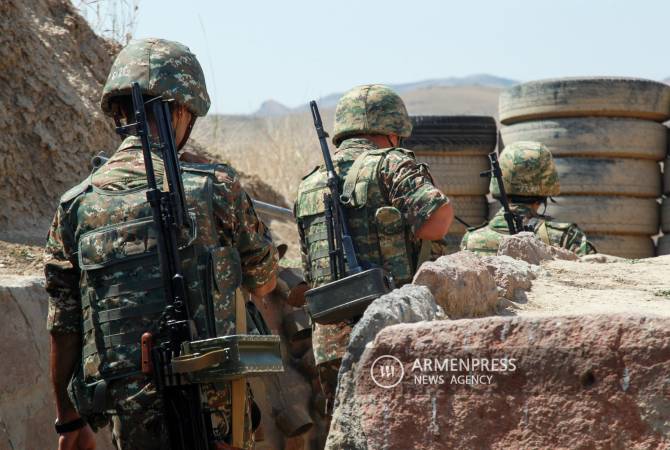 15:07, 22 September 2023
STEPANAKERT, SEPTEMBER 22, ARMENPRESS. Negotiations brokered by Russian peacekeepers are underway between Nagorno-Karabakh representatives and the Azerbaijani side on organizing a process of withdrawal of troops and ensuring the return of evacuated citizens to their settlements after the military aggression, the Nagorno-Karabakh InfoCenter reported.
The procedure of entering and exiting NK for citizens is also under discussion.

Selected Articles – The News And Times – 4:11 AM 9/23/2023
The Azerbaijani government has begun arresting anti-war activists in the country following its offensive to take over Nagorno-Karabakh. At least five people known for publicly criticizing the attack were arrested in the last few days, and one’s whereabouts is unknown. In the weeks preceding the offensive, Azerbaijani state-run and government-aligned…
15:07, 22 September 2023 STEPANAKERT, SEPTEMBER 22, ARMENPRESS. Negotiations brokered by Russian peacekeepers are underway between Nagorno-Karabakh representatives and the Azerbaijani side on organizing a process of withdrawal of troops and ensuring the return of evacuated citizens to their settlements after the military aggression, the Nagorno-Karabakh…
Police officers detain a demonstrator during a protest against Prime Minister Nikol Pashinyan in Yerevan on September 22. YEREVAN — Dozens of people have been detained as anti-government protests continued in the Armenian capital on September 22. Armenian police said after noon local time that 84 people had been detained and…
В традиционном выпуске программы Дипломатия с Тофиком Зульфугаровым поговорили о новых реалиях в регионе, которые соответственно требуют новых подходов и оценок. Спасибо Темуру Векуа за помощь в работе канала. Просьба вести себя прилично, комментировать по делу и не переходить на личности. Не забывайте о Правила Сообщества Youtube. Спасибо…
Published: 14:35 BST, 22 September 2023 | Updated: 14:48 BST, 22 September 2023 Vladimir Putin has lost one of his top nuclear submarine force commanders after his vehicle was hit by heavy machine gun fire while he was on a peacekeeping mission in Azerbaijan. Captain Ivan Kovgan, 52, was gunned down in the disputed Azerbaijani territory of Nagorno-Karabakh,…
You don’t have any notifications. Breaking News Subscribe News Alert Subscribe
I’m not a lawyer. I’m going to go out on a limb and guess that the majority of the Metropolitan’s readers are also not lawyers. And while there are a few exceptions, I know most of my Facebook followers aren’t lawyers. And yet, there are many people who seem to be so sure of their understanding about how a grand jury works, that they’re willing to…
NPR News: 09-22-2023 2PM EDT
With the ceasefire in Nagorno-Karabakh falling apart, and no deal between local leaders and the central government in Azerbaijan, the future of Armenians in the region remains precarious. While the vast majority of Armenian society, the Armenian foreign minister, as well as international observers are gravely concerned for their security, Prime…
It was Mao Zedong who said that “political power grows out of the barrel of a gun.” That harsh lesson certainly applies to the long-running battle between Armenia and Azerbaijan over the contested territory known as Nagorno-Karabakh — where Azerbaijan this week imposed its sovereignty by force of arms.For Armenians, who live in the long shadow of the…
Sending a UN peacekeeping mission to Nagorno-Karabakh is possible only with the decision of the UN Security Council. Stephane Dujarric, the representative of the UN Secretary General, said during a briefing. “Decisions regarding any peacekeeping mission are made by the UN Security Council,” he said, answering TASS’s question. Earlier, at the emergency…
The Azeri policemen were killed “on the territory of Azerbaijan, where Russian peacekeepers are temporarily stationed [under the trilateral statement].The truck was on its way to the site of the terrorist attack that took place on the same day at the 58th kilometer of the Ahmadbayli-Fuzuli-Shusha road passing through the Khojavand district, which killed…
With this piece of information from Ararat Petrosyan, the puzzle came together: the incident with the group of Azeri policemen “occurred within a demining area, suggesting that this was a planned provocation.” They were sent there, on purpose: Aliyev-2 needed a pretext, a casus belli, to justify the one day special operation: from 1PM on 9.19.23 to…
Georgian experts on Karabakh, JAMNews JAMnews
Turkish-Russian Joint Observation Center detects 258 cease-fire … Anadolu Agency | English
Pashinyan says Armenians should stay in Karabakh Eurasianet
Azerbaijan’s Foreign Minister Jeyhun Bayramov expressed special gratitude to the Turkic states for the support of the anti-terrorist measures carried out on the sovereign territory of Azerbaijan.
The News And Times Information Network – Blogs By Michael Novakhov – thenewsandtimes.blogspot.com

My Opinion: Russian peacekeepers look at these duties as the extended vacation (see video). UNSC mandated peacekeepers would be more preferable for both sides. They will be needed for a while. And there is no reason, why both sides, Armenian and Azeri, could not say to the Russians: “Thank you for your help, from now on we will manage by ourselves. Good By.” Russians may be happy to use these forces somewhere else. M.N.
Т. Зульфугаров: То, что произошло выгодно как Азербайджану, так и Армении
В традиционном выпуске программы Дипломатия с Тофиком Зульфугаровым поговорили о новых реалиях в регионе, которые соответственно требуют новых подходов и оценок.
The News And Times Information Network – Blogs By Michael Novakhov – thenewsandtimes.blogspot.com
NPR News: 09-22-2023 2PM EDT

With the ceasefire in Nagorno-Karabakh falling apart, and no deal between local leaders and the central government in Azerbaijan, the future of Armenians in the region remains precarious.
While the vast majority of Armenian society, the Armenian foreign minister, as well as international observers are gravely concerned for their security, Prime Minister Nikol Pashinyan says otherwise.
“At this moment, our assessment is that there is no direct threat to the civilian population of Nagorno-Karabakh,” Pashinyan said in a live address on September 21.
In a complete contradiction, Foreign Minister Ararat Mirzoyan told a UN Security Council meeting on the same day that “Azerbaijan’s intention is to complete the ethnic cleansing of the Armenian population of Nagorno-Karabakh.”
Since March 2021, access to Armenian-administered Nagorno-Karabakh has been tightly controlled by the Russian peacekeepers, making information difficult to verify. But three days after the beginning of Azerbaijan’s 2023 offensive, credible reports are starting to emerge of civilian casualties and war crimes. The prime minister’s statement triggered widespread outrage and led his critics to repeat their accusations of treason.
“I believe the PM was talking to the domestic audience and trying to avoid panic in Armenian society, while fighting against Russian state attempts to weaponize the suffering of the Armenians of Artsakh to bring down democratic governance in Armenia. He failed in doing so and even angered many of his own supporters,” analyst Eric Hacopian told Eurasianet.
The timing of the statement, right before the UN Security Council meeting, couldn’t have come at a worse time, according to human rights attorney Sheila Paylan. “The statement is puzzling, and also obviously untrue.”
“Perhaps in trying to calm people down, the prime minister thought he needed to make that statement,” she told Eurasianet, noting the angry protests on the streets of Yerevan.
As of September 20, the de facto Karabakh authorities were counting 200 people killed and over 400 wounded. The streets of Stepanakert are filled with “displaced people, hungry, scared, and in uncertainty,” said Karabakh Human Rights Ombudsman Gegham Stepanyan.
According to Stepanyan, his office has received more than 600 cases of people missing in the region, as of September 22nd.
“Lack of communication made it almost impossible to find them or find out whether they were killed or not. Residential areas are cut off from each other, people’s fates are unknown,” former Armenian human rights defender Arman Tatoyan said. There have been reports of a bounty of $500 being placed on the head of a particular Karabakhi Armenian woman on an Azerbaijani Telegram channel. She is to be given to a man named “Murad” as a birthday present, the alleged Telegram post reads.
Some Armenians on social media recalled video evidence of atrocities by Azerbaijani troops against female Armenian soldiers during Baku’s incursions into Armenian territory in September 2022.
Against this backdrop, many found the prime minister’s comment about Armenians not being under threat in Karabakh inexplicably tone-deaf.
He did say in the same remarks, however, that his government was prepared to handle an influx of 40,000 families from Karabakh (which should roughly cover the region’s entire population that Armenian sources estimate at 120,000).
So far there has been no sign of Karabakh Armenians leaving through the Lachin corridor, the only route connecting Nagorno-Karabakh to Armenia. Azerbaijan has been tightly restricting and at times completely closing the corridor in one form or another for the past nine months, resulting in acute shortages of food and supplies.
“It’s not opening anytime soon,” said journalist Shant Khatcherian, who is standing by on the Armenian side of the border alongside other journalists, NGO representatives and Armenians who have relatives in Karabakh.
Meanwhile in Armenia, today marks the fourth straight day of protests. Roads have been blocked and dozens of people have been arrested. While the anger against Russia, the European Union, and other international institutions has been palpable, many Armenians are looking closer to home for someone to blame.
Fin DePencier is a journalist based in Yerevan
It was Mao Zedong who said that “political power grows out of the barrel of a gun.” That harsh lesson certainly applies to the long-running battle between Armenia and Azerbaijan over the contested territory known as Nagorno-Karabakh — where Azerbaijan this week imposed its sovereignty by force of arms.
For Armenians, who live in the long shadow of the 1915 Ottoman genocide, the plight of an estimated 120,000 ethnic Armenians in Karabakh has been haunting. Lacking the military power to rival Azerbaijan — and without protection from Russia, the United States or even Armenia itself — the Karabakh Armenians were forced to surrender in two days.
Representatives of the Armenian government that had been running Karabakh met Thursday with Azerbaijani representatives for what officials in Baku said were “constructive” talks. The meeting was evidence that Azerbaijan was reestablishing authority over territory it had controlled legally, but not in fact, and that Karabakh Armenians were submitting to the new political reality they had long hoped to avoid.
At least 200 Karabakh Armenians died in the fighting that began Tuesday, according to local reports, as Azerbaijani artillery pounded Karabakh’s small military force and Baku’s commandos seized strategic high ground. Armenian social media carried wrenching stories about families searching for missing children and thousands gathered at the airport in Stepanakert, the region’s de facto capital, hoping to flee.
Follow this authorDavid Ignatius’s opinions
Azerbaijani President Ilham Aliyev made a televised address Wednesday night that seemed intended to stem a flight of Armenian residents who fear that Baku plans to “ethnically cleanse” the territory. He said that Armenian residents would be treated as “citizens” and that Baku would pursue only “criminal” separatists.
Armenian Prime Minister Nikol Pashinyan’s decision to stay out of the conflict has brought intense criticism inside Armenia from those who feel Pashinyan abandoned his ethnic brethren. Even some of those critics conceded in interviews Thursday that Yerevan lacked the firepower to combat Aliyev’s takeover. Armenia was badly outgunned in the 2020 war that reversed nearly three decades of Armenian control of the region, and this mismatch has only grown worse.
Global power politics overlay this week’s dramatic events. The Karabakh turmoil results in part from the vacuum in the region caused by Russia’s preoccupation with Ukraine. Moscow had a small, 2,000-member peacekeeping force in Karabakh that was supposed to prevent conflict. The Russians proved powerless, and Russia said some of its soldiers were killed by Azerbaijani fire this week.
Armenia, which has relied for a century on Russian protection, had begun doubting Moscow and started pivoting to the West this year, hoping for more reliable allies. The Biden administration offered diplomatic help in trying to broker a settlement between Baku and Yerevan, but without effect. The Pentagon this month sent roughly 100 U.S. soldiers to Armenia to train its military, nominally for peacekeeping operations, but they departed on schedule as the assault on Karabakh was underway.
Armenia’s pivot West was probably badly timed. It alienated the Russians without bringing reliable Western help. The Armenians, especially in Karabakh, were isolated and vulnerable — waiting for foreign deliverance that never came. In that respect, it was a cruel recapitulation of modern Armenian history.
The Biden administration has tried for the past two years to prevent a violent resolution of the Karabakh problem by seeking a durable peace deal between Baku and Yerevan. That effort seemed to be progressing, but in the end, Baku decided to gain sovereignty by force rather than negotiation. After the assault began, Secretary of State Antony Blinken called Aliyev and urged a ceasefire, which followed soon after.
The armed takeover of Karabakh has been coming in slow motion since Azerbaijan won a 2020 war for control, reversing the breakaway status Armenian troops had won in battle in 1994. Armenians in the enclave had hoped for some form of independence rather than a compromise deal with Baku, which retained authority under international law. It never came. Azerbaijan, flush with oil wealth, grew stronger year by year. Eventually, the hammer fell.
Azerbaijan began a slow strangulation of Karabakh in December, when a government-backed organization closed the road to Armenia, known as the “Lachin Corridor.” Karabakh was gradually starved of food and fuel — and by this month, basic supplies of flour and other essentials were said to be exhausted. That’s when Aliyev struck militarily.
The Biden administration’s policy now is to prevent the ethnic cleansing that Armenians fear. Blinken is said to have urged Aliyev to grant what amounts to amnesty to the Karabakh Armenians and provide reliable guarantees for their security. The United States also hopes that a lasting accord between Armenia and Azerbaijan will be possible now that the Karabakh issue has been resolved at gunpoint. But that overlooks the deep mistrust and anxiety felt by Armenians, which will only increase after this week’s armed takeover.
Karabakh lies at one of the world’s most dangerous intersections, where the ghosts of the past stalk every living resident. An example of this bloodknot is the 1937 novel “Ali and Nino,” set partly in the mountain forests of Nagorno-Karabakh. It opens with a professor in Baku asking his students whether the surrounding region “should belong to progressive Europe or reactionary Asia.” A charming Azerbaijani prince who is one of the heroes of the story opts for Asia and forms a love match with a Georgian princess. It’s a love story, but it’s animated by the conflict between East and West. The darkest passages of the book take place in the “black garden” of Karabakh.
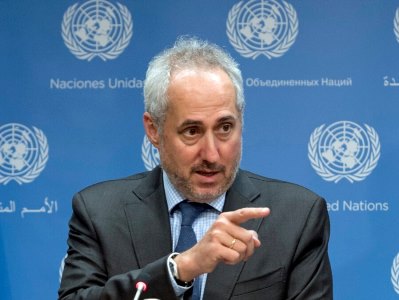
Sending a UN peacekeeping mission to Nagorno-Karabakh is possible only with the decision of the UN Security Council. Stephane Dujarric, the representative of the UN Secretary General, said during a briefing.
“Decisions regarding any peacekeeping mission are made by the UN Security Council,” he said, answering TASS’s question.
Earlier, at the emergency session of the UN Security Council dedicated to the situation in Nagorno-Karabakh, Armenian Foreign Minister Ararat Mirzoyan had said that it is necessary to create an opportunity for UN-mandated peacekeeping forces to maintain security and stability in Nagorno-Karabakh.

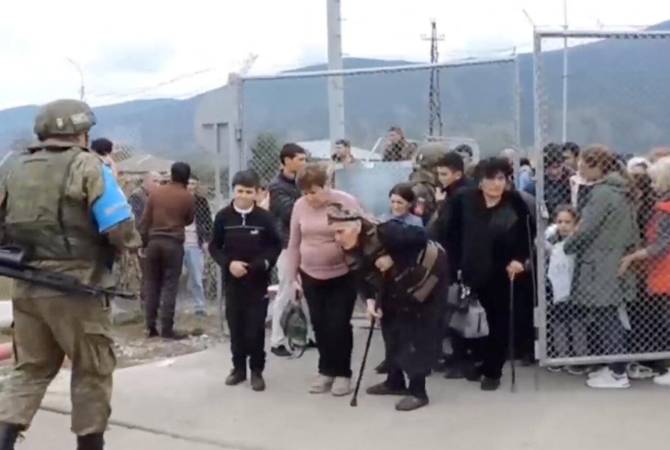
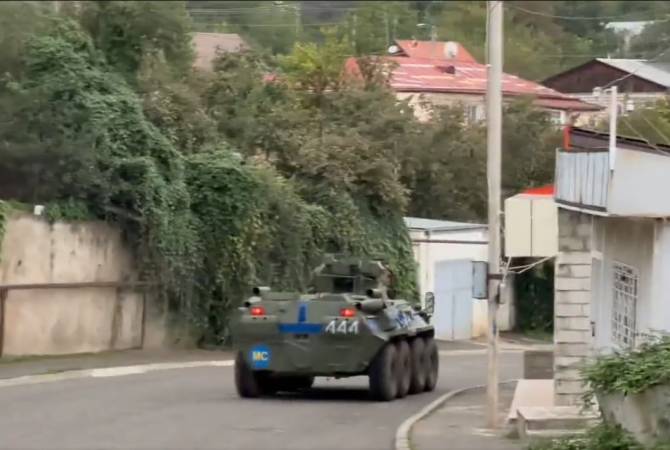

The Azeri policemen were killed “on the territory of Azerbaijan, where Russian peacekeepers are temporarily stationed [under the trilateral statement].
The truck was on its way to the site of the terrorist attack that took place on the same day at the 58th kilometer of the Ahmadbayli-Fuzuli-Shusha road passing through the Khojavand district, which killed employees of the State Road Agency of Azerbaijan.” See also GS – Azerbaijani police officers killed as result of Armenian terror. It looks like a two steps trap, and it reminded me of the similar traps on police in the US. The common denominator might be the Wagner Group, possibly still working with the Russian peacekeepers in the South Caucasus. The Invisible Russian Hand (of the GRU) appears to be likely, and the aims may be several and intertwined: revenge for the Pashinyan’s betrayal, distraction from the Ukraine War criticism, etc. The rifle (sniper?) attack on the group of Russian peacekeepers might have been a response to killing of the Azeri policemen. Curiously enough, one of the Russians killed was a commanding submarine officer in the Baltic Fleet.
M.N.
posted at 17:49:51 UTC via warsawinstitute.org
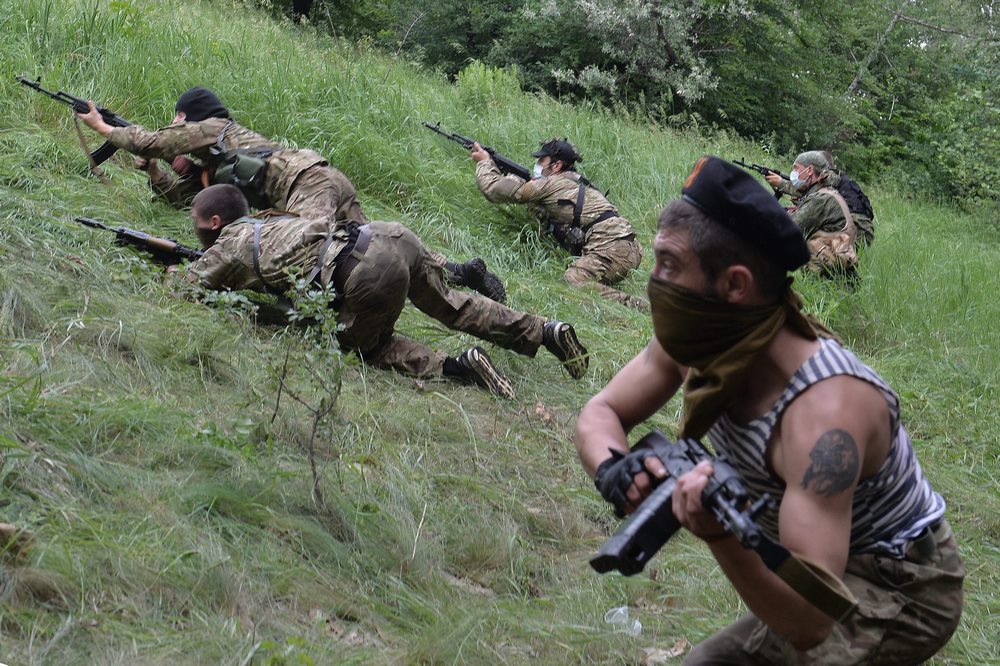 Donetsk, eastern Ukraine, June 1, 2014. Pro-Russian militants from the battalion ‘Vostok’ participate in a military exercise at their training base near. At least two people were reported dead and eight injured as fighting resumed 31 May 2014 between Ukrainian security forces and militant separatists in the country’s east. NATO’s 28 ambassadors are to meet their Russian counterpart in Brussels on 02 June to discuss the security situation in and around Ukraine in the first meeting since the alliance decided in March to suspend all practical cooperation with Moscow due to the crisis in Ukraine. © VALENTINA SVISTUNOVA (PAP/EPA)

NPR News: 09-22-2023 2PM EDT
With the ceasefire in Nagorno-Karabakh falling apart, and no deal between local leaders and the central government in Azerbaijan, the future of Armenians in the region remains precarious. While the vast majority of Armenian society, the Armenian foreign minister, as well as international observers are gravely concerned for their security, Prime…
It was Mao Zedong who said that “political power grows out of the barrel of a gun.” That harsh lesson certainly applies to the long-running battle between Armenia and Azerbaijan over the contested territory known as Nagorno-Karabakh — where Azerbaijan this week imposed its sovereignty by force of arms.For Armenians, who live in the long shadow of the…
Sending a UN peacekeeping mission to Nagorno-Karabakh is possible only with the decision of the UN Security Council. Stephane Dujarric, the representative of the UN Secretary General, said during a briefing. “Decisions regarding any peacekeeping mission are made by the UN Security Council,” he said, answering TASS’s question. Earlier, at the emergency…
The Azeri policemen were killed “on the territory of Azerbaijan, where Russian peacekeepers are temporarily stationed [under the trilateral statement].The truck was on its way to the site of the terrorist attack that took place on the same day at the 58th kilometer of the Ahmadbayli-Fuzuli-Shusha road passing through the Khojavand district, which killed…
With this piece of information from Ararat Petrosyan, the puzzle came together: the incident with the group of Azeri policemen “occurred within a demining area, suggesting that this was a planned provocation.” They were sent there, on purpose: Aliyev-2 needed a pretext, a casus belli, to justify the one day special operation: from 1PM on 9.19.23 to…
Georgian experts on Karabakh, JAMNews JAMnews
Turkish-Russian Joint Observation Center detects 258 cease-fire … Anadolu Agency | English
Pashinyan says Armenians should stay in Karabakh Eurasianet
Azerbaijan’s Foreign Minister Jeyhun Bayramov expressed special gratitude to the Turkic states for the support of the anti-terrorist measures carried out on the sovereign territory of Azerbaijan.
Israel and Saudi Arabia are at the cusp of an historic peace, Israeli Prime Minister Benjamin Netanyahu said, Report informs via foreign media.
The creation of new transport infrastructure in the territories liberated from occupation, including with the start of the Zangazur Corridor, will play a decisive role in the opening of a new transport hub along the Middle Corridor, Azerbaijani Foreign Mi
Members of the illegal Armenian armed formations in Karabakh are surrendering their weapons based on the agreements reached at the meeting in Yevlakh.
Opinion | Azerbaijan waited for its opening on Nagorno-Karabakh. This week it found it. The Washington Post
Ethnic Armenian separatists and Azerbaijan agree to end fighting in … WJCT NEWS
‘Genocide is being committed’: Armenians protest after Nagorno-Karabakh violence – video The Guardian
FM Fidan meets Israeli, OTS counterparts in New York | Daily Sabah Daily Sabah
Ukraine war latest: Five to be charged in UK with spying for Russia … Sky News
Activists against war Since September 19, four activists and a journalist who spoke out against military actions in Karabakh have been arrested in Azerbaijan on various charges. Despite statements by law enforcement agencies that all of these individuals were arrested for specific acts, they themselves, as well as human rights activists, claim…
Natik Jafarli on the counter-terrorist operation Azerbaijani society continues to discuss the September 19-20 counter-terrorist operation in Karabakh. According to opposition politician, one of the leaders of the Republican Alternative party Natik Jafarli, the operation was carried out professionally and in the shortest possible time. He also…
Azerbaijan leader apologized to Putin for peacekeeper deaths in Nagorno-Karabakh Al Arabiya English
Donetsk, eastern Ukraine, June 1, 2014. Pro-Russian militants from the battalion ‘Vostok’ participate in a military exercise at their training base near. At least two people were reported dead and eight injured as fighting resumed 31 May 2014 between Ukrainian security forces and militant separatists in the country’s east. NATO’s 28 ambassadors are…
BAKU, Azerbaijan, September 19. Photos of Azerbaijani police officers killed as a result of Armenian terror have been released, Trend reports. On September 19, 2023, at 04:30 (GMT+4), as a result of a terrorist act, on a newly built tunnel road near the village of Taghavard in Khojavand district, a KAMAZ truck carrying employees of the Ministry…
By Ararat Petrosyan, Deputy Editor in Chief of Armenpress We will examine recent events, specifically the wars of September 27, 2020, and September 19, 2023, to expose the false pretexts behind military operations in Artsakh and the aggression against civilian populations. The Deception of September 27, 2020: On September 27, 2020, Azerbaijan blatantly…
NPR News: 09-22-2023 9AM EDT
Unmasking Azerbaijan’s Pattern Of Deception And Aggression GreekCityTimes.com
Talks have opened on the future of Nagorno-Karabakh as … Spectrum News NY1
Abandoned combat position near the Janyatag settlement of the Terter region – VIDEO Abandoned combat position near the Janyatag settlement of the Terter region – VIDEO …
The powerful armed forces of Iran are present in the region to prevent any changes in the geopolitics of the region and changes in the borders, and they have succeeded in this task, Iranian President Ebrahim Raisi said at the military parade on the occasion of Sacred Defense Week, according to the President’s website. “Regarding the developments…
Azerbaijan troops ‘all around’ Nagorno-Karabakh separatist stronghold Al Jazeera English
Armenia ready for 40,000 families after Nagorno-Karabakh surrender BBC
Karabakh Armenians: No Agreement Yet With Azerbaijan on … U.S. News & World Report
Mass unrest organized by the opposition with the aim of overthrowing the Armenian government continues unabated in Yerevan, Report informs via Caliber.az.
Opposition members and civic activists are holding a protest rally in front of the Parliament building, where today’s parliamentary session will see the Minister of Economy and Sustainable Development, Levan Davitashvili, address the MPs regarding the the Anaklia Deep Sea Port, along with Minister of Internal Affairs, Vakhtang Gomelauri, who was summoned…
Anti-government protesters block streets in Armenia capital FRANCE 24 English
Tony Blair faces fresh scrutiny over Azerbaijan PR work amid Nagorno-Karabakh offensive POLITICO Europe
Azerbaijan eyes amnesty for Karabakh Armenian fighters Shepparton News
Talks are held on Nagorno-Karabakh’s fate as Azerbaijan claims full … Spectrum News
Azerbaijan is close to taking control of Nagorno-Karabakh The EconomistAfter Surrender in Nagorno-Karabakh, Leaders Discuss Armenians’ Fate The New York TimesWhy have there been clashes over control of Nagorno-Karabakh? CNN
Azerbaijan launches operation against Armenian forces in Nagorno-Karabakh CNN International
President Ilham Aliyev`s address to nation in spotlight of Moldovan … AZERTAC News
Turkish, Iranian Foreign Ministers Say Era of Conflict in Caucasus … Hetq Online
Nagorno-Karabakh Armenians seek guarantees before disarming … The Christian Post
Nikoloz Shurga, the CEO of PASHA Bank OJSC’s subsidiary in Georgia, has resigned, Report informs.
Azerbaijan will provide support to the Armenian population of the Karabakh region, Spokesman of the Azerbaijani Foreign Ministry Aykhan Hajizada said in an interview with Al-Jazeera.
Исполнительный секретарь «Грузинской мечты» Мамука Мдинарадзе заявил, что ради спасения финансовой системы парламентское большинство проголосовало бы за любого кандидата в члены правления Совета Нацбанка, которого представила бы президент. «Национальный банк и финансовая система были спасены», — утверждает политик. Мдинарадзе также указал, что не видит…
Azerbaijani side is ready to provide medical assistance to wounded servicemen of Armenian origin or help them through the ICRC, Hikmat Hajiyev, Assistant to President of Azerbaijan – Head of the Foreign Policy Affairs Department of the Presidential Admini
Designated European Union Special Representative for the South Caucasus and the Crisis in Georgia Toivo Klaar will visit Azerbaijan in the coming days
In January-August 2023, investments in fixed assets in Azerbaijan amounted to 10.864 billion manats, an increase of 15.4% compared to the same period last year, Azernews reports.
Iran says thousands of ancient clay tablets returned from US Al-Monitor
Today, Parliament of Georgia adopted the controversial Defense Code in the 3rd hearing with 80 votes. The overhaul of compulsory military service is a central element of the new code. Under the revised Defense Code, effective from 2025, all conscripts will be under the exclusive jurisdiction of the Ministry of Defense, departing from previous…
Six vehicles of the International Committee of the Red Cross (ICRC) are moving from Khankandi to Khojavand, Report informs.
The Central Bank of Azerbaijan (CBA) and the World Bank (WB) discussed the elaboration of the new Country Partnership Framework for Azerbaijan (2023-2028), CBA Chairman Taleh Kazimov said on X, Report informs.
In Shusha, a tractor was hit by a mine in the area under the control of the Azerbaijani Army, and one person was injured, Report informs, citing the Ministry of Internal Affairs and the Press Service of the Mine Action Agency of the Republic of Azerbaijan
Michael Novakhov’s favorite articles on InoreaderArmenian PM hopes ethnic Armenians can remain in Nagorno-Karabakhposted at 11:39:03 UTC via theguardian.comArmenia’s prime minister, Nikol Pashinyan, has expressed hopes that ethnic Armenians can stay in Nagorno-Karabakh amid fears that Azerbaijan, which says it controls the region after a military offensive…
“The current government sees the future of Georgia in Russia. The vast majority of the Georgian people do not want this. Society supports the Western governance system,” said Saba Buadze, a functionary of the Lelo Party, at a protest action held by the Ge
During the anti-terrorist activities carried out by the Azerbaijani Army in Karabakh, the illegal Armenian armed groups left their positions near the Galaychilar village of Aghdam, abandoning a large number of weapons and ammunition.
Azerbaijani side is ready to provide medical assistance to wounded servicemen of Armenian origin or help them through the ICRC, Hikmat Hajiyev, Assistant to President of Azerbaijan – Head of the Foreign Policy Affairs Department of the Presidential Admini
According to the plan of military cooperation between the Ministry of Defense of the Republic of Azerbaijan and the Ministry of National Defense of the Republic of Türkiye, the International Military Cooperation Department hosted a meeting of experts spec
Designated European Union Special Representative for the South Caucasus and the Crisis in Georgia Toivo Klaar will visit Azerbaijan in the coming days
NPR News: 09-22-2023 8AM EDT
Opinion | A genocide is unfolding in Nagorno-Karabakh – The … The Washington Post
Talk to Coldhearted Criminals The Atlantic
Prime Minister Nikol Pashinyan received Toivo Klaar, the special representative of the European Union for the South Caucasus and the Crisis in Georgia. The head of the EU delegation to the Republic of Armenia, Ambassador Vassilis Maragos also participated in the meeting. The military-political situation created around Nagorno-Karabakh…
PM Pashinyan, EU’s Toivo Klaar discuss military-political situation … Public Radio of Armenia
A new print edition of the AZERNEWS online newspaper was released on September 22.
Since the new academic year, the “Mother Tongue – Azerbaijani School” project has begun distance learning, Azernews reports.
When the Azerbaijani army carried out local anti-terrorist measures in Garabagh, illegal Armenian armed formations fled, abandoning a significant amount of weapons and ammunition in positions near the village of Galaychilar, Aghdam district.
European Union Special Representative for the South Caucasus Toivo Klaar will visit Azerbaijan in the coming days, Azernews reports with reference to the Ministry of Foreign Affairs of Azerbaijan.
Nagorno-Karabakh: talks on the Armenians’ future Eurotopics
EU Special Representative for S.Caucasus to visit Azerbaijan AzerNews.Az
Warm relations between Azerbaijan and Kazakhstan have ancient roots
(MENAFN – The Peninsula) AFP Vatican City: Pope Francis heads Friday to Marseille for a two-day visit focused on the Mediterranean and migration, and bringing a message of tolerance amid bitter …
Le mani azere sul Nagorno Karabakh: 24 ore di guerra dopo un … L’HuffPost
OPINION – Armenia’s “Gray zone” tactics in Karabakh region Anadolu Agency | English
По словам исполнительного секретаря «Грузинской мечты» (ГМ) Мамуки Мдинарадзе, бывший генпрокурор Отар Парцхаладзе, попавший под санкции США и разоблаченный в связи с ФСБ России, был вызван на опрос в рамках начатого расследования. О других подробностях расследования Мдинарадзе умолчал. При этом он отметил, что проверил указанную информацию после интервью…
444 Days: The Story of the Iran Hostage Crisis The Collector
The price of a hostage deal with Iran is more terrorism — and trouble for America The Hill
Why new fighting in Azerbaijan’s troubled region may herald a new … Spectrum News
Concerns Grow For Humanitarian Situation Of Nagorno-Karabakh … Radio Free Europe / Radio Liberty
The Mother See of Holy Etchmiadzin has decided to postpone the Blessing of the Holy Muron scheduled for October 1 given the difficult situation created around Artsakh. The decision was made at the meeting of the Supreme Spiritual Council chaired by His Holiness Karekin II, Supreme Patriarch and Catholicos of All Armenians. It was also…
Bulgarian Ambassador to Moscow Atanas Krastin will be summoned to the Russian Foreign Ministry over the expulsion of Russian Orthodox priests from that country, Russian envoy to Sofia Eleonora Mitrofanova told the Rossiya-24 TV channel, Report informs, ci
Two people were killed and two injured in a shooting at a restaurant in eastern Sweden late on September 21 that police said appeared to be part of an escalating spiral of violence among criminal gangs
Palestinian Foreign Minister Riyad al-Maliki intends to travel to Moscow on a working visit in the near future, the parties are discussing dates
“The current government sees the future of Georgia in Russia. The vast majority of the Georgian people do not want this. Society supports the Western governance system,” said Saba Buadze, a functionary of the Lelo Party, at a protest action held by the Ge
In January-August of this year, 1,343,700 people from 183 countries came to Azerbaijan, or 33.8% more foreigners and stateless persons compared to the same period last year, Report informs, citing the State Statistics Committee.
A Baku court ruled on September 21 to arrest a coordinator of Azerbaijan’s Alternative Confederation of Trade Unions, Afiaddin Mammadov, and placed him to pretrial detention for two months.
Russia will compensate for damage from inaction in Karabakh by … Robert Lansing Institute
Azerbaijan State Academic National Drama Theater invites theater lovers to enjoy a play “Oh, this long love road” on September 24.
Հետևե՛ք NEWS.am-ին սոցիալական ցանցերում՝ Telegram – https://bit.ly/newsamtl Facebook – http://bit.ly/2KnWOhr Twitter – http://bit.ly/2x2ixml Instagram – http://bit.ly/2x2jefr NEWS.am Style – http://bit.ly/2Ncs5EA Տեսացանկեր՝ ԼՈՒՐԵՐԻ ԹՈՂԱՐԿՈՒՄ – https://bit.ly/3KqTPD4 ՈՒԺԻ ԳՈՐԾՈՆ | FACTOR OF POWER – https://bit.ly/3KqTPD4 Օրվա գլխավոր լուրերը՝…
Tərtər rayonu Canyataq yaşayış məntəqəsinin yaxınlığında tərk edilmiş döyüş mövqeyi – VİDEO https://mod.gov.az/az/news/terter-rayonu-canyataq-yasayis-menteqesinin-yaxinliginda-terk-edilmis-doyus-movqeyi-video-49470.html ____ Оставленная боевая позиция близ населенного пункта Джанъятаг Тертерского района – ВИДЕО https://mod.gov.az/ru/news/ostavlennaya-boevaya-poziciya-bliz-naselennogo-punkta-dzhanyatag-terterskogo-rajona-video-49471.html…
posted 6h ago by Azərbaycan Respublikası Müdafiə Nazirliyi via Azərbaycan Respublikası Müdafiə Nazirliyi
Azerbaijan says civilians can safely leave Nagorno-Karabakh Al Arabiya English
As Azerbaijan regains control of Nagorno-Karabakh, ‘most acute … news.com.au
Since the beginning of the year, Ukraine has received financial assistance from the EU for 13.5 billion euros
A number of EU countries spoke out against Azerbaijan at a meeting of the UN Security Council, guided solely by the fact that Armenia is a Christian country
“Azerbaijan envisages amnesty for Garabagh Armenian fighters who surrendered their weapons, although there were some Garabagh military units that said they would continue resistance,” Hikmet Hajiyev, assistant to the Azerbaijani president – head of the foreign policy department of the presidential administration – told Reuters, Azernews reports.
Armenia’s prime minister, Nikol Pashinyan, has expressed hopes that ethnic Armenians can stay in Nagorno-Karabakh amid fears that Azerbaijan, which says it controls the region after a military offensive this week, is seeking to push out tens of thousands of people.Speaking during a government meeting in Yerevan, Pashinyan said Armenia would welcome…
Representatives of Nagorno-Karabakh have met with Azerbaijani officials in the central Azerbaijani city of Yevlakh, to discuss the future of the region following Nagorno-Karabakh’s surrender. Thursday’s meeting reportedly lasted around three hours, with further meetings expected in the days and weeks ahead. The discussions were said to involve the…
Ukraine war latest: Biden welcomes Zelenskyy to White House … Sky News
Establishment of ceasefire doesn’t mean Azerbaijan no longer seeks to drag Armenia into military operations, warns PM ARMENPRESS
Azerbaijan sees possible amnesty for Karabakh fighters who lay … Colorado Springs Gazette
Azerbaijan sends food, other aid to Nagorno-Karabakh after ending an offensive against Armenians The Associated Press
Azerbaijan claims big advance in Nagorno-Karabakh as civilians … POLITICO Europe
OSCE Chairman-in-Office, the Minister of Foreign Affairs of North Macedonia Bujar Osmani, held separate meetings yesterday with the Minister of Foreign Affairs of Azerbaijan, Jeyhun Bayramov, and the Minister of Foreign Affairs of Armenia, Ararat Mirzoyan, on the margins of the UN General Assembly. Chairman Osmani raised his deep concerns over…
The authorities of the Republic of Artsakh have agreed to the proposal of the Russian peacekeepers to establish ceasefire from 1 pm today. Artsakh President’s staff said in a statement the analysis of the actions of the Armed Forces of Azerbaijan shows that they aim at dividing Artsakh and causing irreparable damage to its vitality. “During…
U.S. joint exercise in Armenia to end on Wednesday as planned … Reuters
Armenia Says 32 Killed, Over 200 Wounded In Azerbaijan Operation Barron’s
Azerbaijan and Armenian forces reach cease-fire deal for breakaway Nagorno-Karabakh, reports say KPRC Click2Houston
Azerbaijan and Armenian forces fight for 2nd day over the breakaway region of Nagorno-Karabakh WIVB.com – News 4
“Illegal armed formations in Karabakh pose a serious threat to the lives of hundreds of our people every day. About 10,000 illegal militants have been present in that area for nearly three years,” Representative of the President of the Republic of Azerbai
Four people have died in a gas explosion in a nine-story residential building in the Moscow Region’s Balashikha in Russia, four others were injured and two remain under the rubble
Introduces Sanctions Act Revoking the President’s Authority to Waive Section 907, Providing Direct U.S. Aid to Artsakh WASHINGTON – Senate Foreign Relations Committee Chairman Bob Menendez introduced legislation today to revoke the President’s authority to waive Section 907 of the FREEDOM Support Act and enact U.S. sanctions against President…
Azerbaijan and representatives of Nagorno-Karabakh’s de-facto Armenian government have begun re-intergration talks for the territory after a 24 hour offensive by Azerbaijani forces. On Tuesday, September 19 Azerbaijan launched a new offensive against the self-governing Armenian-populated region. The attack followed a nine-month blockade of the territory…
The transfer of our compatriots from Nagorno-Karabakh to Armenia may take place in the conditions when it is recorded that it is impossible for our compatriots to stay in Nagorno-Karabakh; that is, if this situation continues. Prime Minister Nikol Pashinyan stated this at Friday’s Cabinet meeting of the Armenian government. “We assess that this impossibility…
19:19, 21 September 2023 YEREVAN, SEPTEMBER 21, ARMENPRESS. Prime Minister Nikol Pashinyan has said that Armenia bears its share of responsibility but the failures of the Russian peacekeeping mission in Nagorno-Karabakh shouldn’t be ignored. Addressing the nation live on Thursday, PM Pashinyan commented on Russian media claims that Armenia is…
Azerbaijani President Ilham Aliyev appears to relish embarrassing the State Department. Just weeks after the now-voided ceasefire, Aliyev castigated on live television Andrew Schofer, at the time the chief US representative on the Karabakh issue, during a Baku meeting. Noting that Aliyev did not invite the American and French representatives, he…
For years, the European Union was treading a thin line, keeping things even-handed when dealing with Armenia and Azerbaijan. The two neighbors are locked into a decades-old dispute over Nagorno-Karabakh, the mountainous breakaway region located in Azerbaijani territory but populated largely by ethnic Armenians. Long-standing hostilities erupted 30 years…
11:37, 22 September 2023 YEREVAN, SEPTEMBER 22, ARMENPRESS. The Armenia International Airports and governmental agencies came under heavy cyberattacks prior to the Azeri attack on Nagorno-Karabakh. Information security expert Samvel Martirosyan told ARMENPRESS that the attacks happened September 10-19. Hackers used an MS Word document with a…
Azerbaijan envisages an amnesty for Karabakh Armenian fighters who give up their arms, though there have been some Karabakh military units which have said they will continue their resistance, Assistant to the President of Azerbaijan – Head of the Foreign Policy Affairs Department of the Presidential Administration Hikmet Hajiyev told Reuters, Report…
Azerbaijani Foreign Minister Jeyhun Bayramov attended a reception organized by US President Joe Biden within the framework of the high-level week of the 78th session of the UN General Assembly. The Ministry of Foreign Affairs of Azerbaijan informed on its page in X that within the framework of the reception, the Azerbaijani Foreign Minister met with…
Azerbaijan’s President Ilham Aliyev moved closer to asserting rule over the separatist region of Karabakh this week, in what would mark a major victory for the autocratic leader of almost two decades. Issued on: 21/09/2023 – 14:54 3 min A file photo of Azerbaijan’s President Ilham Aliyev reviewing the honour guard with the Hungarian President…
Thirty years after the Soviet Union’s collapse, the geopolitical boundaries that once marked its former republics are blurring. Treating this space as simply post-Soviet, as Western policymakers have done for the past three decades, is out of date. Undoubtedly, Russia is anything but shy about throwing its weight around the neighborhood. Countries along…
18:16, 21 September 2023 YEREVAN, SEPTEMBER 21, ARMENPRESS. Nagorno-Karabakh Defense Army units are deployed in the same positions where they were stationed at the time of the ceasefire taking effect, PM Nikol Pashinyan said on September 21 while presenting the situation in Nagorno-Karabakh. “At this moment, when the ceasefire is established,…
In the conflict over Nagorno-Karabakh, Russia, drained by the war in Ukraine, seemed incapable of acting as the indispensable power capable of knocking heads together.
What is happening in Artsakh (Nagorno-Karabakh) is a real tragedy. Arman Tatoyan, director of the Tatoyan Foundation Center for Law and Justice, and the former Human Rights Defender (ombudsman) of Armenia, noted about this on Facebook. Tatoyan added as follows: “Tens of thousands of civilians are forced to displacement from their homes and communities…
Windows of a government building that were broken during a protest following the launch of a military operation by Azerbaijani forces in the region of Nagorno-Karabakh, in Yerevan, Armenia, on Sept. 20.IRAKLI GEDENIDZE/ReutersArmenia needs to be “free of conflict” for the sake of its independence, Prime Minister Nikol Pashinyan told his compatriots…
Op-ed | Speaker’s Words About Ukraine Friendship Ring Hollow Civil Georgia
По мнению члена группы «Renew Europe» европарламентария от Литвы Пятраса Ауштрявичюса, решения подобные решению Нацбанка об изменении порядка применения санкций, являются причиной того, что Европа все больше сомневается в том, что Грузия действительно соблюдает санкции. «Я был немного шокирован первоначальным решением центрального банка Грузии. Потом…
Azerbaijani authorities have arrested at least five people who spoke out against the war following the beginning of Azerbaijan’s military offensive against Nagorno-Karabakh. On Wednesday and Thursday, three people were arrested after speaking out against the war for posting ‘prohibited’ content on social media. Two of the three have already been sentenced…
The North Atlantic Alliance will remain a regional bloc and does not intend to expand globally, beyond the European continent, NATO Secretary General Jens Stoltenberg stated during a speech at the Council on Foreign Relations in the United States, Report
Nagorno-Karabakh: Fresh reports of gunfire despite ceasefire BBC
Azerbaijan is committing another war crime by killing peaceful and unprotected people – senior diplomat ARMENPRESS
Inget avtal klart i Nagorno-Karabach – eldupphör brutet Dagens Nyheter
Diktator ber Putin om ursäkt Marcus Oscarsson
Azerbaiyán y Nagorno Karabaj acuerdan seguir con el diálogo y … FRANCE 24 Español
The Independent
In less than 24 hours, Azerbaijan changed the situation in the Karabakh region, the French newspaper L’Opinion stated in an article, Report informs.
If Iran gets a nuke, we have to get one: Saudi crown prince DAWN.com
Türkiye’s Defense Ministry on Thursday said Ankara will continue supporting Azerbaijan’s actions to protect its territorial integrity, as well as “sincere” efforts to facilitate permanent peace with Armenia after Baku sent troops to disputed Karabakh on Tuesday to disarm Armenian separatists, according to Azerbaijan in Focus, reporting Daily Sabah….
Chaos and Crisis as Azerbaijan Attacks Nagorno-Karabakh … bellingcat
The ceasefire in Nagorno Karabakh is generally holding, Prime Minister Nikol Pashinyan said in a statement livestreamed on Facebook. “One incident has been registered in the outskirts of Stepanakert, but the ceasefire regime is generally holding,” PM Pashinyan said. He also refuted the reports claiming that Azerbaijani troops had entered…
Headlines for September 21, 2023 Democracy Now!
Links – The News And TimesLinks – The News And Times – links-newsandtimes.com Michael Novakhov’s favorite articles on Inoreader2023 Nagorno-Karabakh clashesposted at 14:39:26 UTC via en.wikipedia.orgMilitary offensive by AzerbaijanA request that this article title be changed is under discussion. Please do not move this article until the discussion…
EU Council chief calls for dialogue on Karabakh Yeni Şafak English
Azerbaijan says it wants to reintegrate Karabakh Armenians smoothly Reuters.com
Former prosecutor general Otar Partskhaladze’s Georgian citizenship is in the process of being revoked, after the National Bank rescinded its commitment to applying Russia-related sanctions to Georgian citizens. International organisations have warned that this may affect financial support programmes in the country. On Wednesday, three vice-governors…
King Charles III went from a meeting with young athletes in a working-class, multicultural suburb of Paris to an emotional stop in front of the fire-damaged Notre Dame cathedral on Thursday, the second day of his state visit to France, Report informs via
Azerbaijani Foreign Minister Jeyhun Bayramov will take part in discussions on the situation in Karabakh that will take place today at the UN Security Council, Report informs.

The News And Times Information Network – Blogs By Michael Novakhov – thenewsandtimes.blogspot.com
Categories