Categories
Selected Articles

New Armenian-Azerbaijani meeting follows Yevlakh talks, Artsakh President participates


default.jpg

Following the negotiations in Yevlakh, new contacts between Armenia and Azerbaijan have taken place. Journalist Tatul Hakobyan shared this development on his Facebook page.

“On September 22, the President of Artsakh, Samvel Shahramanian, traveled from Stepanakert to Shush, where he met with the head of the State Security Service of Azerbaijan, Ali Nagiyev.

I won’t delve into the details of this meeting, but I’d like to highlight the significance of such contacts during these challenging times. It’s regrettable that the Artsakh authorities recognized the importance of direct communication only after our people experienced another tragedy. That’s all for now,” he wrote.

!

This text available in   Հայերեն

Print


Categories
Selected Articles

The fall of Nagorno-Karabakh


1120_Nagorno_Karabakh_Armenia_Azerbaijan

After 32 years, the de facto independence of the Republic of Nagorno-Karabakh is reaching its end.

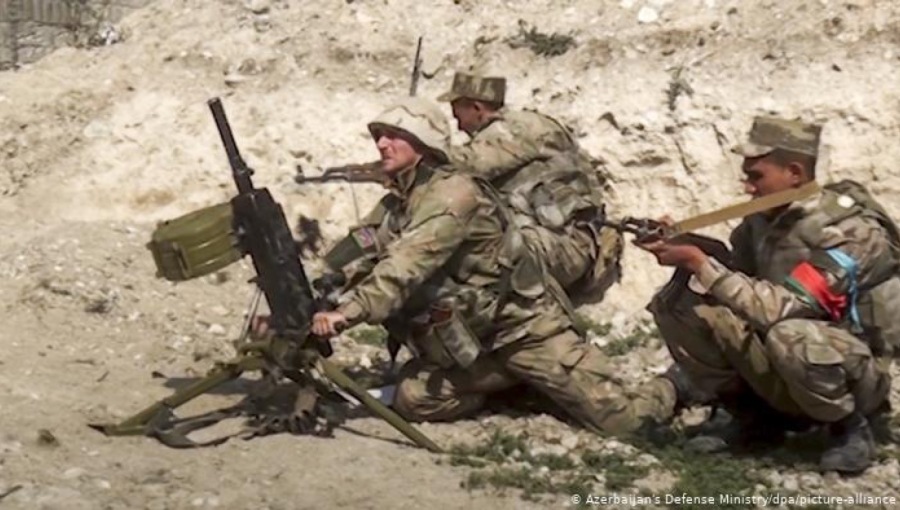
The tense and often-violated ceasefire that had governed the region since the end of the 2020 Second Karabakh War was overwhelmingly violated by Azerbaijan around 1pm local time on Tuesday. Azerbaijani military units, which had been gathering near the line of contact in Nagorno-Karabakh and on the borders of Armenia for weeks, launched a massive assault across all areas of the Nagorno-Karabakh frontline.

Artillery, precision missile strikes and airstrikes struck the beleaguered units of the Artsakh Defence Army, as the breakaway region’s military forces are known, while Azerbaijani infantry launched an offensive on the ground.

24 hours later, it was all over. Weakened by nine months of siege and starvation, without any supply lines to the outside world and hopelessly outmatched by Azerbaijan’s modern military, the president of the Republic of Artsakh, Samvel Shahramanyan, announced that his government had accepted the demands of Azerbaijani President Ilham Aliyev. The Artsakh Defence Army would be dissolved, its weapons would be handed over, and the region would, finally and definitively, come under Azerbaijani control.

In a sense, all of this was expected. Nagorno-Karabakh and its ally, Armenia, had suffered a devastating defeat in the 2020 war. Much of Nagorno-Karabakh had been captured – around 75% of the lands held by Karabakh Armenians before 2020 were conquered by Azerbaijan or ceded to them in the ceasefire agreement. The Armenian army, reeling from its losses, had been forced out of the conflict, left struggling to repel even the Azerbaijani incursions into Armenia itself.

The nine months of Azerbaijani blockade that began in December 2022 had been met with indifference from the international community, with ‘urges’ and ‘calls’ for Azerbaijan to reopen the Lachin Corridor – Nagorno-Karabakh’s single lifeline to the outside world – but no consequences when Azerbaijan refused to do so, ignoring even the International Court of Justice ruling on the matter.

The Russian peacekeeping mission, entrusted with ensuring that road remained open and active, similarly demurred from any real attempts to unblock it. Aliyev clearly read these signals – that there would be no consequences for violating yet another tenet of the 2020 ceasefire – and sent his army in for the kill.

Massive casualties

At the time of writing, so much is still unclear. The 24-hour war involved massive casualties: Nagorno-Karabakh’s authorities have confirmed over 200 dead and 400 wounded from their side, a number that is sure to rise as more bodies are found, while Azerbaijani social media reports place the number of Azerbaijan casualties at over 150.

What exactly happens next is anyone’s guess, including the people of Nagorno-Karabakh themselves. In the wake of the Azerbaijani assault and subsequent capture of numerous villages and key roads, tens of thousands of the region’s 120,000 inhabitants have been displaced. Stepanakert is overrun, with every public building hosting dozens of families; the city’s airport, the site of the main Russian peacekeeping base, is an even more dire site, with thousands of civilians now encamped there in the open air, having fled from the Azerbaijani soldiers who captured their villages.

Other areas are entirely isolated: the towns of Martuni and Martakert, Nagorno-Karabakh’s second- and third-largest settlements, are surrounded by Azerbaijani forces, their populations unable to escape and with little known about their condition. 

In this near-total information blackout, with no independent media access and limited internet connectivity, rumors of Azerbaijani atrocities have spread. One woman claimed that Azerbaijani troops had beheaded her three young children in front of her; another said that the same had happened to a Karabakh Armenian soldier. A woman named Sofik, from the Karabakh village of Sarnaghbyur, described in video testimony how Azerbaijani artillery bombardment of her village had killed at least five children and wounded 13 more.

There is little verification or ability to confirm these claims, but there is ample precedent for them: Azerbaijani troops have previously filmed themselves beheading elderly Karabakh Armenian civilians, have executed groups of POWs, and indiscriminately bombarded Karabakh settlements. In the coming days, videos of atrocities committed over the past few days are likely to come to light.

The ultimate fate of the population of Nagorno-Karabakh is similarly unclear. While Azerbaijani officials have said that civilians will be allowed to stay there unharmed, few, if any, of the locals believe them.

Armenian Prime Nikol Pashinyan stated in a speech on Thursday that a mass evacuation was “not plan A nor plan B,” and that he hoped the Karabakh Armenians would still be able to live a “safe and dignified” life there, but that Armenia was ready and able to accept 40,000 families if the need arose.

More despair than revolution

The view of Nagorno-Karabakh’s residents is a sharply different one. Ashot Gabrielyan, a local teacher who has documented life in Nagorno-Karabakh under the blockade, summed up the local community’s views in an Instagram post on Friday. “We, the people in Artsakh, need a humanitarian corridor to leave [to Armenia],” he wrote. “We are not ready to live with a country [Azerbaijan] which starved us, then killed us. We NEED to leave.”

The catastrophic situation has understandably led to political unrest in Armenia itself. On Tuesday night, as the Azerbaijani offensive into Nagorno-Karabakh was still going strong, thousands gathered in Yerevan’s Republic Square, a common spot for demonstrations in the capital. The clashes reached a rare level of violence, with police deploying stun grenades against the crowd at one point; 16 policemen and 18 civilians were wounded in the event.

But the mood was more despair than revolution. While many of those in attendance demanded the resignation of the government, few had any suggestions for what should be done differently.

“Nikol [Pashinyan] led us to this horrible situation, this catastrophe,” said Tigran, one of those in attendance. “He must resign.” Another attendee, Daniella, a 20-year old student from Nagorno-Karabakh, had a different take. “I don’t know what [the government] can even do [about this],” she said. “My family are still there [in Karabakh] and I’m very worried for them, but I don’t know that violence here [in Yerevan] will help anything,” she said.

The public paralysation is exacerbated by Russia, which has come out staunchly against the Armenian government and sought to pin the entire blame for the present tragedy in Nagorno-Karabakh on Pashinyan. A series of Kremlin media guidelines for Russian state media was leaked to the Russian opposition outlet Meduza, in which Russian government publications are instructed to blame the Azerbaijani assault on “Armenia and its Western partners”.

Mass public outrage at Russia and its absent peacekeepers in both Armenia and Nagorno-Karabakh has been fanned further by posts by top Russian propagandists such as Margarita Simonyan and Vladimir Solovyov, who shared identical Telegram posts suggesting that Armenians should overthrow the Pashinyan government.

Armenian journalist Samson Martirosyan summed up the mood succinctly in a Twitter post. “Most people in Armenia don’t know what to do, caught between Pashinyan and [the] opposition. By going to protests, you would stir up chaos, which serves Russia and Azerbaijan. Not going would mean silently agreeing with Pashinyan’s disastrous policies,” Martirosyan wrote.

Meanwhile, the 120,000 inhabitants of Nagorno-Karabakh await the outcome of the surrender negotiations currently taking place between their leadership and that of Azerbaijan in the Azerbaijani city of Yevlakh.

There are few reasons for optimism: Nagorno-Karabakh presidential advisor David Babayan said on Friday that there were “no concrete results” from Baku on either security guarantees for the population of Karabakh or regarding amnesty for its soldiers and leaders, all of whom Azerbaijan regards as criminals and terrorists.

The Azerbaijani army currently sits at the entrances to Stepanakert, poised to enter. It is difficult to imagine the scenes that will result when that happens.


Categories
Selected Articles

Georgia ready to involve Armenia and Azerbaijan in government’s Peaceful Neighborhood Initiative


default.jpg

During his address at the 78th UN General Assembly, Georgian Prime Minister Irakli Garibashvili announced his country’s commitment to fostering lasting peace in the South Caucasus. He unveiled Georgia’s “Peaceful Neighborhood Initiative” and extended an invitation to Armenia and Azerbaijan to participate in this effort.

Launched by Prime Minister Garibashvili in late 2021, the “Peaceful Neighborhood Initiative” seeks to create a platform for informal dialogue among regional neighbors. Its primary goal is to facilitate cooperation and peaceful relations in a historically complex and conflict-prone region. In July 2022, the first meeting of the foreign ministers of Armenia and Azerbaijan took place in Tbilisi.

One of the central elements of the initiative is the invitation for Armenia and Azerbaijan to join the process. By engaging these neighboring countries, Georgia aims to work collaboratively to achieve enduring peace in the South Caucasus.

Prime Minister Garibashvili also emphasized Georgia’s transformation into a multifaceted regional hub. The country’s financial sector has gained global recognition, attracting international investors and capital. Georgia is prioritizing investments in infrastructure, aiming to strengthen connectivity and bolster the logistics and energy sectors.

Furthermore, Georgia is actively developing strategic transport corridors that will serve as vital links between Asia and Europe. These corridors are crucial for facilitating trade and economic development in the Black Sea region.

!

This text available in   Հայերեն and Русский

Print


Categories
Selected Articles

Nagorno-Karabakh residents await their fate


bneGeneric_ARMENIA_Mount_Ararat_and_the_

Talks are continuing over the weekend between the victorious Azerbaijani forces and the defeated breakaway administration in Nagorno-Karabakh over guarantees for the territory’s ethnic Armenians after the territory is reabsorbed by Azerbaijan.

The unrecognised Nagorno-Karababh government in Stepanakert surrendered after 24 hours’ fighting on Wednesday. Now the territory’s 120,000 inhabitants await news over their fate under rule from Baku, or at least whether they will be allowed to flee to Armenia safely.

Russian peacekeepers, who stood by during the invasion, have reported that Nagorno-Karabakh forces have begun handing over their weapons under the peace deal reached on September 22.

Negotiations in the Azerbaijani city of Yevlakh are focused on security guarantees for the withdrawal of the Nagorno-Karabakh forces to Armenia and amnesties for its soldiers and leaders. News agencies reported that Nagorno-Karabakh presidential advisor David Babayan said on Friday that so far there were “no concrete results”.

Nagorno-Karabakh’s authorities say 200 ethnic Armenians were killed and 400 wounded in the fighting, while Azerbaijani social media reports say there were more than 150 casualties on their side.

There have been several credible reports of atrocities committed during the invasion by Azerbaijani forces, though none have yet been independently verified. Azerbaijani military forces have a well justified reputation for barbarities.

The Nagorno-Karabakh population has suffered an Azerbaijani blockade since December, which had only just been lifted before the invasion began.

Annalena Baerbock, Federal Minister for Foreign Affairs of Germany, told the United Nations General Assembly on Thursday:  “Just at the moment when a glimpse of hope was emerging, when humanitarian supplies were allowed into Nagorno-Karabakh, Baku broke its repeated assurances to refrain from the use of force, causing tremendous suffering to a population already in dire straits.”

The UN Security Council has expressed its willingness to provide support if humanitarian access is granted. The EU Commission has already allocated €500,000.

The issue of what rights the ethnic Armenians of Nagorno-Karabakh will be granted by the Azerbaijan dictatorship is likely to be key to whether the population stays or leaves.

President Ilham Aliyev has promised the Karabakh Armenians that “all their rights will be guaranteed: educational rights, cultural rights, religious rights, and municipal electoral rights, because Azerbaijan is a free society.”

But Azerbaijanis themselves have few democratic rights and Aliyev has long rejected any kind of real autonomy for Nagorno-Karabakh. When Azerbaijan retook some of its territory in the 2020 war, the inhabitants were expelled. Nagorno-Karabakh leaders fear that Baku intends to ethnically cleanse their region and settle it with Azerbaijanis.

“A whole host of questions still need to be resolved,” Babayan told Reuters. “We do not know what guarantee of security our people will get. This needs to be resolved.”

The region’s inhabitants are already beginning to flee. The Russian peacekeeping contingent in the territory said it had evacuated more than 5,000 people from the regions of Martakert, Martuni, and Askeran after Azerbaijani forces advanced into those regions.

Stepanakert is overrun, with every public building hosting dozens of families. At the city’s airport, thousands of civilians are encamped there in the open air, having fled from the Azerbaijani soldiers who captured their villages.

Armenian Prime Minister Nikol Pashinian said in a video address that Nagorno-Karabakh’s residents should stay.

“We don’t want to talk about this, because we believe that the Armenians of Nagorno-Karabakh should live in their homes, in their homeland, in dignified and safe conditions,” Pashinyan said on September 21. “At this moment, our assessment is that there is no direct threat to the civilian population of Nagorno-Karabakh.”

Pashinyan added that a mass evacuation was “not plan A nor plan B,” and that he hoped the Karabakh Armenians would still be able to live a “safe and dignified” life in Nagorno-Karabakh, but that Armenia was ready and able to accept 40,000 families if the need arose.

Pashinyan is facing strong criticism for failing to back Nagorno-Karabakh in recent months, an approach which opponents say encouraged the Azerbaijani offensive.

Thousands have been protesting against Pashinyan in Yerevan this week, with police deploying stun grenades against the crowd at one point. Armenian opposition groups claimed that some 350 supporters were detained on September 22.  The authorities said 16 policemen and 18 civilians were wounded on Tuesday night.

The protesters are also angry with Russia for the inaction of its peacekeepers. The Russian embassy in Yerevan has become one of the main targets of the protests in recent days.


Categories
Selected Articles

Abkhazia and Karabakh JAMnews


381373998_284036021151118_24212970851591


Categories
Selected Articles

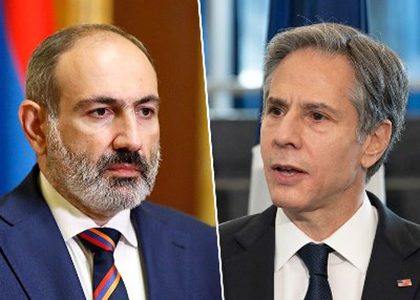
Antony Blinken holds phone conversation with Armenian PM


default.jpg


Categories
Selected Articles

Azerbaijan, Ethnic Armenians Reach Nagoro-Karabakh Cease-Fire – Voice of America – VOA News


Azerbaijan, Ethnic Armenians Reach Nagoro-Karabakh Cease-Fire  Voice of America – VOA News

Categories
Selected Articles

People are not able to take the bodies of the victims to forensic examinations so that they can bury them, since Azerbaijani armed servicemen keep communities isolated from each other


In Artsakh, bodies of about 100 victims killed by Azerbaijani military are in communities cut off from Stepanakert (Martuni, Martakert, etc.). There are cases when several peaceful civilian victims…

Categories
Selected Articles

Protests continue in Yerevan


Young activists continue protests in the capital of Armenia, Yerevan, Azernews reports.

Categories
Selected Articles

Bodies of 100 victims are in settlements cut off from Stepanakert


default.jpg