BREAKING:
Azerbaijani forces just killed 8 Russian soldiers in Karabakh pic.twitter.com/ke0au0AwnX
— Visegrád 24 (@visegrad24) September 20, 2023
–
BREAKING:
Azerbaijani forces just killed 8 Russian soldiers in Karabakh pic.twitter.com/ke0au0AwnX
— Visegrád 24 (@visegrad24) September 20, 2023
–
By Emil Avdaliani
Amid the reshuffling of Eurasian connectivity as a result of the Ukraine conflict, the South Caucasus has grown in importance as a vital transit hub between the European Union (EU) and China. Comprising of Georgia, Armenia and Azerbaijan, this region serves as the shortest geographic point between these two Eurasian economic hubs. Consequently, the South Caucasus nations have attracted attention from both Beijing and Brussels.
According to Chinese customs statistics, during the period from 2001 to 2020 trade between China and the South Caucasus increased from US$25 million to US$3.7 billion, while the collective Caucasian national statistics put recent figures as trade valued at US$1.1 billion in 2009 to almost US$4 billion in 2020.
However, China’s place in the ranking largest trading partners of the countries the region is still not very large. The World Bank data shows that in 2005-2018 period China’s trade turnover with Armenia increased about 2070%, with Azerbaijan 380% and with Georgia around 1885%.
More recently, from 2016 to 2020, bilateral trade between China and the South Caucasus region almost doubled, from US$1.9 to US$3.6 billion.
In 2020 China was the 4th largest trading partner both for all three countries of the South Caucasus combined, and for Azerbaijan and Georgia separately (after the EU, Russia, and Turkey). At the same time, the share of China in the trade turnover of countries region ranges from a minimum of 7.5% to Azerbaijan to a maximum of 13.6% in Armenia and is growing steadily, if slowly.

As is typical for China’s trade with the developing world, China’s imports from the South Caucasus are dominated by raw materials (ores and oil), while exports are dominated by machinery and equipment. From the South Caucasus, China mainly imports ores and oil, while imports of other goods are extremely insignificant: in 2020, more than 97% of China’s imports from Armenia were copper and molybdenum ores/concentrates (in fact, almost a third of Armenia’s exported copper ore and 85% of molybdenum ore accounted for to China), 94% of all Chinese imports from Georgia are copper and precious metal ores/concentrates (more than half of Georgian exports of these goods go to China), 89% of China’s imports from Azerbaijan are oil and oil products.
The raw material component of exports of the South Caucasian countries to China is therefore pronounced and can even be considered excessive. All of the countries of the South Caucasus as regards their China trade are experiencing trade balance deficits.
According to their national statistics, in 2020, Armenia’s imports from China exceeded exports to China by 2.3 times (674 against US$290 million), Georgia – by 1.5 times (709 against US$477 million), and Azerbaijan – 3.3 times (1414 against US$477 million. Armenia as a regional South Caucasus nation has the least developed economic relations of the three.
In 2017, China and Georgia signed a free trade agreement, based on the Georgian government hoping the country’s location on the Black Sea would prove a transit benefit. Yet this did not materialize. Reasons vary, but they mostly range from geographic disconnect to geopolitical aspects.
The South Caucasus is poorly connected to Central Asia where China has been building its presence, as was apparent at the latest successful summit held in May in Xi’an between Chinese and Central Asian states’ leaders.
Some of the regional projects such as the BTK railway corridor have thus far failed to deliver what was promised in terms of volumes, although a late recognition in terms of resolving BTK bottlenecks is now underway.
Although China does not yet consider the South Caucasus as a primary region for extending its economic influence, Georgia and Azerbaijan have always been considered in the context of the historical Great Silk Road right from early 1990s. On a practical level, the TRACECA project initiated by the EU in 1993, the INOGATE project starting in 1996 and later supported by US through the Silk Road Strategy Act adopted in 1999. Dozens of silk road projects are still functioning successfully today.
For the period from 2014 to 2019 accumulated direct foreign investment (FDI) of China in countries of the South Caucasus exceeded US$700 million per annum.

Between 2000-2017, China invested US$581 million in Azerbaijan. Beijing has also provided loans to Baku to purchase Chinese goods for smaller projects, such as the expansion of an aluminum plant in Ganja.
Chinese businesses are active in a number of Azerbaijan’s industries such as oil, banking, finance, banking, and communications. For instance, in October 2018 a memorandum of understanding was signed on the creation of a joint venture between SOCAR and the China National Petroleum Corporation (CNPC).

In Armenia the overall level of Chinese investment is smaller. In 2011, China announced that it would invest around US$500 million in Armenian iron production. Yet the investment promise made by Hong Kong’s Fortune Oil did not materialize. In another case, a Chinese company from Guangdong pledged to invest about US$100 million in furniture production which also did not proceed. In 2019, a Chinese aluminum company announced plans to invest US$100 million to develop an aluminum industrial zone in Armenia.
However, a new “Smart Science City” will be built in Armenia with Chinese investments of US$10-15 billion. Another project is based on a 15-year project agreement between China Technology Academy, China Technical Development Company and ADCARS Agency for Reconstruction and Development of Armenia.

Traditionally major Chinese investment in the South Caucasus have been going to Georgia. For example, in 2019 investments worth US$671 million were sent as outbound investment. In 2022 Chinese investments reached US$109 million. the numbers remain negligeable. In the same year Georgia received US$$2 billion in total inbound FDI. Investments in Georgia or other South Caucasus countries are dwarfed by what China sends to Central Asian states or Pakistan.
The largest project implemented during this period was the construction of a special economic zone in the suburbs of Tbilisi called Hualing Tbilisi Sea New City, for which the Eximbank of China provided a loan of US$195 million. China funded the construction of the Khadori Hydropower Plant. Another project is the US$100 million Nenskra hydropower plant, funded via the AIIB.
In 2017 the AIIB provided Tbilisi with US$114 million to improve the country’s connectivity. One of the elements of the planned project is the bypass road around Georgia’s port city of Batumi with the goal to increase international transit from China to Europe. In 2019, the Chinese company China Railway 23rd Bureau Group (China Railway) announced that it will build the new 22.7 km Kvesheti-Kobi road in Georgia. The total cost of the project is estimated at 1.2 billion laris (US$428.6 million). China Railways will build 13 km of the road, which is part of the International North-South Transport Corridor.
There is also work going on along the Khulo-Zarzma road, which will represent the shortest route between Georgia’s poorly connected Samtskhe-Javakheti and Adjara regions. The refurbished section will go from Khulo and to Zarzma village in Adigeni via the Goderdzi Pass significantly reducing travel time between Georgia’s two southern regions.
Overall, China has a tailored geo-economic approach to each of the three South Caucasus state. The countries recognize that China’s economic interests overlap with their own development goal of transforming their respective countries into full-fledged connectivity hubs between Europe and Asia. For China, cooperation with Georgia and Azerbaijan will remain central as both countries represent a continuous transit corridor on the route to the EU. Increasing investment into the South Caucasus countries can be expected as a result of the INSTC development and the Middle Corridor routes.
Emil Avdaliani is a professor of international relations at the European University in Tbilisi, Georgia, and a Belt & Road Initiative scholar.
For months, the negotiations over the fate of Nagorno-Karabakh seemed to be going in Azerbaijan’s favor. Armenia’s government had publicly and explicitly said it recognized the breakaway territory — which is the center of the two countries’ decades-long conflict — as part of Azerbaijan. All that was to be worked out, in essence, were the details. So why did war break out again?
The Backdrop To War
At issue is Nagorno-Karabakh, a mountainous enclave of Azerbaijan that historically has been home to both Armenians and Azeris. On the eve of the collapse of the Soviet Union, the population of what was then the Nagorno-Karabakh Autonomous Oblast was roughly 75 percent ethnic Armenian. A nationalist movement in the 1980s sought to separate the territory from Azerbaijan and join it with Armenia. The ensuing war in the early 1990s killed some 30,000 people and resulted in Armenian-backed separatists seizing the territory from Azerbaijan.
Diplomatic efforts to settle the conflict brought little progress, and the two sides fought another war in 2020 that lasted six weeks before a Russian-brokered cease-fire effectively recognized the loss of Armenian control over parts of the region and seven adjacent districts.
In 2022, Baku and Yerevan embarked on negotiations aimed at finally resolving the conflict. Azerbaijan’s stated goal has been to regain full control over the rest of Karabakh, and Armenian Prime Minister Nikol Pashinian has indicated that he was willing to comply.
But the Karabakh Armenian leadership has been more recalcitrant, fearing that Azerbaijani promises to peacefully “reintegrate” ethnic Armenians amounted to a smokescreen for a plan to eventually squeeze them out of the territory for good. International mediators had been trying to find a compromise to the standoff but with little to show for it.
So Why Did Azerbaijan Attack Now?
On September 19, Azerbaijan launched a wide-scale attack against Nagorno-Karabakh and the remnants of its armed forces, forcing residents of the region’s capital, Stepanakert (Xankendi in Azeri), to hunker down in bomb shelters and those in outlying settlements to evacuate to the center. After a day of attacks, the offensive achieved Baku’s stated aim: The de facto ethnic Armenian Karabakh authorities agreed to disband and disarm their armed forces.
The worst fears of violence now appear to be averted, with the Azerbaijani and ethnic Armenian sides agreeing on an immediate cease-fire. But the offensive laid bare how the dynamics of the conflict are all on Azerbaijan’s side, to the point where Baku felt that it was in its interest to accelerate the process with force, despite the possibility of facing international condemnation and risking the lives of the people in Nagorno-Karabakh it says are its citizens.
Azerbaijan has been dissatisfied with the pace of negotiations, complaining that the Karabakh Armenian leadership was digging in and becoming intransigent. Baku also may have seen a moment of opportunity when Armenia’s traditional security guarantor, Russia, had turned against the Armenian government and its leader, Pashinian. And finally, Azerbaijan likely calculated that whatever international costs it might face for the assault, they would not be too painful.
Was The Azerbaijani Offensive Unexpected?
The ostensible trigger for the operation was a mine explosion that killed six Azerbaijanis early in the morning on September 19, near the city of Xocavend, which is now under the control of Russian peacekeepers and a part of wider territory that Azerbaijani forces retook in the war in 2020. The Azerbaijani side blamed the mine attack on Armenian saboteurs from Karabakh.
But the preparations for the assault had been going on for weeks. Azerbaijani troops had massed on the line of contact separating Azerbaijani-controlled territory from the rump Karabakh entity that remained following the 2020 war. There were also reports of military cargo flights between Azerbaijan and Israel, suggesting that Azerbaijan may have been rearming in preparation for more fighting.
Baku’s rhetoric had also taken a notably sharper turn in recent weeks, as well. Azerbaijan “will not tolerate the presence of any gray zone in its territory,” Hikmet Haciyev, a senior adviser to Azerbaijani President Ilham Aliyev, said in late August. It was a reference to the part of Karabakh Azerbaijan did not yet control.
Photo Gallery:
Well before this summer, analysts say that Azerbaijan had been using military escalations to push along the diplomatic process.
Talks between the central government in Baku and the Karabakh Armenians had stalled, with Azerbaijanis complaining about their interlocutors’ intransigence. “The Karabakh Armenians refused to talk about anything except independence,” said Farid Shafiyev, the head of the Azerbaijani government-run think tank Center of Analysis of International Relations. He noted that the de facto ethnic Armenian government had organized an election of a new president in early September 2022, a step that in Azerbaijani eyes confirmed the unwillingness to accept their rule.
But the Karabakh Armenian authorities’ position had been “evolving,” with a greater willingness to accede to Azerbaijan’s demands, said Olesya Vartanyan, the senior South Caucasus analyst at the Crisis Group think tank. “They were ready to meet in Azerbaijan and discuss the integration process — what Baku had been demanding.”
As the standoff dragged on, the risk of another attack from Azerbaijan rose. “The absence — or more accurately the stagnation — of the political process exacerbates these concerns,” Zaur Shiriyev, a Baku-based analyst for Crisis Group, said in an online discussion on September 15, just days before the offensive began. “If a military escalation occurs in the Armenian-populated areas of Karabakh in the coming days or weeks, it wouldn’t be a surprise.”
The Russia Factor
Accelerating the process was a rapid collapse in relations between Armenia and its traditional big-power patron, Russia. As part of the 2020 cease-fire agreement, a contingent of 2,000 Russian peacekeepers were deployed to the part of Karabakh that ethnic Armenians still controlled. But they have proven unable or unwilling to push back against steady Azerbaijani pressure on the territory. And Russia itself — despite having treaty obligations to defend Armenia in case of external attack, as both are members of the Collective Security Treaty Organization (CSTO), a mutual defense pact — has not intervened in spite of repeated Azerbaijani incursions across the border into Armenia.
This led to an increasing estrangement between Yerevan and Moscow that came to a head this month, when the Armenian government took a series of seemingly calculated steps to signal its displeasure with Russia. Among them: It dispatched Pashinian’s wife, Anna Hakobian, to Kyiv to deliver a package of aid; it announced it intended to sign the treaty to join the International Criminal Court, which would in effect obligate it to arrest Russian President Vladimir Putin; and it withdrew its representative from the CSTO. “They crossed about three Russian red lines simultaneously,” said Thomas de Waal, an analyst at the think tank Carnegie Europe.
Baku appears to have been emboldened by the Russian-Armenian rift, says Shujaat Ahmadzada, a nonresident research fellow at the Baku-based Topchubashov Center, which focuses on international relations and security. “It points to Russia here more than other factors,” he said. “The only actor that could have caused problems to a degree [for Azerbaijan] was Russia, and now, given the Armenia-Russia decoupling, I think they believe the time is right.”
How Has The World Reacted?
As their position vis-a-vis Azerbaijan has weakened, and the alliance with Russia frayed, Armenia has been seeking international support wherever it can get it. It hosts border monitors from the European Union, is buying weapons from India, and regularly tries to bring up the conflict at the United Nations Security Council.
But it has thus far failed to get any international actor to take substantive action to slow Azerbaijan down, which also likely played into Baku’s thinking, Ahmadzada says. “If I were in [Armenia’s] shoes, I would not be expecting significant actions against Azerbaijan coming from the West,” he said.
Indeed, while the reaction from abroad to Azerbaijan’s September 19 attacks was swift and critical, it was limited to expressions of concern. U.S. Secretary of State Antony Blinken called Aliyev to “urge Azerbaijan to cease military actions in Nagorno-Karabakh immediately.” The European Union said it “condemns the military escalation” and that the “violence needs to stop.”
“The international community is just making statements. It’s just statements,” said Edmon Marukian, an Armenian ambassador-at-large. “You know, statements are not helping when you’re attacked and somebody is trying to kill you.”
What Now?
The offensive managed to secure a concession that Azerbaijan has been demanding — and the ethnic Armenian Karabakh leadership has been fiercely resisting — for months: the disbanding and disarmament of the armed forces of the Karabakh authorities. Meetings between representatives of the Karabakh Armenians and of the central government in Baku are scheduled for September 21 in the Azerbaijani city of Yevlax.
A statement before that meeting from the de facto Karabakh presidency said that the talks would discuss the region’s possible “reintegration” into Azerbaijan and the Karabakh Armenians’ rights and security “within the framework of the Azerbaijani Constitution.” Those are conditions that Karabakh Armenians had previously considered unacceptable, but with Azerbaijan gaining the upper hand once again, their leaders had no choice but to accept them.
A week before the offensive, Armenian historian and diplomat Gerard Libaridian gave a lecture in the United States for his new book, A Precarious Armenia. He discussed the ongoing negotiations and argued that, as time goes on, Armenians’ bargaining position will become worse and worse.
“The more we wait, the less leverage we have…. Today, we cannot get what we could get last year. Last year, we couldn’t get what we could have gotten four or five years ago,” he said. “The more we have waited, the harder Aliyev has become.”
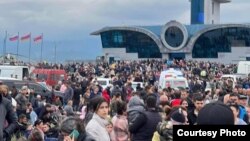
Thousands gathered at Stepanakert airport on September 20.
Thousands of panicked ethnic Armenians converged on the airport in Nagorno-Karabakh where Russian peacekeeping forces are based after de facto leaders of the breakaway region agreed to lay down their arms and accept talks to “reintegrate” the territory into bitter rival Azerbaijan.
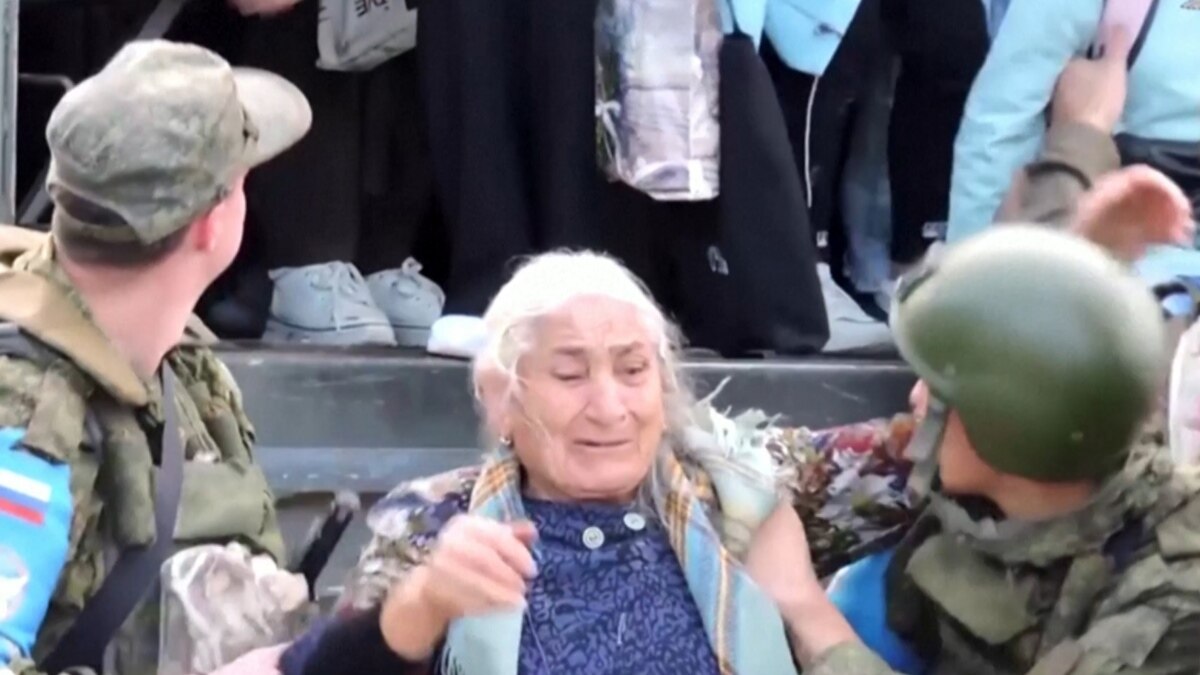
Amid the chaos on September 20, the Russian Defense Ministry reported that an unknown number of the country’s peacekeepers were killed when their vehicle was fired upon while returning from an observation post in the region.
Details remained scarce in the incident, and information could not immediately be verified. Russia authorities said peacekeeping teams were continuing to work with both sides, adding that 3,154 people, including 1,428 children, had been evacuated to safe areas.
Earlier, Azerbaijani leaders on September 20 vowed to allow “safe passage” to Armenia for the separatist forces of the region as part of the agreement to end fighting, seemingly putting an end to a decades-long struggle for ethnic Armenians seeking independence or attachment to Armenia for the territory.
“Safe passage to appropriate assembly points will also be provided by the Azerbaijani side,” presidential adviser Hikmet Hajiyev told reporters. “All the actions on the ground are coordinated with Russian peacekeepers.”
The president of the European Council, Charles Michel, urged Azerbaijani President Ilham Aliyev in a phone call to protect the rights of ethnic Armenians in the region and “to ensure full cease-fire and safe, dignified treatment by Azerbaijan of Karabakh Armenians.”
“Their human rights and security need to be ensured. Access needed for immediate humanitarian assistance,” Michel wrote on social media.
Aliyev, in a national address, said Azerbaijan had “restored sovereignty” after the latest developments in Karabakh. He claimed Baku had “nothing against” the people of the region, only its “criminal leadership.”
Aliyev declared his country’s military operation over and said separatist forces had begun withdrawing from Nagorno-Karabakh.
Separatist leaders said at least 200 people had been killed and 400 wounded in Baku’s latest military drive.
Photo Gallery:
Flights between Iran and Azerbaijan and Armenia resumed on September 20 following the cease-fire, the semiofficial ISNA news agency reported. Iran had earlier canceled all flights to Azerbaijan and Armenia until further notice for security reasons.
Earlier in the day, the Azerbaijani and ethnic Armenian sides agreed to an immediate cease-fire on the second day of a major flare-up in fighting over the territory of Nagorno-Karabakh.
The de facto leadership of the mostly ethnic Armenian enclave accepted a proposal by the Russian peacekeeping mission there and agreed to talks on the territory’s “reintegration” into Azerbaijan.
The expected halt in intense fighting in the decades-old Caucasus hot spot came as international concerns mounted of a widening conflict and as the death toll mounted in the deadliest military escalation there in nearly three years.
The apparent concession came hours after Baku had signaled its intention to continue its military operations in the absence of a surrender by ethnic Armenian forces despite appeals from the United Nations, Western powers, and Russia for a halt to the hostilities that have killed dozens in the past 24 hours.
Local officials reported that fighting had mostly ceased by the agreed time of 1 p.m. local time. The Russian Defense Ministry later said that “no cases of cease-fire violations have been recorded.”
The ethnic Armenian leadership of the territory they call Artsakh, which is recognized as part of Azerbaijan but for decades until late 2020 was controlled by Armenians, reported accepting the Russian proposal about an hour earlier.
It also accepted a proposal from Baku on talks to integrate the region into Azerbaijan, a potentially bitter pill to swallow for the government and public in neighboring Armenia, which has made control of Nagorno-Karabakh a nationalist keystone since the breakup of the Soviet Union and where anti-government protests greeted news of the latest Azerbaijani offensive.
Both sides agreed to talks on September 21 in the Azerbaijani city of Yevlax, about 265 kilometers west of Baku. The Kremlin said Russian peacekeepers would mediate the talks.
Nagorno-Karabakh’s de facto leadership in Stepanakert said that “issues raised by the Azerbaijani side on reintegration, ensuring the rights and security of the Armenians of Nagorno-Karabakh…will be discussed at a meeting between representatives of the local Armenian population and the central authorities of the Republic of Azerbaijan.”
The Azerbaijani Presidency and Defense Ministry confirmed agreeing to the cease-fire.
Aliyev’s office issued a similarly worded statement announcing a meeting that “representatives of the Armenian residents of Karabakh to discuss reintegration issues based on the constitution and laws of the Republic of Azerbaijan” at the Yevlax meeting.
In addition to a suspension of fighting and some sort of integration effort, the cease-fire proposal reportedly includes a commitment for a pullout of any “remaining units of the armed forces of Armenia,” the withdrawal and destruction of any heavy military equipment from the territory, and the disbandment of the so-called Artsakh Defense Army established by ethnic Armenians in the early 1990s at an early phase of the conflict.
It was a dramatic turn in a fast-moving crisis that sent shock waves through the region and beyond.
Armenia’s embattled prime minister, Nikol Pashinian, who was blamed by nationalists and other critics for losses in the 2020 fighting, noted the cease-fire but immediately distanced his government from its terms.
“Armenia did not participate in drafting the text of the cease-fire declaration in Nagorno-Karabakh under the mediation of Russian peacekeepers,” Pashinian told the nation in a televised appearance, according to AFP.
He added in a shot at Baku’s justification for its offensive that Yerevan “has not had an army” in Nagorno-Karabakh since August 2021.
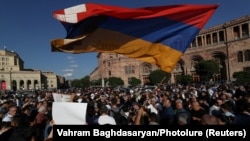
In the capital, Yerevan, thousands of people gathered to demand the government do more to help the ethnic Armenians of Nagorno-Karabakh, with some calling for Pashinian’s resignation.
Pashinian said the “latest information from Nagorno-Karabakh is that the intensity of fighting has greatly decreased.”
He also expressed hope that there would be no new military escalation.
“Now the most important issue is that the right of Nagorno-Karabakh Armenians to live in their homes is fully ensured by the Russian Federation,” he said, according to RFE/RL’s Armenian Service.
A deputy foreign minister in Armenia had been quoted by Reuters as saying a further accumulation of Azerbaijani forces appeared to be readying a “second stage” of the operation.
WATCH: Protests broke out in the Armenian capital, Yerevan, after Azerbaijan launched a military assault on ethnic-Armenian inhabited areas of Nagorno-Karabakh on September 19. Angry crowds gathered outside government buildings, calling for Prime Minister Nikol Pashinian to resign, and clashed with police.
The Armenian government said Pashinian discussed the situation with Russian President Vladimir Putin, who many Armenians have accused of not living up to promises of Russian protection in Nagorno-Karabakh.
The European Union’s diplomatic service said that it took note of the cease-fire and is “following the development of the situation.” It added a warning to Baku against “using the military operations as an excuse for the forced displacement of the Armenians of Nagorno-Karabakh.”
Hours earlier, Azerbaijan’s Defense Ministry said that what it has described as an “anti-terrorist operation” targeting saboteurs was continuing “successfully.” It eventually described capturing 90 Armenian positions in a day of fighting.
Aliyev had also issued a statement saying he had told U.S. Secretary of State Antony Blinken in a phone call “that anti-terrorist measures will be stopped if [forces in Karabakh] lay down their arms.”
The UN Security Council, meanwhile, scheduled an emergency meeting for September 21 as the international community sought ways to avoid an intensification of a long-running conflict that has already sparked two intense wars between the post-Soviet Caucasus neighbors, most recently just three years ago.
The de facto human rights ombudsman in the ethnic Armenian-controlled Azerbaijani region said early on September 20 that 32 people had been killed, including seven civilians, two of them children, and more than 200 wounded as a result of shelling, although some death estimates put the death toll considerably higher.
“The secretary-general calls in the strongest terms for an immediate end to the fighting, de-escalation, and stricter observance of the 2020 cease-fire and principles of international humanitarian law,” UN Secretary-General Antonio Guterres’s spokesman, Stephane Dujarric said.
WATCH: Azerbaijan on September 19 said it had launched an “anti-terrorist operation” in Nagorno-Karabakh following recent bloody clashes and a monthslong blockade of the breakaway territory. The de facto human rights ombudsman in the ethnic Armenian-controlled Azerbaijani region said that two civilians had been killed and 23 wounded — including at least eight children — in the attacks.
Blinken spoke by telephone with the leaders of both countries late on September 19.
The U.S. State Department said he urged Aliyev to stop military operations in Nagorno-Karabakh, which is internationally recognized as Azerbaijani territory, immediately and return to dialogue.
Blinken “noted President Aliyev’s expressed readiness to halt military actions and for representatives of Azerbaijan and the population of Nagorno-Karabakh to meet, and he underscored the need for immediate implementation,” according to the State Department.
Blinken reportedly told Pashinian that the United States “fully supports Armenia’s sovereignty, independence, and territorial integrity.”
A U.S. military spokesperson said the outbreak of fighting did not affect the ongoing 10-day joint military exercises with Armenian troops in Armenia, dubbed Eagle Partner 2023, which were scheduled to conclude on September 20.
In an increasingly rare show of agreement with the West, Moscow called on both sides to stop the violence.
Russian state television on September 20 showed Russian President Vladimir Putin alongside visiting Chinese Foreign Minister Wang Yi saying Moscow was “in close contact with all sides to the conflict” and expressing hope to reach “de-escalation and transfer a solution to this problem to a peaceful course.” It was unclear whether he was speaking before or after word of the cease-fire deal.
It added that Russian peacekeepers were assisting the civilian population in Nagorno-Karabakh, made up mostly of around 120,000 ethnic Armenians, and providing medical and evacuation assistance.
TASS quoted the Russian Defense Ministry as saying on September 20 that its peacekeepers had evacuated more than 2,000 civilians from Nagorno-Karabakh.
After weeks of bloody skirmishes and one day after an aid shipment was finally allowed into the area, Azerbaijan launched the major escalation on September 19 with the breakaway region already teetering on the brink of a humanitarian crisis after being essentially blockaded for more than eight months despite international calls for Baku to allow food and other shipments.
The shelling started shortly after Azerbaijan blamed what it called “Armenian sabotage groups” for two separate explosions that killed at least four military personnel and two civilians in areas of Nagorno-Karabakh that are under the control of Russian peacekeepers.
Those peacekeepers are in place since a cease-fire that ended six weeks of fighting in 2020 in which Azerbaijan recaptured much of the territory and seven surrounding districts controlled since the 1990s by ethnic Armenians with Yerevan’s support.
UPDATES with analyst quotes
Armenian Prime Minister Nikol Pashinyan swept to power promising change, but a humiliating military defeat to Azerbaijan and a dramatic escalation in Nagorno-Karabakh tarnished his reputation in the poor ex-Soviet country.
In the three years since his military was defeated in the breakaway mountainous region, Pashinyan has fought for political survival, while balancing Armenia’s volatile ties with its weakened ally Russia and the West.
Before fighting broke out this week again in Nagorno-Karabakh, the 48-year-old had warned in an interview with AFP in July that full-scale hostilities could erupt again with Azerbaijan. He accused Armenia’s arch-enemy of ethnic cleansing in the majority-Armenian territory.
“We’re talking not about a preparation of genocide, but an ongoing process of genocide,” Pashinyan said.
Hundreds of protesters rallied outside government buildings in Yerevan this week, demanding he resign for his handling of the Karabakh crisis, with the opposition branding him a “traitor”.
“He has brought us only sorrow and mourning, so we want him to resign,” protester Vahagn Nikoghosyan told AFP, as demonstrators clashed with police.
“His presence brings only war and mourning.”
Pashinyan has been criticised in Armenia since ceding swathes of territory in Nagorno-Karabakh to Azerbaijan in 2020 under an agreement brokered by Russia.
Azerbaijan’s sweeping “anti-terror operation” in Karabakh dealt a further blow to his reputation, analysts said.
“After the latest (Karabakh) developments, his legitimacy is critically low,” Armenian analyst Vigen Hakobyan said. “People don’t trust him anymore.”
His political future may depend on events in the coming days in Karabakh.
“What happens next in Karabakh will directly influence the internal political situation in Armenia,” analyst Hakob Badalyan said.
Pashinyan has increasingly turned to Western countries for political backing.
When Azerbaijan launched its military operation, Pashinyan telephoned US Secretary of State Antony Blinken and French President Emmanuel Macron, not the Kremlin.
He had said Russian forces deployed to Nagorno-Karabakh were “unable or unwilling” to fulfil their mandate, and launched peacekeeping drills in Armenia with US forces, angering Russia.
Pashinyan, a former journalist, who came to power in 2018, was celebrated as a national hero when he channelled widespread desire for change into a broad protest movement against corrupt post-Soviet elites.
Karen MINASYAN
But it was under his watch that Armenia lost the six-week war and handed over territory ethnic Armenians had controlled for decades, after hostilities that claimed more than 6,000 lives, mostly Armenians, in 2020.
He won favour with Armenians at the time by announcing that both his son and wife — who this year visited Ukraine in a rebuke to Russia — had served on the frontline in Nagorno-Karabakh.
He described having to sign the ceasefire as “unspeakably painful” both personally and for Armenians, many of whom took to the streets to protest the peace deal, leading to clashes with police.
Despite the widespread criticism however, his party won the 2021 snap parliamentary polls called in an effort to defuse the political crisis after the war.
The self-styled man of the people rode to power vowing reforms, spearheading a wave of peaceful protests against corrupt post-Soviet elites.
In the provinces, villagers greeted him as a hero, offering him fresh bread and berries as he led the protest movement.
He walked hundreds of kilometres across the country, slept in the open, clambered onto the roofs of garages and stood on benches to deliver speeches.
Pashinyan was born in 1975 in the small resort town of Ijevan in northern Armenia and studied journalism at Yerevan State University but was expelled for what he said were articles he wrote that were critical of the regime.
He was in prison between 2009 and 2011 on charges of trying to seize power and provoking riots in post-election violence in 2008.
He was elected to parliament after his release and would ultimately unseat veteran leader Serzh Sargsyan after a decade in power.
Karen MINASYAN
As prime minister he launched a crusade against graft, initiated economic reforms and sidelined corrupt oligarchs and monopolies.
Supporters praised him for accelerating economic growth, reducing poverty and creating new jobs. Then the coronavirus pandemic struck, followed by the war with Azerbaijan.
On Wednesday, he said that Armenia had played no role in negotiating a ceasefire between separatists in Nagorno-Karabakh and Azerbaijan, illustrating the dramatic shift of a war-time leader who had vowed to “break the back” of Armenia’s enemies during the 2020 war.