The speaker of the Georgian Parliament, Shalva Papuashvili, has taken his grievances directly to OC Media’s institutional donors in an apparent bid to influence or punish the outlet for declining to publish an opinion piece he had written.
At least one international organisation that provides funding to OC Media confirmed that the speaker’s office wrote to them following the rejection.
In a letter to the donor seen by OC Media, the speaker’s office said that cooperation between the Georgian Government and the donor ‘rests on a shared understanding of Georgia’s aspirations towards European and Euro-Atlantic integration’.
‘The fact that you are funding an organisation that provides only one-sided coverage of Georgian politics and flatly refuses to even consider a differing opinion for publication, does not correspond to this spirit’, the letter read.
A representative of the donor organisation in question told OC Media they were ‘surprised’ by the letter. ‘We were surprised by the complaint and not sure how to interpret this’, they said.
A representative of the speaker’s office, Tiko Mgeladze, first approached OC Media about Papuashvili’s wish to publish an opinion piece on 28 June.
Mgeladze refused to send the text until OC Media confirmed they would publish it. After being informed it would not be possible to publish an article without first seeing it in full, the speaker’s office again declined, sending only a headline — ‘The tactic of virtually separating Georgia’s democratic government from Georgian people fits the Russian hybrid playbook’ — and the first paragraph of the text.
OC Media’s editorial team ultimately rejected the pitch. Papuashvili later published the text on his personal X (formerly Twitter) account.
OC Media’s Editor-in-Chief, Robin Fabbro, said that while it was not an easy decision, the editorial board was guided by a desire to ensure they best served and informed their readers.
‘In our regular reporting, we always strive to accurately portray the positions of all sides involved in a story, including that of the Georgian Government’, Fabbro said. ‘This is a mission that is often made difficult by the government’s outright hostility to the press. This government regularly shows a lack of interest in engaging with our questions, even the most innocuous ones. Our journalists’ emails go unanswered and phone calls are rarely if ever returned.’
‘We are also extremely selective with what we choose to publish in our opinions section. While we welcome a diversity of opinions, we choose to only commission opinion pieces that we believe to be factually sound, an honest expression of an idea, and broadly in line with our core values — this is our right as an independent media outlet.’
‘The fact is, the Georgian Government frequently attempts to portray themselves differently to an international audience, especially to decision-makers in the West, than they do to their own people. There was too high of a risk that the op-ed simply would not be genuine.’
‘These were some of the primary factors that brought our editorial team to the unanimous decision that publishing this opinion piece would go against our mission to inform, and that doing so simply because of the Speaker’s position of authority would do a disservice to our readers’, Fabbro said.
Mariam Nikuradze, the co-founder and co-director of OC Media, said that contacting the organisation’s donors was a clear attack on the organisation’s editorial independence, and freedom of the press more generally.
‘Georgian Dream’s attacks on the press continue unabated. If you had asked me three years ago, I could never have imagined that the environment we work in in Georgia could have deteriorated so much so quickly’, Nikuradze said.
Nikuradze did not rule out further retribution from the Speaker’s Office, especially on going public with the incident.
‘It would not surprise me at all if we face some form of legal harassment, for example, an “unannounced” audit or a defamation lawsuit in response’, she said. ‘We are also concerned about possible surveillance of our office and staff, as the security services have already demonstrated that they are willing to surveil journalists.’
‘Ultimately, I think this incident shows the power of our reporting, and that the Georgian Government is intimidated by the journalism we produce, especially given the reach of our reporting in Brussels, Washington, and elsewhere.’
‘Sanitising the ruling party’s rhetoric’
One of the reasons for the rejection of Papuashvili’s article — the contents of which were not provided to OC Media in full — was that the argument being presented appeared to directly contradict the actions of Georgian Dream’s government towards the EU, and the West more broadly, in recent years.
Since the Russian invasion of Ukraine, the Georgian Government has taken a dramatic turn against the West.
[Read more: Irakli Kobakhidze: The face of Georgia’s turn from the West]
Papuashvili himself has done nothing to contradict the conspiracy theories against the West promoted by his own party and its spin-off People’s Power.
In July, he described democratically-supported opposition groups as traitors and the ‘fifth column’, and insisted they and some local civil society groups had tried to overthrow the government.
After backtracking on the highly unpopular draft foreign agents law authored by the government’s pro-Russian satellite group in parliament, People’s Power, Georgian Dream and Papuashvili himself continued to advocate for financially probing Western-funded local civil society groups and media organisations.
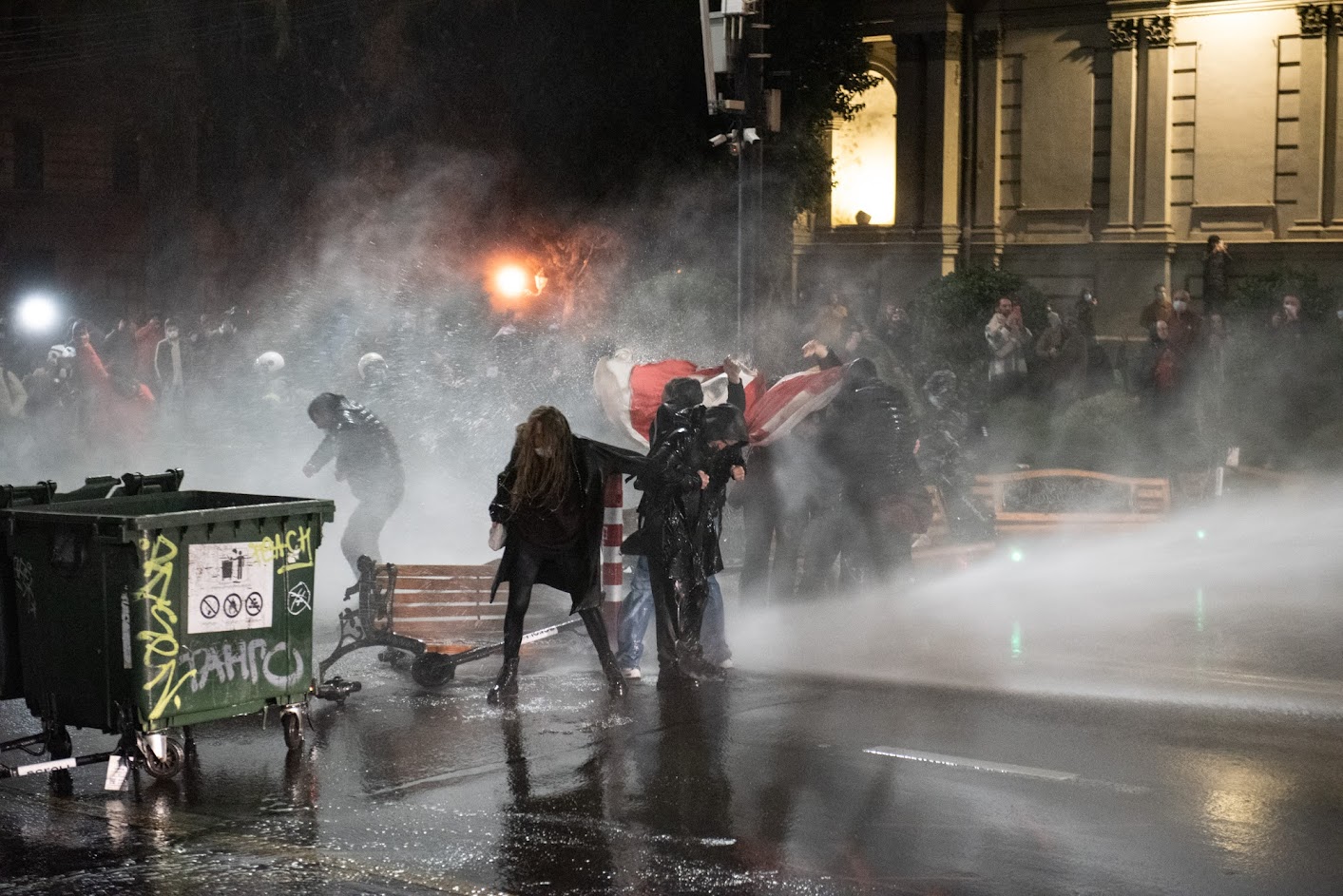 Protests in March 2023 against Georgia’s draft foreign agent law. Photo: Mariam Nikuradze/OC Media
Some of Papuashvili’s first actions as speaker after taking office in 2021 were to refuse to meet a delegation from the European Parliament and to reject the idea of offering a remote platform to Ukraine’s President Volodymyr Zelenskyi to address the Georgian parliament.
Papuashvili has also regularly defended anti-Western statements made by other members of his party.
In May, Prime Minister Irakli Gharibashvili appeared to claim that Ukraine’s intention to join NATO was a primary cause of Russia’s invasion of Ukraine. Papuashvili responded that the PM’s comments were being misinterpreted.
Papuashvili was elected the speaker of parliament in December 2021 after then-speaker Kakha Kuchava resigned for reasons that remain unclear. His resignation coincided with the escalation of Georgian Dream’s anti-Western rhetoric, which has grown exponentially since.
Kuchava had previously been prominent in communicating pro-Western messages to an international audience, both publicly and privately.
While selling his party’s anti-Western and anti-democratic rhetoric to a local audience in Georgian, Papuashvili appears to have taken up Kuchava’s role in pushing more pro-Western messages to an international audience. This includes on X (formerly Twitter), and in op-eds in English language media.
In private conversations with Western diplomats and officials, Papuashvili is known to play down his party’s anti-Western rhetoric while insisting on Georgia’s respect for the West.
‘Our team had taken note of this pattern of certain officials being tasked with sanitising the ruling party’s rhetoric and actions in English to an international audience’, OC Media’s editor-in-chief, Robin Fabbro said. ‘This is not something we intended to aid them in.’
‘An opinion piece, unlike an interview — standalone or as part of a wider story — gives the author a platform to speak without scrutiny’, he added. ‘Such a platform is a privilege, not a right’.
Papuashvili’s office told OC Media that declining to publish the speaker’s article ‘contradicts both the state-recognised freedom of speech and [OC Media’s] self-declared principles of pluralism.’
‘Since the ideas of freedom of expression and pluralism are the basis of cooperation between the Georgian Government and donor organisations, the chairman of the parliament considered it necessary to inform the donor organisations about your actions against these values.’
‘The Chairman of the Parliament of Georgia exclusively offered your media platform to publish an article that reflected his opinion on current political issues’, they continued. ‘Unfortunately, you rejected us without giving reasons.’
After rejecting Papuashvili’s article, OC Media informed his office of a broad set of criteria with which the editorial board decides whether or not to publish an opinion article.
OC Media also requested an interview with the speaker. Papuashvili’s office declined.
The offer remains open.
A deteriorating media environment
In their letter to OC Media’s donor, Papuashvili’s office stated that they ‘respect OC Media’s journalistic independence’ and that ‘media freedom in Georgia is widely guaranteed and respected by the Government’.
However, Mamuka Andghuladze, Head of the Georgian Coalition for Media Advocacy, told OC Media that the actions of the speaker’s office were ‘a mechanism of pressure, one of the instruments to pressure the media’.
‘Unfortunately, this is a continuation of a tradition of all branches of the government trying to curtail freedom of the media in the country.’
‘Considering they had the chance to get acquainted with the criteria based on which any media organisation decides for itself, as per its own editorial independence, what to publish, and also considering the fact that [OC Media’s] op-eds is a format less dedicated to giving platform to those holding power, and that they did not even share the full draft, it represents an attempt to pressure the media group by directly or indirectly influencing their financial sources’.
International human rights and media rights groups have noted a deterioration in the state of press freedom in Georgia in recent years. According to Reporters Without Borders ‘official interference undermines efforts undertaken to improve press freedom’.
‘[T]he authorities often refuse to respond to media that criticise them and sometimes resort to censorship, raids, smear campaigns, and intimidation’, the group stated.
The government has introduced a number of measures in recent years that have curtailed freedom of the press in Georgia.
Earlier this year, in his role as Speaker of Parliament, Papuashvili introduced a new parliamentary ‘code of conduct’ for journalists. Alongside limitations on the number of journalists from outlets allowed to attend parliament, and a requirement that they receive parliamentary accreditation, the code allows the authorities to ban journalists from parliament for asking questions to MPs after they refuse to respond to queries.
‘The accreditation rule violates the rights of the media as well as society’s right to receive and disseminate information about ongoing political processes at the legislative body’, MediaOmbudsman’s Natia Kapanadze said.
Since the new code of conduct came into force, the accreditation of journalists from online news site Publika, as well as TV channels Pirveli, Mtavari, and Formula have been revoked by parliament.
During the March protests against the draft foreign agents law, reporters with parliamentary accreditation were also ejected from the building as they tried to cover political events unfolding inside.
The law itself would have directly targeted independent media, many of which rely on donor funding.
If adopted, the laws would have labelled many independent media outlets as ‘foreign agents’, similar to legislation that has obliterated independent media and civil society in Russia. The law’s vague wording could also have given the government the power to seize or freeze assets of such organisations.
[Read more on OC Media: Editorial | Only decisive action can save Georgia’s democracy]
Several opposition and critical TV channels have also faced ownership disputes during Georgian Dream’s rule, with several media owners facing prosecution.
In May 2022, just weeks before Georgia’s EU candidate status was rejected, the head of Mtavari, the most-watched opposition channel, was arrested. Several local and international rights groups said the charges against him were politically motivated, with some claiming it was a deliberate attempt to sabotage Georgia’s EU candidacy bid.
In recent years, Georgian Dream has also begun to use defamation legislation against journalists from critical media. The number of such lawsuits has significantly increased recently. According to information obtained by Transparency International Georgia, 28 lawsuits have been filed against representatives of critical TV channels Mtavari, Formula, and Pirveli, a large portion of which were filed in 2021.
Papuashvili’s own actions against the media can be traced back to his time as spokesperson for Georgian Dream. In the summer of 2021, he announced the ruling party would boycott four independent and opposition-leaning TV channels over their demand for the government to resign.
The demand came after over 50 media workers were injured in a single day and after one of them, camera operator Lekso Lashkarava, passed away.
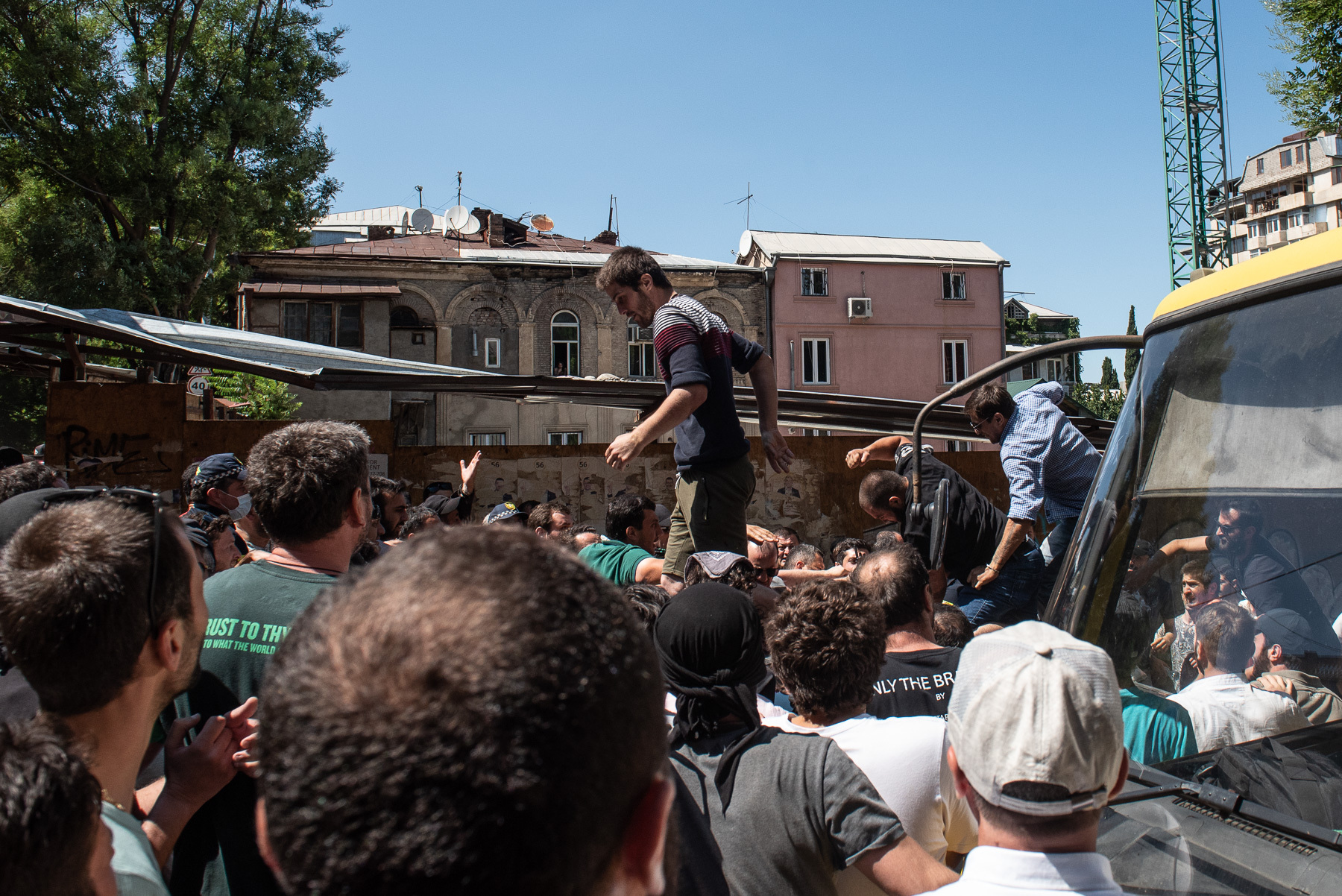 A mob attacks journalists near the parliament building in Tbilisi on 5 July. Photo: Mariam Nikuradze/OC Media.
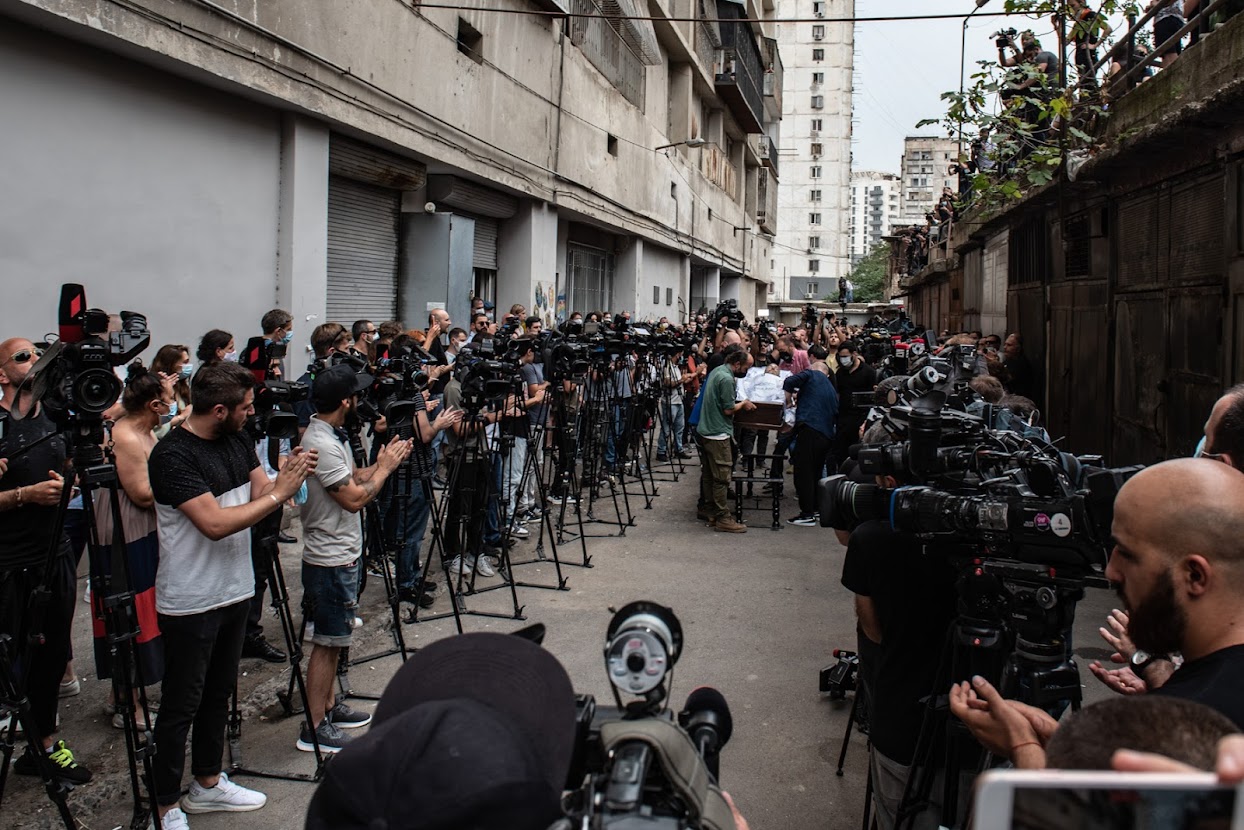 Media workers bid farewell to Aleksandre Lashkarava with a corridor of cameras and long applause on 13 July 2021. Photo: Mariam Nikuradze/OC Media.
[Read on OC Media: Editorial | A state-sanctioned attack on Georgia’s free press]
The government has since maintained its boycott of TV channels that do not follow a pro-government editorial line.