
Cold Warrior @chrislhayes dusts off the Russiagate playbook to warn that Joe Biden, Mitch McConnell, and US arms merchants might not get another $61 billion to prolong the Ukraine proxy war.
Think about the incentives since 2016 for being a Russiagate useful idiot: https://t.co/LntNXU4U7f
— Aaron Maté (@aaronjmate) February 14, 2024
Day: February 14, 2024
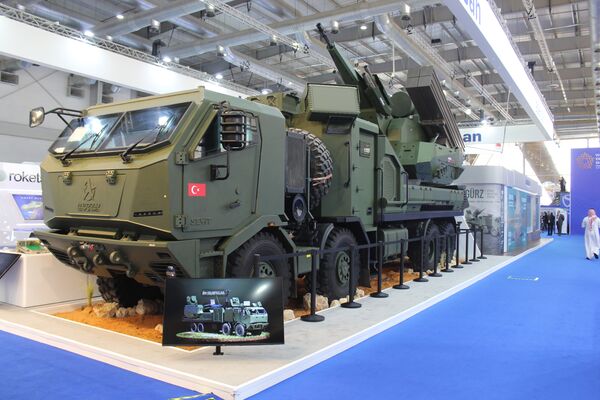
<div><img class=”invisible” style=”display: none” src=”[images%7COpenAccessDataProvider]cd4986bd-0191-45a6-9356-8361b05ee78f?sfvrsn=4fd8c394_2″></div><div class=”w-100 position-relative”> <img src=”/ResourcePackages/Janes/assets/dist/images/placeholder-16-9.jpg” class=”invisible w-100″> <div style=”background-image: url(“https://www.janes.com/images/default-source/news-images/bsp_70851-jdw-25120.jpeg?sfvrsn=4fd8c394_2″)” class=”news-hero bg-center bg-cover position-absolute left-0 top-0 h-100 w-100″></div></div>
<p class=”text-body text-muted small”>Aselsan Gürz SHORAD system shown at WDS 2024. (Janes/Sunil Nair)</p>
<p>Aselsan’s Gürz short-range air-defence (SHORAD) system was displayed at the World Defense Show (WDS) 2024 held in Riyadh from 4 to 8 February. This was the system’s international debut after it was shown at the 16th International Defence Industry Fair (IDEF) in Istanbul in July 2023. An all-in-one, layered air and missile-defence system, the Gürz is designed to intercept aerial targets ranging from unmanned aerial vehicles (UAVs) of all types and sizes, fixed- and rotary-wing aircraft, and cruise missiles from a single integrated system that can fire on the move.</p>
<p>The Gürz system shown at WDS 2024 was based on an Anadolu Isuzu trucks’ Anadolu Savunma Seyit military vehicle division 8×8 truck with a two-door armoured cabin. The command-and-control workstation cabin is located behind the second axle.</p>
<p>Four active electronically scanned array (AESA) search and fire-control radars with an identification friend-or-foe (IFF) capability are located on the vehicle’s four corners, two on top of the armoured cabin and two at the rear of the vehicle. There are also two datalinks on the roof along with the AESA radar. An electromagnetic jammer is fitted at the rear of the cabin on the left side of the vehicle behind the second axle.</p>
<p>The armament section over the third and fourth axles consists of a four-pod container that can fire either the Göksur or Hisar missiles with imaging infrared seekers, a 35 mm anti-aircraft gun with an automatic ammunition feeding system, and four Bözdoğan and Gökdoğan very-short-range air-defence (VSHORAD) missile pods adjacent to it. At the very end of the vehicle is the fire-control radar and an electro-optic suite consisting of a day/night camera, a thermal camera, and a laser rangefinder.</p>
<div><img class=”invisible” style=”display: none” src=”[images%7COpenAccessDataProvider]e24f51c3-901b-4934-b37a-1321444679a0?sfvrsn=61541857_2″></div><div class=”w-100 position-relative”> <img src=”/ResourcePackages/Janes/assets/dist/images/placeholder-16-9.jpg” class=”invisible w-100″> <div style=”background-image: url(“https://www.janes.com/images/default-source/news-images/bsp_71007-jdw-25121.jpeg?sfvrsn=61541857_2″)” class=”news-hero bg-center bg-cover position-absolute left-0 top-0 h-100 w-100″></div></div>
<p class=”text-body text-muted small”>GA-ASI’s Gambit UAV concept. Though the companies involved in the CCA programme have been tight-lipped about their submissions, GA-ASI’s may be based off the Gambit concept revealed in 2022. (GA-ASI)</p>
<p>The US Air Force (USAF) is set to downselect contractors on the Collaborative Combat Aircraft (CCA) programme from five current potential providers to two to three “within the next few months”, Secretary of the Air Force Frank Kendall told reporters on 13 February on the sidelines of the Air Force Association conference. A further winnowing is likely before the CCA enter the production phase.</p>
<p>“We’re going to have at least two [contractors]. We’d like to have three, [which] is going to be difficult, because of the level of funding we have in the budget. With some cost-sharing from industry, I think we could do three, and that would be our preference.”</p>
<p>
“The next phase is going to take us into development for production,” Kendall continued. “Then we’ll be moving forward in a couple of years to downselect for production. How many [contractors] we’ll be able to carry into production is still uncertain. We [will] definitely [have] one
<strong></strong>
but there’s a possibility that we could do more than one.”
</p>
<p>Five companies are currently on contract to advance their CCA designs: Anduril, Boeing, General Atomics Aeronautical Systems (GA-ASI), Lockheed Martin, and Northrop Grumman. The USAF has largely kept the CCA contracting process under wraps, and how advanced the companies’ designs are is publicly unknown.</p>
<p>A second round of the CCA programme is to be contracted in fiscal year (FY) 2025, Kendall said, and may include contributions from “strategic” international partners.</p>
<p class=”text-body text-muted small”>GA-ASI’s Gambit UAV concept. Though the companies involved in the CCA programme have been tight-lipped about their submissions, GA-ASI’s may be based off the Gambit concept revealed in 2022. (GA-ASI)</p>
<p>The US Air Force (USAF) is set to downselect contractors on the Collaborative Combat Aircraft (CCA) programme from five current potential providers to two to three “within the next few months”, Secretary of the Air Force Frank Kendall told reporters on 13 February on the sidelines of the Air Force Association conference. A further winnowing is likely before the CCA enter the production phase.</p>
<p>“We’re going to have at least two [contractors]. We’d like to have three, [which] is going to be difficult, because of the level of funding we have in the budget. With some cost-sharing from industry, I think we could do three, and that would be our preference.”</p>
<p>
“The next phase is going to take us into development for production,” Kendall continued. “Then we’ll be moving forward in a couple of years to downselect for production. How many [contractors] we’ll be able to carry into production is still uncertain. We [will] definitely [have] one
<strong></strong>
but there’s a possibility that we could do more than one.”
</p>
<p>Five companies are currently on contract to advance their CCA designs: Anduril, Boeing, General Atomics Aeronautical Systems (GA-ASI), Lockheed Martin, and Northrop Grumman. The USAF has largely kept the CCA contracting process under wraps, and how advanced the companies’ designs are is publicly unknown.</p>
<p>A second round of the CCA programme is to be contracted in fiscal year (FY) 2025, Kendall said, and may include contributions from “strategic” international partners.</p>
Should the U.S. House of Representatives vote to Pass the $95 Billion Emergency Aid Package for Ukraine, Israel, and Taiwan?
— OSINTdefender (@sentdefender) February 13, 2024