
This is a rush transcript. Copy may not be in its final form.
AMY GOODMAN: This is Democracy Now!, democracynow.org, The War and Peace Report. I’m Amy Goodman.
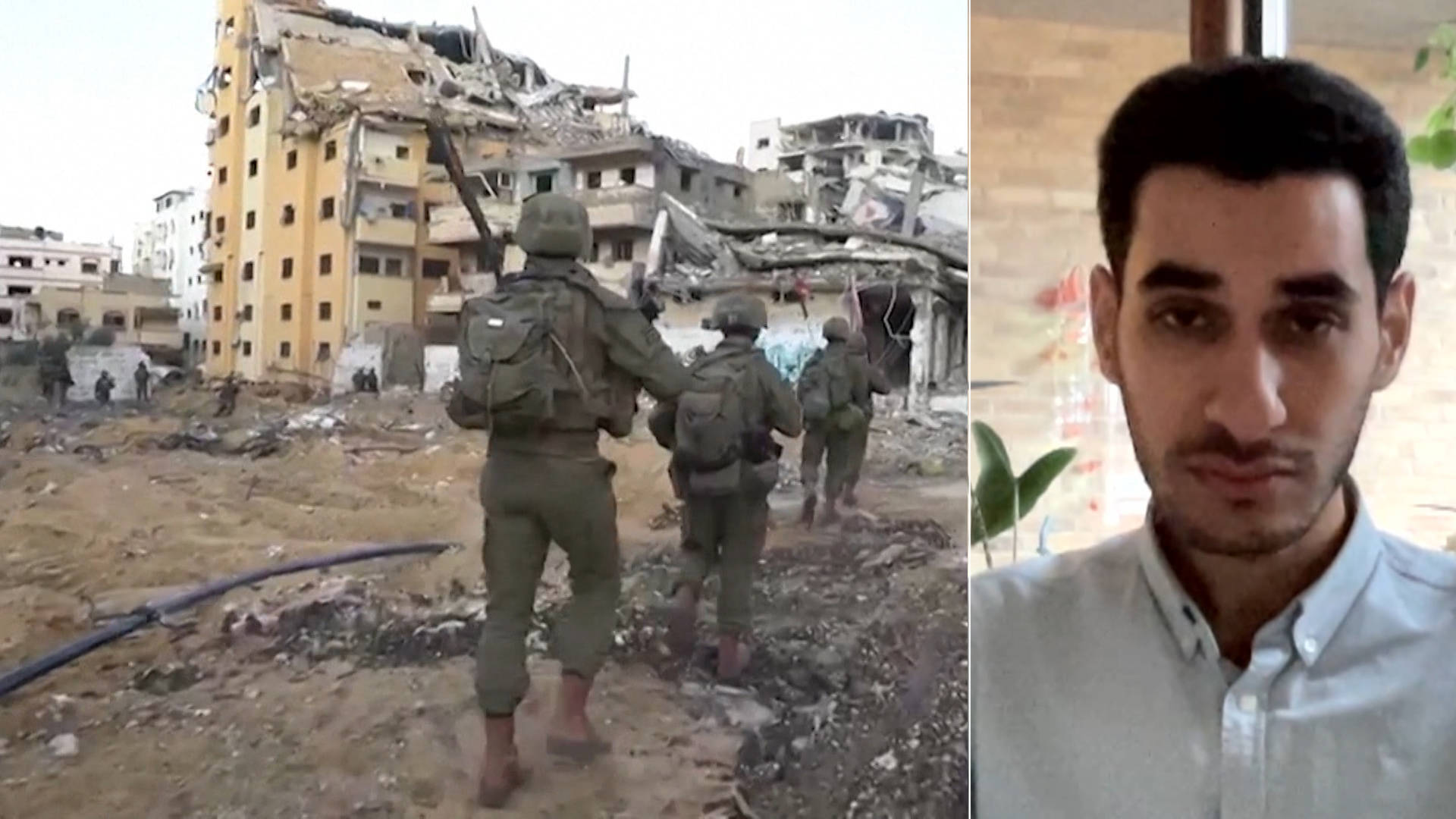
To talk more about the dire situation in Gaza, we’re joined by Muhammad Shehada, a writer and analyst from Gaza, chief of communications at Euro-Mediterranean Human Rights Monitor and a columnist at The Forward newspaper, a Jewish weekly in New York. He’s joining us from Copenhagen, where there have been a number of protests.
In fact, Muhammad, can you start with those protests? We are covering the protests here in the country and around the world. What’s happening in Copenhagen?
MUHAMMAD SHEHADA: It was actually pretty remarkable. I’ve never seen a protest of that size in Denmark for at least the last two years. There was the climate march last year in November around elections time, so every political party was very keen to show up there, including the prime minister. But the demonstration yesterday for Gaza was almost twice the size of Denmark’s climate march, and the climate is a very huge topic here. And it’s been a tremendous ongoing daily movement where people move with demonstrations every night to different locations of Denmark’s capital to make a statement about the necessity of a ceasefire and to stop the bloodshed in Gaza. So it’s been extraordinary.
AMY GOODMAN: And do people there face the same issue that they face in the United States, being accused by some that if they criticize Israel, they’re automatically antisemitic?
MUHAMMAD SHEHADA: Yeah, yeah, absolutely. There’s plenty of that. Even the Danish prime minister, she laid a wreath of flowers at the Israeli Embassy, and then she was asked, “Would you do the same to Palestinian victims?” And she said, “There is no comparison whatsoever. Israel is defending itself. Hamas is a terrorist organization.” So, that was basically the sentiment. It’s the same in Danish media. So, for instance, the question of “Do you condemn Hamas?” is, again, the same question asked to any person of color whenever they want to talk about what Israel has done to them and their own families in Gaza. And the media bias is very visible, as well.
AMY GOODMAN: In the last few days — well, the Israeli military completely controls the media of international journalists in Gaza, does not let them in unless they are embedded with the Israeli military, and they review their video, unless they’re, you know, journalists, Gazan journalists, Palestinian journalists inside Gaza, of course, are there operating. So many of them, more than 30 of them, have been killed. But in the last few days, the Israeli military has brought in journalists from BBC, from CNN, and they show them a hole at Al-Shifa Hospital, where they say this goes directly down, right near Al-Shifa, into the ground and then underneath Al-Shifa. Can you talk about what we understand at this point?
MUHAMMAD SHEHADA: Yeah, absolutely. As you said, Amy, it’s very horrendous to see journalists agreeing to these humiliating conditions that basically mean anything they convey is literal propaganda, because there are three conditions. You are not allowed to speak to any Palestinian or Gazan to challenge what the IDF is spoon-feeding you. You are not allowed to go beyond the tour that the IDF has staged, so you stick to what the IDF wants to show you and where they take you. And you have to review the material with them before you publish, so that the result of that is not journalism. It’s propaganda.
But with Al-Shifa Hospital, what we’ve seen is, basically, for Gaza’s main medical complex, of giant symbolic value and of important, crucial necessity to the lives of thousands — there were about 50,000 people sheltering there — for Israel to say that it has lost its protected status, it has a huge burden of proof to show that the hospital was used to direct or engage in hostilities against it. But up until now, what we have, the facts that we know, is that not a single bullet was fired against the IDF from the hospital over the last week or they have operated in the hospital completely. Not a single bullet. Not a single footage of a Hamas rocket being fired from the hospital. And not a single incident of the sprawling — alleged sprawling command-and-control centers that Israel has published as CGI-animated footage of and claimed that they knew the precise entrance to. They have not shown any of that. And they have not shown or captured any Hamas militants in the hospital or Hamas members. So, basically, there is no satisfying proof for the hospital to lose its protected status and for what Israel has inflicted on the hospital for the last week. They starved, literally starved, everyone inside. About eight babies were suffocated to death. Twenty-two people in the ICU units were killed, and six dialysis patients were killed. The overall totality of how many people killed were there were 53 in total. So, that is very atrocious.
And as you said, the only evidence that Israel had to show for it was a hole in the ground. And I consulted with experts in Gaza, experienced engineers who are familiar with sort of different structures that were observed — for instance, Hamas tunnels — and they said that does not look like a Hamas tunnel whatsoever, because you have two very giant, very solid concrete columns on both sides of the entrance, the shaft’s entrance, and these can only be built by pouring cement down in a mold and vibrating every time you pour a little bit, and vibrate it with a concrete vibrator, and wait for it to dry. And that takes days, and it makes a huge noise. In a hospital in full view of thousands of people going in and out on a daily basis, that’s not how you build a secret tunnel. And the IDF has not allowed anyone to go inside the alleged tunnel to see what’s in it. But even if you presume that it is a tunnel, the IDF would still have a burden of proof to show that Hamas was actually using it at the time of the IDF raid to essentially legitimize their raid, or using it at all during that war. They have not shown any evidence of that.
AMY GOODMAN: I saw one Israeli military spokesperson showing a CNN reporter and saying, “We believe that at the bottom there,” where you see a metal door — they haven’t opened it, because they say they’re afraid there are explosives that are attached to it — it would make some kind of sharp turn, and that would then go under the hospital. So, they haven’t shown that the tunnel itself is under the hospital. They say what’s behind it, what they can’t see, they think, makes a turn.
MUHAMMAD SHEHADA: Yeah, but even with that door, I know [inaudible] that Hamas and other militant groups were abiding by a very strict decision, since 2014 at least, to not have any military activities in or around hospitals, because that was previously Israel’s pretext for bombing medical facilities and schools and homes. So they say they had a strict decision not to use it. You don’t need to believe Hamas, but you take a statement that Gaza’s Ministry of Health and Hamas, as well, have made. They said that we would allow any international expedition, a group of experts, to come into Gaza and vet and scrutinize every little aspect of the hospital, without any of the patients dying. And Israel’s answer to that has been a resounding refusal.
So, if Israel had more than a week — they had eight days inside the hospital, daily operations, uninterrupted, unattacked, unimpeded, going through every single room, every single detail — and still unable to show any traces of Hamas using the hospital for military activities, the IDF propaganda becomes more or less a laughingstock than actual sort of evidence or communication. Especially when last week they went to a children’s hospital, the Rantisi Hospital, after doing the same, surrounding it, besieging it, starving people inside, forcing them out at gunpoint, and then, once they went inside, the spokesperson of the IDF, he went to the basement, and he showed a piece of paper on the wall, and he said, “This shows the names of Hamas terrorists that were guarding hostages here.” And he showed a baby nappy and a bottle of milk, and he said that’s proof — a bottle of milk in a children’s hospital, where thousands of people were taking refuge. But even with the list that he showed on the wall, it was basically a calendar with the names “Saturday,” “Sunday,” “Monday.” So, if you believe Monday is a terrorist, a legitimate target, go ahead and kill Monday. You would have my utmost sympathy.
AMY GOODMAN: Do you have any information on the latest negotiations, the deal where dozens of hostages would be released by Hamas, particularly women and children, prisoners would be released by Israel — there are thousands of Palestinian prisoners in Israeli jails — and there would be some kind of ceasefire?
MUHAMMAD SHEHADA: Yeah, yeah. There’s plenty of proposals that have been put on the table, and I’ve been following them up very meticulously. So, the priority right now is to get Israeli children, women and elderly, and civilian hostages altogether, especially foreigners, released and returned to Israel. And Hamas alleges that some of them were kidnapped by other groups, once the fence collapsed, and that they still need to audit and collect these hostages and release them, which is why they’ve been asking for a temporary ceasefire for five days, to allow them to go and find the hostages held by more minor and less known groups, and with Nasser Salah al-Deen, Saraya al-Quds, Kitab ul-Mujahideen, etc. So, basically, that’s one of the reasons.
The other is, the negotiations, where it stopped is Hamas promised to release about 50 to 70 civilian hostages on stages during a five-day ceasefire, in return mainly for Israel to allow food and humanitarian aid and fuel to go to all of Gaza, especially the north, because now the northern half, Israel has not been allowing any food, water, electricity or fuel to go inside the north for the last 44 days. It has become a death zone to force people out and to defeat Hamas militarily by besieging and starving and randomly even killing everyone inside. So, basically, Hamas’s condition was that Israel allows aid to go to the north for people that are still there, tens of thousands, if not over 100,000 people, and to allow fuel to go through the United Nations to run, for instance, Gaza’s sole power plant to power water distillation facilities and water sewage treatment facilities, etc., to prevent diseases and a humanitarian catastrophe. So, that has been the demand.
There are two logistical stumbling blocks that are obstructing the talks. They say the two sides are almost in agreement, but the two major blocks is basically Hamas asking that people who fled to the south be allowed during these five days of ceasefire — they should be allowed to go back if they wanted to, or people in the north to go south. And Israel is objecting to that. And Hamas is asking the Israeli military tanks and vehicles on the ground to pull back a little bit to allow for the hostages to be taken out and to be moved to Rafah, where they would be released, and also in the south, as well. And they’re asking the Israelis to suspend their drone surveillance on top of Gaza, because they are afraid that Israel would use that moment of the hostage release to find out the hideouts of Hamas and their military infrastructure. So it’s more of a logistical militant demand than sort of a substantial block. But Israel is still refusing, as I said, the entry of humanitarian aid and fuel to the northern half, and they are refusing the return of people that were displaced south to return back to the north.
AMY GOODMAN: Muhammad Shehada, I want to thank you for being with us, writer and analyst from Gaza, chief of communications at Euro-Mediterranean Human Rights Monitor, columnist with The Forward newspaper, a Jewish weekly here in New York, joining us from Copenhagen.
Page 2
This is a rush transcript. Copy may not be in its final form.
AMY GOODMAN: This is Democracy Now!, democracynow.org. I’m Amy Goodman.
We end today’s show remembering the 74-year-old Canadian Israeli peace activist Vivian Silver. She was killed October 7th during the Hamas attack on Kibbutz Be’eri, where she lived. She was declared dead only last week, after Israeli authorities identified her remains. Up until last week, her family thought that she may have been taken hostage. Vivian Silver had co-founded the Arab-Jewish Center for Equality, Empowerment, and Cooperation and was a member of Women Wage Peace. In 2017, she joined a march of Israeli and Palestinian women to the shores of the Jordan River to call for an end to Israel’s occupation.
VIVIAN SILVER: We are organizing women from all over the country, from every side of the political spectrum, who are saying, “Enough! Maspik” — in Arabic, it’s ”makkafi” — “Enough. We’re no longer willing to do this.” We must reach a political agreement. We must change the paradigm that we have been taught for seven decades now, where we’ve been told that only war will bring peace. We don’t believe that anymore. It’s been proven that it’s not true.
AMY GOODMAN: Those were the words of Vivian Silver in 2017. On Thursday, friends and family and relatives of Vivian Silver gathered for her memorial service. During a recent BBC interview, her son Yonatan Ziegen was asked what his mother would say about what’s happening in Israel and Gaza now.
YONATAN ZIEGEN: That this is the outcome. This is the outcome of war, of not striving for peace. We’ve been — you know, Israelis have that saying, “living under a sword.” And this is what happens. You know, it’s very overwhelming, but it’s not completely surprising. We couldn’t — it’s not sustainable to live in a state of war for so long. And now it bursts. It burst.
AMY GOODMAN: We’re joined now by Samah Salaime. She is a writer at +972 Magazine, a Palestinian feminist activist, her most recent piece, “A tribute to Vivian,” which went viral. In the piece, Samah writes, quote, “Nothing prepared me for yesterday’s bitter news of Vivian’s tragic end. I felt deep despair, like a bottomless sink-hole had opened under the foundations of humanity, where thousands are already buried — men, women, children, innocent Palestinians and Israelis. People who had wished for peace, and did not live to see that wish fulfilled,” Samah Salaime wrote.
Samah, welcome to Democracy Now!, under horrific circumstances. Can you tell us more about Vivian, and your response last week when you learned, no, she wasn’t a hostage, as you all and her family had hoped, but she had died at the kibbutz she lived on for decades, Be’eri?
SAMAH SALAIME: Yeah. So, thank you for the invitation. And I will use the few minutes that you give me to introduce Vivian Silver to your audience.
Vivian was a feminist, very optimistic woman. And she believed in people. She believed in humanity. And she made a difference in every room that she joined, every group or initiative or any peace process that she wished to be part of. Vivian, for five decades, put all of her — dedicated her life to make shared life possible in Israel. She truly believed of partnership between Palestinians and Israelis to end this vicious, ugly conflict that we all live in.
Vivian passed away. She was killed, and we didn’t know. We all believed — all her friends, we believed that she became a hostage like 240 hostages, because the army told her family that there is no any evidence that something bad happened to her. And they believed it. And it [inaudible]. All the friends, all the feminists and peace activists prayed for her safety. And we truly believed that she will know how to communicate with people in Gaza. She was in Gaza. She visited Gaza many times. And after the siege started, she insisted to take Palestinian kids from the checkpoint, from the border, to the hospitals inside Israel. And she combined them. We have a dream that one of these kids that she helped will find her and will communicate with her in Gaza. These images were wishful thinking for anyone and for everyone. And we had to deal with the devastating sad news that she’s gone.
And the painful thing in Israel, that there are some people who used her memory to justify the war in Gaza, something that she truly didn’t believe in force and militarism and bombs. And she really wanted and fighted for peaceful process and peaceful ending for this conflict. And, for example, one of the Israeli activists put her name on a rocket that was supposed to bomb Gaza and for her memory. And this is the quite opposite thing that Vivian teach us. The minister of security, on internal security in Israel, Ben-Gvir, he’s this extremist fascist minister in Netanyahu’s government, also posted in his — tweeted on his Twitter account saying that this is what the Palestinian do with people who believe in peace, and she paid the price.
And this kind of ugliness and harassment and incitement against peace activists, this is the atmosphere here. We were not allowed to demonstrate, and still, against the ministry, against the war. We cannot shout, as Palestinian activists inside Israel, that we need and we want ceasefire. Any gathering between Arab and Jewish is now forbidden in Israel. But what the death of or the murder of Vivian succeeds to do is to gather hundreds of people in her memorial, Arab and Jewish, Palestinian and Israelis, men and women, religious and secular, from all the aspect, all the region, came to say goodbye to this wonderful, amazing, prominent woman.
AMY GOODMAN: We had hoped to have her son Yonatan on, as well, but he is still sitting shiva right now since the funeral, still mourning his mother’s death. Is it true that someone wrote Vivian’s name on a rocket that would be used in Gaza?
SAMAH SALAIME: This is one of the photos that one of the activists showed me during the memorial, and I was shocked by this photo. Someone posted that on the social media for her memorial, which is — it’s like putting salt in our open wound. And we both cried to see this, because this is not on the memory of thing that is something that Vivian Silver will do or wish or want her name on any military action or violent tool. She used to say that if your only tool is a hammer, everything and every problem around you will be — will look like a nail, that you have to hit it. And the Palestinian-Israeli conflict have to be dealt with with different tool, and you have to be creative, and we have to be optimistic. We have to speak and to keep the dialogue going on and to compromise to find the solution, and not to keep this circle of blood going every two years. And this was her legacy, and this is what we have to march for and fight for after her death.
AMY GOODMAN: We just have a minute to go, but, Samah, what do you want to see happen now, and what do you think Vivian would be saying right now?
SAMAH SALAIME: I think Vivian, as we know her, with her sarcasm and great sense of humor, she will gather us as a group of women. She will speak, and she will break the law by organizing a demonstration against the war, and she will call for ceasefire now. She will have the courage to share photos and images from Gaza, and she will — she usually always had this unique or rich voice that nobody have around her. And she will be the voice of Palestinian families, Palestinian colleagues and Palestinian innocent people that send us all the time messages that they are very sad for her loss, and they are missing her, and they could not be at the memorial because of the war. Vivian will march around and will break the siege. She will do everything against this war. And she usually have this — I don’t know where she brings this power from, to approach people, and people will follow. And this is her energy. And we certainly — the peace movement in Israel-Palestine had a great loss today.
AMY GOODMAN: Samah Salaime, I want to thank you so much for being with us. We’ll link to your piece in +972 Magazine. I’m Amy Goodman.
 FBI agents leave the Brooklyn home of Mayor Adams’ campaign consultant, Brianna Suggs, on Nov. 2. (Obtained by Daily News)
  Gated front steps lead up to the Brooklyn residence of Brianna Suggs, a top fundraiser and longtime confidante to New York City Mayor Eric Adams, on Thursday, Nov. 2, 2023, in Brooklyn. (AP Photo/Eduardo Munoz Alvarez)
  Mayor Eric Adams is pictured during an in-person media availability at City Hall on Tuesday, Nov. 14, in Manhattan, New York. (Barry Williams for New York Daily News)
 :quality(70)/cloudfront-us-east-1.images.arcpublishing.com/archetype/ABKAD5O7N5A37D2OMTS32ANO24.jpg)


