Categories
Selected Articles

How Does the Intelligence Community Adapt in the Age of AI?


OPINION — CIA Director William Burns’ recent remarks to the Ditchley Foundation highlighted three key challenges to American security; (1) strategic geopolitical competition; (2) transnational threats; and (3) the “revolution in technology which is transforming how we live, work, fight, and compete with possibilities and risks we can’t yet fully grasp.” 

This last point requires emphasis—because never again will ‘technology change’ occur as slowly as it is occurring today.  So how does the Intelligence Community (IC) adapt in the Age of AI?

From World War II until the early-2000s, the IC was revered for driving technology innovation to advance U.S. national security. Working closely with America’s scientific and commercial communities, the Agency launched America’s first spy satellite, CORONA, in 1960, and soon after helped develop lithium batteries to improve the performance of surveillance equipment and prolong satellite operations.

In 2003, the CIA’s venture capital arm, In-Q-Tel, backed a start-up called Keyhole, which focused on geospatial data visualization applications. That same year, In-Q-Tel backed Palantir, the company where I now serve as a senior advisor. Beyond advancing American national security, IC-led innovation also improved Americans’ daily lives. Today, there are more than 7,000 satellites in space; lithium batteries power everything from our cell phones, laptops, and toothbrushes, to increasingly, our vehicles; and Operation Warp Speed distributed about 500 million COVID vaccine doses across 64 jurisdictions in 12 months. 

It’s not just for the President anymore. Cipher Brief Subscriber+Members have access to their own Open Source Daily Brief, keeping you up to date on global events impacting national security.  It pays to be a Subscriber+Member.

The public sector began to lose its collective innovation edge with the advancement of the internet, software and commercial broadband in the early 2000’s. Study after study warned of the IC’s eroding marginal share of scientific and technical knowledge and the risks that posed to U.S. national security.

While the Department of Defense (DoD) still faces challenges, some military leaders have made great strides to become more effective adopters of emerging technology.  Given the gravity of the moment, IC leaders must look to these examples for inspiration and harness existing innovation capabilities.

What did the Pentagon get right?

Starting in the early-2010s, the DoD took major steps to ensure the U.S. military was both a leading consumer and partner in American innovation. In 2012, then-Deputy Defense Secretary Ash Carter established the Strategic Capabilities Office to find new ways to use existing weaponry to counter new threats. Then, Deputy Secretary of Defense Robert Work designed the Third Offset Strategy to address the erosion of the US military’s technological superiority and to focus on technologies like artificial intelligence (AI), cloud computing and data analytics. In 2017, DoD established an effort to automate and augment the military’s use of full-motion video in the campaign against ISIS. The Department partnered with industry to apply technology to automate functions and enable analysts to work more effectively and efficiently.

By 2022, Deputy Secretary of Defense Hicks launched the AI and Data Accelerator Initiative and directed the new Chief Digital and Artificial Intelligence Office to take charge of the Global Information Dominance Experiments while leading the department’s Joint All Domain and Command and Control efforts. The benefits of this multi-year campaign of learning are evident every day as the U.S. helps Ukraine fight a digital war against an analog enemy.

Today, the CIA and broader IC face a daunting challenge. In 2021, the CSIS Technology and Intelligence Task Force published a remarkable report on the state of IC innovation and technology, finding that despite a plethora of opportunities to apply technology across intelligence missions, progress was blocked by a culture that was “resistant to change.” The report indicated that the IC was “averse to risk-taking, particularly in acquiring and adopting new technologies and integrating outside information sources.”

The Cipher Brief Threat Conference is taking place October 7-10 in Sea Island, Georgia. This is the nation’s premiere conference for professionals working in the field of national security and cybersecurity. Space is limited.  Apply today for your seat at the table. 

To be fair, recent signs indicate that the IC may be preparing for its own technological revolution. For example, CIA Director William Burns created a Transnational and Technology Mission Center and appointed the Agency’s first-ever Chief Technology Officer. Similarly, the DNI-driven commercial cloud program has advanced to a multi-cloud environment. However, for the IC to leverage the Age of AI and progress against geopolitical and transnational threats, leaders must turn these organizational and contractual changes into mission wins.

Leading the AI revolution for intelligence

In 2017 DoD tackled the challenge of quickly processing massive volumes of video into actionable intelligence.  In 2023, the IC should apply AI to the massive declassification opportunity. Declassification imperatives include (1) enabling an informed citizenry to hold their government accountable; (2) building public trust; (3) combating the coming surge of mis/disinformation; (4) sharing more information with foreign partners (e.g., replicate the effort that preceded Russia’s invasion of Ukraine on other topics); and (5) saving taxpayer dollars used to maintain huge troves of classified data.

DNI Avril Haines announced in January, that the IC is already seeing some progress in piloting AI solutions against this challenge.  By publicly committing to prioritize this issue, being transparent about its progress, and achieving material impact, the IC will learn how to work effectively on a large AI program and set an example for other AI projects to succeed. 

Once the IC learns how to do Human+Machine teaming, AI can help the IC identify misinformation and deepfakes leading up to the next election; can generate content to bypass China’s censorship regime; dramatically improve offensive and defensive cyber operations; advance our ability to monitor foreign technology developments; and improve both analytic and human intelligence tradecraft.    

The IC also can supercharge American industry by setting both technical and ethical standards. If the IC can trust an AI to develop alternative hypothesis for a Presidential Daily Brief, surely a food manufacturer can trust an AI to identify alternative supply chain opportunities.

This statement from DNI Haines’ 2023 Annual Threat Assessment is profound: “Foreign intelligence services are adopting cutting-edge technologies—from advanced cyber tools to unmanned systems to enhanced technical surveillance equipment—that improve their capabilities and challenge U.S. defenses. Much of this technology is available commercially, providing a shortcut for previously unsophisticated services to become legitimate threats.” 

With the AI revolution now in full swing, the IC must do these same things—partner with the private sector and the broader defense community—to steal secrets and make sense of them.  Applying AI to aid in the declassification process has significant merits onto itself and can be the jolt that the IC needs to reemerge as a leader in adopting emerging technology.  

The Cipher Brief is committed to publishing a range of perspectives on national security issues submitted by deeply experienced national security professionals. 

Opinions expressed are those of the author and do not represent the views or opinions of The Cipher Brief.

Have a perspective to share based on your experience in the national security field?  Send it to [email protected] for publication consideration.

Read more expert-driven national security insights, perspective and analysis in The Cipher Brief


Categories
Selected Articles

Ukraine’s Crimea operation is going to plan


Ukraine’s operation to strangle supply lines in annexed Crimea and make it untenable for occupying Russians is going according to plan, with Kyiv one step closer to an attempt to liberate the Black Sea peninsula, an official said on Thursday.

The peninsula was rocked by explosions on Wednesday and Thursday. Attacks targeted the Russian navy’s Black Sea fleet and damaged a large vessel and a submarine at a key naval base in Sevastopol; and a Russian air force S-400 air-defense battery was reportedly destroyed in Western Crimea a day later.

Strikes in Crimea, which is Russia’s central logistics hub for its forces in southern Ukraine, have become routine in recent months amid Kyiv’s counteroffensive to reclaim territory occupied by Russian forces. Attacks have struck military targets in a push to weaken Moscow’s defenses and disrupt Russia from transporting equipment, weapons, and troops from mainland Russia into the peninsula.

Kerch bridge

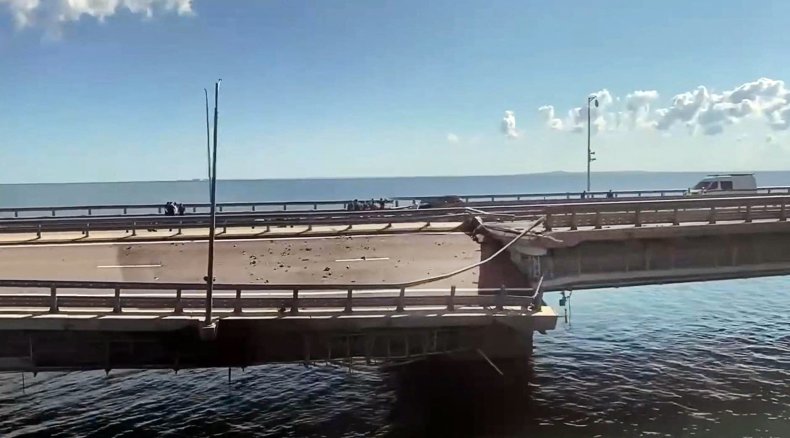
This video grab taken from a Crimea24TV footage on July 17, 2023 shows the damaged Kerch Strait Bridge, linking Crimea to Russia, following an attack. Moscow said two drones had hit the structure in the early hours and blamed the Kyiv regime.
-/Crimea24TV/AFP/Getty Images

Ukrainian President Volodymyr Zelensky has pledged to undo Putin’s annexation of Crimea.

While Ukraine didn’t immediately claim responsibility for strikes in Crimea’s Yevpatoria area on Thursday, Natalia Humeniuk, the spokesperson for the southern military command, appeared to hint at involvement from Kyiv.

“The concentration of military facilities, the presence of an airfield nearby—all this suggests that the work is being carried out absolutely as planned. The goals are legitimate, entirely military,” Humeniuk said on national TV.

And the commander of Ukraine’s air force, Lieutenant General Mykola Oleshchuk, wrote on his Telegram channel after Wednesday’s Sevastopol strikes: “While the occupiers are still recovering from the night-time bombardment in Sevastopol, I would like to thank the pilots of the Ukrainian Air Force for their excellent combat work! To be continued…”

Meanwhile, on Monday, Ukrainian military forces said they had reclaimed control over four strategically vital oil and gas drilling platforms in the Black Sea near Crimea.

This week’s developments are just a sliver of a long-term, sophisticated operation by Ukraine to pave the way toward the peninsula’s recapture, experts assess.

“Raids on Crimea and oil/gas platforms to eliminate radar, then a complex drone/missile strike against Sevastopol. This is a very sophisticated approach to making Crimea untenable for the Russians,” former U.S. General Ben Hodges said on X, formerly Twitter, on Thursday.

Kerch Strait Bridge

Retired Army Lt. General Stephen Twitty, former deputy commander of U.S. European Command, told Newsweek in May that an attempt to retake the peninsula would involve Ukraine taking action to prevent Russia from resupplying from Crimea, whether it be logistics or whether it be troops.

Retired U.S. Marine Corps Colonel Mark Cancian told Newsweek that Ukraine will try to cut Crimea off, take out the strategically vital Kerch Strait Bridge that connects Russia with Crimea, and “just squeeze it over time make it untenable to hold.”

Cancian added that there will be an extended siege in a Ukrainian attempt to recapture Crimea.

Ukraine’s second strike on the Kerch Strait Bridge on July 17, which damaged its crucial railway, brought those objectives closer to reality, according to Humeniuk. She said last month that the peninsula is increasingly becoming an island in a logistical sense.

Supply of Russian logistics via Crimea has become complicated and slow, Humeniuk added, saying that, while other routes exist for transporting weapons and equipment, these are overloaded because they’re also used by civilians.

The Kerch Strait Bridge is a key supply route for Russia’s forces and is its sole land link with Crimea. It consists of two main parts—a four-lane roadway for vehicles and a railway bridge with two tracks—and is crucial to sustaining Moscow’s military offensives in southern Ukraine.

Importantly, Newsweek found that the July 17 strike on the bridge damaged its crucial railway, contrary to Russian claims that the attack affected only the roadway on spans of the structure.

Data and satellite images sent exclusively to Newsweek by Molfar, a global open-source intelligence agency, dated on July 17 and 23, show damage to railroad parts of the bridge.

While the visible portion of the railroad structure appears stable and is likely able to safely carry passenger cars, a source with knowledge of construction work at the Crimean bridge told Molfar that, as one column has cracks, the movement of freight trains across the bridge is no longer possible.

The railway link between annexed Crimea and Russia had enabled the Russian army to transport heavy equipment swiftly, and troops regularly relied on the railroad to deploy such machinery to Crimea. This will now be hindered due to the damage caused by the explosions on July 17, and could have serious strategic implications for the Russian military presence in the region, Molfar researchers assessed.

Krym.realii, the Crimean project of the Ukrainian service of Radio Liberty, reported on September 6 that the July explosion on the Kerch bridge has greatly affected Russia’s military logistics of Russia. It added that its journalists noticed a large convoy of Russian military equipment and armored trucks taking alternative routes this month. Local residents told the publication that Russian military convoys have been moving through the peninsula day and night, creating emergency situations on the roads.

The Washington D.C.-based Institute for the Study of War assessed last month that Ukraine’s strikes on key bridges linking Crimea to southern Ukraine and to mainland Russia are impacting Moscow’s ability to move resources. The think tank said this was also hampering the Kremlin’s efforts to fend off Kyiv’s ongoing counteroffensive to reclaim its territory.

Cancian told Newsweek this month that attacks on the Kerch Bridge are important steps for squeezing Crimea.

“I think the Ukrainian characterization is correct; Russian logistics are becoming more complicated and slowing down. The bridge, with its road and rail connections, provided an easy way of getting supplies and equipment from Russia proper to Crimea and on to the western parts of the front,” Cancian said.

Fuel Shortages

Elina Beketova, an in-residence fellow with the Democracy Fellowship program at the Center for European Policy Analysis, told Newsweek that Ukraine has been successful in strangling Russia’s supply lines and hampering Russia’s logistics, particularly with the July 17 strike on the Kerch bridge.

“Since then, the occupying authorities have been closing the Kerch bridge from time to time, and it has less functional capacity to have the same amount of transport on it, as it was before the attack,” said Beketova, noting that in recent days, people on local social media have been complaining about the lack of diesel fuel at gas stations or that it is more expensive than in other places.

The occupying authorities of Crimea confirmed that they had interruptions and logistical problems with its delivery and conducted a meeting of the so-called government on the topic of the deficit of fuel on September 11, said Beketova.

“According to the local occupying authorities, as of September 12, they had fuel reserves for four days, and their main task was to support agricultural producers during fieldwork,” she said. “But even after it, people complained that they would still have problems finding the fuel or that it was expensive.”

Newsweek has contacted Russia’s foreign ministry for comment via email.

Do you have a tip on a world news story that Newsweek should be covering? Do you have a question about the Russia-Ukraine war? Let us know via worldnews@newsweek.com.

Update 09/14/23, 10:08 a.m. ET: This article was updated with quotes from Elina Beketova.


Categories
Selected Articles

Ursus rotundus: contenders compete in Alaska’s Fat Bear Week


3500.jpg?width=1200&height=630&quality=8

Public to vote in contest organized by Katmai national park to see which bear looks to have put on most pre-hibernation weight

Fat Bear Week, the annual competition to see which Alaskan bears can pack on the most pounds before hibernation season, begins this week, with a combination of fan favorites and newcomers vying for the title of the state’s most rotund bear.

The contest, which has become increasingly popular in recent years, will see 12 bears in the Katmai national park in Alaska face off against each other, in an online vote.

Continue reading…


Categories
Selected Articles

Royal family website attacked by Russian hackers – Yahoo News


Royal family website attacked by Russian hackers  Yahoo News

Categories
Selected Articles

Prince William bewildered by Harry’s request for an apology, as pro-Russian hackers claim cyber-attack on Royal Family | The Citizen – The Citizen


Prince William bewildered by Harry’s request for an apology, as pro-Russian hackers claim cyber-attack on Royal Family | The Citizen  The Citizen

Categories
Selected Articles

Donald Trump Gets Some Shockingly Good News


Donald Trump speaking with supporters at a campaign rally at the Phoenix Convention Center in Phoenix, Arizona. By Gage Skidmore.

According to the latest Morning Consult tracking poll, released Monday, Donald Trump now has 61 percent support in the Republican contest, nearly 50 points ahead of the rest of the field. 

The post Donald Trump Gets Some Shockingly Good News appeared first on 19FortyFive.


Categories
Selected Articles

France welcomes Armenia’s ratification of Rome Statute


Categories
Selected Articles

NATO official: Alliance preparing for confrontation with Russia for 15 years


NATO is ready to confront an increasingly aggressive Russia, said Chair of the NATO Military Committee Admiral Rob Bauer, Report informs.

The post NATO official: Alliance preparing for confrontation with Russia for 15 years first appeared on The South Caucasus News.


Categories
Selected Articles

Russia says 335000 sign up to fight, no plans for new mobilisation – Reuters


Russia says 335000 sign up to fight, no plans for new mobilisation  Reuters

Categories
Selected Articles

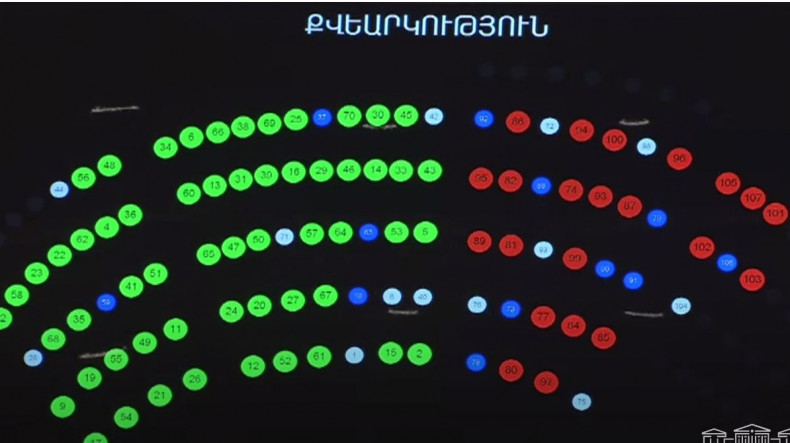
Armenian parliament ratifies Rome Statute


f651be59bf38b3_651be59bf38f4.thumb.jpg

11:00

French FM due in Armenia

French Minister for Europe and Foreign Affairs Catherine Colonna will travel to Armenia on Tuesday. “I’ll be visiting Armenia on…