Categories
Selected Articles

Russia maneuvers carefully over the Israel-Hamas war as it seeks to expand its global clout


?url=https%3A%2F%2Fassets.apnews.com%2Fc

Updated [hour]:[minute] [AMPM] [timezone], [monthFull] [day], [year]  

Russia has issued carefully calibrated criticism of both sides in the war between Israel and Hamas. But the conflict also is giving Moscow bold new opportunities — to advance its role as a global power broker and challenge Western efforts to isolate it over Ukraine.

While Moscow lacks leverage to mediate a settlement in the Middle East, it could try to play on some perceived credibility problems with the West’s response to the crisis.

It also expects the Israel-Hamas war to distract attention from the fighting in Ukraine and erode support for Kyiv.

There are risks for Moscow, however. It could damage its relationship with Israel, which until now has kept it from sending weapons to Ukraine.

Russian President Vladimir Putin has condemned the Oct. 7 attack by Hamas militants on towns in southern Israel. At the same time, he warned Israel against blockading the Gaza Strip, likening it to Nazi Germany’s siege of Leningrad during World War II.

He has cast the war as a failure of U.S. diplomacy, charging that Washington has opted for economic “handouts” to the Palestinians and abandoned efforts to help create a Palestinian state.

Putin declared earlier this month that Moscow could play the role of mediator, thanks to its friendly ties with both Israel and the Palestinians, adding that “no one could suspect us of playing up to one party.”

Despite that claim of even-handedness, a U.N. Security Council resolution that Russia submitted last week condemning violence against civilians made no mention of Hamas. It was rejected by the council.

China was among a few countries that backed the Russian draft, reflecting a shared stance by Moscow and Beijing. Chinese and Russian Middle East envoys met last week to discuss working together to help cool the situation, noting their adherence to a two-state solution for Israel and the Palestinians.

While U.S. President Joe Biden, British Prime Minister Rishi Sunak and other Western leaders visited Israel to show support, Putin waited for nine days before calling Israeli Prime Minister Benjamin Netanyahu, even though they previously had developed warm personal ties. Putin also discussed the war in calls with the leaders of Egypt, Iran, Iraq, Syria and the head of the Palestinian Authority.

Putin offered Netanyahu condolences to the families of Israelis killed by Hamas and emphasized “his strong rejection and condemnation of any actions that victimize the civilian population, including women and children,” according to a Kremlin readout of the call. He also emphasized the need for a “peaceful settlement through political and diplomatic means,” it added. Netanyahu’s office said he told Putin that Israel would not stop until it had eliminated Hamas.

Unlike Putin, who carefully balanced his statements, other Russian officials were more blunt in their criticism of Israeli strikes on Gaza.

Konstantin Kosachev, deputy speaker of the upper house of Russian parliament, said that while Hamas unleashed the war, Israel’s response was “disproportionate” and “inhumane.”

The Kremlin’s maneuvering may reflect domestic politics, with Muslims making up about 15% of the its population. The Moscow-backed leader of Chechnya, Ramzan Kadyrov, spoke strongly in support of the Palestinians, assailing Israel for capturing their lands and establishing blockades.

Moscow’s stance won quick praise from Hamas, which said it appreciates Russia’s call for a cease-fire. Russia’s statements also play well in the Arab world, where many have accused the U.S. and its allies of squarely supporting Israel while turning a blind eye to the rising civilian death toll in Gaza.

But this position also threatens Russia’s friendly ties with Israel, which hasn’t joined Western sanctions against Moscow or given weapons to Ukraine.

“There is a real threat of exacerbation of our ties with Israel in the current situation,” said Andrei Kortunov, academic director of the Russian International Affairs Council.

The Times of Israel reported Tuesday an Israeli diplomat expressed “displeasure with the role Russia is playing” to Moscow’s diplomatic officials, voicing hope the Kremlin will take “more balanced” positions.

Amir Weitmann, a leading member of Netanyahu’s Likud party, accused Russia of supporting Hamas. Speaking on Kremlin-funded broadcaster RT, he warned that after Israel defeats Hamas, “we will make sure that Ukraine wins, we will make sure that you pay the price for what you have done.”

Asked about Israeli criticism of Moscow’s stance on the war, Kremlin spokesman Dmitry Peskov emphasized Russia’s condemnation of terrorism and reaffirmed its push for a quick cease-fire and the need for a Palestinian state.

Amid what Israel sees as Moscow’s pro-Palestinian stance, some prominent Russian voices have backed Israel.

In a sign of the split sympathies, the head of the most popular political talk show on Russian state TV, Vladimir Solovyov, fired one expert on his televised panel who alleged in an online interview that two of Moscow’s top diplomats have anti-Israeli sentiments.

Yevgeny Satanovsky, a pro-Kremlin foreign policy expert, described Russia’s Middle East envoy, Deputy Foreign Minister Mikhail Bogdanov, as leaning toward Arab countries and alleged that Foreign Ministry spokesperson Maria Zakharova detests Israel. He later apologized.

Some commentators described the anti-Israeli sentiments as a throwback to Soviet times.

“Friendship with the Arabs against Israel and the West is an important part of that legacy,” Alexander Baunov of the Carnegie Russia Eurasia Center said in an analysis. “A global rebellion against the Western order to a certain extent makes Russia and Hamas natural allies and certainly prevents them from being enemies.”

Kortunov of the Russian International Affairs Council argued that Russia could use its strong contacts with Iran and Syria to help negotiate a settlement.

“Russia could be part of a multilateral coalition that would offer security guarantees,” he said. “It’s very important to maintain a well-balanced, delicate approach that wouldn’t alienate either party.”

Izabella Tabarovsky, senior adviser at the Kennan Institute, noted that for Putin, Hamas’ “attack and the anticipated ground invasion of the Gaza Strip present an opportunity to shed his pariah status and elevate his profile as the Middle East faces its most dangerous crisis in years.”

___

Follow AP’s coverage at https://apnews.com/hub/israel-hamas-war and https://apnews.com/hub/russia-ukraine


Categories
Selected Articles

How Putin Learned to Hold Deadly Grudges


The invasion of Ukraine caught many analysts of Russia off guard. Russian President Vladimir Putin had long been thought of as rough, tough, and brutal—but also calculating and cautious. The wild and reckless Ukrainian adventure seemed out of character.

Some observers believe Putin has changed as a result of his deep isolation during the COVID-19 pandemic or that he has some secret illness that renders him irrational. Both U.S. President Joe Biden’s former press secretary, Jen Psaki, and Republican Sen. Marco Rubio have observed that Putin seems different since the pandemic, and rumors about a hidden illness are circulating in Russia and among Russian émigrés. But Putin’s personal history reveals that his decision to go to war is entirely in character—and that he is very likely to continue it indefinitely.

Putin has justified his invasion by citing a long list of grievances against the West, especially NATO’s expansion into the former Soviet sphere of influence in Eastern Europe, and against Ukraine itself. Pandemic isolation may have warped his thinking. But the roots of Putin’s recklessness go back to a tendency he has shown since childhood to lash out when he has felt wronged or betrayed. Later passages of his life are more than stages he has lived through; they are layers that have built on one another, turning a boy who brawled his way through adolescence into a man who has directed his wrath against a U.S.-led West that he once tried and failed to get along with and that he now blames for betraying him.

LAYER ONE

Early Life—The Brawler (1952-1975)

Left: Vladimir Putin with his mother, Maria Ivanovna Putina. Right: Putin wrestles with a classmate at the St. Petersburg Sportschool in 1971. Left: Vladimir Putin with his mother, Maria Ivanovna Putina. Right: Putin wrestles with a classmate at the St. Petersburg Sportschool in 1971.

Left: Vladimir Putin with his mother, Maria Ivanovna Putina. Right: Putin wrestles with a classmate at the St. Petersburg Sportschool in 1971. Russian Archives and Laski Diffusion/via Getty Images

Putin’s family barely survived the siege of Leningrad during World War II, and although his father was a factory worker and Communist Party member, they were stuck after the war in a large, run-down apartment complex framing a central courtyard frequented by neighborhood toughs. Little Volodya—a diminutive of Vladimir used by friends and family—found a way to defend himself. “If anyone ever insulted him in any way,” a friend of his recalled, “Volodya would immediately jump on the guy, scratch him, bite him, rip his hair out by the clump—do anything at all never to allow anyone to humiliate him in any way.” Putin’s wrath became even more dangerous when, at age 11 or 12, he discovered judo and the Soviet-developed martial art of sambo. He was standing at a tram stop in the eighth grade, another friend remembered, when “two huge drunken men got off and started trying to pick a fight with somebody. They were cursing and pushing people around. Vovka calmly handed his bag over to me and … sent one of the men flying into a snowbank, face-first.” The second man started screaming, “What was that?” A few seconds later, “he was lying there next to his buddy.” “If there is anything I can say about Vovka,” his friend continued, “it’s that he never let bastards and rascals who insult people and bug them get away with it.”

Putin’s grade-school teacher, Vera Gurevich, noticed a similar pattern: Volodya “never forgives people who betray him or are mean to him.”

LAYER TWO

KGB—Brawling Institutionalized (1975-1989)

Putin (right) with his parents in 1985 just before his departure to East Germany as a KGB officer. Putin (right) with his parents in 1985 just before his departure to East Germany as a KGB officer.

Putin (right) with his parents in 1985 just before his departure to East Germany as a KGB officer. Laski Diffusion/via Getty Images

The KGB, which Putin joined in 1975, codified the pattern that Gurevich described. The KGB and its predecessors (the Cheka, the NKVD, and others) had defended the infant Soviet republic in a bloody civil war, carried out massive purges that killed millions of people under Joseph Stalin, and persecuted post-Stalinist dissidents. Externally, they targeted foreign intelligence services in a bitter, decades-long struggle. But internally, the secret police was plagued by intense competition for advancement and other bitter internecine squabbles.

The result was a pervasive cynicism. The only former KGB chief who rose to become supreme Soviet leader, Yuri Andropov, was theoretically open to the liberalization of the regime he headed. “In 15 to 20 years we’ll be able to allow ourselves what the West allows itself now,” Andropov once told a Soviet diplomat, “freedom of opinion and information, diversity in society and in art. But only in 15 to 20 years, after we’re able to raise the population’s living standards.” But Andropov, a veteran party apparatchik who took over the KGB in 1967, wasn’t a KGB-lifer. Much more representative was Stalin’s longtime secret police chief Lavrenty Beria, who was so entirely cynical that the hyper-suspicious Stalin was quite right to fear that Beria was plotting against him. Beria’s predecessors Genrikh Yagoda and Nikolai Yezhov were executed under Stalin’s orders: Beria would meet the same fate in the power struggle after Stalin’s death.

By the time Putin joined, the KGB was less murderous, but its office politics were both brutal and cynical. The KGB expanded Putin’s childhood instincts into the world of adulthood: Politics, whether international or domestic, is a dog-eat-dog struggle. Everybody lies, cheats, and steals. Everyone is suspect. One must always be on guard, ready to fight fire with fire. That is the way of the world. When U.S. leaders portray themselves as “holier than thou,” they are hypocrites.

Putin didn’t distinguish himself in the KGB. Beginning as a lowly spy-chaser in Leningrad, he was then assigned to Germany—not to West Germany, a prime target of Soviet espionage, but East Germany, where he ran agents operating in the West and kept his eye on the Stasi, the dreaded East German intelligence service, which KGB agents didn’t trust any more than they trusted each other. But he worked hard, played by the rules, and found a way to please his bosses rather than trying to outshine them. Ironically, these habits and skills equipped him to adapt to post-communism when what was left of the Soviet Union collapsed at the end of the 1991.

LAYER THREE

Adapting to Post-Communism (1990-2001)

Left: Putin, as a member of the city administration of St. Petersburg, signs an agreement about the marketing of inventions in 1993. Right: Putin (left) and former Russian President Boris Yeltsin attend an inauguration ceremony for Putin, after his election as Russian president, at the Kremlin in Moscow on May 7, 2000. Left: Putin, as a member of the city administration of St. Petersburg, signs an agreement about the marketing of inventions in 1993. Right: Putin (left) and former Russian President Boris Yeltsin attend an inauguration ceremony for Putin, after his election as Russian president, at the Kremlin in Moscow on May 7, 2000.

Left: Putin, as a member of the city administration of St. Petersburg, signs an agreement about the marketing of inventions in 1993. Right: Putin (left) and former Russian President Boris Yeltsin attend an inauguration ceremony for Putin, after his election as Russian president, at the Kremlin in Moscow on May 7, 2000. Newsmakers and Antoine Gyori/via Getty Images

As East Germany collapsed and moved toward reunification with West Germany, Putin returned from Dresden to Leningrad. He rose rapidly to become deputy mayor of post-Soviet St. Petersburg and then, astoundingly, to become post-Soviet Russia’s second president. The skills he had cultivated in the KGB turned out to be needed in the turbulent decade that followed the Soviet collapse. St. Petersburg Mayor Anatoly Sobchak needed hard-working, efficient, disciplined aides, and he chose Putin, who was not only competent, resourceful, and loyal but admirably unprepossessing. He struck Sobchak as someone who “does not like to stand out,” as a “person devoid of vanity, of any external ambition, but inside he is a leader.”

Putin dealt with politicians and foreigners of all sorts in St. Petersburg. But he trusted most his old Leningrad friends, many of them from the KGB, such as Nikolai Patrushev and Aleksandr Bortnikov, who are still his closest associates today. He “distrusted almost everyone else,” his biographer Steven Lee Myers concluded. “He always remembered acts of loyalty … just as he never forgave betrayals.”

These same qualities impressed President Boris Yeltsin in Moscow. Yeltsin was charismatic, bombastic, and anti-communist but an erratic administrator who needed competent aides, especially those inconspicuous enough not to pose any threat to his own power, image, and authority. He also needed a successor who would protect him after he retired from charges of corruption while in office. So he continued to promote Putin, who became head of the KGB’s successor, the Federal Security Service; then prime minister; and, finally, acting president of Russia, when Yeltsin himself, ailing and depressed, stepped down.

In 2005, Putin famously labeled the Soviet collapse a “major geopolitical disaster” of the 20th century. He didn’t miss communism itself, but his preference for a strong Russian state was already obvious. “Russia needs strong state power and must have it,” he wrote in December 1999 in a 5,000-word manifesto published just days before he became acting president. But Putin also sounded open in the long run to democracy: “I am not calling for totalitarianism,” he wrote. “History proves all dictatorships, all authoritarian forms of government, are transient. Only democratic systems are lasting.”

Putin also seemed to welcome a kind of alliance with the West. He was the first foreign leader to phone U.S. President George W. Bush after the 9/11 attacks. He helped Washington get men and supplies to Afghanistan. “Russia knows firsthand what terrorism is,” he declared on Russian TV. “I would like to say that we are with you. We entirely and fully share and experience your pain.” He even suggested that one day Russia might join NATO. That helps to explain, if not excuse, Bush’s infamous appraisal: “I looked the man in the eye. I found him to be very straightforward and trustworthy. We had a very good dialogue. I was able to get sense of his soul.”

LAYER FOUR

Disenchantment (2002-2007)

From left: Putin, German Chancellor Angela Merkel, and U.S. President George W. Bush joke as they sit together during the first day of the G-8 summit in Heiligendamm, Germany, on June 7, 2007. From left: Putin, German Chancellor Angela Merkel, and U.S. President George W. Bush joke as they sit together during the first day of the G-8 summit in Heiligendamm, Germany, on June 7, 2007.

From left: Putin, German Chancellor Angela Merkel, and U.S. President George W. Bush joke as they sit together during the first day of the G-8 summit in Heiligendamm, Germany, on June 7, 2007. Ralph Orlowski/Getty Images

It’s tempting, in retrospect, to see Putin’s openness to democracy and to the West as pure dissimulation at a period of relative Russian weakness. But if they were real, although partial, attempts to adapt to post-communism, they eventually brought a bitter disillusionment between 2002 and 2007—and with it a deep sense that he had been betrayed by the West.

At the core of this was the steady expansion of NATO. Putin has contended that Western leaders had promised Soviet leader Mikhail Gorbachev in 1990 that NATO would not expand “one inch” to the east. This isn’t true. U.S. Secretary of State James Baker did orally promise “not one inch” but never in writing, and he later claimed he was referring to East Germany, not barring a more general eastward expansion; West German Chancellor Helmut Kohl and Foreign Minister Hans-Dietrich Genscher declared more broadly that NATO would not expand to the east. But U.S. President George H.W. Bush shut down such talk, telling Kohl, “To hell with that. We prevailed, and they didn’t. We can’t let the Soviets clutch victory from the jaws of defeat.”

So NATO incorporated Poland, Hungary, and the Czech Republic in 1999 and added Bulgaria, Romania, Slovakia, Slovenia, plus three former Soviet republics, Estonia, Latvia, and Lithuania, in 2004. Worse still would be George W. Bush’s insistence in 2008 that NATO remain open to Ukraine and Georgia, too.

But Putin’s list of grievances went much further: the NATO bombing of Belgrade; the U.S.-led war in Iraq; and two critical “color revolutions” in other post-Soviet states—the Rose Revolution in Georgia, leading to the 2004 election of pro-Western President Mikheil Saakashvili, followed by the Orange Revolution in Ukraine, which prompted an election redo and brought to power pro-Western President Viktor Yushchenko over his pro-Russian opponent Viktor Yanukovych. Putin saw these upheavals as having been created and manipulated by Washington, with the Georgians and Ukrainians playing an essentially passive role—part of his pattern of detecting the U.S. hand behind everything, a view that gives the CIA too much credit but is a natural product of his KGB background.

By 2007, Putin had had enough. At the annual Munich Conference on Security Policy that February, he issued a blazing indictment of the United States, citing “unilateral and frequently illegitimate actions,” “almost uncontained hyper use of force,” overstepping “its national borders in every way,” “military operations that are … killing people—hundreds and thousands of civilians,” and substituting “NATO or the EU for the U.N.,” which is “the only mechanism that can make decisions about using military force as a last resort.”

LAYER FIVE

Interregnum (2008-2012)

Russian President Dmitry Medvedev (right) and Putin, then prime minister of Russia, ride bikes outside Moscow on June 11, 2011. Russian President Dmitry Medvedev (right) and Putin, then prime minister of Russia, ride bikes outside Moscow on June 11, 2011.

Russian President Dmitry Medvedev (right) and Putin, then prime minister of Russia, ride bikes outside Moscow on June 11, 2011. DMITRY ASTAKHOV/via Getty Images

Putin could have followed these bitter complaints with a burst of actions against the United States. But 2008-2012 marked a lull in the growing tension, resulting from changes in both Russian and U.S. leadership.

The Russian Constitution barred Putin from serving a third consecutive term as president. He wasn’t prepared to ignore that restriction (although he later arranged to eliminate it and thus clear the way for him to serve as president until 2036), so he chose his prime minister, Dmitry Medvedev, to replace him for the next four years. Although Medvedev was effectively his puppet, Putin allowed him to set a more liberal tone and gave him one more chance to improve U.S.-Russian relations. The new U.S. president, Barack Obama, set out to do likewise.

In response to Obama’s attempt to “reset” relations, Medvedev agreed on a new nuclear arms control treaty, New START, that extended limitations on intercontinental missiles for another 10 years. He refrained from vetoing a U.N. resolution authorizing the use of force to prevent Libyan leader Muammar al-Qaddafi from obliterating opponents in the city of Benghazi.

Obama spokesperson Robert Gibbs summarized the president’s view of Medvedev this way: He “genuinely feels like they can sit down or call each other and work through a series of issues in a very frank and honest way, that each side is always negotiating in good faith, and that there’s a level of confidence and trust also that’s built up in the two sides working together.” In contrast, Obama regarded Putin, whom he saw slouching behind Medvedev in Moscow, as “looking like the bored kid in the back of the classroom,” a taunt that apparently infuriated Putin. Perhaps it reminded him of his childhood struggles.

Putin remarked later that he found the U.N. resolution on Libya, which Medvedev failed to veto, “flawed and inadequate,” allowing the United States and its allies not just to protect Benghazi but to pursue and destroy Qaddafi. As for Saakashvili, Putin told French President Nicolas Sarkozy in 2008, “I’m going to hang him by the balls. … Why not? The Americans hanged Saddam Hussein.”

LAYER SIX

Putin’s Gorge Rises; the U.S. Seems Irresolute (2012-2016)

Demonstrators carry a model of a prison cell with a figure of Putin inside as they march in an anti-Putin rally in St. Petersburg, Russia, on Feb. 4, 2012. The sign on the cell reads: "[Convicted] for the usurpation of power." Demonstrators carry a model of a prison cell with a figure of Putin inside as they march in an anti-Putin rally in St. Petersburg, Russia, on Feb. 4, 2012. The sign on the cell reads: “[Convicted] for the usurpation of power.”

Demonstrators carry a model of a prison cell with a figure of Putin inside as they march in an anti-Putin rally in St. Petersburg, Russia, on Feb. 4, 2012. The sign on the cell reads: “[Convicted] for the usurpation of power.”OLGA MALTSEVA/via Getty Images

In 2011, Medvedev and Putin announced that Putin would stand for the presidency in the 2012 election. The fact that the two men alone dared to decide such an important matter (although voters later reelected Putin), along with grievances over 2011 Russian legislative election results, sparked mammoth protests in Moscow. Putin blamed U.S. Secretary of State Hillary Clinton. “She set the tone for some of the actors in our country and gave them a signal,” he said three days after the 2012 vote. “They heard the signal and with the support of the State Department began active work.”

The term “active work,” used by the KGB to describe ongoing intelligence operations, underlined Putin’s charge that the protests were the result of CIA meddling. In response, he cracked down on dissent at home and stepped up military assistance to Bashar al-Assad as the Syrian dictator attempted to crush his own opposition. Obama warned that any use of chemical weapons by Assad would cross a red line and trigger strong U.S. counteraction. But when Assad did just that, Obama retreated. Putin apparently took that as a sign that he could increase pressure on Ukraine, where Yanukovych, who was elected president in 2010, had been ousted by massive protests in 2014 and replaced by a pro-Western government.

Read More

In an echo of Cold War thinking, Putin saw the world as a chess game in which Washington and Moscow were the real players. He regarded the Ukrainian upheaval in 2014, too, as inspired and directed by Washington. His response then—seizing Crimea and grabbing more territory for Russian-backed separatists in eastern Ukraine—was harsher and more daring, as if his growing thirst for vengeance had prompted him to take greater risks. The fact that he got away with it makes his moves seem less risky in retrospect than they were. The West did respond with sanctions against close Putin associates. But oligarch Vladimir Yakunin explained at the time that Putin would reject any effort by them to resist him as yet another betrayal: “He will not forget that—or forgive that.”

Putin lashed out more angrily than ever against the United States in 2014. The U.S. policy of containment had supposedly been devised after World War II to restrain the Soviet Union, but in fact, he charged in a presidential address that December, “for many years, always, for decades, if not centuries,” its real target was Russia itself. Putin’s recollection of how he had tried to befriend the United States in the 1990s, only to be betrayed, blended self-pity and rage. He continued: “Despite our unprecedented openness back then and our willingness to cooperate in all, even the most sensitive issues, despite the fact that we considered … our former adversaries as close friends and even allies, the support for separatism in Russia from across the pond … was absolutely obvious and left no doubt that they would gladly let Russia follow the Yugoslav scenario of disintegration and dismemberment. With all the tragic fallout for the people of Russia. It didn’t work. We didn’t allow that to happen. Just as it did not work for [Adolf] Hitler.”

LAYER SEVEN

Pausing for Trump (2016-2020)

U.S. President Donald Trump (right) and Putin talk during the Asia-Pacific Economic Cooperation leaders’ summit in Da Nang, Vietnam, on Nov. 11, 2017. U.S. President Donald Trump (right) and Putin talk during the Asia-Pacific Economic Cooperation leaders’ summit in Da Nang, Vietnam, on Nov. 11, 2017.

U.S. President Donald Trump (right) and Putin talk during the Asia-Pacific Economic Cooperation leaders’ summit in Da Nang, Vietnam, on Nov. 11, 2017. JORGE SILVA/via Getty Images

Yet shortly after he lashed out so strongly, Putin found himself facing a new U.S. president who seemed so well disposed to Russia as to spark suspicions that Donald Trump was actually in Putin’s employ.

According to Fiona Hill, the Putin biographer who became a Trump expert while working as his lead Russia specialist on the National Security Council staff, Trump was not “intentionally doing something for Putin or for anyone else. Trump was only ever concerned with himself.” But Trump helped Putin by fomenting poisonous divisions in the United States that Putin himself had been seeking to widen with Russian interference in the 2016 U.S. presidential election.

In March 2017, Putin broached a broad normalization of U.S.-Russian relations, beginning with the restoration of diplomatic, military, and intelligence channels that had been cut off after Russian incursions in Ukraine and Syria; continuing with talks on “information security” and on Ukraine, Iran, Afghanistan, and the Korean Peninsula; and then, after meetings between the CIA, FBI, National Security Council, and the Defense Department with their Russian counterparts, a Trump-Putin summit. But the main thing that came out of this initiative was the infamous Helsinki summit, during which Trump declared that he trusted Putin’s word (that he had not interfered in the 2016 election) more than the conclusions of the United States’ own intelligence agencies.

Whether because Trump didn’t follow through or because harder-line U.S. officials resisted his efforts to appease Putin or because Putin himself soured on Trump, this latest attempt to reset relations with Washington, or at least to pretend to do so, led nowhere. Putin held his fire as long as Trump was in office, but he had had enough and was about to boil over.

LAYER EIGHT

Going to War (2021-2022)

Left: A boy sits in front of a destroyed building after a strike in the city of Kramatorsk in the Donbas region of Ukraine on May 25. Right: A woman holds a portrait of Putin with a bloody hand on his face as members of Canada's Ukrainian community protest in Montreal on Feb. 25. Left: A boy sits in front of a destroyed building after a strike in the city of Kramatorsk in the Donbas region of Ukraine on May 25. Right: A woman holds a portrait of Putin with a bloody hand on his face as members of Canada’s Ukrainian community protest in Montreal on Feb. 25.

Left: A boy sits in front of a destroyed building after a strike in the city of Kramatorsk in the Donbas region of Ukraine on May 25. Right: A woman holds a portrait of Putin with a bloody hand on his face as members of Canada’s Ukrainian community protest in Montreal on Feb. 25. ARIS MESSINIS and Andrej Ivanov/AFP via Getty Images

Ukraine, as we now know, was the target. In Putin’s mind, it had no independent history of its own. It had long been part of the Russian Empire, Putin declared in a speech three days before the invasion began, and it must become that again. It had never been a real nation or state, and now the allegedly sovereign Ukraine had allowed neo-Nazis to gain power and commit “genocide.” Moreover, he charged, Ukraine had been “placed under external control” of the West, was being “pumped with arms,” was determined to join NATO, and “intends to create its own nuclear weapons”—after which it would serve as an “advanced bridgehead” for a strike against the missile systems of its main adversary, Russia. Americans “just do not need a big and independent country like Russia around,” Putin continued, and NATO’s “one and only goal is to hold back the development of Russia.”

And if Ukraine wasn’t truly a country, it also couldn’t be in control of its own actions. Once again, Putin compared the United States to Hitler: The Soviet Union had tried to appease Hitler ahead of World War II, he said in a speech on Feb. 24 just before Russian troops moved into Ukraine, but “we will not make this mistake the second time. … For our country, it is a matter of life and death, a matter of our historical future as a nation.”

So it is for Putin himself. He sees his own standing, his own reputation, his own future on the line. He had been patient too long. The bastards who insulted him and humiliated him and betrayed him again and again would now get what they deserved. Whoever tries to “stand in our way,” he warned in his Feb. 24 speech, “must know that Russia will respond immediately, and the consequences will be such as you have never seen in your entire history.”

Putin’s many grievances against the West, his revivified nationalist ideology and dream of resurrecting the Russian Empire, his recent isolation during the pandemic, and perhaps a hidden illness, too, if he really has one, all help explain his bloody war against Ukraine. But all are baked into the layers of a man whose main theme of life is a fierce determination to avoid defeat by lashing out against those who humiliate and betray him.

LAYER NINE

What’s Next?

Putin attends a concert marking the eighth anniversary of Russia's annexation of Crimea at the Luzhniki Stadium in Moscow on March 18. Putin attends a concert marking the eighth anniversary of Russia’s annexation of Crimea at the Luzhniki Stadium in Moscow on March 18.

Putin attends a concert marking the eighth anniversary of Russia’s annexation of Crimea at the Luzhniki Stadium in Moscow on March 18. MIKHAIL KLIMENTYEV/SPUTNIK/AFP via Getty Images

How will the Russia-Ukraine war end—if it ever does? One scenario assumes continuing Russian setbacks so severe as to lead Putin to be overthrown or to concede defeat before he can be ousted. But as a biographer of Nikita Khrushchev and Gorbachev, I can testify that Putin’s power exceeds even that of those Communist leaders. The Communist Politburo dethroned Khrushchev not once but twice. The first time, in 1957, he managed to turn the tables on his opponents; the second time, in 1964, they ousted him.

In August 1991, top party, government, military and secret police officials mounted the abortive coup that paved the way to Gorbachev’s eventual ouster in December. So far there has been no such constraint on Putin, nor does one appear likely. There exists no body like the Communist Politburo or Central Committee with at least the theoretical authority to depose him, and there is no enduring precedent in Russian or Soviet tradition of military coups against supreme leaders, let alone free and fair elections.

As for Putin himself conceding defeat, his whole life testifies to his determination not to do so.

A second scenario imagines Russia defeating Ukraine. This, obviously, is what Putin expected. But it hasn’t happened so far, and if massive Western support continues to flow to Kyiv, this scenario, too, seems highly unlikely.

A third scenario is the kind of compromise that former U.S. Secretary of State Henry Kissinger has suggested and that Western European leaders such as French President Emmanuel Macron seem to favor—that is, a settlement based on the status quo ante with a return to front lines existing on Feb. 23. Would this be acceptable to Putin? Probably not, unless, using his huge propaganda apparatus, he can portray it as a victory. But even if he could, would Ukraine, having been brutalized so savagely, be willing or able to agree?

A fourth scenario is that the war continues indefinitely. This is, alas, the most likely scenario because it fits Putin’s personality. It also appears to be what most Russians expect. Whether it continues at the present level or becomes a frozen conflict, as has happened in Georgia and between Armenia and Azerbaijan, isn’t clear. But after all the savage bloodletting in Ukraine, and the bitter enmity it has created there and in Russia, it’s hard to see the fighting fading away entirely.

Unless, in a fifth scenario, Putin opts to break a stalemate, or ward off a seeming defeat, by going nuclear. In the past, few observers would have expected him to do so. But then again few (including this writer) expected him to invade Ukraine, even after he massed nearly 200,000 troops on its border. The reason is that his decision to launch such a war seemed so out of character. But if, as I have argued, it was in fact so squarely in character, then who is to say that going nuclear would not be? Whether Putin does so depends on many factors. Will he actually apply the much-disputed idea in Russian military doctrine of “escalating to de-escalate”? Will he be sufficiently certain that exploding a small tactical weapon won’t trigger an all-out nuclear exchange? Will he break the taboo that has prevented any use of nuclear weapons since 1945? Let us hope not. But if he decides that such a move is the only way to avoid a humiliating defeat, then the once unimaginable will be all too likely.



Categories
Selected Articles

Opinion | Netanyahu Must Go


25gorenberg-short-art-facebookJumbo.jpg

The responsibility Israel’s prime minister bears for Oct. 7.


Categories
Operation "Doppelganger"

Trastorno por estrés postraumático – Síntomas y causas – Mayo Clinic


The successful use of left-sided stellate ganglion block in patients that fail to respond to right-sided stellate ganglion block for the treatment of post-traumatic stress disorder symptoms: A retrospective analysis of 205 patients.

Categories
Selected Articles

Israel-Hamas war live updates: Israel envoy calls for UN secretary-general’s resignation; Gaza fuel running out


United Nations Secretary-General Antonio Guterres (C) speaks during a press conference at the Rafah border crossing between Egypt and the Gaza Strip.

Gehad Hamdy | Picture Alliance | Getty Images

Israel’s representative to the U.N. has called for the resignation of the organization’s Secretary-General Antonio Guterres, following his remarks on the Israel-Hamas conflict and action in Gaza.

Read the full story here.

Ruxandra Iordache

Israeli army spokesperson Rear Admiral Daniel Hagari speaks to the press from The Kirya, which houses the Israeli Ministry of Defense, in Tel Aviv, on Oct. 18, 2023.

Gil Cohen-magen | Afp | Getty Images

Israel’s military has accused Iran of ordering attacks by militia groups it supports in Yemen, Iraq and Lebanon.

In Reuters-reported comments from a briefing, chief military spokesperson Daniel Hagari said Iran is supplying Palestinian militant group Hamas with intelligence and deploying an online messaging campaign to bolster anti-Israel sentiment.

Iran and Israel have long been at odds, with Tehran celebrating but denying involvement in the Hamas terror attacks of Oct. 7. Tehran backs Hamas, the Syrian regime of Bashar al-Assad and Lebanese militant group Hezbollah — all three of which have exchanged fire with Israel since early October.

Ruxandra Iordache

Israel’s long-anticipated ground incursion into Gaza could set the tone for a Western response against Hamas-backing Iran and spell consequences for the oil market, said Helima Croft, head of global commodity strategy at RBC Capital Markets.

Speaking to CNBC’s Dan Murphy in Saudi Arabia, she said, “It certainly looks like the United States is trying to delay an Israeli ground operation because they want to get out the hostages, they want to get out the hundreds of Americans that are trapped in Gaza, but the question is, is this going to be postponed indefinitely, but I think people are bracing for some type of escalation in Gaza.”

Describing the oil price reaction to the Israel-Hamas war as “sanguine” so far, she nevertheless said that “a lot’s going to hinge on what does a potential ground incursion look like” and that a widening of the conflict into the broader Middle Eastern region could affect the crude supplies of OPEC member Iran. Brent futures with December delivery were trading at $87.78 per barrel at 7:34 a.m. London time, down 29 cents per barrel from the Tuesday settlement.

Tehran has historically financially supported Hamas and has praised the Palestinian militant group’s multi-pronged terror attacks of Oct. 7 against Israel — but has denied involvement.

The Biden administration is desperate to contain the Israel-Hamas war, strategist says

Croft said the West and U.S. President Joe Biden would, “at a minimum,” consider a retaliatory gesture of curbing Iranian exports, which she estimates have climbed near levels seen before 2018, when Donald Trump’s administration reimposed sanctions against Tehran’s crude.

“The argument is, can you continue to allow Iran to keep the bank open for groups like Hamas? So I think the Biden administration is going to have to tighten those sanctions.”

She expects such measures to come into effect soon, amid rising bipartisan U.S. congressional pressure to cut off the availability of Iranian financing for groups like Hamas.

Ruxandra Iordache

Eight Syrian soldiers were killed and seven others injured following an Israeli strike in Daraa, in southwest Syria, the state-run Syrian Arab News Agency said Wednesday, according to a Google translation.

The Israeli offensive targeted a number of Syrian military positions in the Daraa countryside, a military source told SANA.

The Israel Defense Forces said early Wednesday on social media that its fighter jets struck military infrastructure and mortal launchers belonging to the Syrian army, in response to rocket launches from Syria on Tuesday. The IDF did not mention any casualties in its report.

Israel and the Iran-backed Syrian regime of Bashar Assad have been inimical and repeatedly exchanged fire since the start of Israel’s war with Palestinian militant group Hamas. This and Israeli hostilities with neighboring Lebanon have bolstered fears of the Israel-Hamas conflict spilling into the broader Middle East.

Ruxandra Iordache

The situation in the Middle East is “growing more dire by the hour,” U.N. Secretary-General Antonio Guterres warned overnight, urging respect for civilian lives as the Israel-Hamas conflict unfolds.

“The grievances of the Palestinian people cannot justify the horrific attacks by Hamas. Those horrendous attacks cannot justify the collective punishment of the Palestinian people,” he said on the X social media platform, previously known as Twitter.

Guterres has repeatedly pleaded for the safety of civilians across both Israel and the Palestinian territories, requesting a humanitarian pause to the hostilities to allow the delivery of aid to the besieged Gaza Strip.

United Nations Secretary-General Antonio Guterres speaks to the media, after visiting the Rafah border crossing between Egypt and the Gaza Strip, as Egyptian Red Crescent members coordinate aid for Gaza,at Al Arish Airport, Egypt, October 20, 2023. 

Amr Abdallah Dalsh | Reuters

U.N. relief chief Martin Griffiths reiterated that call, stressing on social media, “The aid delivered to Gaza so far is barely making a dent. We need more, and we need it now. We need it to include fuel.”

The United Nations Relief and Works Agency for Palestine Refugees (UNRWA) has previously noted it would be unable to carry out aid operations after Wednesday night, if it does not receive fuel supplies necessary for transport, water desalination and running medical equipment

The Israel Defense Forces insist that fuel is present in Gaza, but monopolized by Hamas:

“These fuel tanks are inside Gaza,” the military said on social media in response to UNRWA, alongside a wide-shot picture of what could be tanks. “They contain more than 500,000 liters of fuel. Ask Hamas if you can have some.”

CNBC could not independently verify what area the IDF picture featured.

Ruxandra Iordache

A girl tries to collect usable belongings amid wreckage of vehicles after Al-Ahli Baptist Hospital was hit in Gaza City, Gaza on October 18, 2023. 

Ali Jadallah | Anadolu Agency | Getty Images

Intelligence officials told reporters that U.S. spy agencies believe the blast at a Gaza hospital that killed hundreds a week ago was caused by a Palestinian rocket that suffered engine failure and broke apart into two pieces, NBC News reported.

“We assess with high confidence that Israel was not responsible for the explosion at the hospital and that Palestinian militants were responsible,” an intelligence official said. “We assess with low confidence that Palestine Islamic Jihad was responsible for launching the rocket that landed on the hospital.”

Read the full NCB News story here.

Riya Bhattacharjee

A group of more than two dozen Republican lawmakers urged the mayor of Washington, D.C., to rename “Black Lives Matter Plaza,” claiming that the group for which the plaza is named has voiced support for Hamas following the Oct. 7 terrorist attacks in Israel.

The lawmakers, including Sens. Lindsey Graham of South Carolina and Florida’s Marco Rubio, also argued that the street painting reading “Black Lives Matter” should be scrubbed from the plaza due the group’s “celebration of violent antisemitic terrorism.”

The plaza, a two-block-long pedestrian zone just north of the White House, got its name in 2020 amid the rapid rise of Black Lives Matter, the political movement that emerged in response to the killings of Black Americans.

In a letter to D.C. Mayor Muriel Bowser, the group of eight senators and 17 House members cited a handful of posts from BLM chapters and entities that expressed support for Palestine, criticized Israel or “cast doubt” on the Oct. 7 attacks.

“These posts are meant to delegitimize Israel and rationalize brutal attacks on the Jewish people,” the letter read. “It is hard to escape the conclusion that these statements are motivated by an ugly animus against the Jewish people.”

“America must clearly affirm its stance against antisemitism, wherever it appears. We therefore urge you to immediately rename the Black Lives Matter Plaza, to remove the associated street painting in the plaza, and to end the city’s celebration of this terrorist sympathizer group.”

BLM and Bowser’s office did not immediately respond to CNBC’s request for comment on the letter.

Kevin Breuninger

People gather at the site of an Israeli strike on a house, in Khan Younis, in the southern Gaza Strip, Oct. 24, 2023. 

Ibraheem Abu Mustafa | Reuters

Crowds of people gather to assess residential damage in the southern Gaza Strip after an Israeli strike on Tuesday. Israel has been launching hundreds of airstrikes daily while demanding that Hamas release its remaining 222 hostages.

Correction: The Reuters photo above was taken on Tuesday, Oct. 24. The day of the week was misstated in an earlier version.

— Elisabeth Cordova

Columbia University in New York City

Barry Winiker | The Image Bank | Getty Images

Columbia University postponed a major annual fundraising event this week as the campus grapples with fallout triggered by the ongoing Israel and Hamas conflict.

After careful consideration and consultation with University and alumni leadership, we decided that this is not the appropriate time to move forward with Columbia Giving Day. It is postponed for the time being, and a decision on rescheduling will be made in the near future,” said Samantha Slater, a university spokeswoman, in a statement.

Last year, Columbia Giving Day raised almost $30 million in about 24 hours, according to The New York Times.

— Amanda Macias


Categories
Selected Articles

IDF shows foreign press Hamas bodycam videos, photos of murder, torture, decapitation


The Israeli government on Monday screened for 200 members of the foreign press some 43 minutes of harrowing scenes of murder, torture and decapitation from Hamas’s October 7 onslaught on southern Israel, in which over 1,400 people were killed, including raw videos from the terrorists’ bodycams.

The government said it had decided to show journalists part of its collected documentation in order to dispel what a spokesperson characterized as “a Holocaust-denial-like phenomenon happening in real-time,” as doubts have been raised around the world about some of the most horrific of Hamas’s atrocities.

Journalists were not permitted to record the screening, which took place on a closed military base.

The footage was collected from call recordings, security cameras, Hamas terrorists’ body cameras, victim dashboard cameras, Hamas and victims’ social media accounts, and cellphone videos taken by terrorists, victims and first responders. Over 1,000 civilians were slaughtered by the terrorists, and at least 224 people were abducted.

In one pair of videos that were screened, Hamas terrorists are seen dressed in IDF uniforms, flagging down passing cars and then shooting their occupants.

Get The Times of Israel’s Daily Edition
by email and never miss our top stories
By signing up, you agree to the terms

Dead bodies are dragged out of vehicles and left in the middle of the road after terrorists rifle through their belongings and in some cases steal the blood-soaked, bullet-ridden cars.

The IDF just screened 43 minutes of horrors from the Hamas massacre on October 7 for foreign journalists. I was not there, my colleague @cjkeller8 was.

Here is the one minute of footage approved for mass publication at this point, barring most of it out of respect for the dead. pic.twitter.com/UDmQSrkYBL

— Amy Spiro (@AmySpiro) October 23, 2023

In another video, first responders are seen pouring bottled water over still-smoldering bodies, hoping to snuff out the remaining embers.

In another, a man writhes on the ground, bleeding from his stomach, as a terrorist tries repeatedly to decapitate him with farming equipment. The man appears to be southeast Asian, possibly one of Israel’s foreign agricultural workers.

In another clip, from after the assault, an Israeli woman is seen trying to work out if a partially burned woman’s corpse, with a mutilated head, is that of a family member. The dead woman’s dress is pulled up to her waist and her underpants have been removed.

Major Gen. Mickey Edelstein, who briefed reporters after the viewing, said that “we have evidence” of rape but “we cannot share it,” declining to elaborate further.

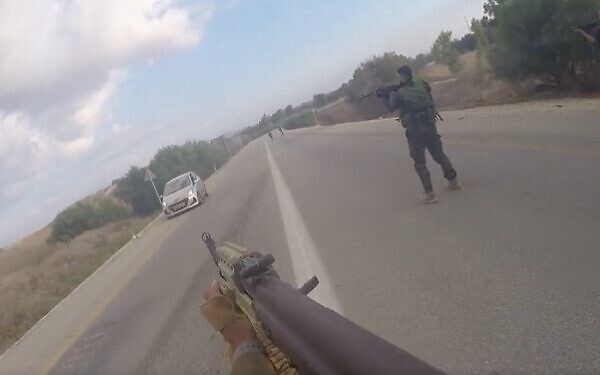
Screenshot of Hamas body cam footage as terrorists fire on an Israeli vehicle during the terror organization’s October 7 attack in southern Israel, released by the IDF and GPO. (Screenshot)

In a two-part video segment recorded in two Israeli communities near the Gaza border, a home security camera shows a father scooping up his two young sons to run to their outdoor bomb shelter, the three of them just roused from their beds and all still in underwear.

Moments after they enter presumed safety, a hand appears onscreen, tossing a grenade in after the family. The father dies, and the boys exit, covered in his blood.

“Dad’s dead, it wasn’t a prank,” one says after they run back into their home. “I know, I saw it,” responds his brother, later screaming, “Why am I alive?”

In the second segment, captured through a call recording application on a victim’s phone, a different son reaches out to a different father. “Dad, I killed 10 with my bare hands,” the terrorist excitedly tells his father in Gaza. “Their blood is on my hands, let me speak to Mom.”

“Please be proud of me, Dad,” he adds.

The voice of evil.

A Hamas terrorist murders TEN JEWS and calls home to brag about it. He made the call using a phone belonging to one of those he killed.

Listen to the pride in his voice. Hear how proud his parents are.#HamasworsethanISIS #HamasMassacre pic.twitter.com/lvoiHAhGEu

— COGAT (@cogatonline) October 24, 2023

Identified by his father as Mahmoud, the terrorist says he is calling his family from the phone of a Jewish woman he’s just murdered, and implores them to check his WhatsApp messages for further documentation.

The military also pulled footage from within Gaza that was uploaded to social media on the day of the attack. In one video, a bloody IDF soldier is pulled from a car — it is not clear whether he is dead or alive — dropped on the ground, and kicked and beaten by a local Palestinian crowd.

In another, a young girl — revealed by Israeli media to be a 19-year-old soldier — wears bloody sweatpants while being dragged out of the trunk of a car to a chorus of cheers. One man yells in English, “You’re in Gaza!”

IDF spokesman Rear Admiral Daniel Hagari announces that Israel is at war, after a deadly mass Hamas infiltration from Gaza, October 7, 2023. (IDF Spokesman)

Among the still images included in the raw footage reel were those of a decapitated soldier, several charred human remains including those of young children, a pile of dead bodies in a bomb shelter, and several Islamic State flags that the military said were found in Israel.

Speaking to the press corps, Israel Defense Forces Spokesman Rear Admiral Daniel Hagari said that Israel has been identifying Hamas with Islamic State (or ISIS) since October 7 primarily because of the Gaza-based terror group’s methods.

“When we say Hamas is ISIS, it’s not a branding effort,” said Hagari.

“We say ISIS in the sense of — [Hamas’s] media elements, cruelty, and barbarism are ISIS elements,” he said. He also noted “the guidance of manuscripts” found on killed and captured Hamas terrorists, the primary force of which was from the group’s Nukhba commando unit.

“It’s this idea that they would take all measures, [even] against Islam, to not allow the existence of Israelis, wherever they are, [including] Bedouins, Arab Israelis, foreigners,” Hagari said.

“Why does a person take a GoPro [to such an attack]?” the military spokesperson continued. “Because he’s proud of what he does.”

“It’s indoctrination, and if the indoctrination is to commit crimes against humanity, it’s not just Israel’s problem,” Hagari added, alluding to a broader Western war against fundamentalist Islamic terror.


Page 2

The Israeli government on Monday screened for 200 members of the foreign press some 43 minutes of harrowing scenes of murder, torture and decapitation from Hamas’s October 7 onslaught on southern Israel, in which over 1,400 people were killed, including raw videos from the terrorists’ bodycams.

The government said it had decided to show journalists part of its collected documentation in order to dispel what a spokesperson characterized as “a Holocaust-denial-like phenomenon happening in real-time,” as doubts have been raised around the world about some of the most horrific of Hamas’s atrocities.

Journalists were not permitted to record the screening, which took place on a closed military base.

The footage was collected from call recordings, security cameras, Hamas terrorists’ body cameras, victim dashboard cameras, Hamas and victims’ social media accounts, and cellphone videos taken by terrorists, victims and first responders. Over 1,000 civilians were slaughtered by the terrorists, and at least 224 people were abducted.

In one pair of videos that were screened, Hamas terrorists are seen dressed in IDF uniforms, flagging down passing cars and then shooting their occupants.

Get The Times of Israel’s Daily Edition
by email and never miss our top stories
By signing up, you agree to the terms

Dead bodies are dragged out of vehicles and left in the middle of the road after terrorists rifle through their belongings and in some cases steal the blood-soaked, bullet-ridden cars.

The IDF just screened 43 minutes of horrors from the Hamas massacre on October 7 for foreign journalists. I was not there, my colleague @cjkeller8 was.

Here is the one minute of footage approved for mass publication at this point, barring most of it out of respect for the dead. pic.twitter.com/UDmQSrkYBL

— Amy Spiro (@AmySpiro) October 23, 2023

In another video, first responders are seen pouring bottled water over still-smoldering bodies, hoping to snuff out the remaining embers.

In another, a man writhes on the ground, bleeding from his stomach, as a terrorist tries repeatedly to decapitate him with farming equipment. The man appears to be southeast Asian, possibly one of Israel’s foreign agricultural workers.

In another clip, from after the assault, an Israeli woman is seen trying to work out if a partially burned woman’s corpse, with a mutilated head, is that of a family member. The dead woman’s dress is pulled up to her waist and her underpants have been removed.

Major Gen. Mickey Edelstein, who briefed reporters after the viewing, said that “we have evidence” of rape but “we cannot share it,” declining to elaborate further.

Screenshot of Hamas body cam footage as terrorists fire on an Israeli vehicle during the terror organization’s October 7 attack in southern Israel, released by the IDF and GPO. (Screenshot)

In a two-part video segment recorded in two Israeli communities near the Gaza border, a home security camera shows a father scooping up his two young sons to run to their outdoor bomb shelter, the three of them just roused from their beds and all still in underwear.

Moments after they enter presumed safety, a hand appears onscreen, tossing a grenade in after the family. The father dies, and the boys exit, covered in his blood.

“Dad’s dead, it wasn’t a prank,” one says after they run back into their home. “I know, I saw it,” responds his brother, later screaming, “Why am I alive?”

In the second segment, captured through a call recording application on a victim’s phone, a different son reaches out to a different father. “Dad, I killed 10 with my bare hands,” the terrorist excitedly tells his father in Gaza. “Their blood is on my hands, let me speak to Mom.”

“Please be proud of me, Dad,” he adds.

The voice of evil.

A Hamas terrorist murders TEN JEWS and calls home to brag about it. He made the call using a phone belonging to one of those he killed.

Listen to the pride in his voice. Hear how proud his parents are.#HamasworsethanISIS #HamasMassacre pic.twitter.com/lvoiHAhGEu

— COGAT (@cogatonline) October 24, 2023

Identified by his father as Mahmoud, the terrorist says he is calling his family from the phone of a Jewish woman he’s just murdered, and implores them to check his WhatsApp messages for further documentation.

The military also pulled footage from within Gaza that was uploaded to social media on the day of the attack. In one video, a bloody IDF soldier is pulled from a car — it is not clear whether he is dead or alive — dropped on the ground, and kicked and beaten by a local Palestinian crowd.

In another, a young girl — revealed by Israeli media to be a 19-year-old soldier — wears bloody sweatpants while being dragged out of the trunk of a car to a chorus of cheers. One man yells in English, “You’re in Gaza!”

IDF spokesman Rear Admiral Daniel Hagari announces that Israel is at war, after a deadly mass Hamas infiltration from Gaza, October 7, 2023. (IDF Spokesman)

Among the still images included in the raw footage reel were those of a decapitated soldier, several charred human remains including those of young children, a pile of dead bodies in a bomb shelter, and several Islamic State flags that the military said were found in Israel.

Speaking to the press corps, Israel Defense Forces Spokesman Rear Admiral Daniel Hagari said that Israel has been identifying Hamas with Islamic State (or ISIS) since October 7 primarily because of the Gaza-based terror group’s methods.

“When we say Hamas is ISIS, it’s not a branding effort,” said Hagari.

“We say ISIS in the sense of — [Hamas’s] media elements, cruelty, and barbarism are ISIS elements,” he said. He also noted “the guidance of manuscripts” found on killed and captured Hamas terrorists, the primary force of which was from the group’s Nukhba commando unit.

“It’s this idea that they would take all measures, [even] against Islam, to not allow the existence of Israelis, wherever they are, [including] Bedouins, Arab Israelis, foreigners,” Hagari said.

“Why does a person take a GoPro [to such an attack]?” the military spokesperson continued. “Because he’s proud of what he does.”

“It’s indoctrination, and if the indoctrination is to commit crimes against humanity, it’s not just Israel’s problem,” Hagari added, alluding to a broader Western war against fundamentalist Islamic terror.


Categories
Selected Articles

Second aid convoy reaches Gaza as Israel attacks targets in Syria and occupied West Bank


Israel bombs market in Gaza, killing at least 10

Videos

Israel bombs market in Gaza, killing at least 10

Israel bombs market in Gaza, killing at least 10

Drone video shows aftermath of Israeli airstrike on home in central Gaza

At least six people have been confirmed killed in Deir al Balah when an Israeli strike hit the home of the Abu Me’leq family on Sunday afternoon. Dozens of injured were rushed to the hospital, many of them children, covered in dust and blood following the blast. (October 22) (AP video by Mohammad Fayeq)

Photos

By NAJIB JOBAIN, SAMY MAGDY and Ravi Nessman
Updated [hour]:[minute] [AMPM] [timezone], [monthFull] [day], [year]  

RAFAH, Gaza Strip (AP) — The second aid convoy destined for desperate Palestinian civilians reached Gaza on Sunday, as Israel widened its attacks to include targets in Syria and the occupied West Bank and the Israeli prime minister warned Lebanon’s Hezbollah militant group that if it launches its own war, “we will cripple it with a force it cannot even imagine.”

For days, Israel has been on the verge of launching a ground offensive in Gaza following Hamas’ brutal Oct. 7 rampage through a series of Israeli communities. Tanks and troops have been massed at the Gaza border, waiting for the command to cross.

Israel’s military spokesman, Rear Adm. Daniel Hagari, said the country had increased airstrikes across Gaza to hit targets that would reduce the risk to troops in the next stage of the war.

Fears of a widening war grew as Israeli warplanes struck targets across Gaza, two airports in Syria and a mosque in the occupied West Bank allegedly used by militants.

Israel has traded fire with Hezbollah militants since the war began, and tensions are soaring in the West Bank, where Israeli forces have battled militants in refugee camps and carried out two airstrikes in recent days.

Prime Minister Benjamin Netanyahu told troops in northern Israel that if Hezbollah launches a war, “it will make the mistake of its life. We will cripple it with a force it cannot even imagine, and the consequences for it and the Lebanese state will be devastating.”

Hamas said it fought with Israeli forces near Khan Younis in southern Gaza and destroyed a tank and two bulldozers.

Late Sunday, Hagari announced that a soldier was killed and three others wounded by an anti-tank missile during a raid inside Gaza as part of efforts to rescue more than 200 hostages abducted in the Oct. 7 attack.

On Saturday, 20 trucks entered Gaza in the first aid shipment into the territory since Israel imposed a complete siege two weeks ago.

Israeli authorities said late Sunday they had allowed a second batch of aid into Gaza at the request of the United States. COGAT, the Israeli defense body responsible for Palestinian civilian affairs, said the aid included water, food and medical supplies and that everything was inspected by Israel before it was brought into Gaza.

The U.N. agency for Palestinian refugees confirmed the arrival of 14 trucks.

Israel has not allowed any fuel to enter Gaza.

In a sign of how precarious any movement of aid remains, the Egyptian military said Israeli shelling hit a watchtower on Egypt’s side of the border, causing light injuries. The Israeli military apologized, saying a tank had accidentally fired and hit an Egyptian post, and the incident was being investigated.

Relief workers said far more aid was needed to address the spiraling humanitarian crisis in Gaza, where half the territory’s 2.3 million people have fled their homes. The U.N. humanitarian agency said Saturday’s convoy carried about 4% of an average day’s imports before the war and “a fraction of what is needed after 13 days of complete siege.”

The Israeli military said the humanitarian situation was “under control,” even as the U.N. called for 100 trucks a day to enter.

In a Sunday phone call, Netanyahu and U.S. President Joe Biden “affirmed that there will now be continued flow of this critical assistance into Gaza,” the White House said in a statement.

Israel repeated its calls for people to leave northern Gaza, including by dropping leaflets from the air. It estimated 700,000 have already fled. But hundreds of thousands remain. That would raise the risk of mass civilian casualties in any ground offensive.

Israeli military officials say Hamas’ infrastructure and underground tunnels are concentrated in Gaza City, in the north, and that the next stage of the offensive will include unprecedented force there. Israel says it wants to crush Hamas. Officials have also spoken of carving out a buffer zone to keep Palestinians from approaching the border, though they have given no details.

Hospitals packed with patients and displaced people are running low on medical supplies and fuel for generators, forcing doctors to perform surgeries using sewing needles, resorting to vinegar as disinfectant and operating without anesthesia.

The World Health Organization says at least 130 premature babies are at “grave risk” because of a shortage of generator fuel. It said seven hospitals in northern Gaza have been forced to shut down due to damage from strikes, lack of power and supplies, or Israeli evacuation orders.

Palestinian women react as a body is carried out from the rubble of a destroyed house following Israeli airstrikes on Gaza City, Saturday, Oct. 21, 2023. (AP Photo/Abed Khaled)

Palestinian women react as a body is carried out from the rubble of a destroyed house following Israeli airstrikes on Gaza City, Saturday, Oct. 21, 2023. (AP Photo/Abed Khaled)

Shortages of critical supplies, including ventilators, are forcing doctors to ration treatment, said Dr. Mohammed Qandeel, who works in Khan Younis’ Nasser Hospital. Dozens of patients continue to arrive and are treated in crowded, darkened corridors, as hospitals preserve electricity for intensive care units.

“It’s heartbreaking,” Qandeel said.

Palestinians sheltering in U.N.-run schools and tent camps are running low on food and are drinking dirty water. The lack of fuel has crippled water and sanitation systems.

Heavy airstrikes were reported across Gaza, including in the southern part of the coastal strip, where Israel has told civilians to seek refuge. At the Al-Aqsa hospital in Deir al-Balah, south of the evacuation line, several bodies wrapped in white shrouds were lined up outside.

Khalil al-Degran, a hospital official, said more than 90 bodies had been brought in since early Sunday, as the sound of nearby bombing echoed behind him. He said 180 wounded people had arrived, mostly children, women and the elderly displaced from other areas.

Soldiers drive a militar vehicle near the border between Israel and Gaza Strip in Israel, Saturday, Oct. 21, 2023. (AP Photo/Francisco Seco)

Soldiers drive a militar vehicle near the border between Israel and Gaza Strip in Israel, Saturday, Oct. 21, 2023. (AP Photo/Francisco Seco)

Airstrikes also smashed through the marketplace in the Nuseirat refugee camp. Witnesses said at least a dozen people were killed.

The Israeli military has said it is striking Hamas fighters and installations and insists it does not target civilians. Palestinian militants have fired over 7,000 rockets at Israel, according to the military, and Hamas says it targeted Tel Aviv early Sunday.

More than 1,400 people in Israel have been killed — mostly civilians slain during the initial Hamas attack. At least 212 people were captured and dragged back to Gaza.

Two Americans were released Friday, hours before the first shipment of humanitarian aid.

More than 4,600 people have been killed in Gaza, according to the Hamas-run Health Ministry. That includes the disputed toll from a hospital explosion.

Syrian state media, meanwhile, reported that Israeli airstrikes hit the international airports in the capital, Damascus, and the northern city of Aleppo, killing one person and putting the runways out of service.

Israel has carried out several strikes in Syria since the war began. Israel rarely acknowledges individual strikes, but says it acts to prevent Hezbollah and other militants from bringing in arms from Iran, which also supports Hamas.

In Lebanon, Hezbollah said six fighters were killed Saturday, and the group’s deputy leader, Sheikh Naim Kassem, warned that Israel would pay a high price if it invades Gaza. Israel struck Hezbollah in response to rocket fire, the military said.

Trucks with humanitarian aid for the 'Gaza Strip enter from Egypt in Rafah on Saturday, Oct. 21, 2023. (AP Photo/Fatima Shbair)

Trucks with humanitarian aid for the ‘Gaza Strip enter from Egypt in Rafah on Saturday, Oct. 21, 2023. (AP Photo/Fatima Shbair)

Israel also announced evacuation plans for another 14 communities near the Lebanon border.

In the Israeli-occupied West Bank, 93 Palestinians have been killed — including eight Sunday — in clashes with Israeli troops, arrest raids and attacks by Jewish settlers since the Hamas attacks, according to the Palestinian Health Ministry. Israeli forces have closed crossings into the territory and checkpoints between cities, measures they say are aimed at preventing attacks. Israel says it has arrested more than 700 Palestinians since Oct. 7, including 480 suspected Hamas members.

The internationally recognized Palestinian Authority administers parts of the West Bank and cooperates with Israel on security, but it is deeply unpopular and has been the target of violent Palestinian protests.

___

Magdy reported from Cairo and Nessman from Jerusalem. Associated Press journalists Amy Teibel in Jerusalem; Samya Kullab in Baghdad; Bassem Mroue in Beirut; Ashraf Sweilam in el-Arish, Egypt, and Albert Aji in Damascus, Syria, contributed to this report.


Categories
Selected Articles

Israel’s endgame is to push Palestinians into Egypt – and the west is cheering it on | Sharif Abdel Kouddous


On 7 October, hours after the surprise offensive by Hamas that left 1,400 Israelis dead, the Israeli prime minister, Benjamin Netanyahu, took to the airwaves to declare war on Hamas and issue a warning to Palestinians in Gaza: “leave now”. The question of where 2.3 million Palestinians, the vast majority of them refugees who have lived under a brutal siege and blockade for the past 16 years, should go to was left unsaid.

Israel proceeded to unleash an unprecedented aerial assault, dropping 6,000 bombs on the densely populated enclave in the first five days alone. Then came the order: a directive for the 1.1 million people in northern Gaza to evacuate to the south within 24 hours.

Maps showing evacuation corridors along which Palestinians were told to flee appeared as manifestations of colonial fantasy: two long arrows pointing southward, away from Palestine towards the Egyptian border.

Egypt, the only country other than Israel to share a border with Gaza, is being pressed by the US and other western states to open the gates and accept a flood of Palestinians fleeing the relentless assault and humanitarian crisis. In an interview on Sky News, Israel’s former ambassador to the US, Danny Ayalon, said: “The people of Gaza should evacuate and go to the vast expanses on the other side of Rafah at the Sinai border in Egypt … and Egypt will have to accept them.”

Instead of putting pressure on Israel to halt its bombing campaign, protect civilian life and allow in aid, various western governments have instead tried to broker a deal with Egypt by offering economic incentives for them to let in Palestinians, according to the Egyptian news site Mada Masr.

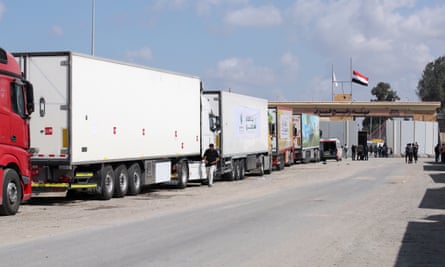
Egypt has said it will allow foreigners and Palestinian dual nationals through the Rafah crossing on the condition that Israel allows humanitarian aid in. Thousands of tonnes of food, fuel, water, medicine and other lifesaving aid packed into a long convoy of trucks have been idling on the Egyptian side of Rafah for days. On Wednesday, Israel said that it will allow Egypt to deliver limited humanitarian aid to Gaza, though the flow of relief is expected to fall short of what is needed, and the deal remains fragile.

Trucks loaded with humanitarian aid wait on the Egyptian side of the Rafah border‘Hundreds of tonnes of food, fuel, water, medicine and other lifesaving aid packed into a long convoy of trucks have been idling on the Egyptian side of Rafah for days.’ Photograph: Khaled Elfiqi/EPA

However, Egypt has remained steadfast in its refusal to allow for the mass resettlement of Palestinians in North Sinai. “We reject the displacement of Palestinians from their land,” the Egyptian president, Abdel Fatah al-Sisi, said on Wednesday, stressing that “the Palestinian cause is the mother of all causes and has a significant impact on security and stability”. He also warned that Egypt could then become a new base of Palestinian attacks against Israel. Meanwhile, Egypt’s foreign minister, Sameh Shoukry, speaking on CNN, warned that the forcible resettling of Palestinians into Egypt might constitute a war crime.

While rejecting a policy that essentially amounts to a second Nakba (the mass displacement of Palestinians during the 1948 Arab-Israeli war) is laudable, Cairo’s rhetoric invoking the Palestinian cause rings hollow. Egypt’s decisions are ultimately driven by national security concerns and avoiding what it would consider a nightmare scenario of a mass Palestinian refugee population to contend with on its own territory.

For years, Egypt has been complicit in the siege on Gaza, helping to enforce the blockade, destroying tunnels that provided a lifeline to the strip, and coordinating with Israel on security, including allowing Israeli drones, helicopters and warplanes to carry out a covert air campaign in Sinai. Egypt’s treatment of Palestinians entering and exiting Gaza is notorious for its indignity – the latest iteration being Palestinians who tried to enter Gaza only to find the border closed on 7 October, stranding them in North Sinai; they are being hosted by families who are under strict security instructions not to allow them to leave the neighbourhoods where they reside.

Egypt has erected barricades at the border to contain more tightly any mass exodus – should it come. Meanwhile, Israel has bombed the Rafah crossing four times, most recently slamming a missile right by the concrete barrier on Egyptian territory.

As it stands, the situation in Gaza is at a catastrophic impasse. Food and water are running out. Medicines and other critical supplies have been exhausted, with doctors performing surgery on floors, often without anaesthetics. There is little to no fuel or electricity. Even colour has been obliterated, with entire neighbourhoods now reduced to rubble, encased in grey concrete dust.

As of Thursday, the death toll in Gaza stood at 3,478, including more than a thousand children, according to the health ministry in Gaza. Another 1,300 people are believed to be buried under the rubble, alive or dead. About a million have been displaced. And many more untold horrors we have yet to discover.

Mohammed Ghalayini, the son of an acquaintance, fled his home in Gaza City to Khan Yunis, in the south of Gaza. He told me on Wednesday: “I think Israel’s endgame is for Palestinians to be pushed out of Gaza into Egypt: 100% that’s their gameplan. I think this is ethnic cleansing and genocide all wrapped into one.”

The idea of resettling Palestinians in Gaza to Sinai is not new. In the mid-1950s, the UN devised a plan to transfer thousands of Palestinian refugees in Gaza to Sinai’s north-western region, a project that was met with popular outrage and crushed in a mass uprising. After the Naksa of 1967 (the six-day war, in which Israeli forces captured East Jerusalem and the Palestinian territories, including Gaza), the Allon plan, drafted by Israeli politician Yigal Allon, envisioned the Gaza Strip being annexed to Israel. In 1971, about 400 Palestinian families displaced by the Israeli army were relocated to Arish, while 12,000 relatives of suspected Palestinian guerrillas were deported to detention camps in the Sinai desert and were only able to return to Gaza two decades later after significant international pressure.

Israel is seizing the moment. As western governments cheer them on, they are driving Palestinians in Gaza to the very brink. They might be trying to drive them out of Gaza altogether, to extend the arrows on the maps further outward.

  • Sharif Abdel Kouddous is an independent journalist based in New York and Cairo. He has reported multiple times from Gaza and across Palestine since 2011

  • Do you have an opinion on the issues raised in this article? If you would like to submit a response of up to 300 words by email to be considered for publication in our letters section, please click here.


Categories
Selected Articles

Despite their rhetoric, neither Iran nor Hezbollah want an escalation of war in the Middle East. Here’s why | Lina Khatib


5808.jpg?width=1200&height=630&quality=8

Since 7 October, questions have been posed over whether Hezbollah would intervene in the fight against Israel in aid of Hamas, and on the extent of Iran’s involvement in Hamas’s attack on Israel. Iran backs both Hamas and Hezbollah: they are military partners and have coordinated training and battles with support from the Islamic Revolutionary Guards Corps. Neither Hamas nor Hezbollah take decisions to declare war or peace without explicit prior agreement from Iran.

However, battles are not the same as full-on war. To date, Hamas and Hezbollah have never been involved in a war on two fronts against Israel. This is a scenario that neither the two groups nor Iran take lightly, because such a scenario amounts to regional war in the Middle East, which is in no one’s interest.

Hamas’s objectives in the 7 October attack on Israel were political: it wants to assert itself as the sole legitimate representative of Palestinian voices by engaging in an act which, in its eyes, would be seen by its supporters as heroic and would force the international community to engage with it as a de – facto military and political authority.

Hezbollah recognises this approach as it pursued a similar strategy in its own war with Israel in 2006. At that time, Hamas did not intervene to support Hezbollah, leaving the latter to claim singlehanded “victory” against Israel. With Hezbollah being the better equipped of the two militant groups, there is a clear imperative for Hezbollah to let Hamas be the leading actor in this war so as not to detract from Hamas’s pursuit of status. This is partly why Hezbollah’s leader, Hassan Nasrallah, has been noticeably absent from the public domain since 7 October.

Iran, on the other hand, has always made sure its superiority over the groups it supports is known. Iran does not need to instruct Hamas to start a war with Israel or even to be directly involved in Hamas’s war planning. What Iran does is more nuanced: on the one hand it expresses support for the actions of Hamas but then shakes the stick of Hezbollah against Israel. This was seen in the 12 October speech by the Iranian foreign minister, Hossein Amir-Abdollahian, during his visit to Beirut when he raised the prospect of Israel receiving a response from “the rest of the axis”. This way Iran does not undermine Hamas’s stature, but at the same time the invocation of Hezbollah places it as a stand-in for all Iran-backed militias in the Middle East – Hamas included – and therefore affirms Iran’s position as their patron.

Yet, while they have been careful not to detract from the leading role Hamas is taking in the war, Hezbollah’s status does carry the expectation of not standing still while its ally is engaged in the most important fight of its history against Israel. This is translating into escalated but calculated attacks by Hezbollah on areas in northern Israel. The attacks have mainly been on military targets and disputed territories that Hezbollah regards as Lebanese but occupied by Israel. Hezbollah’s rockets have not reached areas further inside Israel, as they did in 2006. Although Israel has responded by bombing southern Lebanon, killing two civilians and a Reuters journalist in separate attacks, the extent of this bombing remains within 3km of Lebanon’s southern border and most of the targets are connected to Hezbollah. It is clear from Hezbollah’s actions and Israel’s reactions that both still abide by their undeclared rules of engagement whereby neither side sparks a new war.

But there is a threat that still looms: if such a war were to happen again, Israel has said it would no longer distinguish between Hezbollah and the rest of Lebanon. It is, though, not in Israel’s interest to open a northern front while it is engaged in a significant southern front, especially considering political divisions within the country and question marks over its security and intelligence apparatuses, which failed to see the Hamas attack coming. While this may seem like an opportune moment for Hezbollah to take advantage, the group must also answer to the Lebanese public. Lebanon is suffering from the worst financial crisis in its modern history and cannot withstand the cost of another war. Unlike in 2006, when the country could expect aid and reconstruction money from Arab Gulf countries in the war’s aftermath, those countries have made it clear they will no longer engage in this kind of unconditional rescue.

As things stand, the likelihood of escalation from Hezbollah is low, and lowered further by the fact that, unlike in 2006, it does not need another “victory” to consolidate its position in the country, as it is comfortably the the most powerful political actor in Lebanon. Nor will Iran want to sacrifice Hezbollah’s political gains for the sake of Hamas, as the Lebanese militant group’s role in aiding Iranian allies across the Arab world is key to Iran’s regional influence.

Iran’s preferred method of balancing politics and military action is for its allies to be on the frontline against Israel, so it can celebrate them as winners and martyrs at once. This way both Iran and these militant groups reap the political benefits while keeping Iranian territory out of the line of fire. That is why a Lebanese front is unlikely: it wouldn’t be in Iran’s interests, as it would entail the intervention of the US, which has already sent aircraft carriers to the eastern Mediterranean as a deterrent. US intervention sparks the potential for the war to spread to Iran itself, which is the last thing Iran wants. Its role and Hezbollah’s position would seem to suggest that, unless something dramatically changes, they are adhering to their post-2006 stance of mutual deterrence.

  • Lina Khatib is director of the Soas Middle East Institute and associate fellow at the Middle East and North Africa programme at Chatham House


Categories
Operation "Doppelganger"

Criterion Film Club Discussion. Week 166: In the Mouth of Madness


In the Mouth of Madness is a film that finally hits that middle ground for me. Sam Neil (ever underrated) is fantastic as the skeptical insurance man who is thrown headfirst into the world of the occult by disappeared horror writer Sutter Cane (who is no doubt inspire Stephen King).