Categories
Selected Articles

Stronger US-Azerbaijan ties can help counter Russia and Iran


Stronger US-Azerbaijan ties can help counter Russia and Iran

Russia’s war against Ukraine has wrought major upheaval across Eurasia, forcing countries to search for new partners as they seek security and stability. Some Eurasian countries are looking to strengthen ties with the United States to maintain regional security and to develop new economic opportunities. Azerbaijan, for example, has sought to further its partnership with the United States on the two countries’ shared strategic interests.

Relations between the United States and Azerbaijan have historically centered on energy transit, most significantly the Baku-Tbilisi-Ceyhan oil pipeline and the Southern Gas Corridor. In July 2022, Baku signed a new memorandum of understanding with the European Union (EU) to increase Azerbaijani gas exports to the EU from 12 billion cubic meters (bcm) per year to 20 bcm by 2027. Officials in Brussels certainly see the importance of diversifying energy imports away from Russia—European Commission President Ursula von der Leyen called Azerbaijan a “reliable” partner in the bloc’s renewed emphasis on energy security.

But Azerbaijan’s geography means it is also a gateway to the countries of Central Asia and the Trans-Caspian International Transport Route (TITR), also known as the Middle Corridor, that connects Europe with China via Central Asia and the South Caucasus. The Middle Corridor provides Europe with a critical alternative to trade routes that pass through Russia and Belarus, the so-called Northern Corridor.

At the same time, the Middle Corridor provides the inverse opportunity for Central Asian countries to reduce dependency on transit through Russia to the European market. It is in Washington’s strategic interest to help develop alternative trade routes between Europe and Central Asia that minimize opportunities for Russian malign interference along the way.

Moreover, Azerbaijan and the United States share a set of strategic interests that may only grow in the coming years. Washington should resist the calls from some commentators to distance itself from Baku. Russia’s war on Ukraine has shaken stability in the South Caucasus, and Moscow may try to claw back influence in the region at the expense of regional peace and security. Greater US engagement with Baku should reinforce a platform for peace between Azerbaijan and Armenia. Stronger US-Azerbaijan ties can also help counter threats to shared interests emanating from Moscow and Tehran.

The United States has been a major mediator between Armenia and Azerbaijan since the early years of the two countries’ conflict over the Karabakh region of Azerbaijan that began in the 1990s. This mediating role gained new importance and urgency following the Second Karabakh War, which ended in November 2020 with Azerbaijan liberating Karabakh and much of its surrounding territory.

While the situation remains tense, leaders in both Armenia and Azerbaijan have worked hard to build lasting peace. Baku and Yerevan have reached important achievements to this end, with one set of peace talks mediated by Russia and a second negotiating platform with the EU and the United States. The turning point came in May, when Armenian Prime Minister Nikol Pashinyan recognized Karabakh as part of Azerbaijan in the EU-mediated summit in Brussels, following US-mediated talks weeks earlier between the two countries’ foreign ministers in Washington. There are even signs the long-standing dispute over access to the Lachin road is improving, with new reports that humanitarian aid is reaching Karabakh via the Aghdam road.

The peace process is, however, fraught with major challenges.

Some political groups in Armenia and in the diaspora continue to pressure the Pashinyan government against acknowledging Azerbaijan’s internationally recognized sovereignty over Karabakh. Separatist leadership in Karabakh refuses to integrate the region into Azerbaijan and recently undertook unrecognized “elections.” These authorities also receive financial and diplomatic support from Kremlin-connected individuals.

A peace treaty signed via Western mediation and built upon the recognition of Karabakh as part of Azerbaijan would deal a severe blow to Russia’s influence in the region. Such a treaty would create preconditions for the withdrawal of Russia’s peacekeeping mission from the Karabakh region where it was deployed after the 2020 war and, generally, deprive Moscow of one lever of influence against Baku.

This contradiction in the interests of Azerbaijan and Russia has at times strained relations between them. By voicing a plan not to extend the Russian peacekeeping mission beyond 2025 and by investing more in the Western-mediated track of negotiations, Baku regularly challenges Russia’s policies vis-à-vis the peace process.

Azerbaijan stands out as a rare post-Soviet state that has provided humanitarian and political support to Ukraine in the context of the country’s fight against Russian aggression. Azerbaijan has so far sent almost thirty million dollars’ worth of humanitarian aid, including free fuel to ambulances and vehicles operated by the State Emergency Service of Ukraine and power transformers and generators. Azerbaijan’s independent foreign policy course has drawn “bewilderment” from Russia’s foreign ministry and nuclear threats from its political circles.

The Azerbaijani government’s stance on Russia’s war of aggression against Ukraine contrasts with the policies of two of its neighbors, Armenia and Iran. Investigations and media reports in Europe and the United States have uncovered how Armenia and some other post-Soviet countries have been assisting Russia to import prohibited goods. Officials both in the United States and the EU have listed Armenia among the states that help Russia to circumvent Western sanctions. Armenia only belatedly sent a small package of humanitarian aid to Ukraine in early September.

Iran has been one of Russia’s most strident military allies in its war, providing Moscow with thousands of Shahed drones that terrorize Ukrainian civilians and helping the Kremlin evade Western sanctions. In October 2022, an Iranian military commander Yahia Rahim Safav reportedly said that Armenia may buy Shahed drones. Baku has long opposed Tehran’s brazenly aggressive foreign policy, even as Iran’s ties with Armenia and Russia may be growing. Significantly, Baku has also redoubled its support for Israel—a major US ally—despite Iran’s anti-Israel threats and increasingly militaristic posture in the region.

The time is right for the United States to strengthen its relationship with Azerbaijan and take the historic opportunity to pursue peace and break ground on a new template for regional stability.

Vasif Huseynov is the head of the Western Studies department at the Center for Analysis of International Relations (AIR Center), a think tank founded by the government of Azerbaijan. He is also a lecturer at Khazar and ADA universities in Baku, Azerbaijan.

Further reading

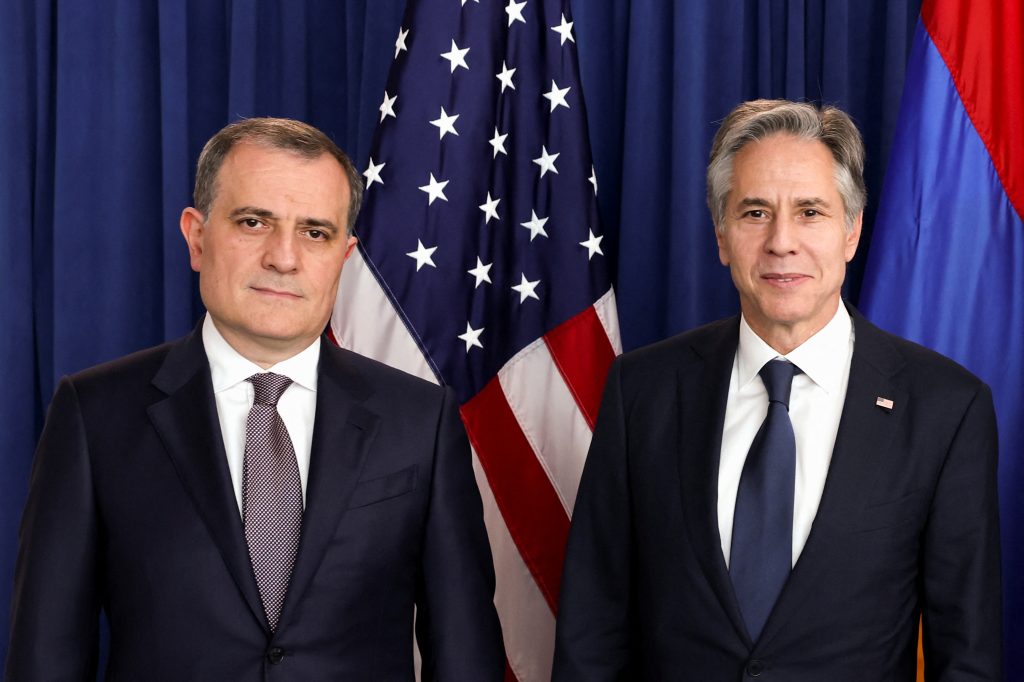
Image: U.S. Secretary of State Antony Blinken hosts Armenian Foreign Minister Ararat Mirzoyan (not pictured) and Azerbaijani Foreign Minister Jeyhun Bayramov for talks at the George Shultz National Foreign Affairs Training Center in Arlington, Virginia, U.S., June 29, 2023. REUTERS/Evelyn Hockstein

Categories
Selected Articles

Study: The Indo-European language family was born south of Caucasus


Proto-Indo-European (PIE) is a language that gave rise to many others. About 46% of humans, well over three billion people, are native speakers of an Indo-European language. But where did PIE first arise, and who spoke it: pastoralists from the Pontic steppe straddling eastern Europe and west Asia or agrarians from Anatolia in Turkey? The answer to that question has been eluding anthropologists for ages. And now, researchers in the journal Science suggest a third place: the Lesser Caucasus, primarily found in Armenia, Azerbaijan, and parts of eastern Turkey and southern Georgia.

PIE is both the deadest and most alive of languages. The last speaker died thousands of years ago, and if it was ever written down, we don’t know about it. The only evidence of PIE’s existence are the traces it left in the languages that descended from it.

We say “only,” but that is a lot of evidence. Modern descendants of PIE include not only English, Spanish, and Russian, but also Persian, Hindi, Bengali, and dozens more. Indo-European is by far the largest language family in the world. Sino-Tibetan, which includes Mandarin Chinese, is a distant second, with about 1.3 billion native speakers.

For the better part of a century, linguists have been looking for clues to the origin of Indo-European from within the languages themselves. Using phylogenetic analysis — phylogenetics is the study of evolutionary relationships over time, be they organisms or languages — they have reconstructed a vocabulary for PIE that gives us an idea of the culture of the people who spoke it. We know they had words for bear (bʰérōs) and goose (h₂énos), willow (wélə) and honey (méli), and peat (péḱus) and enclosure (h₂órtos).

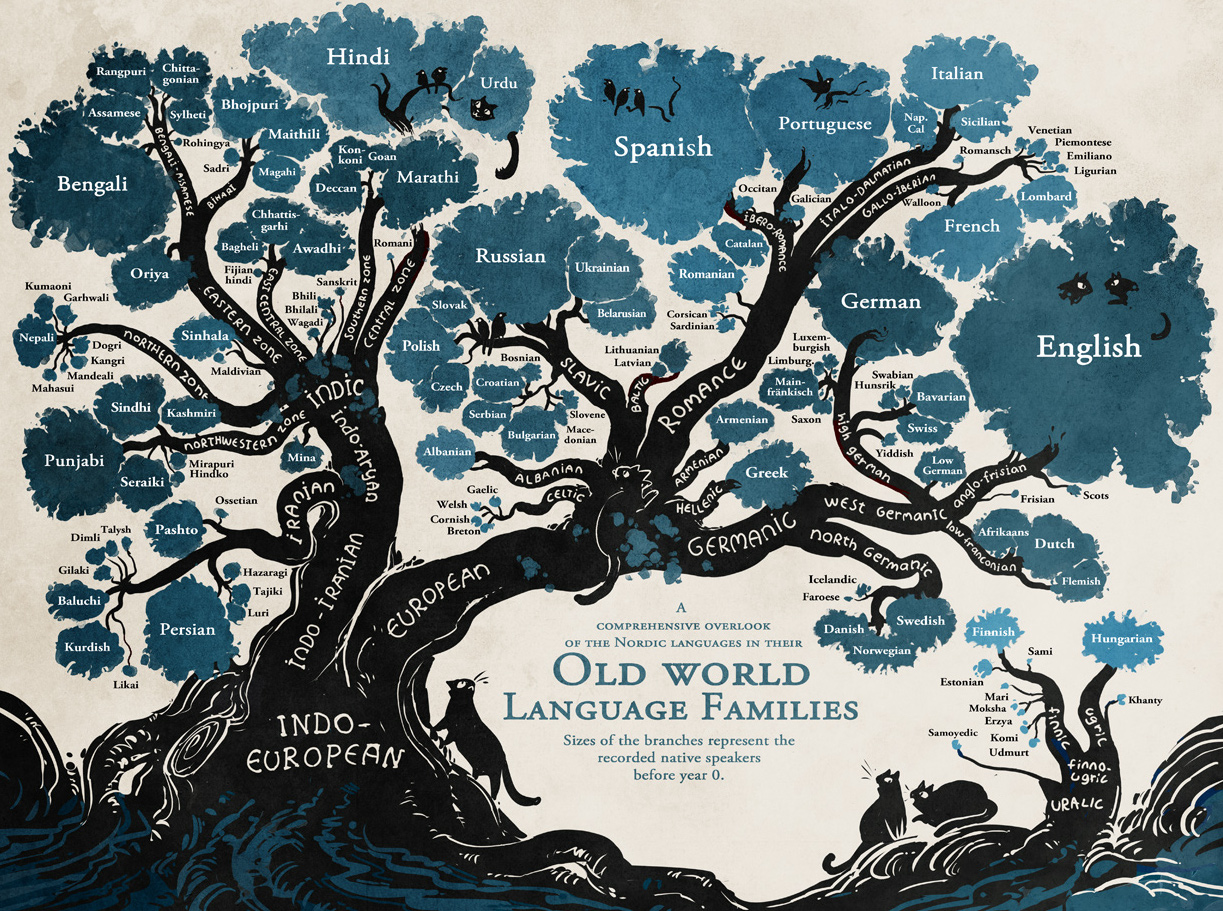
The old world language family tree.

The language families descended from Proto-Indo-European beautifully rendered as the branches of a tree, with each leaf approximating the relative numbers of native speakers of each language. (Credit: Stand Still, Stay Silent by Minna Sundberg)

Based on such evidence, two schools of thought emerged. One proposed that PIE originated some 6,000 years ago in the Pontic-Caspian steppe located north of the Black and Caspian Seas, in the flatlands that stretch from northeast Romania via southern Ukraine and southwestern Russia into the furthest west of Kazakhstan. The nomadic pastoralists who lived here tamed the horse, allowing them to migrate far and wide. This is called the steppe or kurgan hypothesis, the latter after the local word for the prehistoric burial mounds that dot the area.

Other scholars posit an older and more southerly beginning for PIE: around 9,000 years ago in Anatolia. Also known as Asia Minor, this peninsula bordered by the Black, Aegean, and Mediterranean Seas is the westernmost extension of Asia. Today, it is the Asian part of Turkey. The theory is that the language piggybacked on the spread of agriculture from here to large parts of the Old World.

The kurgan hypothesis is the more widely accepted of the two. Many of its proponents think that PIE speakers, kurgan builders, and the ancient Yamnaya culture are actually one and the same. However, conflicting evidence from previous phylogenetic analyses has prevented either hypothesis from completely knocking out the other.

So, the Max Planck team constructed a new dataset of core vocabulary from 161 Indo-European languages that was more comprehensive and balanced than previous samples. Using recent advances in phylogenetic analysis, they were able to estimate that PIE was approximately 8,100 years old, and that five main branches had already split off around 7,000 years ago.

The study’s results fit poorly with both the kurgan and Anatolian hypotheses. As a solution, the researchers propose a third possibility: an early homeland for PIE immediately south of the Caucasus, with one migration veering off north into the steppe. There, PIE speakers established a “secondary homeland,” from where Indo-European entered the rest of Europe beginning 5,000 years ago, courtesy of the Yamnaya and later expansions.

A map of europe with a green area in the middle.

Map showing the spread of Indo-European according to the kurgan hypothesis: from the Pontic steppe (dark green) to an area covering most of Europe and large parts of Asia (light green). Note the non-Indo-European language islands in Europe, representing Finnish, Estonian, Hungarian, and Basque. (Credit: Joe Roe, after Wolfgang Haak, CC BY-SA 4.0)

By offering a hybrid of the farming and pastoralist theories about the spread of Indo-European, the south-of-Caucasus hypothesis suggests a solution for an enigma that has dogged the study of Indo-European for about 200 years. Wolfgang Haak, group leader at the department of archaeogenetics at the Max Planck Institute for Evolutionary Anthropology, said:

“Aside from a refined time estimate for the overall language tree, the tree topology and branching order are most critical for the alignment with key archaeological events and shifting ancestry patterns seen in the ancient human genome data. This is a huge step forward from the mutually exclusive, previous scenarios, towards a more plausible model that integrates archaeological, anthropological, and genetic findings.”

Strange Maps #1220

Got a strange map? Let me know at [email protected].

Follow Strange Maps on Twitter and Facebook.


Categories
Selected Articles

#SouthCaucasus The problems of the South Caucasus are larger and deeper than the most visible of them Nagorno-Karabakh conflict and the Armenia – Azerbaijan hostilities. There are more than 50 distinct ethnic groups in this region, and they should be seen and heard from also. The ethnic groups of the Caucasus are the unique precious stones in God’s necklace, big and small, rolled up and down the high mountains, escaping the tragedies of history and in search of security. Gather them together into the modern South Caucasus Federation.


 #SouthCaucasus The problems of the South Caucasus are larger and deeper than the most visible of them Nagorno-Karabakh conflict and the Armenia – Azerbaijan hostilities. There are more than 50 distinct ethnic groups in this region, and they should be seen and heard from also. The ethnic groups of the Caucasus are the unique precious stones in God’s necklace, big and small, rolled up and down the high mountains, escaping the tragedies of history and in search of security. Gather them together into the modern South Caucasus Federation.

______________

South Caucasus News #SouthCaucasus #News #SouthCaucasusNews, Armenia – #Armenia, Azerbaijan – #Azerbaijan, Georgia – #Georgia, #SouthCaucasusFederation, Nagorno-Karabakh #NagornoKarabakh (Artsakh – #Artsakh), Nikol Pashinyan – #NikolPashinyan, #IlhamAliyev, #IrakliGaribashvili, #EU, #US, #Russia, #Turkey, #Iran, #Israel. https://southcaucasusnews.com https://inoreader.com/stream/user/1006407045/tag/South%20Caucasus%20News/view/html

Image

The News And Times Information Network – Blogs By Michael Novakhov – thenewsandtimes.blogspot.com

Categories
Selected Articles

US Senior Advisor for Caucasus Negotiations meets Azerbaijani FM – Armenia News


US Senior Advisor for Caucasus Negotiations meets Azerbaijani FM  Armenia News

Categories
Selected Articles

US Senior Advisor for Caucasus Negotiations meets Azerbaijani FM


default.jpg

Senior Advisor to the US State Department for Negotiations in the South Caucasus, Louis Bono, met with Azerbaijani Foreign Minister Jeyhun Bayramov, the Press Service of the Azerbaijani Foreign Ministry reports.

“During the meeting, the situation in the region, normalization and peace process between Azerbaijan and Armenia, current threats and challenges were discussed,” the statement said. Bayramov told Bono that “the obstacle to the implementation of the agreement on the simultaneous opening of the [Akna-Stepanakert] Agdam-Khankendi and [Berdzor] Lachin Corridor, reached during the conversation between Azerbaijani President Ilham Aliyev and US Secretary of State Antony Blinken on September 1, is Armenia and the illegal regime it created.”

At the same time, Bayramov began to deny the fact of the blockade and humanitarian crisis in Artsakh.

“Jeyhun Bayramov emphasized the unacceptability of international partners, including the United States, repeating the claims of the Armenian side, despite their well-informed understanding of the situation in the region. He further highlighted that despite Armenia’s ongoing military and political provocations, its worldwide defamation campaign against Azerbaijan, and its support for separatism on our territories, Azerbaijan continues to maintain a constructive stance. […] The head of the Azerbaijani Foreign Ministry expressed regret that the unfounded allegations of Armenia, which it spreads in order to divert attention from the presence of Armenian armed forces in Azerbaijani territories and mislead the international community, were reflected in the speech of the acting US Assistant Secretary of State for European and Eurasian Affairs Yuri Kim”, the statement further reads.

!

This text available in   Հայերեն and Русский

Print


Categories
Selected Articles

Armenians see a new genocide taking place. Azerbaijan sees propaganda.


GDVISEHVBAZWO6FCDBM4GZ4I3Q.jpg&w=1440

You’re reading an excerpt from the Today’s WorldView newsletter. Sign up to get the rest free, including news from around the globe and interesting ideas and opinions to know, sent to your inbox every weekday.

The firsthand accounts are harrowing. There’s no food on shelves in stores. Children stand for hours in bread lines to help feed their families. Mothers walk for miles in search of cooking oil and other provisions. Electricity, gas and water are in short supply. Ambulances can’t whir into motion for lack of fuel. Clinics report a surge in miscarriages in pregnant women who are malnourished, anemic and consumed by stress.

Such is the apparent state of the isolated and increasingly desperate ethnic Armenian enclave in Nagorno-Karabakh, whose 120,000 people are enduring what local authorities and a host of international experts describe as a blockade at the hands of Azerbaijan, the country within which the territory sits. Armenia and Azerbaijan have fought multiple wars over Nagorno-Karabakh after the collapse of the Soviet Union and the advent of their independent nation-states. Though recognized by the international community as part of Azerbaijan, Nagorno-Karabakh and some areas surrounding it have been governed for decades by a separatist ethnic Armenian entity.

For the entirety of this year, Azerbaijan has restricted movement along the Lachin corridor, the sole route connecting Armenia directly to the enclave, which Armenians refer to as Artsakh. The restrictions intensified this summer, with the International Committee of the Red Cross unable to deliver humanitarian assistance to the region and trucks with hundreds of tons of supplies stranded on the roads. The plight of the afflicted communities led Luis Moreno Ocampo, a former chief prosecutor of the International Criminal Court, to publish an opinion earlier this month determining that the conditions of starvation inflicted on the enclave’s ethnic Armenians was an act of genocide. He cited an article in the Genocide Convention that referred to “deliberately inflicting on the group conditions of life calculated to bring about its physical destruction.”

“The idea of genocide is not just about killing, but about removing people from the land,” Moreno Ocampo told me during a phone call this week. In his report, he wrote: “There are no crematories, and there are no machete attacks. Starvation is the invisible genocide weapon. Without immediate dramatic change, this group of Armenians will be destroyed in a few weeks.”

On Wednesday, the situation was discussed at an emergency session of the United Nations Security Council. Various officials, including U.S. ambassador to the United Nations Linda Thomas-Greenfield, called on Azerbaijan to “restore free movement through the corridor.” Armenian foreign minister Ararat Mirzoyan said the deprivation imposed on the enclave was a form of warfare that would lead to the “ethnic cleansing of the people of Nagorno-Karabakh.”

That sentiment was echoed in Washington by a handful of U.S. lawmakers. “Azerbaijan’s systematic ethnic cleansing of the people of Nagorno-Karabakh through a large-scale and unprovoked invasion is unconscionable,” Sen. Alex Padilla (D-Calif.) told me, referring to the territory seized by Azerbaijan during a lopsided six-week war in 2020 that saw thousands die. “Particularly egregious is their weaponization of the blockade to starve the people of Nagorno-Karabakh and block humanitarian assistance.”

Responding to these charges, Yashar Aliyev, Azerbaijan’s U.N. envoy, described talk of a blockade as “unfounded and groundless allegations” and said his government was subject to an Armenian “campaign” to “manipulate and mislead the international community.” Officials in Baku claim that the restrictions on movement along the Lachin corridor, which is supposed to be administered by Russian peacekeepers, are necessary to stop, among other things, the illicit supply of arms from Armenia into the enclave. They point to the intransigence of the de facto authorities in Nagorno-Karabakh, who have refused the delivery of supplies through an alternate eastern road from Azerbaijan.

“An administration of occupation is blocking the Azerbaijani government’s provision of food and medicine to an Azerbaijani region. Tellingly, nowhere in the Ocampo report is this mentioned,” wrote Hikmet Hajiyev, top foreign affairs adviser to Azerbaijan’s long-ruling President Ilham Aliyev. “Claiming they are under threat while engineering a crisis to galvanize the international community’s support is intended to convince the world that Azerbaijanis and Armenians cannot live together, as we once did.”

With diplomatic corps we are on the entrance of Agdam-Khankandi highway and railway. Only highway’s daily capacity is 17.000 vehicles. Azerbaijan is building roads not walls for reintegration of armenian residents of Karabakh but they put road blocks and barriers. pic.twitter.com/P3v3J59Fxv

— Hikmet Hajiyev (@HikmetHajiyev) August 16, 2023

The impasse reflects the profound gulf between the two sides. Some analysts believe that Azerbaijan, wealthier and reinforced by Turkish and Israeli arms, is pressing its considerable advantage with the world distracted by the war in Ukraine to apply intolerable pressure on the separatist enclave in its midst. Armenia and Azerbaijan have been locked in rounds of negotiations over a lasting peace settlement that would normalize ties and find an acceptable accommodation over the status of Nagorno-Karabakh.

But the current crisis has highlighted the existential fears and deep-seated enmities felt on both sides. As Armenians around the world raised the alarm over the plight of blockaded Nagorno-Karabakh, Azerbaijani media focused on the discovery of a mass grave of Azerbaijani people in the city of Shusha, dating back to the battles of the 1990s and the area’s occupation by ethnic Armenian forces. The city was “liberated” by Azerbaijan in the brief 2020 war, which saw Baku’s forces seize significant swaths of territory captured by Armenian troops in the earlier phase of the conflict.

Now, some ethnic Armenians who fled Shusha — known to Armenians as Shushi — in 2020 find themselves in even more dire straits. One of those is Alvina Nersesyan, a resident of the enclave and mother, who briefed reporters on a virtual call organized by Armenian officials on Thursday. She described the “fearful” bread lines in Stepanakert, the enclave’s de facto capital, known in Azerbaijan as Khankendi, and lamented that she doesn’t “even say the words for sweets anymore,” lest she upset her deprived children who are “too small to understand the situation.”

The immediate hardships are recognized by diplomats elsewhere. “Access to food, medicine, baby formula and energy should never be held hostage,” Thomas-Greenfield said Wednesday. “We urge the government of Azerbaijan to restore free movement through the corridor.”

“U.S. officials believe that Armenians in Nagorno-Karabakh are managing to survive only because of backyard gardens and other home-produced food,” wrote Post columnist David Ignatius. “They fear that within two months, as winter approaches, the population could face starvation. Armenians dread a repetition of the Ottoman genocide of 1915, an ever-present historical memory for Armenians around the world.”

Moreno Ocampo summoned that deep, bitter history, noting that hundreds of thousands of Armenians who perished more than a century ago were driven from their homes by Ottoman forces and left to die of hunger. “Starvation was the weapon of the genocide in 1915 and now Azerbaijan is using starvation against Armenians,” he told me. “It’s tragic but history is repeating, and that’s why humanity has to react.”


Categories
Selected Articles

Armenians see a new genocide taking place. Azerbaijan sees propaganda. – WP


Activists protest in front of the U.N. Office in Yerevan, Armenia, on Aug. 16. (Karen Minasyan/AFP/Getty Images)

The firsthand accounts are harrowingThere’s no food on shelves in stores. Children stand for hours in bread lines to help feed their families. Mothers walk for miles in search of cooking oil and other provisions. Electricity, gas and water are in short supply. Ambulances can’t whir into motion for lack of fuel. Clinics report a surge in miscarriages in pregnant women who are malnourished, anemic and consumed by stress.

Such is the apparent state of the isolated and increasingly desperate ethnic Armenian enclave in Nagorno-Karabakh, whose 120,000 people are enduring what local authorities and a host of international experts describe as a blockade at the hands of Azerbaijan, the country within which the territory sits. Armenia and Azerbaijan have fought multiple wars over Nagorno-Karabakh after the collapse of the Soviet Union and the advent of their independent nation-states. Though recognized by the international community as part of Azerbaijan, Nagorno-Karabakh and some areas surrounding it have been governed for decades by a separatist ethnic Armenian entity.

Residents of Nagorno-Karabakh say it’s getting harder to access food and medicines following a months-long Azerbaijani blockade of the region. (Video: Reuters)

For the entirety of this year, Azerbaijan has restricted movement along the Lachin corridor, the sole route connecting Armenia directly to the enclave, which Armenians refer to as Artsakh. The restrictions intensified this summer, with the International Committee of the Red Cross unable to deliver humanitarian assistance to the region and trucks with hundreds of tons of supplies stranded on the roads. The plight of the afflicted communities led Luis Moreno Ocampo, a former chief prosecutor of the International Criminal Court, to publish an opinion earlier this month determining that the conditions of starvation inflicted on the enclave’s ethnic Armenians was an act of genocide. He cited an article in the Genocide Convention that referred to “deliberately inflicting on the group conditions of life calculated to bring about its physical destruction.”

“The idea of genocide is not just about killing, but about removing people from the land,” Moreno Ocampo told me during a phone call this week. In his report, he wrote: “There are no crematories, and there are no machete attacks. Starvation is the invisible genocide weapon. Without immediate dramatic change, this group of Armenians will be destroyed in a few weeks.”

On Wednesday, the situation was discussed at an emergency session of the United Nations Security Council. Various officials, including U.S. ambassador to the United Nations Linda Thomas-Greenfield, called on Azerbaijan to “restore free movement through the corridor.” Armenian foreign minister Ararat Mirzoyan said the deprivation imposed on the enclave was a form of warfare that would lead to the “ethnic cleansing of the people of Nagorno-Karabakh.”

That sentiment was echoed in Washington by a handful of U.S. lawmakers. “Azerbaijan’s systematic ethnic cleansing of the people of Nagorno-Karabakh through a large-scale and unprovoked invasion is unconscionable,” Sen. Alex Padilla (D-Calif.) told me, referring to the territory seized by Azerbaijan during a lopsided six-week war in 2020 that saw thousands die. “Particularly egregious is their weaponization of the blockade to starve the people of Nagorno-Karabakh and block humanitarian assistance.”

Responding to these charges, Yashar Aliyev, Azerbaijan’s U.N. envoy, described talk of a blockade as “unfounded and groundless allegations” and said his government was subject to an Armenian “campaign” to “manipulate and mislead the international community.” Officials in Baku claim that the restrictions on movement along the Lachin corridor, which is supposed to be administered by Russian peacekeepers, are necessary to stop, among other things, the illicit supply of arms from Armenia into the enclave. They point to the intransigence of the de facto authorities in Nagorno-Karabakh, who have refused the delivery of supplies through an alternate eastern road from Azerbaijan.

“An administration of occupation is blocking the Azerbaijani government’s provision of food and medicine to an Azerbaijani region. Tellingly, nowhere in the Ocampo report is this mentioned,” wrote Hikmet Hajiyev, top foreign affairs adviser to Azerbaijan’s long-ruling President Ilham Aliyev. “Claiming they are under threat while engineering a crisis to galvanize the international community’s support is intended to convince the world that Azerbaijanis and Armenians cannot live together, as we once did.”

The impasse reflects the profound gulf between the two sides. Some analysts believe that Azerbaijan, wealthier and reinforced by Turkish and Israeli arms, is pressing its considerable advantage with the world distracted by the war in Ukraine to apply intolerable pressure on the separatist enclave in its midst. Armenia and Azerbaijan have been locked in rounds of negotiations over a lasting peace settlement that would normalize ties and find an acceptable accommodation over the status of Nagorno-Karabakh.

But the current crisis has highlighted the existential fears and deep-seated enmities felt on both sides. As Armenians around the world raised the alarm over the plight of blockaded Nagorno-Karabakh, Azerbaijani media focused on the discovery of a mass grave of Azerbaijani people in the city of Shusha, dating back to the battles of the 1990s and the area’s occupation by ethnic Armenian forces. The city was “liberated” by Azerbaijan in the brief 2020 war, which saw Baku’s forces seize significant swaths of territory captured by Armenian troops in the earlier phase of the conflict.

Now, some ethnic Armenians who fled Shusha — known to Armenians as Shushi — in 2020 find themselves in even more dire straits. One of those is Alvina Nersesyan, a resident of the enclave and mother, who briefed reporters on a virtual call organized by Armenian officials on Thursday. She described the “fearful” bread lines in Stepanakert, the enclave’s de facto capital, known in Azerbaijan as Khankendi, and lamented that she doesn’t “even say the words for sweets anymore,” lest she upset her deprived children who are “too small to understand the situation.”

The immediate hardships are recognized by diplomats elsewhere. “Access to food, medicine, baby formula and energy should never be held hostage,” Thomas-Greenfield said Wednesday. “We urge the government of Azerbaijan to restore free movement through the corridor.”

“U.S. officials believe that Armenians in Nagorno-Karabakh are managing to survive only because of backyard gardens and other home-produced food,” wrote Post columnist David Ignatius. “They fear that within two months, as winter approaches, the population could face starvation. Armenians dread a repetition of the Ottoman genocide of 1915, an ever-present historical memory for Armenians around the world.”

Moreno Ocampo summoned that deep, bitter history, noting that hundreds of thousands of Armenians who perished more than a century ago were driven from their homes by Ottoman forces and left to die of hunger. “Starvation was the weapon of the genocide in 1915 and now Azerbaijan is using starvation against Armenians,” he told me. “It’s tragic but history is repeating, and that’s why humanity has to react.”


Categories
Selected Articles

Ambassador: ‘Armenia’s refusal to provide transport link to Nakhchivan is major hurdle for peace’ 


2 major violations by Armenia with regard to the 2020 statement are refusal to fully withdraw its troops from Azerbaijan and refusal to provide a transport link to Nakhchivan, Azerbaijani Ambassador to Germany, Nasimi Aghayev wrote on X, Report informs.

Categories
Selected Articles

Georgian President congratulates all who celebrate Jewish New Year – Agenda.ge


Georgian President congratulates all who celebrate Jewish New Year  Agenda.ge

Categories
Selected Articles

Defense Minister Güler: Stability in Caucasus priority for Türkiye


Türkiye prioritizes stability and peace in the Caucasus and supports its brotherly nation Azerbaijan, Defense Minister Yaşar Güler said Friday, according to Azerbaijan in Focus, reporting Daily Sabah.

“We place great importance on stability in the Caucasus. We are making significant efforts to establish lasting peace in the region and continue to support our brotherly nation Azerbaijan with the understanding of ‘one nation, two states,’” Güler said at a ceremony held at the Defense Ministry marking September 19, Veterans Day.

In a speech, he said that Türkiye will continue contributing to regional and global peace in many regions.

“We are continuing our constructive efforts to reactivate the Black Sea grain agreement,” he added, referring to a pact reached last summer to enable grain exports from Ukraine despite the ongoing war, which Russia withdrew from in July.

Güler also said Türkiye is continuing its endeavors to maintain the favorable atmosphere with Greece that it has been fostering in recent years.

“We will continue our fight against terrorism with the same determination and unwavering commitment as we have done so far, without making any concessions,” he stressed.

The post Defense Minister Güler: Stability in Caucasus priority for Türkiye appeared first on Azerbaijan In Focus.