
Azerbaijan must allow ‘safe’ return to Nagorno-Karabakh: UN court Watauga Democrat
The post Azerbaijan must allow ‘safe’ return to Nagorno-Karabakh: UN court – Watauga Democrat first appeared on The South Caucasus News.
Top UN court to rule on Armenia-Azerbaijan Karabakh dispute Napoleon Northwest Signal
The post Top UN court to rule on Armenia-Azerbaijan Karabakh dispute – Napoleon Northwest Signal first appeared on The South Caucasus News.
George Santos’ communications director has resigned following scathing Ethics report https://t.co/vDJgIePxZH
— The Hill (@thehill) November 17, 2023
Categories
The News And Times

Categories
Pashinyan, Macron Meet in Paris
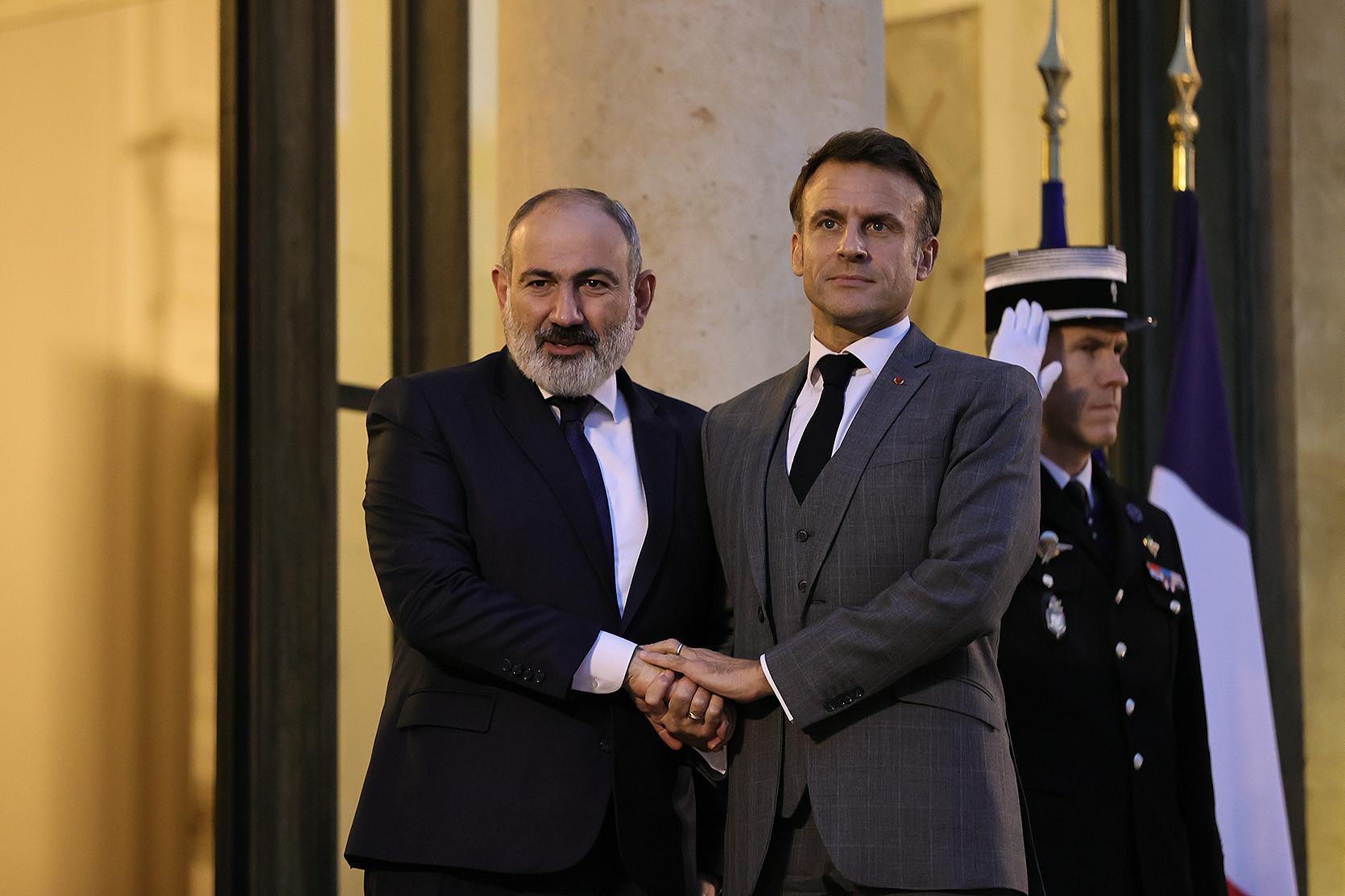
Prime Minister Nikol Pashinyan and French President Emmanuel Macron met at the Élysée Palace today.
The President of France first expressed his condolences to the Prime Minister on the death of Christian Ter-Stepanyan, Permanent Representative of the Republic of Armenia to UNESCO, Personal Representative of the Prime Minister of Armenia to the International Organization of La Francophonie. Emmanuel Macron once again emphasized France’s support to Armenia in the direction of further development and overcoming existing challenges.
Nikol Pashinyan thanked for the warm hospitality and condolences. The Prime Minister emphasized the development of Armenian-French cooperation in all fields, stressing the interest of the Armenian government in this matter.
The interlocutors discussed issues related to the process of normalization of Armenia-Azerbaijan relations. The importance of the principles set down in the four-sided Granada declaration of the Prime Minister of Armenia, the President of France, the Chancellor of Germany and the President of the European Council was emphasized in the matter of the normalization of relations between Armenia and Azerbaijan.
Reference was made to the humanitarian problems of more than 100,000 persons forcibly displaced from Nagorno-Karabakh as a result of Azerbaijan’s ethnic cleansing policy, as well as to the steps taken by the Armenian government to overcome them. The support of the international community in solving the existing problems was highlighted.
Issues related to further deepening and expansion of Armenian-French cooperation in economy, infrastructure development and other fields were also discussed. The parties expressed their willingness to consistently continue the work in that direction.
Nikol Pashinyan and Emmanuel Macron exchanged thoughts on the issues of regional peace and stability, as well as Armenia-European Union cooperation.
If you found a typo you can notify us by selecting the text area and pressing CTRL+Enter
Amman, Jordan – The Israeli army released footage on October 22 of its Maglan commando unit deploying a new precision-guided 120mm mortar bomb called the Iron Sting, against Hamas in Gaza.
The bomb’s Haifa-based manufacturer, Elbit Systems, has been advertising its qualities on the public relations page of its website since March 2021, when it was integrated into the Israeli military.
list of 3 itemslist 1 of 3list 2 of 3list 3 of 3end of list
Benny Gantz, then Israel’s defence minister and now a part of Prime Minister Benjamin Netanyahu’s war cabinet, described the Iron Sting as “designed to engage targets precisely, in both open terrains and urban environments, while reducing the possibility of collateral damage and preventing injury to non-combatants”.
It’s a claim echoed by Mark Regev, Netanyahu’s former spokesperson, for the country’s overall approach to its war on Gaza, in which, he has said, Israel is “trying to be as surgical as humanly possible”.
Yet, more than one month after Israel launched the aerial bombardment of Gaza following a surprise Hamas attack, it has killed at least 11,400 Palestinian civilians, and injured 30,000 in the besieged strip and the occupied West Bank. More than 4,700 of Gaza’s children are dead. Hamas fighters killed 1,200 people in their October 7 attack.
Israel’s devastatingly “surgical” killing machines, tested on Palestinians, have global takers, say analysts.
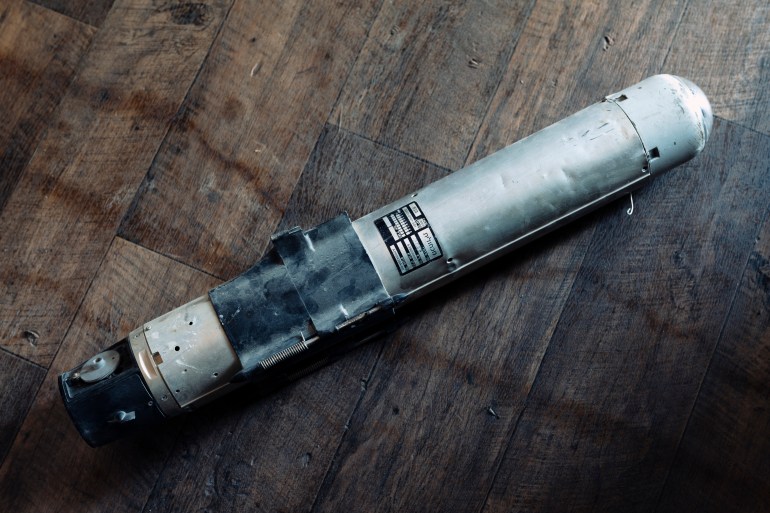 An unspent casing from an Israeli Spike drone rocket designed to explode on impact ejecting metal cubes from a copper canister. The projectile spools out at a velocity that can cut a human in half [Paddy Dowling/Al Jazeera]
‘Tissue torn from flesh’
Ahmed Saeed al-Najar, 28, was driving his taxi in Rafah during Gaza’s third war of 2014 when a drone missile came in through the open sunroof of his taxi. It exploded in the car, instantly decapitating and killing all six of his passengers, his best friend included.
The car had been targeted by an Israeli Spike drone rocket, which can be modified to carry a fragmentation sleeve of thousands of 3mm tungsten cubes, said to affect an area of approximately 20 metres in diameter. The cubes puncture metal and “cause tissue to be torn from flesh”, literally shredding anyone within range, according to Erik Fosse, a Norwegian doctor working in Gaza.
Al-Najar, rescued from the wreckage of his car, suffered extensive burns, the loss of his right eye, multiple shrapnel wounds and the loss of his right leg from the mid-thigh point, amputated by the blast.
But by 2014, drones that carry the Spike rocket had already become highly sought-after by other countries.
The Heron TP “Eitan” drone is Israel’s largest unmanned aerial vehicle (UAV) and was brought into service in 2007. Manufactured by the state-owned Israel Aerospace Industries (IAI) — Israel’s largest aerospace and defence company and the country’s largest industrial exporter – it can fly up to 40 hours continuously and can carry four Spike missiles.
The Eitan was first used during “Operation Cast Lead” in the 2008-09 Gaza war for attacks against civilians, according to the non-governmental organisation, Drone Wars UK. According to Defence for Children International, of the 353 children killed and 860 injured during Operation Cast Lead, 116 died from missiles launched by drones.
After the war, IAI witnessed a surge in orders of Heron variant drones from at least 10 countries between 2008-2011. During this period, more than 100 drones were purchased, leased or acquired under joint venture schemes.
India – Israel’s largest military buyer, which operates more than 100 Israeli-made UAVs – purchased 34 Heron drones in this period, followed by France (24), Brazil (14) and Australia (10), according to a 2014 report by Drone Wars UK.
That does not mean that Israel wages wars to advertise its weapons, said experts. “Nobody fights wars just to show off their weapons,” said Lawrence Freedman, emeritus professor of war studies at King’s College London.
Yet, at the same time, “in every war against Gaza a range of weapons and surveillance tech has been deployed against the Palestinians which is then marketed and sold to huge amounts of nations around the world,” said Antony Loewenstein, independent journalist and author of The Palestine Laboratory.
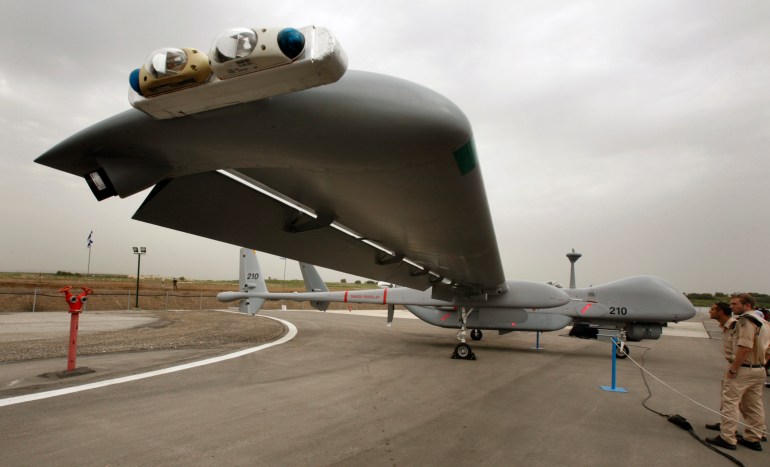 Israeli soldiers look at an IAI Eitan, also known as the Heron TP, surveillance unmanned air vehicle (UAV) on display at Tel Nof Airbase near Tel Aviv in February, 2010 [Gil Cohen/Reuters]
‘An insurance policy’
Weapons exports have uses beyond the revenue they bring to Israel.
“It’s more than that, it’s also an insurance policy to insulate themselves from the intense pressure to change their behaviour over the decades-long occupation of Palestinians,” said Loewenstein.
Last month, Colombian President Gustavo Petro refused to condemn the surprise attack launched by Hamas on October 7 as a “terrorist attack” instead responding that “terrorism is killing innocent children in Palestine”.
In response, the Israeli government halted all sales of defence and security equipment and associated services to the Latin American country.
Colombia is one of an estimated 130 countries that have bought weapons, drones and cyberspying technology from Israel, the world’s 10th-largest weapons exporter.
Israel is, by far, the world’s largest exporter of military drones: in 2017, it was estimated that it was behind nearly two-thirds of all UAV exports over the previous three decades.
Elbit, the maker of the Iron Sting, provides up to 85 percent of the land-based equipment procured by the Israeli military and about 85 percent of its drones, according to Database of Israeli Military and Security Export (DIMSE).
But after the 2014 Gaza war, its export market expanded significantly, too. Erbit promotes its Hermes UAVs as “combat-proven” and the “primary platform of the IDF in counter-terror operations”.
The Hermes 450 and Hermes 900 were both used extensively in “Operation Protective Edge”, Israel’s 2014 war, during which 37 percent of fatalities were attributed to drone attacks, according to an estimate by the Gaza-based Al Mezan Center for Human Rights.
Elbit subsequently secured contracts for the new Hermes 900 drone with more than 20 countries worldwide including the Philippines, which purchased 13, as well as India, Azerbaijan, Canada, Brazil, Chile, Colombia, Iceland, the European Union, Mexico, Switzerland and Thailand. In March 2023, Elbit Systems announced their 120th order for the Hermes 900.
The new “Nizoz” (Spark) surveillance drone manufactured by Rafael, a state-owned weapons contractor that forms the Big Three of Israel’s arms industry with IAI and Elbit, has reportedly now entered the current Gaza war. Rafael has an order backlog which currently stands at $10.1bn.
Al Jazeera approached Elbit Systems, Rafael Advanced Defense Systems and IAI for comment but the firms were yet to respond before time of publication.
![The destroyed remains of the al-Jawhara Tower in Gaza City’s Rimal neighbourhood bombed in May 17, 2021 during Gaza’s fourth war [Paddy Dowling/Al Jazeera]](https://www.aljazeera.com/wp-content/uploads/2023/11/3-1700223968.jpg?w=770&resize=770%2C513) The remains of the al-Jawhara Tower in Gaza City’s Remal neighbourhood, which was bombed in May 17, 2021, during Gaza’s fourth war [Paddy Dowling/Al Jazeera]
The remains of the al-Jawhara Tower in Gaza City’s Remal neighbourhood, which was bombed in May 17, 2021, during Gaza’s fourth war [Paddy Dowling/Al Jazeera]
Hard to track
For all of its military export successes, the full extent of Israel’s defence industry sales remains masked.
A report from Amnesty International in 2019 noted that the whole process by which Israel sells arms is shrouded in secrecy “with no documentation of sales, one cannot know when [these arms] were sold, by which company, how many and so on”.
Amnesty found that “Israeli companies exported weapons which reached their destination after a series of transactions, thereby skirting international monitoring”.
Israel has not ratified the Arms Trade Treaty, which prohibits the sale of weapons at risk of being used in genocide and crimes against humanity. As such, its weapons exports have influenced the course of history for several nations, many led by controversial regimes.
Israel sold weapons to the South African apartheid government in 1975 and even agreed to supply nuclear warheads, according to declassified documents – though Israel denies doing so. Napalm and other weapons were supplied to El Salvador during its counterinsurgency wars between 1980-1992 that killed more than 75,000 civilians.
In 1994, Israeli-made bullets, rifles and grenades were allegedly used in Rwanda’s genocide which killed at least 800,000 people. Israel supplied weapons to the Serbian army that waged war against Bosnia from 1992-1995.
Despite the Israeli government’s own statement in 2018 declaring it had ceased sales to Myanmar, the Haaretz newspaper reported last year that weapons manufacturers continued supplying the military government until 2022, in violation of the 2017 international arms embargo against the country.
And, in September this year, Israel supplied UAVs, missiles and mortars to Azerbaijan for its campaign to recapture Nagorno-Karabakh, during which 100,000 ethnic Armenians were displaced.
Part of what makes it hard to track Israeli weapons exports is the very nature of the arms trade. “Governments buy and sell to each other directly and through their large defence contractors, but also there is a parallel trade by private firms that is usually not illegal but provides plausible deniability,” Stephen Badsey, professor of conflict studies at Wolverhampton University, said.
The largest single control that seller nations maintain over the use of their weapons by other countries is the requirement for “end user” or “end use” rules, Badsey said. But as a major weapons exporter that doesn’t subscribe to the Arms Trade Treaty, Israel has built a reputation for loose export norms.
In 2018, former Philippines President Rodrigo Duterte said he would ask his military to purchase weapons exclusively from Israel because, unlike the United States or Europe, Israel did not impose restrictions.
New government regulations introduced last year will allow Israel to sell more weapons to a greater range of countries without licences – and so, with less oversight. It pays: Israeli weapon export figures have doubled over the past decade, totalling $12.5bn last year.
Battle proven on ‘human animals’
Two days after the October 7 Hamas attack, Israel’s minister of defence Yoav Gallant compared the Palestinian people with “human animals”.
To Loewenstein, the dehumanising comments were unsurprising. “It is obvious over Israel’s occupation and countless wars that Palestinians are treated as second-class citizens. Like animals,” he said.
Over the years, the Israeli army has tested rubber bullets, artificial intelligence-powered robotic guns and various forms of crowd dispersal solutions, which have inflicted severe injuries on Palestinians.
Nabeel al-Shawa, a consultant orthopaedic surgeon who has worked in Gaza since 1978, treated many Palestinians wounded by Israeli firing on the Great March of Return in 2018 – when tens of thousands of Palestinians demanded they be allowed to return to the land they were forcibly removed from in 1948.
“For Israeli snipers, this was merely target practice with humans,” he said. “Most patients had been shot in joints deliberately to cause maximum damage, but not kill.
“These new rounds the Israeli army used caused injuries I have never seen before. In some cases the limb appeared intact, however, during surgery, I could not distinguish between bone and soft tissue.”
So can Israeli weapons manufacturers legitimately market their weaponry as “battle proven” when the combat often targets unarmed civilians?
They can, said Zoran Kusovac, a geopolitical and security analyst.
“If a weapon’s main purpose is proven in the actual battlefield or in as near realistic circumstances as possible, then they are battle proven,” he said. “You cannot blame countries for buying from Israel. You can test all you want in a lab, but Israel is testing in the field, and as there are never any lags of time between one period of combat to the next, the development cycle is virtually in real time.
“And there is of course that adage; that if it’s good enough for the IDF, then it must be good enough for us.”
![Sharp metal cube projectiles which are ejected from an Israeli designed Spike drone rocket [Paddy Dowling/Al Jazeera]](https://www.aljazeera.com/wp-content/uploads/2023/11/5-1700224126.jpg?w=770&resize=770%2C513) Sharp metal cube projectiles which are ejected from an Israeli-designed Spike drone rocket [Paddy Dowling/Al Jazeera]
Sharp metal cube projectiles which are ejected from an Israeli-designed Spike drone rocket [Paddy Dowling/Al Jazeera]
New weapons test in Gaza 2023?
Ashraf al-Qudra, spokesperson for the Ministry of Health in Gaza, last week said in a press statement that medical teams in the enclave had “observed severe burns on the bodies of Palestinians who were killed and wounded by Israel’s bombs – whether caused by an unknown weapon or not – is something they have not seen in previous conflicts”.
Dr Ahmed el-Mokhallalati from the burn and plastic surgery division at al-Shifa Hospital, in an interview with the Toronto Star, described the wounds as “very deep – third and fourth-degree burns, and the skin tissue is impregnated with black particles and most of the skin thickness and all the layers underneath are burned down to the bone”.
El-Mokhallalati said that these weren’t phosphorus burns, “but a combination of some kind of incendiary bomb wave and other components”.
The Israeli military has not commented so far on the statement made by Gaza’s Ministry. But the mystery incendiary bombs, the Iron Sting’s debut and the reported use of the new Spark drone in the current war suggest that Israel is once again testing new weapons in conflict.
“Israel’s weapons will continue to remain attractive to international buyers based on performance in the occupation,” Loewenstein said. “But Israel is not just selling weapons; they’re selling the ideology to other countries – of getting away with it.”
Source: Al Jazeera
Editor’s Note: A version of this article first appeared in the “Reliable Sources” newsletter. Sign up for the daily digest chronicling the evolving media landscape here.
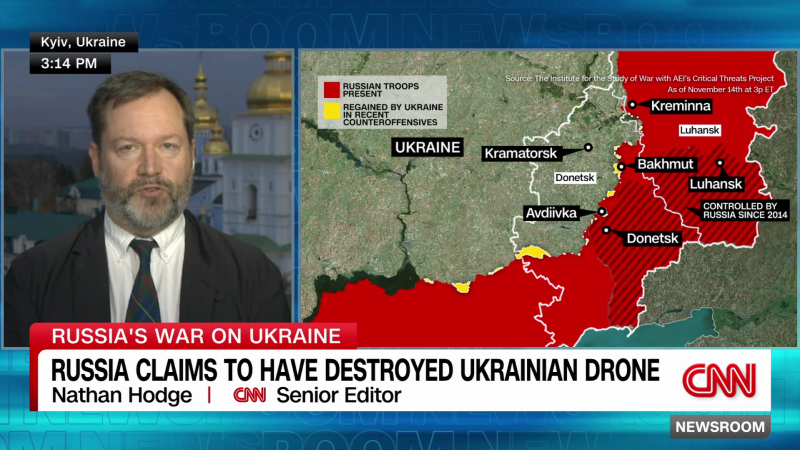
When was the last time you saw a live television news report from Ukraine? It’s likely been a while.
The raging war in the Middle East has put the prolonged war in Eastern Europe largely on the back burner, in terms of media coverage, with Vladimir Putin’s campaign of brutality against Ukraine receiving much less attention from the press than it did prior to the Israel-Hamas conflict breaking out.
Closed-captioning data from the Internet Television Archive, which was analyzed by the GDELT Project, showed that on cable news, coverage of the Ukraine war plummeted dramatically after Hamas’ shocking Oct. 7 terror attack. In the days before the Israel-Hamas war, the battle in Ukraine amounted to about eight percent of CNN’s television coverage. After the attacks, CNN —the cable news network that provided the most Ukraine coverage — fell to under one percent.
As the chaos to elect a new House speaker ensnared Washington, there was a notable uptick in mentions of Ukraine on cable news networks — but the focus of the coverage mostly pertained to U.S. funding of the embattled nation, not the actual state of play in the war.
Data provided by ComScore, an Internet analytics firm, showed a similar trend play out online. The data indicated that there has been a significant drop in discussion on social media about the Ukraine war since the onset of the Israel-Hamas conflict, though it also indicated that in general, there had been a lull in attention to Putin’s invasion in recent months.
The noted drop in Ukraine war coverage from the press, given the fresh violence in the Middle East, is not completely surprising. The horrific acts of violence Hamas carried out in Israel has shocked the world, arresting the attention of those who normally pay little regard to global affairs. U.S. outlets have also been juggling several other important stories in the last several weeks, including disarray in Congress, Donald Trump’s legal issues and a monstrous mass shooting in Maine.
But, at the same time, the drop in attention paid to Ukraine has been nothing short of a boon for Putin. The authoritarian Russian leader, who has committed unspeakable atrocities as his forces invade a sovereign nation, has been able to wage his war with far less scrutiny on his appalling actions.
Paul Kolbe, a senior fellow at the Belfer Center for Science and International Affairs in Harvard Kennedy School, who served for 25 years in the Central Intelligence Agency, told me that Putin must be “delighted” that the war between Israel and Hamas “is diverting US attention” as Russia “continues to strike Ukrainian cities and civilian targets.”
“Even as Western press coverage of war in Ukraine wanes, Russia fills the vacuum in reporting with its own campaign of distributing lies and disinformation,” Kolbe said. “Putin’s strategy is to wear down Western patience and support, play upon U.S. domestic divisions, and to prey upon those in NATO which harbor latent Russian sympathies.”
In addition to the kinetic military action, Putin is also waging an information war, using all the tools at his disposal to lie about and sanitize the acts of savagery being committed against a civilian population under his orders. As Kolbe told me, “Putin’s media campaign to paint Ukraine as divided, corrupt, and a puppet of the U.S. and NATO, is a central part” of his strategy.
The lack of press attention makes that all the more easier.