Categories
Selected Articles

Armenian PM and Russian Minister of Internal Affairs discuss joint programs


default.jpg

Armenian Prime Minister Nikol Pashinyan received Russian Interior Minister Vladimir Kolokoltsev Monday.

The Prime Minister’s Office informed that Nikol Pashinyan emphasized the close cooperation and consistent work between the Ministries of Internal Affairs of the two countries in the fight against crime and in other fields.

Kolokoltsev touched upon the results of discussions with Armenian partners and joint programs.

!

This text available in   Հայերեն and Русский

Print


Categories
Selected Articles

President of Türkiye: ‘We expect Armenia to accept hand of peace extended to it and be sincere’


“Following the recent victory, new windows of opportunity have been opened for a comprehensive normalization of the situation in the region. I believe this opportunity must be appreciated,” Turkish President Recep Tayyip Erdogan said in a press statement

LLOGGO-AZ.png


Categories
Selected Articles

USAID Administrator conveys Biden’s letter to PM Pashinyan


USAID Administrator conveys Biden’s letter to PM Pashinyan
19:46, 25 September 2023

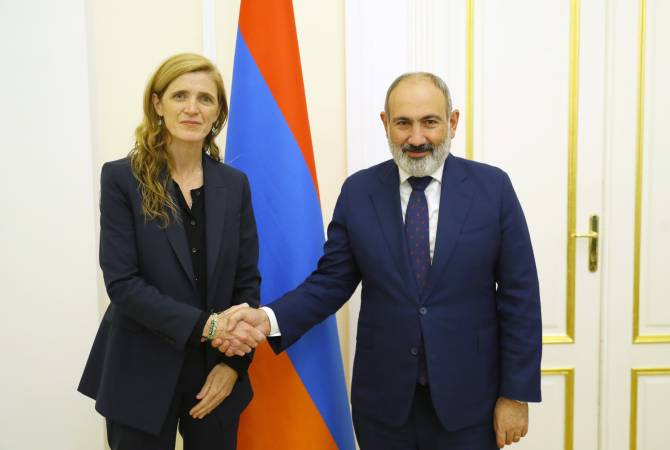
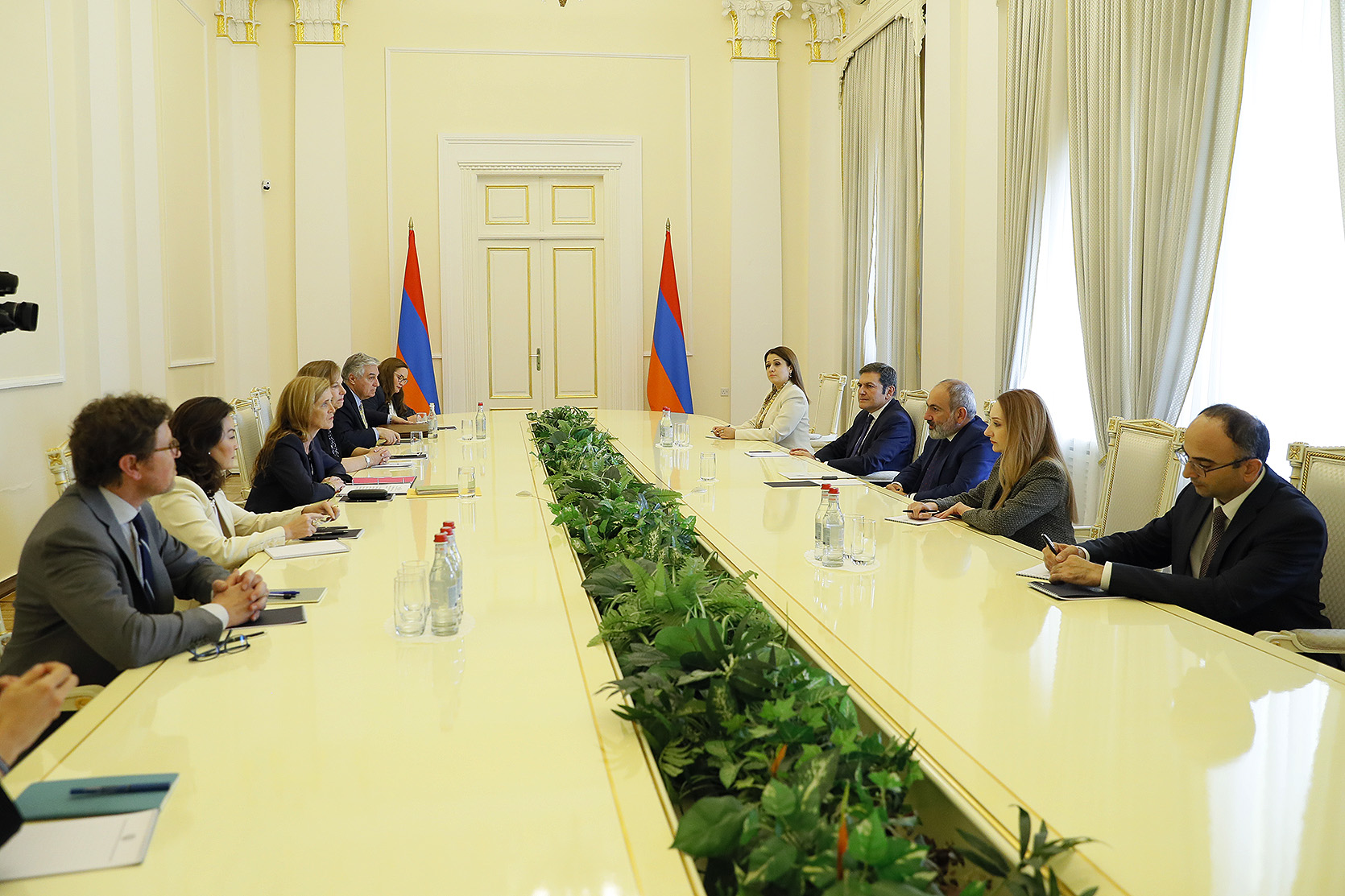
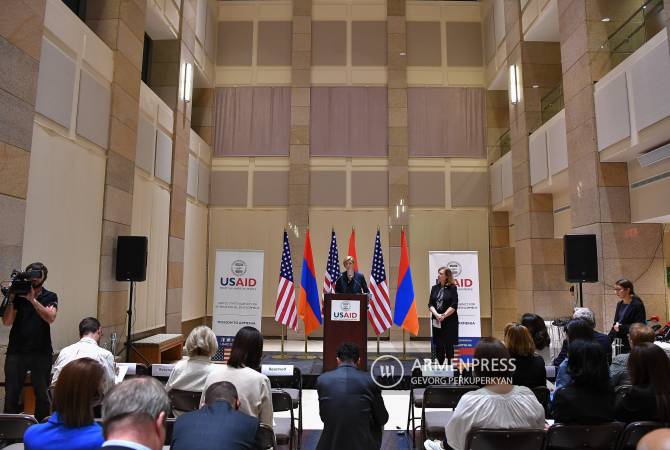
YEREVAN, SEPTEMBER 25, ARMENPRESS. Prime Minister Nikol Pashinyan met on Monday with the delegation led by USAID Administrator Samantha Power, which included U.S. State Department Acting Assistant Secretary for Europe and Eurasian Affairs Yuri Kim.

PM Pashinyan welcomed Power’s visit in this difficult period for Armenia, the Prime Minister’s Office said in a readout.

“I believe you are aware of the overall situation, because we’ve had the opportunity to discuss this situation with members of the US House of Representatives, and two days ago I had a phone call with Secretary of State Blinken. Our partners maintain contact and I think it’s very important that we have this opportunity to discuss all details of the current situation in our region. As you know, unfortunately at this moment the process of ethnic cleansing of Armenians in Nagorno-Karabakh continues, and this is a very tragic fact. We were trying to warn the international community that the ethnic cleansing would happen, but regrettably we were unable to prevent it. But this situation and the tension continues to grow in our region, and now it is very important to take concrete steps to prevent further escalation and even bigger problems. I am very glad for this opportunity and I welcome you in our country,” PM Nikol Pashinyan said.

Samantha Power thanked the Prime Minister for the warm reception.

“I know how busy you are given the current situation. President Biden sent me and my delegation here to underscore the U.S.’s deep commitment to Armenia’s sovereignty, territorial integrity and democracy. I know that the USAID is working with the Armenian people, and the government of Armenia has never displayed irresolution in this matter, and this is very important. We have arrived in Armenia, and I hope to once again have a chance to come here to discuss our steps aimed at strengthening your deepening democracy, but during this visit, of course, we are focused on a concrete crisis, on the humanitarian needs of the people of Nagorno-Karabakh, the humanitarian needs of those who fled Nagorno-Karabakh. I believe approximately 5000 people crossed into Armenia today, and we are treating very seriously our responsibility to mobilize resources, ourselves, to support the local self-governing bodies in finding accommodation and other measures of assistance, but also to encourage other countries to do the same. The United States of America will continue to work with both your and the Azerbaijani government in the direction of achieving lasting peace between the countries, also taking into consideration the deep economic benefit and stability it would ensure for the Armenian people. The steps you have taken in separation of powers, fight against corruption, these are all investments in Armenia’s future,” Power said.

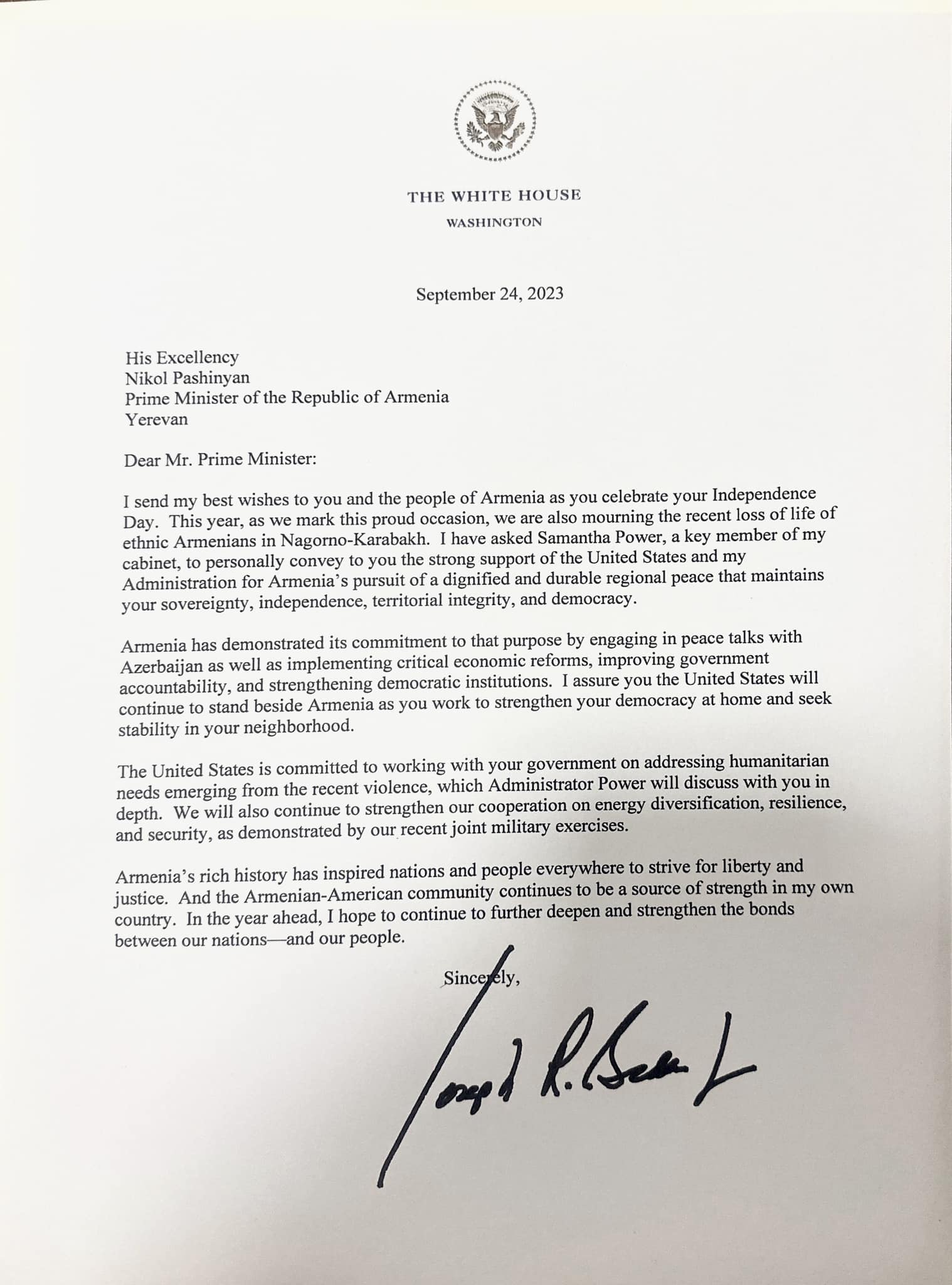
The USAID Administrator conveyed U.S. President Joe Biden’s letter addressed to PM Nikol Pashinyan.

They then discussed the humanitarian situation in NK, the opportunities for providing support to Armenians of NK, the developments in the region, and the future development and expansion of Armenia-USA cooperation.


Categories
Selected Articles

Nagorno-Karabakh representatives and Azeri authorities reach agreement on transfer of wounded, critically-ill to Armenia


Nagorno-Karabakh representatives and Azeri authorities reach agreement on transfer of wounded, critically-ill to Armenia
20:25, 25 September 2023

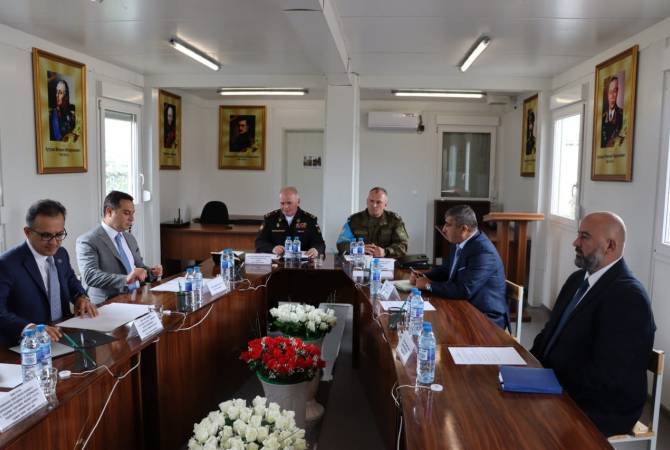
STEPANAKERT, SEPTEMBER 25, ARMENPRESS. A Russian-mediated meeting took place on September 25 between representatives of Nagorno-Karabakh and Azerbaijan.

The meeting took place in Ivanyan (Khojaly) at the base of Russian peacekeepers, the Nagorno-Karabakh InfoCenter reported.

A number of humanitarian issues were discussed, including the course of search and rescue operations of the victims and missing persons of the hostilities. The need for restoring natural gas supply and the uninterrupted work of electricity system and water supply was highlighted.

The Nagorno-Karabakh representatives underscored the need for transporting wounded persons, pregnant women, children and others in need of urgent medical assistance to hospitals in Armenia for treatment. The parties reached an agreement on the issue and outlined the agenda of the next meeting.


Categories
Selected Articles

Azerbaijan’s Nagorno-Karabakh victory highlights limits of Russia’s power


6746.jpg?width=1200&height=630&quality=8

Azerbaijan’s military victory in the extended 35-year conflict over the disputed territory of Nagorno-Karabakh is a notable geopolitical setback for Russia, traditionally Armenia’s partner and ally.

Moscow’s post-Soviet strategy has often been to stoke conflicts to weaken its near neighbours, creating crises in Ukraine, Moldova and Georgia. But on this occasion the Kremlin has had to adapt to Azerbaijan’s rising power – showing a willingness to sacrifice an old ally.

At the beginning of the month, before the current crisis, Nikol Pashinyan, Armenia’s prime minister, rued that his country’s historic “99.999%” dependence on Russia as security partner had amounted to “a strategic mistake”.

By then it had long been clear Russia had become embroiled in a quagmire in Ukraine – and so would be unable to prevent Azerbaijan from finally regaining control of an enclave of territory in ethnic Armenian hands over which it had wanted to assert control since the fall of the Soviet Union.

“Russian resources are clearly finite,” said James Nixey, a Russia expert with the Chatham House thinktank. “Karabakh is clearly an issue of lesser importance to Moscow, it is not a place like Crimea or Syria from which it is possible to project force.”

“In a way, Russia chose the wrong country,” argued Neil Melvin, a director at the Royal United Services Institute thinktank. “Azerbaijan is much closer to Russia: the two share a border. It is clear who is now the dominant force in the south Caucasus, and looks like it wants to align to them.”

Azerbaijan is a larger, wealthier country than Armenia and an autocracy, like Russia. The country’s economy, supported by large oil and significant gas reserves, is able to afford a more powerful military – its $2.64bn (£2.16bn) defence budget is 3.5 times its neighbour in dollar terms, according to figures from the International Institute for Strategic Studies.

Nagorno-Karabakh

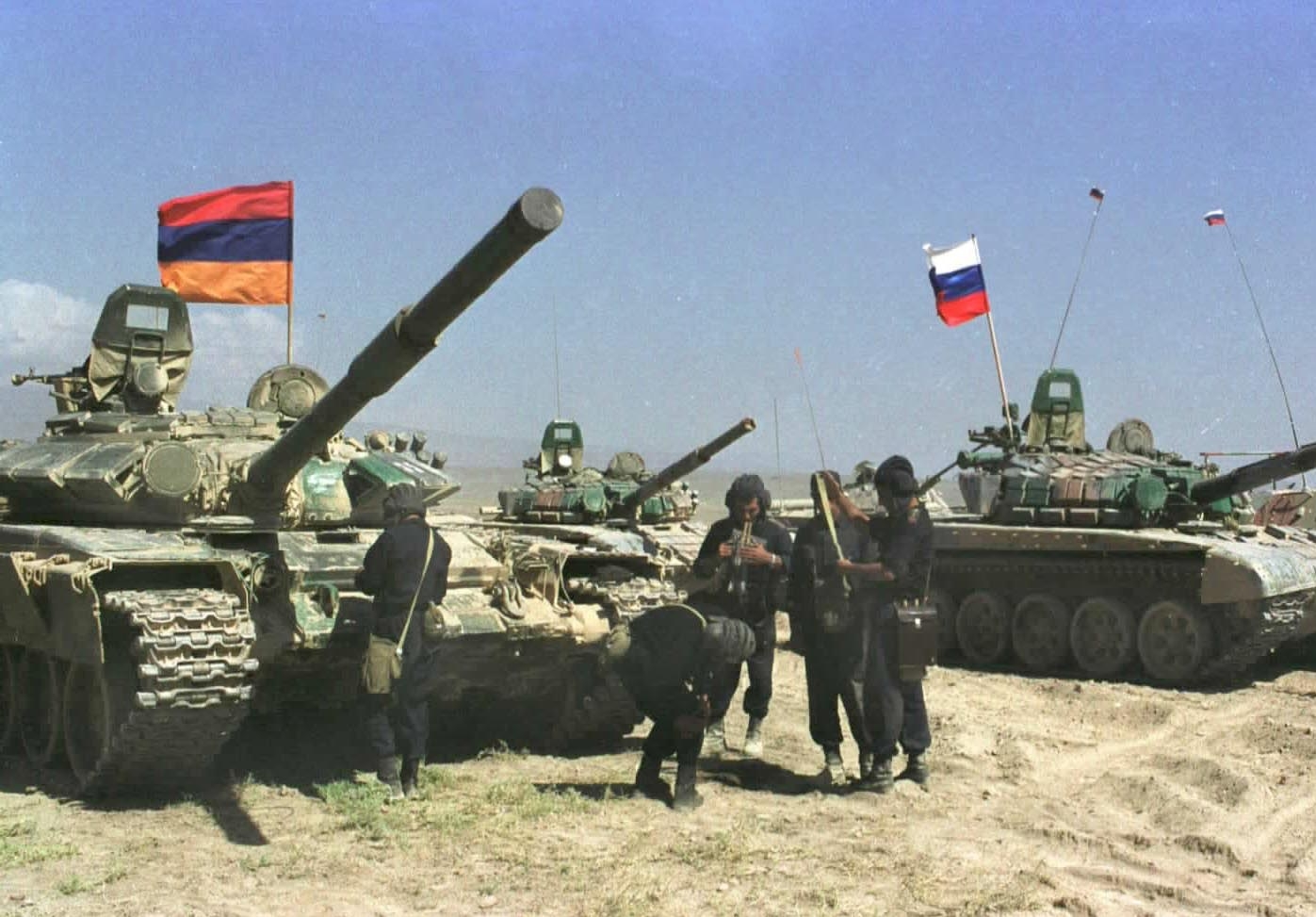
Baku had already formed an effective alliance with Turkey that provided the Bayraktar TB2 drones that helped it win the last war in 2020, a 44-day autumn conflict in which Azerbaijan took control of the skies, bombing Armenia’s Soviet-era tanks and its allies in Nagorno-Karabakh.

It recaptured territories lost in 1994 and in the ensuing peace left only the core of Nagorno-Karabakh in ethnic Armenian hands, with nearly 2,000 Russian peacekeepers in place to control the borders and the protect the small Lachin corridor to Armenia proper.

But in the runup to the Ukraine war, Azerbaijan also turned to Moscow. Its president, Ilham Aliyev, whose father was once a KGB official and a politburo member, travelled to Moscow two days before the invasion to sign an alliance agreement with Vladimir Putin. Azerbaijan later agreed to buy gas from Russia, raising questions whether it was using that to meet commitments to the EU.

Azerbaijan’s final attack last week on Nagorno-Karabakh only lasted 24 hours. During the assault, a number of Russian peacekeepers were killed by Baku’s forces. Aliyev rang the Kremlin to apologise the next day, and the matter appears largely closed without Moscow making any significant complaint.

South of Azerbaijan lies Iran, one of Russia’s few close allies and the three countries agreed in May they would build a new rail corridor along the Caspian Sea, although claims from Мoscow that it could create a trade route to rival that of the Suez Canal seem notably optimistic.

Armenia’s prime minister, meanwhile, has complained that the Moscow-dominated six country Collective Security Treaty Organization (CSTO), did not come to its aid and some hope that it might now try to pivot to the west. Its parliament will now consider signing up to the international criminal court, which, if ratified, could prevent Putin, because he is indicted by The Hague, from visiting.

But that is a long way from Yerevan turning to the EU and Nato. “Look at the difficulties Ukraine is having joining the EU and Nato. A country like Armenia has no chance,” Nixey said. With a long established Russian base, Gymuri, to protect it from Turkey to the west, a rapid realignment is impossible.

Russia’s inability or lack of desire to protect Armenia, though, may not have any major implications for other post-Soviet frozen conflicts because the countries involved have less power than Azerbaijan or simply less hostility to Moscow.

Magomed Torijev, a journalist and expert on the Caucasus region, argued “the government in Georgia is increasingly friendly with Russia”, with no strong interest in trying to reclaim either South Ossetia or Abkhazia while Moldova, with its own Transnistria separatists, is not ready to challenge the Kremlin.

In other countries, such as Syria, Russia’s alliance with the governing regime will help protect its position, and Moscow’s presence is likely to endure unless it is directly challenged. But what has changed, experts say, is that stronger countries such as Ukraine and Azerbaijan are willing and able to challenge Russia as never before.

“The reality is that Russia has been weakening for some time,” Melvin said.


Categories
Selected Articles

There must be international presence in Nagorno-Karabakh, says USAID Administrator


There must be international presence in Nagorno-Karabakh, says USAID Administrator
21:05, 25 September 2023

YEREVAN, SEPTEMBER 25, ARMENPRESS. There must be an international presence in Nagorno-Karabakh to assess whether Azerbaijan is implementing its commitments, USAID Administrator Samantha Power said at a press conference in Yerevan.

“We call on Azerbaijan to adhere to the ceasefire and take concrete steps to protect the rights of civilians in Nagorno-Karabakh. President Aliyev has vowed to guarantee the rights of ethnic Armenians, and Azerbaijan must fulfill this promise,” Power said.

The USAID chief said the world must be able to verify and ascertain that Azerbaijan is fulfilling its promise. “All parties must allow an international humanitarian assessment and humanitarian presence to be there, to see whether Azerbaijan is fulfilling its commitments, and for these organizations to be able to report to the international community,” Samantha Power said.

The USAID Administrator emphasized that Azerbaijan must always ensure unimpeded passenger transport, commercial and humanitarian shipments along Lachin Corridor. The promises on protecting the population of NK would be void as long as civilians are unable to freely travel and when food and medical supplies can’t reach the settlements.

“And organizations such as the USAID must have access in order to provide essential humanitarian assistance,” Power said.


Categories
Selected Articles

Urgently sever ties with Russia or calculate risks? Discussions in Yerevan


738459.jpg

Changes in Armenia’s foreign policy course

After the September military actions in Nagorno-Karabakh, expert circles in Armenia are increasingly talking about the uselessness of the Russian presence in the region.

Analysts focus on the inactivity of Russian peacekeepers stationed on the territory of the unrecognized NKR. There are statements that the peacekeeping mission has not ensured the safety of the residents of Nagorno-Karabakh, as a result of which their mass evacuation is now taking place.

Moscow accuses the Armenian Prime Minister of this, recalling the document he signed in Prague recognizing the territorial integrity of Azerbaijan, including the territory of Nagorno-Karabakh. While Putin himself, long before the Prague agreement, had twice publicly stated that Nagorno-Karabakh is part of Azerbaijan.

Even threats to Armenia are heard from Russia. A State Duma deputy threatened that “Armenia will cease to exist” and become a province of the Russian Federation.

Prime Minister Nikol Pashinyan also raised this topic in his Sunday address to the nation. He said that every Armenian citizen should make a choice whether he is “a participant of the movement for the defense of independence or a supporter of a submissive distant province.”

Many Armenian political analysts believe that it is necessary to urgently and definitively sever all ties with Russia, to stop considering this country as a guarantor of security, despite the possible consequences. Others suggest still calculating the risks, as the West, in their opinion, will not take responsibility for ensuring Armenia’s security.

Changes in Armenia’s foreign policy course

“Unshackled state or province?” Pashinyan’s address

“The attacks launched by Azerbaijan against the Republic of Armenia in recent years lead to the obvious conclusion that those external security systems, of which we are a part, are not effective from the point of view of the state interests and security of the Republic of Armenia,” the Armenian Prime Minister said in his address to the nation yesterday.

According to him, this was observed both during the 44-day war in Karabakh and after it, including during the recent hostilities.

In Pashinyan’s assessment, the allies on whom Armenia has relied over the years have set out to “flaunt our vulnerability and justify the Armenian people’s inability to have an independent state.”

He stated that “some partners” are making more and more efforts in that direction, jeopardizing the country’s external and internal security and violating all norms of etiquette and correctness in diplomatic and interstate relations.

The Armenian Prime Minister assured that all measures will be taken to protect the independence of the country, including

  • transformation, supplementing and enriching the instruments of external and internal security in cooperation with all partners ready for mutually beneficial steps,
  • comprehensive reforms of the army and security forces,
  • de jure fixation of the agreements reached on October 6, 2022 in Prague and May 14, 2023 in Brussels,
  • ratification of the Rome Statute.

According to Pashinyan, the deep meaning of the events taking place in Armenia is the following: “whether Armenia will be a sovereign, free, democratic state or a frightened distant province.” He believes that “the citizen of the Republic of Armenia will not lose his pride and determination and will win in this struggle for independence, sovereignty, democracy, happiness and freedom”.

Changes in Armenia’s foreign policy course

“Armenia will cease to exist.”

Yevgeny Fedorov, a State Duma deputy from the ruling United Russia party, recently made a statement about the establishment of a puppet regime in Armenia that would replace Russia’s power:

“Armenia will cease to exist. We will restore control over this territory. There will be a governor there or something else.”

Statements that Armenia has lost its way and this will lead it to various kinds of disasters are also heard at the level of Russian Foreign Minister Sergei Lavrov and Foreign Ministry spokesperson Maria Zakharova.

The latest warning appeared hours ago. It says that Armenia is making “a huge mistake, deliberately trying to collapse Armenia’s multifaceted and centuries-old ties with Russia and making the country a hostage of the West’s geopolitical games.”

The Russian Foreign Ministry statement comments in detail on the theses of Nikol Pashinyan’s address, which contains “unacceptable attacks on Russia.”

“The head of the government, in fact, admitted that all this time the republic was deliberately prepared to turn away from Russia. His steps, designed to set a new – Western – vector of Armenia’s development, are unconvincingly justified by alleged mistakes on the part of the Russian Federation and the CSTO,” it reads.

Russian diplomats declare that “the irresponsible approach of Pashinyan’s team has caused understandable discontent in part of the Armenian society, which was expressed in popular protests”. They claim that Russia has nothing to do with them:

“The head of the Armenian government should be well aware that Moscow does not deal with such things – unlike the West, which is quite skilled in organizing ‘color revolutions’, but by a strange coincidence chose not to notice the numerous facts of persecution of protesters by the authorities in Yerevan.”

Comments

Military and security expert Hrachya Arzumanyan insists that Armenia must take decisive steps immediately. He believes that if Armenia does not sever all ties with Russia, “the events that happened in Stepanakert will happen in Yerevan as well.”

Arzumanyan stated that there is no need for unnecessary words and declare their intentions, it is time to act. In particular, ratify the Rome Statute and withdraw from the Russian military bloc CSTO. Then, he said, the West and power centers will see that Armenia has made its choice:

“If you don’t get out from under Russia’s terrorist blackmail, everything will end up like in Artsakh, confidence will be lost. We need to blow up this blackmail to get a chance to save and protect our independence”.

According to the expert’s assessment, Russia itself has declared Armenia an enemy. He opines that Armenia as a democratic country poses an “existential threat” to Moscow.
He is convinced that Moscow is the organizer of the struggle for the change of power, which is going on these days in the streets of Yerevan. Arzumanyan believes the goal is to create chaos in Armenia and destroy the state.

Among the actions aimed at overthrowing the Armenian statehood he names the second Karabakh war in 2020 and military actions on September 19-20, 2023. The analyst declares the Russian-Turkish tandem to be their author:

“This operation will not end with Artsakh. The next step will be the territory of Armenia, Syunik [southern region of Armenia bordering Azerbaijan]”.

It is for this reason that Hrachya Arzumanyan considers it necessary to sever security ties with Russia. He suggests that Armenia build allied relations with those countries with which its national interests coincide. In addition to the collective West, he names Iran and India as potential partners.

Political observer Hakob Badalyan believes that in addition to “brave and self-confident” statements about changing the foreign policy vector, one should also seriously think about the “bloody price” that will have to be paid for it:

“And even after paying this price one should doubt the success of the change. A change of vector will mean a change of the main responsible person. This means that instead of Russia, it is the West that should become responsible. And the West does not need to emphasize the fact of its own responsibility, but only the complete overthrow of Russia’s responsibility”.

The expert says that the “alternative” offered by the West is as follows: “if you want security, you need to negotiate with Turkey and Azerbaijan, and we will provide you with a “room” for negotiations free of charge”.

It reminds that Russia has much more opportunities than Armenia to make favorable agreements with Azerbaijan and Turkey, and at Armenia’s expense. And in order to get out of this “trap,” it is not necessary to change the vector:

“If we do not have sufficient intellectual institutional capacity to develop other mechanisms and options, it does not mean that there is only one possibility left – to change the vector, especially in the situation of a world war.”

At the same time, the observer does not think that Armenia will be immune from “new bloody stages” if it does not change the vector.

According to Badalyan, to increase resilience, changes inside the country are needed, “starting from the relations within the society and ending with the quality and content of socio-political and military institutions.”

In general, he advises to “minimize the motives and causes of acute reactions in the external field, regardless of the risk of this reaction”.

Follow us Twitter | Facebook | Instagram

Changes in Armenia’s foreign policy course


Categories
Selected Articles

United States will continue to stand beside Armenia: Biden to Pashinyan


The Administrator of the US International Development Agency, Samantha Power, conveyed the letter of US President Joe Biden to Prime Minister Nikol Pashinyan.

The letter reads:

Dear Mr. Prime Minister,

I send my best wishes to you and the people of Armenia as you celebrate your Independence Day. This year, as we mark this proud occasion, we are also mourning the recent loss of life of ethnic Armenians in Nagorno Karabakh. I have asked Samantha Power, a key member of my cabinet, to personally convey to you the strong support of the United States and my Administration for Armenia’s pursuit of a dignified and durable regional peace that maintains your sovereignty, independence, territorial integrity, and democracy.

Armenia has demonstrated its commitment to that purpose by engaging in peace talks with Azerbaijan as well as implementing critical economic reforms, improving government accountability and strengthening democratic institutions. I assure you that the United States will continue to stand beside Armenia as you work to strengthen the democracy at home and seek stability in your neighborhood.

The United States is committed to work with your government and addressing humanitarian needs emerging from the latest violence, which Administrator Power will discuss with you in depth. We will also continue to strengthen our cooperation on energy diversification, resilience, and security, as demonstrated by our recent military exercises.

Armenia’s rich history has inspired nations and people everywhere to strive for liberty and justice. And the Armenian-American community continues to be a source of strength in my own country. In the year ahead, I hope to continue to further deepen and strengthen the bonds between our nations – and our people”.


Categories
Selected Articles

Official: Explosion of gasoline tank near Stepanakert leaves several dozen injured


default.jpg

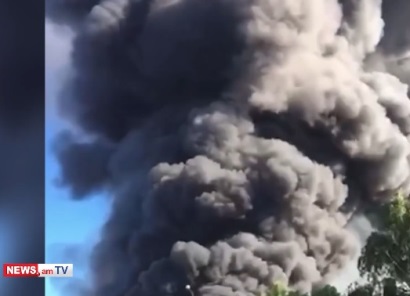
The explosion of a gasoline tank near Stepanakert has left several dozen injured with various burns, the press secretary of the Minister of Health of Artsakh told NEWS.am.

“At the moment, we do not have information about the casualties and the injured. At the moment, we have several dozen wounded with various burns. Right now, that’s all, if there is official information, we will definitely publish it,” Angelina Isakhanyan said.

!

This text available in   Հայերեն and Русский

Print


Categories
Selected Articles

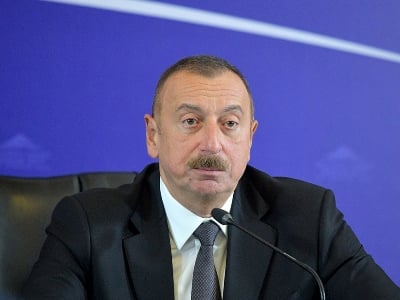
Aliyev again speaks about ‘Zangezur corridor’


default.jpg

The President of Azerbaijan, Ilham Aliyev, has again announced the so called Zangezur corridor. He made the statement after the meeting with Turkish President Recep Tayyip Erdogan in Nakhichevan.

“The construction of the railway connecting Azerbaijan with Nakhichevan and Turkey is progressing successfully. Most likely, the works in the territory of Azerbaijan should be completed by the end of next year,” he said.

!

This text available in   Հայերեն and Русский

Print