Information Cutoff: 2:00 pm EST
Contributor: James Cary
The Iran Update provides insights into Iranian and Iranian-sponsored activities abroad that undermine regional stability and threaten US forces and interests. It also covers events and trends that affect the stability and decision-making of the Iranian regime. The Critical Threats Project (CTP) at the American Enterprise Institute and the Institute for the Study of War (ISW) provides these updates regularly based on regional events. For more on developments and in Iran and the region, see our interactive map of Iran and the Middle East.
Note: CTP and ISW have refocused the update to cover the Israel-Hamas war. The new sections address developments in the Gaza Strip, the West Bank, Lebanon, and Syria, as well as noteworthy activity from Iran’s Axis of Resistance. We do not report in detail on war crimes because these activities are well-covered in Western media and do not directly affect the military operations we are assessing and forecasting. We utterly condemn violations of the laws of armed conflict and the Geneva Conventions and crimes against humanity even though we do not describe them in these reports.
Click here to see CTP and ISW’s interactive map of Israeli ground operations. This map is updated daily alongside the static maps present in this report.
Key Takeaways:
- Palestinian militias targeted IDF ground forces with small arms, anti-tank fire, and indirect fire in the northern Gaza Strip.
- Palestinian militias in the Gaza Strip conducted indirect fire attacks into Israeli territory, primarily in Southern Israel.
- Palestinian militants engaged Israeli forces in small arms and IED attacks in the Jenin refugee camp overnight on November 2-3 amid Israeli arrest raids.
- Lebanese Hezbollah and other Axis of Resistance militias conducted three attacks from southern Lebanon into Israel on November 3, including one attack using a one-way attack drone.
- LH Secretary General Hassan Nasrallah’s November 3 speech supports a long-running Iranian and Axis of Resistance information operation that claims Israeli actions are an extension of US policy.
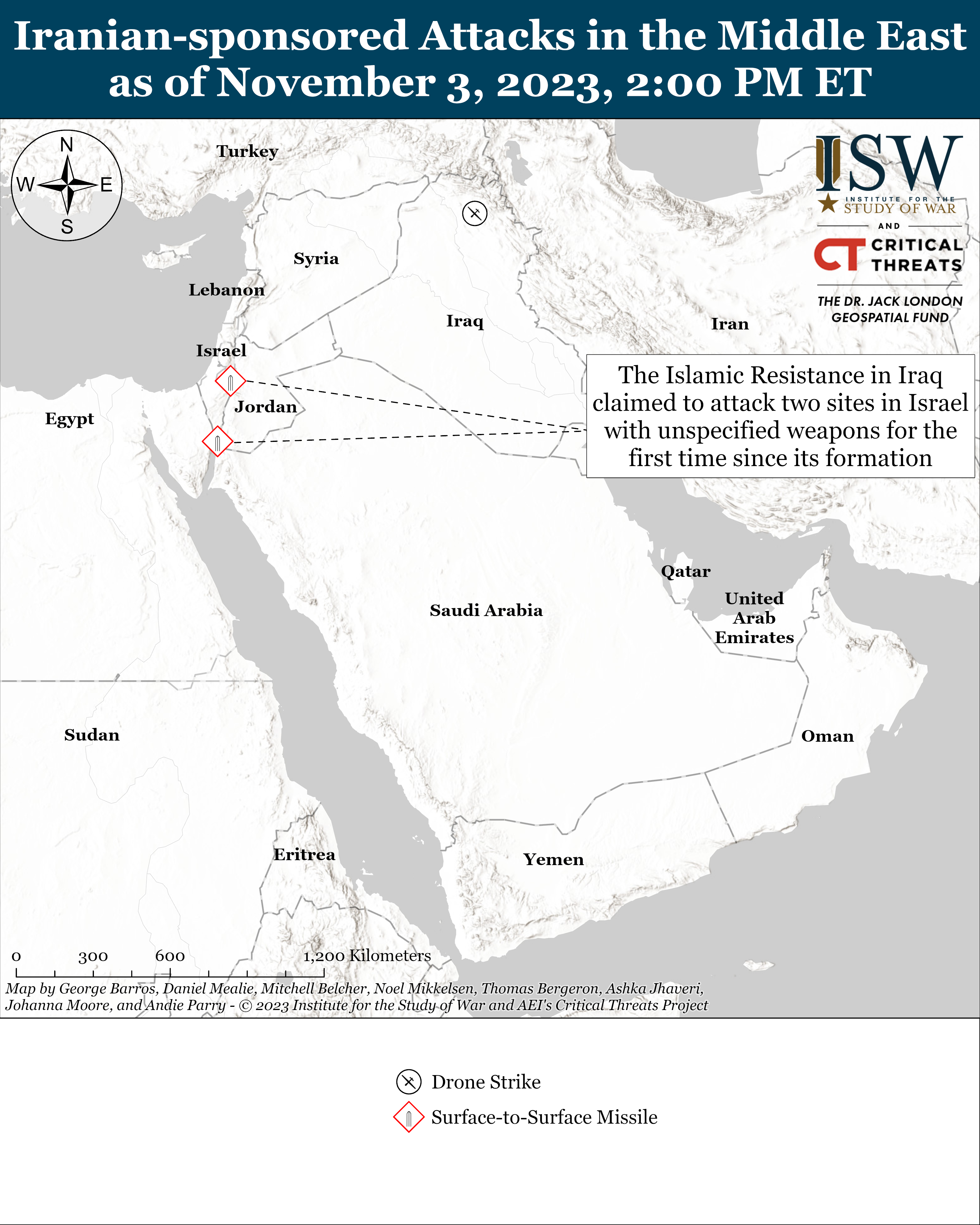
- The Islamic Resistance in Iraq—a coalition of Iranian-backed Iraqi militias—claimed two attacks inside Israel on October 3, the group’s first time attacking outside Iraq and Syria. The Islamic Resistance in Iraq also claimed responsibility for a one-way drone attack targeting US forces in Iraq on November 3.
- Wagner elements in Syria will reportedly transfer Russian Pantsir-S1 air defense systems that Syrian President Bashar al-Assad has agreed to provide to Iranian-backed Lebanese Hezbollah.
- Iranian Foreign Affairs Minister Hossein Amir Abdollahian is continuing to coordinate politically with senior Hamas leadership.
Gaza Strip
Axis of Resistance campaign objectives:
- Erode the will of Israeli political establishment and public to launch and sustain a major ground operation into the Gaza Strip
- Degrade IDF material and morale around the Gaza Strip
Israeli Clearing Operations
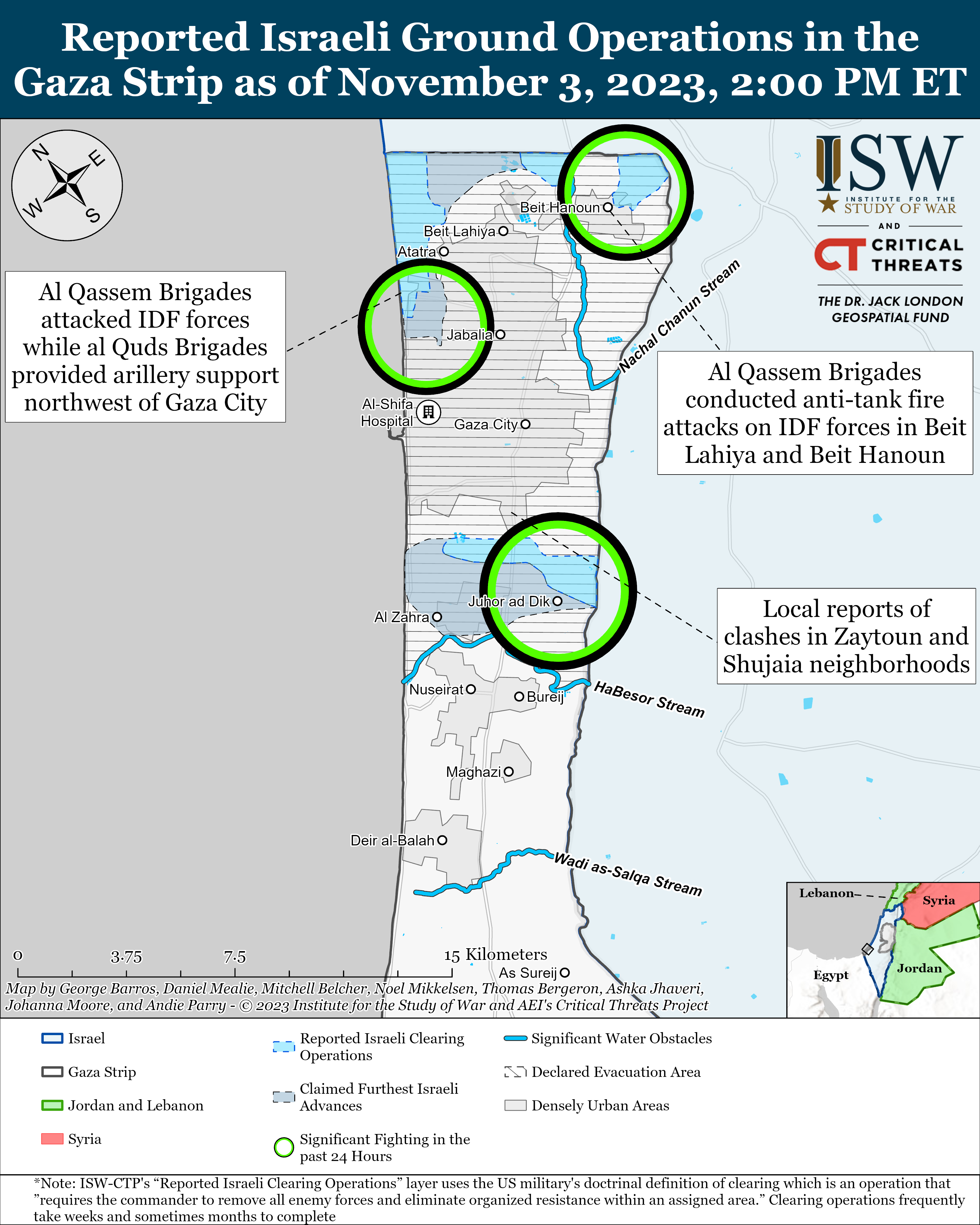
Palestinian militias targeted IDF ground forces with small arms, anti-tank fire, and indirect fire in the northern Gaza Strip. IDF spokesperson Daniel Hagari said that the IDF is encircling Gaza City from the air land, and sea.[i] Fighting continued behind the Israeli forward line of advance in the central Gaza Strip, however. The al Qassem Brigades—the militant wing of Hamas—claimed responsibility for attacking IDF forces in the northwest, northeast, and south of Gaza City.[ii] The al Qassem Brigades used anti-tank munitions and their intricate network of tunnels underneath the Gaza Strip to ambush IDF forces.[iii] They also used rockets and mortars to attack IDF vehicles and infantry near the Erez military checkpoint on the northern border.[iv] The al Quds Brigades—the militant wing of Palestinian Islamic Jihad (PIJ)—claimed to fire artillery at advancing IDF vehicles along the coast.[v] The al Quds Brigades military spokesmen said his fighters fired anti-tank munitions at Israeli vehicles and thwarted a maritime landing attempt west of Gaza City.[vi] A Palestinian journalist reported clashes in the Zaytoun and Shujaia neighborhoods southeast of Gaza City on November 3.[vii] Palestinian militias have attacked IDF forces and vehicles in Zaytoun neighborhood since October 30 as the IDF attempts to clear territory south of the city.[viii]
Hamas and PIJ are coordinating attacks on IDF ground forces in the Gaza Strip. The al Qassem Brigades conducted an attack against IDF ground forces northwest of Gaza City on November 3 with artillery support from the al Quds Brigades.[ix] Hamas and PIJ leadership have coordinated throughout the war in bilateral planning meetings. [x] The tactical coordination on the ground and coordination at the senior level is consistent with the reality that the IDF is facing a coalition of several Palestinian militias in the Gaza Strip.
The IDF said its forces recently took over a Hamas military stronghold used by Nukhba–a naval special forces unit of Hamas’ militant wing–and Hamas’ operational intelligence headquarters in Jabaliya.[xi] The Assistant to the Israeli director of military intelligence said that Jabaliya is a hub of Hamas’ tunnel network used for weapons stockpiles, rocket firing positions, and tunnels leading to the coast.[xii] The IDF is degrading Hamas’ naval capabilities, which Hamas could use to target Israeli gas rigs and other infrastructure, according to an Israeli journalist.[xiii] Palestinian militants continued to operate in Jabaliya. The al Quds Brigades claimed to engage IDF forces at a “close distance” east of Jabaliya.[xiv]
Palestinian militias in the Gaza Strip conducted indirect fire attacks into Israeli territory, primarily in Southern Israel. Palestinian militias in the Gaza Strip conducted indirect fire attacks into Israel at a decreased rate on November 3. The al Qassem Brigades claimed responsibility for four indirect fire attacks.[xv] The al Quds Brigades claimed responsibility for another four indirect fire attacks. The al Quds Brigades’ indirect fire targeted Israeli military concentrations in three locations adjacent to the Gaza Strip.[xvi] The National Resistance Brigades—the militant wing of the Democratic Front for the Liberation of Palestine (DFLP)—claimed one indirect fire attack into southern Israel.[xvii]
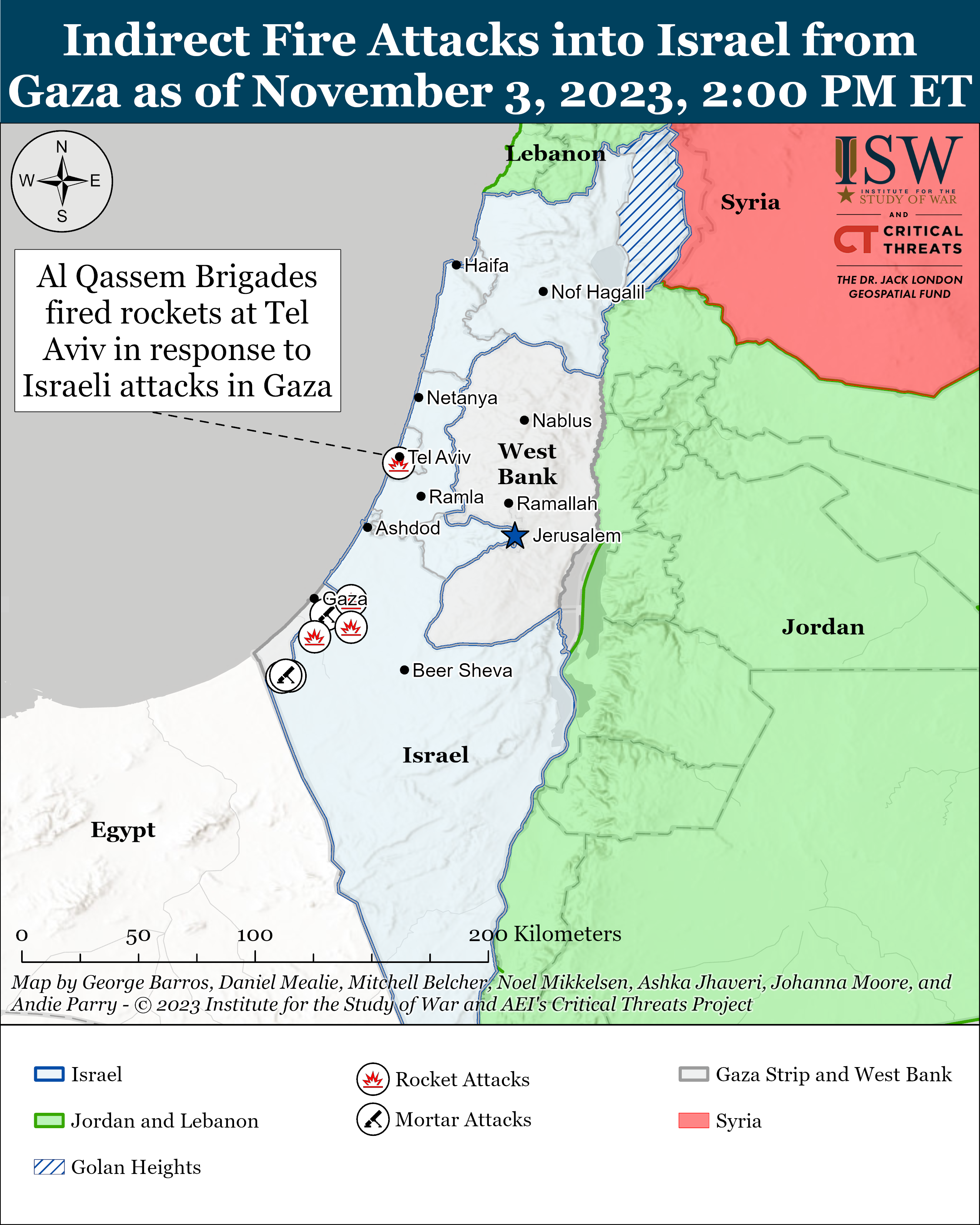
Recorded reports of rocket attacks; CTP-ISW cannot independently verify impact.
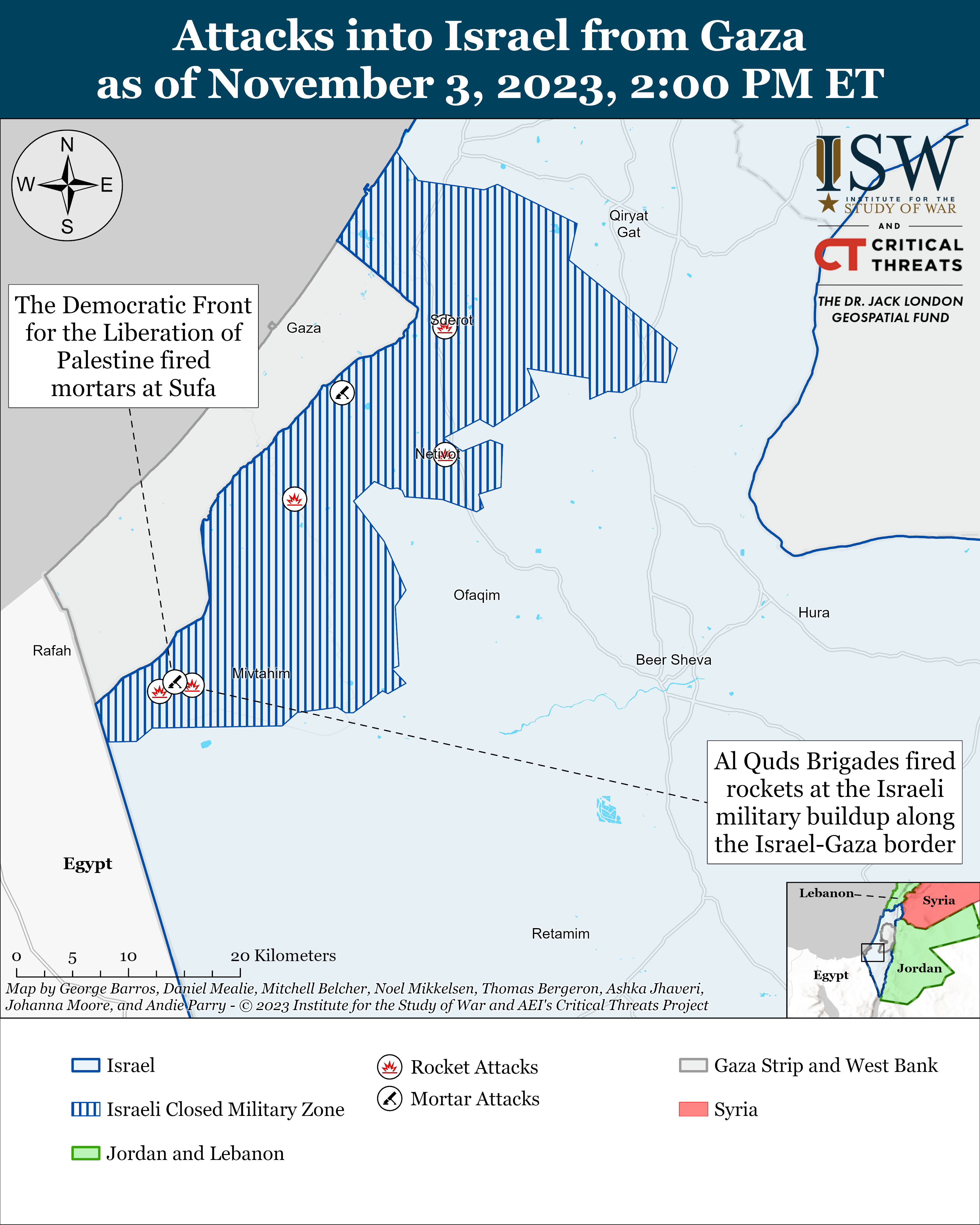
Recorded reports of rocket attacks; CTP-ISW cannot independently verify impact.
West Bank
Axis of Resistance campaign objectives:
- Draw IDF assets and resources toward the West Bank and fix them there
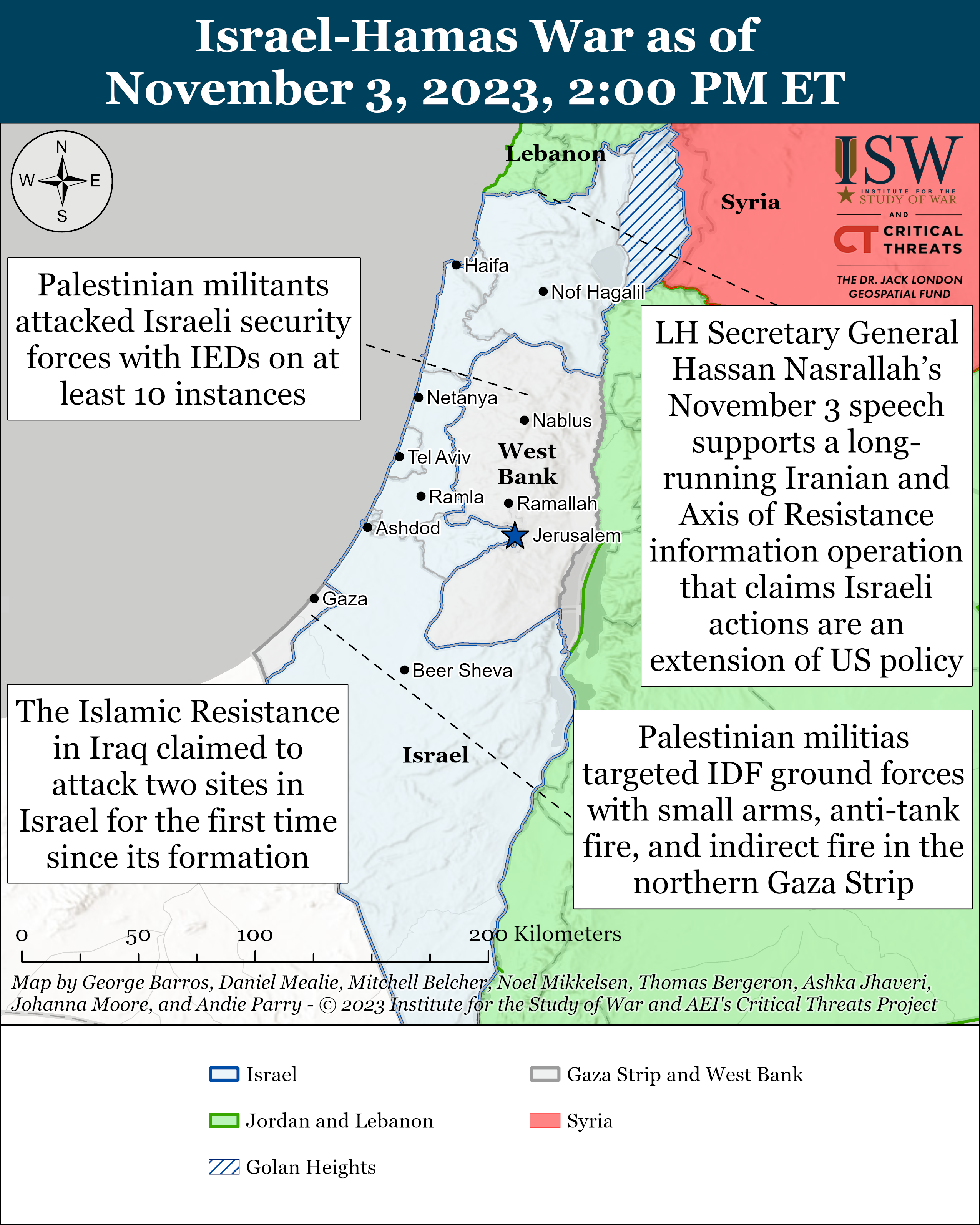
CTP-ISW recorded 12 separate clashes between Israeli forces and Palestinian militants in the West Bank on November 3. CTP-ISW also recorded 10 instances of IED attacks against Israeli forces in the West Bank, which is an increase compared with the daily average of IED attacks in the area over the past week. The Tulkarm Battalion of the al Aqsa Martyrs Brigades claimed IED attacks against Israeli forces in four locations in Tulkarm on November 3.[xviii] The Tulkarm Battalion of the al Quds Brigades engaged Israeli forces with small arms and IEDs in Tulkarm at the same time as the al Aqsa Martyrs Brigades’ attack on November 3, indicating possible coordination between the groups.[xix] The al Aqsa Martyrs Brigades and al Quds Brigades previously conducted combined attacks in Tulkarm on October 30.[xx]
Palestinian militants engaged Israeli forces in small arms and IED attacks in the Jenin refugee camp overnight on November 2-3 amid Israeli arrest raids.[xxi] The Jenin Brigade of the al Quds Brigades claimed it conducted small arms and IED attacks on Israeli forces on November 3, presumably in Jenin, though the brigade did not indicate where the attacks occurred.[xxii] The IDF conducted an airstrike which it said killed multiple militants in the Jenin refugee camp on November 3.[xxiii] The IDF also dropped leaflets calling for West Bank residents not to work with Hamas and other militant groups.[xxiv] The attacks came after West Bank residents in Jenin and Tulkarm broadcasted a speech by al Qassem Brigades spokesperson Abu Obaida on November 2, who said its fighters would ”make the enemy pay.”[xxv]
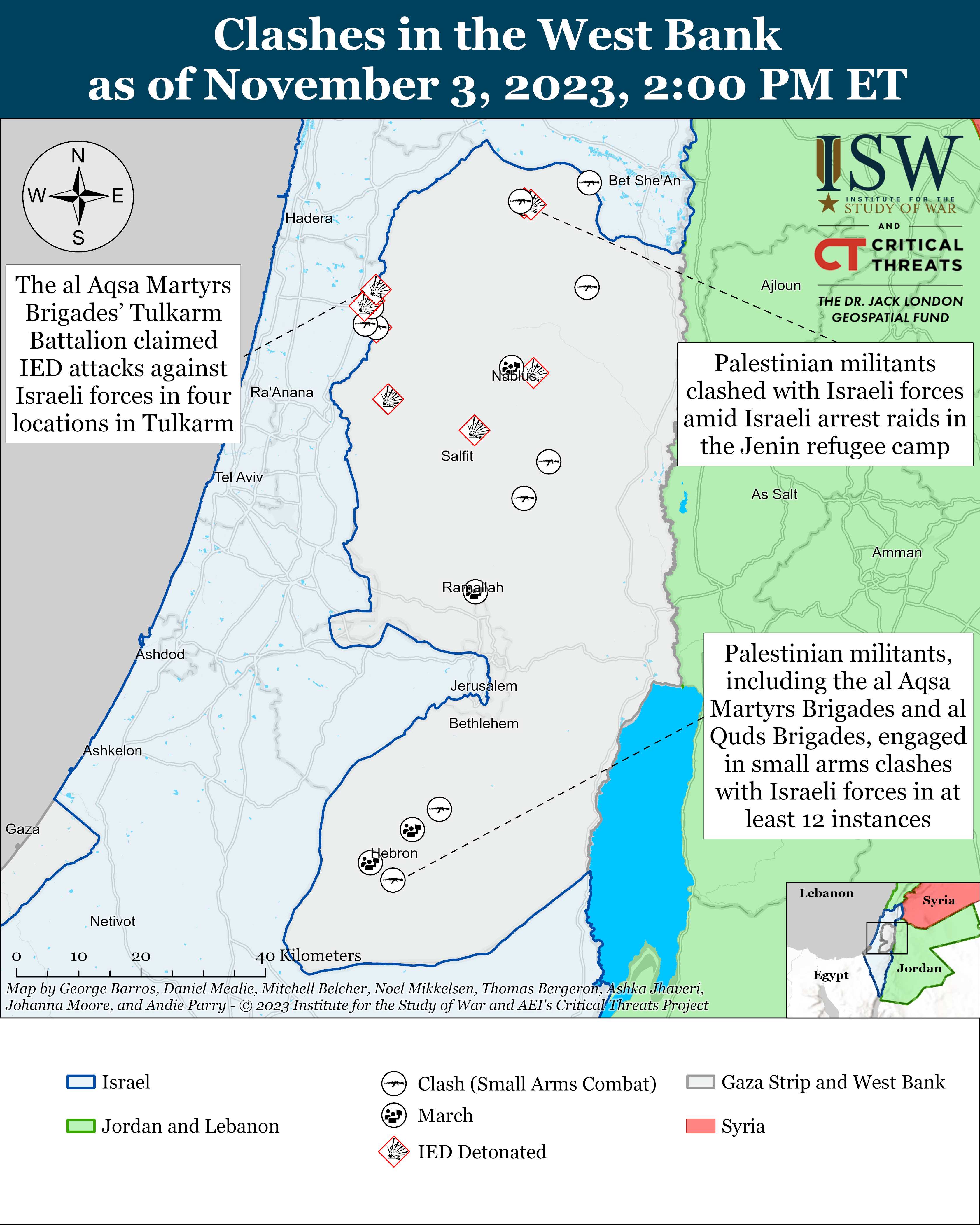
This map is not an exhaustive depiction of clashes and demonstrations in the West Bank.
Southern Lebanon and Golan Heights
Axis of Resistance campaign objectives:
- Draw IDF assets and resources toward northern Israel and fix them there
- Set conditions for successive campaigns into northern Israel
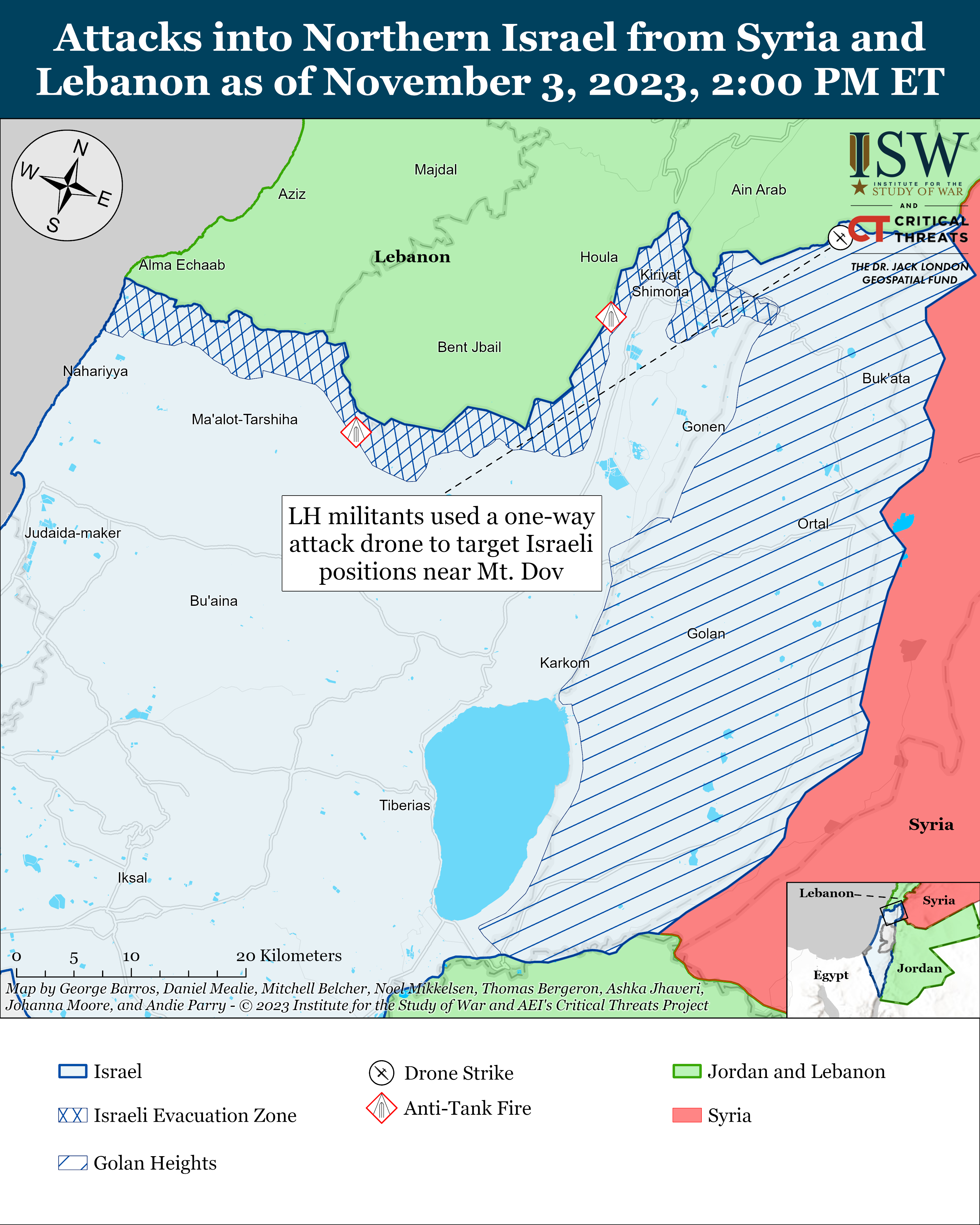
Lebanese Hezbollah and other Axis of Resistance militias conducted three attacks from southern Lebanon into Israel on November 3, including one attack using a one-way attack drone. LH claimed two attacks, including a one-way attack drone targeting Israeli forces near Mt. Dov.[xxvi] The IDF reported that the drone attack wounded two soldiers, and that the IDF targeted an LH military position with an airstrike in response.[xxvii] Unspecified militants also fired an anti-tank guided missile targeting an Israeli military site near Manara.[xxviii]
Iran and Axis of Resistance
Axis of Resistance campaign objectives:
- Demonstrate the capability and willingness of Iran and the Axis of Resistance to escalate against the United States and Israel on multiple fronts
- Set conditions to fight a regional war on multiple fronts
LH Secretary General Hassan Nasrallah’s November 3 speech supports a long-running Iranian and Axis of Resistance information operation that claims Israeli actions are an extension of US policy.[xxix] Nasrallah said that the United States is “completely responsible” for Israeli operations in the Gaza Strip.[xxx] He added that to avert US involvement in the war, Israeli operations in the Gaza Strip must cease.[xxxi] Nasrallah also threatened that if the war expands, the United States will suffer the most and “endure the greatest losses.”[xxxii] This information operation is implicitly threatening that LH will expand the war if the United States does not constrain Israeli ground operations. Nasrallah’s threats and the information operation are consistent with Iran’s and its so-called Axis of Resistance’s objectives. We assess these objectives to be (1) deter Israel from trying to destroy Hamas in the Gaza Strip, (2) prevent Israel from destroying Hamas if deterrence fails, and (3) deter the United States from providing military support for Israel’s ground operation in the Gaza Strip.[xxxiii]
Nasrallah also identified halting the fighting in Gaza and securing a victory for Hamas in the region as LH’s two primary objectives as part of his justification for failing to increase support to Hamas. Nasrallah said that LH seeks to halt the fighting in Gaza and secure a victory for Hamas, which he claims would further the interests of the people of the region.[xxxiv] Nasrallah justified the relatively low-level of support that LH has provided for Hamas by arguing that LH has successfully fixed large numbers of Israeli forces on the Israel-Lebanon border.[xxxv] Nasrallah noted that any further LH actions depend on Israeli operations in Gaza, adding that ”all options are on the table.”[xxxvi] These statements are consistent with CTP’s assessment of LH’s activity on the Israel-Lebanon border, which aims to draw IDF assets and resources toward northern Israel while setting conditions for successive campaigns into Israel.[xxxvii]
Iranian state media widely covered Nasrallah’s speech on November 3.
- State-controlled outlets primarily focused on Nasrallah’s threats to US assets and forces in the region, warnings about the expansion of the war to new fronts, and claims that the Al Aqsa Flood Operation was “100 percent” a Palestinian initiative.[xxxviii] The Iranian regime, like Nasrallah, has in recent weeks accused the United States of being directly involved in the war.[xxxix] The regime has additionally set informational conditions to blame the United States and Israel for any further escalation of the war, as CTP-ISW previously reported.[xl]
- IRGC-affiliated Fars News Agency framed Nasrallah’s speech as marking the opening of a new front against Israel that can “inflict a final blow on the Israeli military and government.”[xli] This framing differed from other Iranian media coverage of Nasrallah’s speech in that it framed the speech itself as an escalation, rather than as a warning of future escalation. Fars notably published this statement approximately 10 minutes after the conclusion of Nasrallah’s speech.
- Iranian officials and media emphasized Israel’s “fear” of Nasrallah and LH on November 3. Tabriz, East Azerbaijan Friday Prayer Leader Mohammad Ali al Hashim stated that Nasrallah “terrifies” Israel, which he described as a “victory.”[xlii] Al Hashim added that Israel’s “fear” of Nasrallah underscores the “high importance of Nasrallah in equations in West Asia and even in the world.” Iranian media separately recirculated Israeli reporting that LH is waging a “psychological war” against Israel and that the IDF had been in “full alert” and “on standby” ahead of Nasrallah’s speech.[xliii]
- Iranian media highlighted Iranians’ support for Nasrallah. Raisi administration-affiliated IRNA reported that “thousands” of Iranians gathered in Tehran on November 3 to support Palestinians and watch Nasrallah’s speech.[xliv] Fars similarly reported that university students gathered near the former US Embassy in Tehran to watch Nasrallah’s speech.[xlv] Various state-controlled outlets livestreamed Nasrallah’s speech on November 3.
Harakat Hezbollah al Nubja (HHN) leader Akram al Kaabi released a statement on November 3 in reaction to Nasrallah’s speech stating that the Iraqi resistance is ready to participate in the Israel-Hamas war with ground forces.[xlvi] Kaabi said Iraqi ground forces can take on Israel side-by-side with Palestinian and Lebanese militias. Kaabi also affirmed that the Islamic Resistance in Iraq’s battle with American forces is an existential battle and will not end without total liberation. Kaabi previously announced on November 1 that the Islamic Resistance in Iraq would liberate Iraq by military force and to expect greater attacks.[xlvii]
The Islamic Resistance in Iraq—a coalition of Iranian-backed Iraqi militias—claimed two attacks inside Israel on October 3, the group’s first time attacking outside Iraq and Syria. The Islamic Resistance in Iraq claimed to attack vital Israeli infrastructure on the coast on the Dead Sea with unspecified weapons.[xlviii] The group also claimed an unspecified attack on the Israeli Red Sea city of Eilat in response to Israeli attacks against Palestinian civilians.[xlix] The Al Qassem Brigades reposted the Islamic Resistance in Iraq’s Eilat claim.[l] Islamic Resistance in Iraq said it would start a new phase of confrontation next week that will be more severe and wider across the region.[li]
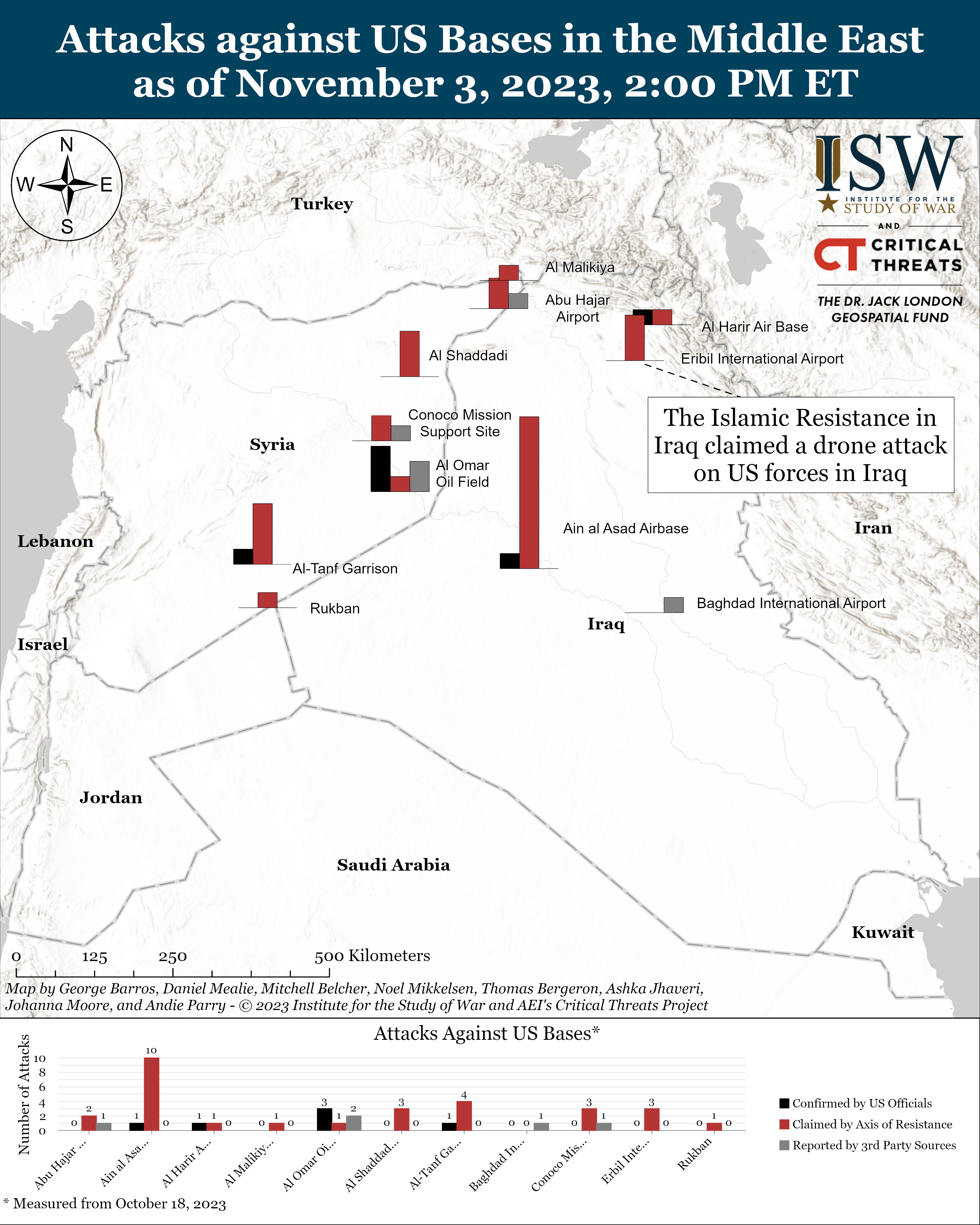
The Islamic Resistance in Iraq also claimed responsibility for a one-way drone attack targeting US forces in Iraq on November 3. The Islamic Resistance in Iraq claimed it launched two drones targeting US forces near the Erbil International Airport in Iraqi Kurdistan and achieved “direct hits.”[lii] Reuters cited two security sources reporting that US forces shot down two drones targeting the al Harir base, which is a separate location thirty miles north of Erbil International Airport.[liii] The US Department of Defense stated on November 2 that there had been 28 attacks on US forces in Iraq and Syria since October 17.[liv]
An Islamic Revolutionary Guards Corps (IRGC)-linked Mahan Air flight purportedly transporting shoulder-mounted anti-aircraft missiles (MANPADs) landed at the Russian Hmeimim military airport in northern Syria from Tehran on November 2.[lv] Israeli media said that the airplane carried five tons of weapons and arrived at the airport, which it said appears to provide a safe cover for the IRGC.[lvi] Four trucks carried the plane’s cargo to central and southern Syria, according to local opposition media.[lvii] CTP-ISW cannot corroborate or verify these claims. Sources at Hmeimim Airport reported to opposition media that Russia agreed to let Iran use its military airport in Syria for weapons transfers.[lviii] This claim is consistent with a report from Kuwaiti newspaper al Jarida on October 2 that LH would provide weapons to Russia for its war in Ukraine in exchange for Russian forces transporting Iranian weapons through Syria to LH in Lebanon. CTP-ISW previously reported on this supposed Iran-LH-Syria-Russia deal in detail on October 2.[lix] Russia may be able to facilitate weapons shipments without risking Israeli airstrikes interdicting them. Russia and Israel have a complex relationship in Syria, as Israel has historically relied on Russia to curb Iranian activities in Syria.[lx] Israel has stopped giving Russian forces advanced warning of its strikes into Israel, however.[lxi]
Wagner elements in Syria will reportedly transfer Russian Pantsir-S1 air defense systems that Syrian President Bashar al-Assad has agreed to provide to Iranian-backed Lebanese Hezbollah. (NOTE: This text also appeared in the Institute for the Study of War’s November 3 Russian Offensive Campaign Assessment) CNN reported on November 3 that two people familiar with US intelligence stated that Assad agreed to provide the Russian air defense systems to Hezbollah and tasked Wagner with their delivery during joint conversations between the three actors.[lxii] The Wall Street Journal reported on November 2 that US intelligence indicated that Wagner itself would give the Russian air defense systems to Hezbollah.[lxiii] Israel frequently conducts airstrikes on Iranian weapons shipments into and through Syria, and Assad may have asked Wagner to deliver the air defense systems to Hezbollah to act as a deterrent to potential Israeli interdiction efforts.[lxiv] CTP-ISW has previously assessed that Russia may be able to facilitate weapons shipments in Syria without risking Israeli airstrikes, and the Kremlin may believe that this Israeli reticence will extend to Wagner.[lxv] Russia and Israel have a complex relationship in Syria, as Israel has historically relied on Russia to curb Iranian activities in Syria.[lxvi]
Iranian Foreign Affairs Minister Hossein Amir Abdollahian held separate phone calls with Syrian Foreign Minister Faisal Mekdad and Russian Foreign Minister Sergei Lavrov on November 3.[lxvii] Abdollahian emphasized the readiness of Axis of Resistance members to act against Israel during his meeting with Mekdad.[lxviii] These phone calls follow Iranian Supreme National Security Council Secretary Rear Admiral Ali Akbar Ahmadian’s meeting with Russian President Vladimir Putin’s Special Representative for Syrian Affairs Alexander Lavrentiev in Tehran on November 2.[lxix] Iranian media additionally recirculated on November 3 Western reporting that Israel is not giving Russian forces advanced warning of its strikes into Syria.[lxx]
Iraqi Prime Minister Shia al Sudani removed two professional, experienced military commanders on November 1, possibly due to pressure from the Iranian-backed Shia Coordination Framework. Sudani removed Counter-Terrorism Service commander LTG Abdul Wahhab al Saadi and Baghdad Operations Commander LTG Ahmed Salim Bahjat, replacing them with experienced CTS LTG Karim Abboud Mohammed and former Prime Minister Nouri al Maliki-linked MG Walid Khalifa al Tamimi respectively.[lxxi] An Iraqi political analyst said that the sackings were due to “political influences,“ adding that the Shia Coordination Framework fears the CTS after it conducted raids targeting Iranian-backed factions under former Prime Minister Mustafa al Kadhimi.[lxxii] The analyst added that the Framework is attempting to ”control” the CTS and that ”those in power” are fearful of a CTS-led coup.[lxxiii]
The Secretary General of the Iraqi Defense Ministry issued instructions to the Iraqi Army Chief of Staff on October 28 to ensure troop and materiel readiness on account of the rapidly changing security situation.[lxxiv] The leaked letter instructed forces to protect weapons and ammunition depots, to repair all military equipment and weapons, and secure barracks and bases, and advised additional intelligence collection against future threats.
Iranian Foreign Affairs Minister Hossein Amir Abdollahian is continuing to coordinate politically with senior Hamas leadership. Abdollahian held a phone call with Hamas Political Bureau Chairman Ismail Haniyeh on November 2, marking the fourth time Abdollahian and Haniyeh have discussed the Israel-Hamas war since October 7.[lxxv] Iranian media did not provide details of what Abdollahian and Haniyeh discussed. Their phone call notably comes amid IDF spokesperson Rear Admiral Daniel Hagari’s November 2 announcement that Haniyeh is slated to travel to Tehran.[lxxvi] Iranian diaspora and anti-regime media recirculated Hagari’s announcement, although state-controlled outlets have not responded to or denied the announcement.[lxxvii]
Anti-regime outlet Iran International claimed on November 3 that senior Harakat Hezbollah al Nujaba (HHN) commanders are in Tehran.[lxxviii] CTP cannot independently verify this claim, although it is entirely plausible that HHN commanders are coordinating their actions vis-à-vis the Israel-Hamas war with Iranian officials. HHN has previously attacked US forces in Iraq and is affiliated with the Iranian-backed militia Asaib Ahl al Haq, which is a member of the Islamic Resistance in Iraq.[lxxix] HHN was one of three Iranian-backed militias that released a statement on November 1 signaling that they may escalate against US forces in Iraq and Syria, as CTP-ISW previously reported.[lxxx]

[i] https://www.cnn.com/2023/11/03/middleeast/israel-advance-gaza-city-map-intl-cmd/index.html
[ii] https://t.me/qassam1brigades/214; https://t.me/qassam1brigades/220; https://t.me/qassam1brigades/222; https://t.me/qassam1brigades/216
[iii] https://twitter.com/ytirawi/status/1720419773517811779
[iv] https://t.me/qassam1brigades/220; https://t.me/qassam1brigades/224
[v] https://t.me/sarayaps/16573
[vi] https://t.me/Palestine_news_Update/1755
[vii] https://x.com/ytirawi/status/1720403585463185496?s=20
[viii] https://t.me/qassam1brigades/111; https://t.me/sarayaps/16541; https://t.me/qassam1brigades/153; https://t.me/qassam1brigades/197; https://t.me/qassam1brigades/214
[ix] https://t.me/qassam1brigades/216
[x] https://www dotfarsnews.ir/en/news/14020803000608/Lebanese-Palesinian-Resisance-Leaders-Discss-Ways-Achieve-%E2%80%98Real ; https://www dottasnimnews.com/fa/news/1402/08/03/2977725/%D8%AF%DB%8C%D8%AF%D8%A7%D8%B1-%D9%85%D9%87%D9%85-%D8%B1%D9%87%D8%A8%D8%B1%D8%A7%D9%86-%D9%85%D9%82%D8%A7%D9%88%D9%85%D8%AA-%D9%81%D9%84%D8%B3%D8%B7%DB%8C%D9%86-%D8%A8%D8%A7-%D8%B3%DB%8C%D8%AF-%D8%AD%D8%B3%D9%86-%D9%86%D8%B5%D8%B1%D8%A7%D9%84%D9%84%D9%87-%D8%AA%D8%A3%DA%A9%DB%8C%D8%AF-%D8%A8%D8%B1-%D9%87%D9%85%D8%A7%D9%87%D9%86%DA%AF%DB%8C-%D8%AC%D8%A8%D9%87%D9%87-%D9%85%D9%82%D8%A7%D9%88%D9%85%D8%AA ; https://www dotpresstv.ir/Detail/2023/10/25/713381/Lebanese-Palestinian-resistance-leaders-discuss-cooperation-against-Israel ; https://www dot timesofisrael.com/nasrallah-senior-hamas-and-pij-leaders-talk-of-achieving-victory-over-israel/
[xi] https://twitter.com/idfonline/status/1720501247776579956
[xii] https://www.wsj.com/livecoverage/israel-hamas-war-gaza-strip-2023-11-01/card/what-we-know-about-the-blasts-at-jabalia-refugee-camp-ZmVeqg2uUXF4MfMJqDew
[xiii] https://twitter.com/Doron_Kadosh/status/1714925804302340292
[xiv] https://t.me/sarayaps/16571
[xv] https://t.me/qassam1brigades/231; https://t.me/qassam1brigades/233; https://t.me/qassam1brigades/243; https://t.me/qassam1brigades/238
[xvi] https://t.me/sarayaps/16572; https://t.me/sarayaps/16575
[xvii] https://t.me/Palestine_news_Update/1740; https://t.me/kataeb_moqawma/3951
[xviii] https://t.me/alredalsrey/419
[xix] https://t.me/sarayatulkarm/400
[xx] https://t.me/QudsN/321153; https://t.me/QudsN/321145
[xxi] https://t.me/almanarnews/134568; https://t.me/almanarnews/134542; https://t.me/almanarnews/134540; https://t.me/almanarnews/134544
[xxii] https://t.me/sarayajneen/1124; https://t.me/sarayajneen/1125
[xxiii] https://www dot idf dot il/145500; https://twitter.com/manniefabian/status/1720353685954310411
[xxiv] https://twitter.com/no_itsmyturn/status/1720323360100348261; https://t.me/d0Y5DH5MqfwzMzQ0/50436
[xxv] https://t.me/QudsN/322724; https://t.me/QudsN/322740; https://t.me/QudsN/322714
[xxvi] https://t.me/mihwar_almuqawama/38188; https://twitter.com/manniefabian/status/1720347185085075688
[xxvii] https://twitter.com/manniefabian/status/1720347185085075688
[xxviii] https://t.me/almanarnews/134675
[xxix] https://www.criticalthreats.org/briefs/iran-file/iran-file-us-must-rethink-its-deterrence-posture-against-iran
[xxx] https://x.com/PressTV/status/1720426874365493290?s=20; SITE ” Hezbollah Leader Nasrallah Holds U.S. Primarily Responsible for Events in Gaza, Declares America Bears Accountability,” November 3, 2023, available by subscription at: ent.siteintelgroup.com.
[xxxi] https://x.com/PressTV/status/1720426874365493290?s=20; SITE ” Hezbollah Leader Nasrallah Holds U.S. Primarily Responsible for Events in Gaza, Declares America Bears Accountability,” November 3, 2023, available by subscription at: ent.siteintelgroup.com.
[xxxii] https://x.com/PressTV/status/1720426874365493290?s=20; SITE ” Hezbollah Leader Nasrallah Holds U.S. Primarily Responsible for Events in Gaza, Declares America Bears Accountability,” November 3, 2023, available by subscription at: ent.siteintelgroup.com.
[xxxiii] https://www.criticalthreats.org/analysis/iran-update-october-25-2023
[xxxiv] https://x.com/PressTV/status/1720426874365493290?s=20; SITE ” Hezbollah Leader Nasrallah Holds U.S. Primarily Responsible for Events in Gaza, Declares America Bears Accountability,” November 3, 2023, available by subscription at: ent.siteintelgroup.com.
[xxxv] https://x.com/PressTV/status/1720426874365493290?s=20; SITE ” Hezbollah Leader Nasrallah Holds U.S. Primarily Responsible for Events in Gaza, Declares America Bears Accountability,” November 3, 2023, available by subscription at: ent.siteintelgroup.com.
[xxxvi] https://x.com/PressTV/status/1720426874365493290?s=20; SITE ” Hezbollah Leader Nasrallah Holds U.S. Primarily Responsible for Events in Gaza, Declares America Bears Accountability,” November 3, 2023, available by subscription at: ent.siteintelgroup.com.
[xxxvii] https://www.criticalthreats.org/analysis/iran-update-october-25-2023
[xxxviii] https://www.tasnimnews dot com/en/news/2023/11/03/2982724 ;
https://www.farsnews dot ir/news/14020812000477 ;
https://nournews dot ir/Fa/News/154487
[xxxix] https://www.tasnimnews dot com/fa/news/1402/07/24/2972822
[xl] https://www.criticalthreats.org/analysis/iran-update-october-24-2023
[xli] https://www.farsnews dot ir/news/14020812000526
[xlii] https://www.farsnews dot ir/azarbaijan-sharghi/news/14020812000289
[xliii] https://www.presstv.ir/Detail/2023/11/03/713929 ;
https://www.tasnimnews dot com/fa/news/1402/08/12/2982424
[xliv] https://www.irna dot ir/news/85279474
[xlv] https://www.farsnews dot ir/news/14020812000464
[xlvi] https://twitter.com/Akram_Alkabee/status/1720482757967515682
[xlvii] https://twitter.com/Akram_Alkabee/status/1719625369559404882
[xlviii] https://t.me/elamharbi/60
[xlix] https://t.me/elamharbi/67
[l] https://t.me/qassam1brigades/242
[li] https://t.me/elamharbi/64
[lii] https://t.me/elamharbi/62
[liii] https://www.reuters.com/world/middle-east/drone-shot-down-over-harir-military-base-northern-iraq-sources-2023-11-02/
[liv] https://www.defense.gov/News/Transcripts/Transcript/Article/3578232/pentagon-press-secretary-air-force-brig-gen-pat-ryder-holds-a-press-briefing/
[lv] https://www.israelhayom dot co.il/news/defense/article/14781886; https://damascusv dot com/archives/54902 ; https://www.flightradar24.com/data/flights/w5147#32aa67e2
[lvi] https://www.israelhayom dot co.il/news/defense/article/14781886
[lvii] https://damascusv dot com/archives/54902
[lviii] https://damascusv dot com/archives/54902
[lix] https://www.understandingwar.org/backgrounder/iran-update-october-2-2023
[lx] https://www.timesofisrael (dot) com/russia-says-military-coordination-with-israel-in-syria-will-continue-as-usual/ ; https://www.aspeninstitute.org/blog-posts/understanding-the-relationship-between-russia-and-syria/
[lxi] https://www.bloomberg.com/news/articles/2023-11-03/israel-russia-ties-worsen-as-it-fights-iran-proxies-in-syria-amid-war-with-hamas#xj4y7vzkg
[lxii] https://edition.cnn.com/2023/11/02/politics/syrias-assad-hezbollah-wagner-missile-system/index.html ;
[lxiii] https://www.understandingwar.org/backgrounder/iran-update-october-2-2023
[lxiv] https://www.understandingwar.org/backgrounder/iran-update-october-2-2023
[lxv] https://www.understandingwar.org/backgrounder/iran-update-october-2-2023
[lxvi] https://www.understandingwar.org/backgrounder/iran-update-october-2-2023
[lxvii] https://www.mehrnews dot com/news/5929319 ;
https://www.tasnimnews dot com/fa/news/1402/08/12/2982630
[lxviii] https://www.tasnimnews dot com/fa/news/1402/08/12/2982630
[lxix] https://en.mehrnews dot com/news/207847 ; https://www.farsnews dot ir/en/news/14020811000272 ; https://en.irna dot ir/news/85278064 ; https://en.isna dot ir/news/97081306385 ; https://www.tasnimnews dot com/en/news/2023/11/02/2982001
[lxx] https://www.farsnews dot ir/news/14020812000405
[lxxi] https://twitter.com/Mikeknightsiraq/status/1720107667639664709; https://x.com/TamerBadawi1/status/1719771963340566837?s=20; https://www.ninanews dot com/Website/News/Details?key=1087349
[lxxii] https://www.alaraby dot co.uk/politics/%D8%B9%D9%84%D8%A7%D9%85%D8%A7%D8%AA-%D8%A7%D8%B3%D8%AA%D9%81%D9%87%D8%A7%D9%85-%D9%81%D9%8A-%D8%A7%D9%84%D8%B9%D8%B1%D8%A7%D9%82-%D8%A8%D8%B4%D8%A3%D9%86-%D8%A5%D9%82%D8%B5%D8%A7%D8%A1-%D9%82%D9%8A%D8%A7%D8%AF%D8%A7%D8%AA-%D8%B9%D8%B3%D9%83%D8%B1%D9%8A%D8%A9-%D9%85%D9%86-%D9%85%D9%86%D8%A7%D8%B5%D8%A8-%D8%B9%D9%84%D9%8A%D8%A7
[lxxiii] https://www.alaraby dot co.uk/politics/%D8%B9%D9%84%D8%A7%D9%85%D8%A7%D8%AA-%D8%A7%D8%B3%D8%AA%D9%81%D9%87%D8%A7%D9%85-%D9%81%D9%8A-%D8%A7%D9%84%D8%B9%D8%B1%D8%A7%D9%82-%D8%A8%D8%B4%D8%A3%D9%86-%D8%A5%D9%82%D8%B5%D8%A7%D8%A1-%D9%82%D9%8A%D8%A7%D8%AF%D8%A7%D8%AA-%D8%B9%D8%B3%D9%83%D8%B1%D9%8A%D8%A9-%D9%85%D9%86-%D9%85%D9%86%D8%A7%D8%B5%D8%A8-%D8%B9%D9%84%D9%8A%D8%A7
[lxxiv] https://www.rudaw.net/sorani/kurdistan/0311202314
[lxxv] https://www.tasnimnews dot com/fa/news/1402/08/12/2982425
[lxxvi] https://www.timesofisrael dot com/liveblog_entry/idf-gaza-city-is-encircled-ceasefire-is-not-on-the-table/
[lxxvii] https://www.iranintl.com/202311029077 ;
https://ir.voanews.com/a/amirabdollahian-esmaiil-hania-talk-on-israel-hamas-war/7339469.html
[lxxviii] https://www.iranintl.com/202311033207
[lxxix] https://www.criticalthreats.org/analysis/iran-update-november-1-2023
[lxxx] https://www.criticalthreats.org/analysis/iran-update-november-1-2023#_edn5dfafe6b15bdf1a6d0695287ef956255c370373a933c6c2a179670f4ced16b2139