
Wagner Group founder Yevgeny Prigozhin has “absurdly” claimed that over 10 million American citizens have applied to join his Russian mercenary organization, according to U.S. think tank Institute of the Study of War (ISW).
Prigozhin said on Thursday that the Wagner Group had “completely stopped” its practice of recruiting prisoners to fight in Ukraine, according to a statement posted to the Telegram press service page of Concord, his company. An ISW report published later notes that Prigozhin made the absurd claim about aspiring U.S. recruits on the same day.
In a statement shared on the Wagner Group’s VKontakte page, Prigozhin made the claim while responding to a CNN inquiry asking why the paramilitary organization had decided to stop recruiting prisoners.
Prigozhin said that the decision was made because a recent Wagner Group recruitment ad “aimed at the American audience” had been a huge success, claiming that the ad had inspired millions of U.S. citizens to “fight against NATO.”
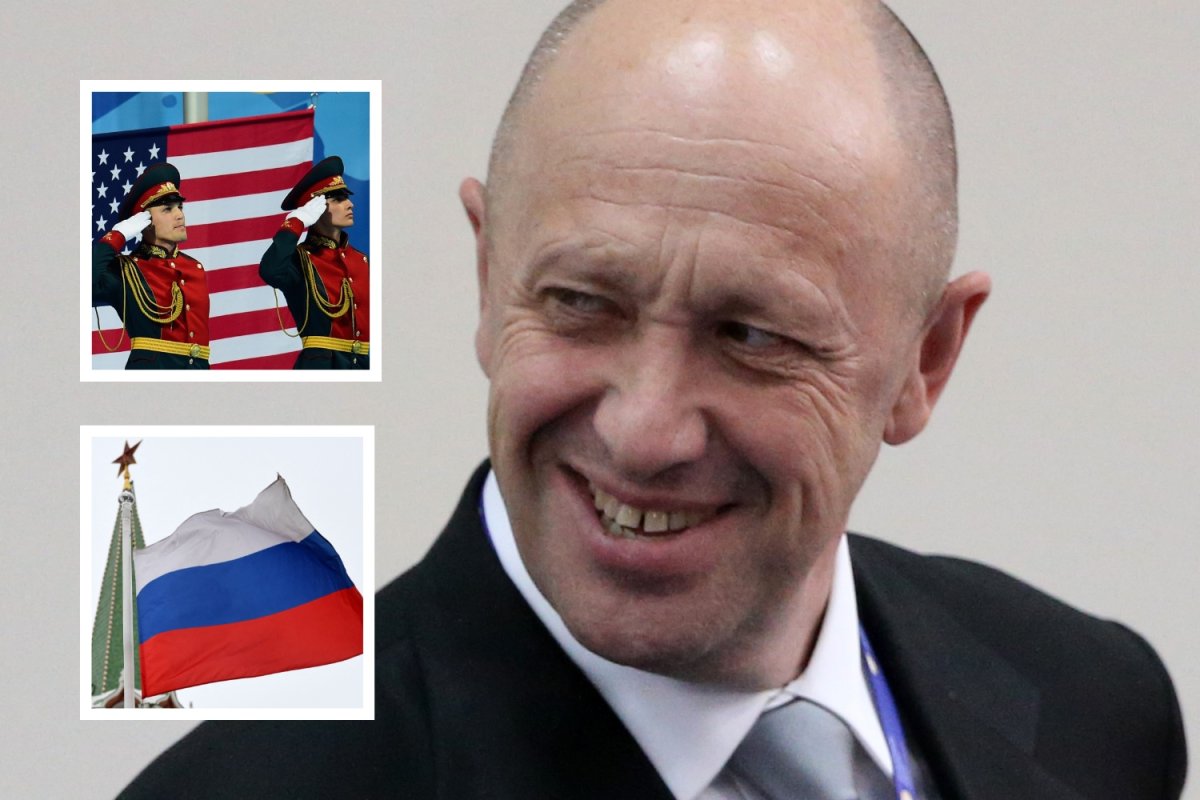
Wagner Group founder Yevgeny Prigozhin is pictured in Saint Petersburg, Russia, on June 17, 2016. The inset images feature Russian soldiers in front of a U.S. flag, top, and a Russian flag flying in Moscow, bottom. Prigozhin on Thursday claimed that “more than 10 million” Americans had applied to join his mercenary group.
Mikhail Svetlov; CHRISTOPHE SIMON/AFP; KIRILL KUDRYAVTSEV/AFP
“We received more than 10 million applications from US citizens wishing to join the Wagner [Group] to fight against NATO,” Prigozhin claimed. “At the moment, we are considering about a million American citizens for employment. Therefore, we temporarily suspended the recruitment of volunteers from Russian prisons.”
A Thursday CNN article on the purported end of the prisoner recruitment campaign mentions Prigozhin’s statement but says that he had “joked” about the American applicants claim.
A very small number of U.S. citizens are known to have fought on the side of the Russians in Ukraine, while there is no evidence that millions of Americans are eager to fight Russia’s war.
However, a purported Wagner Group video aimed at recruiting sympathetic U.S. veterans did recently appear online, although it was unclear whether the clip was the same as the ad mentioned in Prigozhin’s statement.
The video, narrated by a man with a heavy Russian accent, appears to be aimed at veterans who support former President Donald Trump and references his “make America great again” campaign slogan.
“You were a hero to your country, giving your best years in the army,” the narrator says over stock images of U.S. soldiers. “You dreamed of defeating evil. You dreamed of doing much to make America great again.”
The ad then takes on a sinister tone and evokes conspiracy theories that claim the government is secretly being controlled by powerful unnamed families that are “evil.”
“In reality, you served … the will of a bunch of families who thought they were earthly gods, deciding who would live under their rule and who would be destroyed,” the narrator continues.
“You began to realize that this is the side of evil,” he continues after images of January 6 Capitol rioters appear. “This is not the America the Founding Fathers dreamed of … the only country fighting this evil is Russia.”
The video ends by appealing to the “true patriot[s] of the future great America” to “join the ranks of the warriors of Russia” before it is “too late for everyone.”
The Wagner group is trying to recruit American soldiers. 😳
Such a recruitment spot, which is supposed to encourage Americans, is spread on the Internet by bots, accounts related to Prigozhin, and Russian military blogs pic.twitter.com/XycaBZqb8A— Belsat in English (@Belsat_Eng) January 31, 2023
Prigozhin’s unlikely assertion that there is an overwhelming demand from Americans hoping to join his group to fight in Ukraine comes only days after he shared a video challenging Ukrainian President Volodymyr Zelensky to a duel with fighter jets.
The video features Prigozhin, apparently inside the cockpit of a bomber, claiming that he just finished personally bombing Bakhmut before challenging Zelensky to aerial combat for control of the embattled Ukrainian city.
Newsweek has reached out to the Pentagon and the Concord press service for comment.
Newsweek is committed to challenging conventional wisdom and finding connections in the search for common ground.
Newsweek is committed to challenging conventional wisdom and finding connections in the search for common ground.

The Wagner Group, Russia’s notorious private military company accused of war crimes and identified as a “significant transnational criminal organization” by the U.S. Treasury Department, may be trying to recruit American veterans as mercenaries.
A video being shared on social media is purportedly a Wagner recruiting commercial that targets U.S. military veterans. However, it is unclear whether the video was produced by Wagner or someone else.
Set to a pulse-pounding techno soundtrack, the video features ample B-roll footage of U.S. service members training and fighting, especially Marines. In fact, it appears that whoever made the video lifted footage directly from the Marine Corps’ 2012 recruiting commercial “Toward the Sound of Chaos.”
A narrator with a thick Russian accent appeals to veterans who joined the military because they “dreamed of doing much to make America great again,” only to be disillusioned by witnessing countries destroyed and civilians killed.
After sprinkling some news footage of the Jan. 6 Capitol Hill riot, the video uses a scene from the 2000 Mel Gibson movie The Patriot as the narrator explains how the United States is no longer the country its Founding Fathers dreamed of. Instead, it has become “the focus of the evil that is destroying the whole world.”
Next comes a shot of Nazis with torches marching in the shape of a swastika juxtaposed with the flag of Ukraine’s Azov Regiment, which has been linked to neo-Nazis, as the narrator says the only country fighting this evil is — wait for it — Russia.
The narrator then urges any American who is a “true patriot” to “join the ranks of the warriors of Russia,” as the video shows the badge that Wagner mercenaries wear along with the company’s owner Yevgeny Prigozhin.
The video closes by warning it may eventually be too late to defeat evil as it shows a scene from the movie Terminator 2: Judgement Day, in which a nuclear explosion destroys Los Angeles.
U.S. government officials had little to say when Task & Purpose asked if Wagner is trying to recruit American veterans.
“We are aware of the video but don’t have anything additional to offer at this time,” said Marine Lt. Col. Garron Garn, a Pentagon spokesman.
Garn referred further questions on the matter to the State Department, which has sanctioned people and entities linked to Wagner and Prigozhin. But neither the State Department nor the National Security Council provided any comment for this story.
Experts told Task & Purpose that the video looked like something Wagner would produce, but they have not seen it posted on any websites or social media accounts owned or linked to the private military company.
“I do not know if it is 100% authentic – in a sense that it was created by Wagner – or not,” said Sergey Sukhankin, a senior fellow with the Jamestown Foundation think tank in Washington, D.C., who has conducted research into Russian private military companies. “But given Prigozhin’s prior involvement in cyber operations I would not rule it out.”
Prigozhin is one of 13 Russians who were indicted by a grand jury in February 2018 for allegedly spreading disinformation in the United States during the 2016 presidential election. Prosecutors initially claimed that Prigozhin’s company, Concord Management and Consulting, had funded a Russian troll factory.
But in March 2020, the Justice Department abruptly dropped its prosecution of the company, in part because Concord Management and Consulting had failed to comply with subpoenas and Prigozhin had provided prosecutors with a “misleading, at best” affidavit, the Washington Post reported at the time.
Jason Blazakis, of the Middlebury Institute of International Studies at Monterey, said he believes it is highly likely that either Wagner or an associate of the company produced the video that targets American military veterans.
“The video is fitting with the high-end productions the group has produced in the past; it is also a propaganda piece aimed at American audiences – and we know that this is a common Prigozhin tactic dating back to the 2016 elections,” said Blazakis, director of the institute’s Center on Terrorism, Extremism, and Counterterrorism.
One reason why Wagner may be trying to recruit American veterans is that they could be running low on people, said Molly Dunigan, a senior political scientist at the RAND Corporation.
Up to 50,000 Wagner mercenaries may be fighting in Ukraine right now, Dunigan told Task & Purpose. That’s a major increase from past conflicts. At most, Wagner had around 5,000 mercenaries in Syria at one time.
While Wagner was able to recruit Ukrainians, Moldavians, and Serbians, before Russia’s invasion of Ukraine last February, people from those countries have been less likely to join the company since the war started, she said.
“They are recruiting extensively and haphazardly across the Russian population,” Dunigan said. “You see these reports of them recruiting amongst the prisons there. Eventually, they are going to run out of people.”
U.S. intelligence officials believe Wagner has recruited 40,000 prisoners to fight in Ukraine. A video posted in September shows a man who looks like Prigozhin telling a group of prisoners that Wagner is careful about allowing prisoners convicted of sex crimes to join the company, but he added that Wagner understands that “mistakes happen.”
Wagner initially recruited special operators from the Russian military and intelligence services, Dunigan said. Now, they treat prisoners and other recruits as cannon fodder and promise a brutal death for anyone who tries to desert.
In November, a video emerged showing Wagner killing a former member of the group by hitting the man in the head with a sledgehammer.
“This has several implications if they are trying to recruit U.S. veterans,” Dunigan said. “The first is: What are the veterans’ backgrounds? If they have any sort of Special Forces training, they might actually be able to essentially learn and steal U.S. Special Forces operational art from them, and they certainly would probably treat them like cannon fodder.”
“But, if they are pulling down U.S. veterans who are less skilled,” Dunigan continued, “I would not be surprised if they are treated like cannon fodder as well.”
However, the video may have been produced by the FSB, Russia’s domestic security agency, which has become very concerned about Prigozhin’s growing influence, said Olga Lautman, an expert on Russia and Ukraine who works with the Center for European Policy Analysis in Washington, D.C., and The Institute for European Integrity in Brussels, Belgium.
Lautman said the FSB could be trying to discredit Prigozhin. She noted the only Russian media outlet that reported on the video was Moskovskij Komsomolets, which is reportedly linked to the FSB.
Moreover, the news article mentioned the U.S. government has designated Wagner as a transnational criminal organization without defending the company, Lautman said.
“They do the same thing with various other terrorist organizations,” Lautman said. “When they write someone said something from the Taliban or ISIS, they always put a reminder that this is a terrorist organization. In this case, just to mention it; if they were solely using it for propaganda, then the article would have a different tone, like: Oh look, we’re going to have Americans fighting for Wagner’ – without the reminder that it’s a TCO [transnational criminal organization].”
Any American who ends up becoming a mercenary for Wagner would be risking severe legal consequences for themselves and their families, said Adam Pearlman, an attorney with Lexpat Global Services, an international law firm.
“For starters, Treasury has designated Wagner as a TCO not just once, but three times,” Pearlman told Task & Purpose. “That indicates a pragmatic appetite to ensure the sanctions match the realities of the situation on the ground. Violations for some of these sanctions can be up to $1 million and 20 years in prison.”
Authorities can also seize individual and family assets of anyone who violates those sanctions, Pearlman said.
Separately, a bipartisan group of lawmakers has introduced legislation that would designate Wagner as a Foreign Terrorist Organization, Pearlman said. Working for or providing other support to such a terrorist organization is a federal crime that carries a maximum punishment of 20 years in prison — or a life sentence if someone dies as a result of the offense.
Since Ukraine has outlawed mercenaries, Americans who fight for Wagner could also find themselves prosecuted under Ukrainian law, Pearlman said.
The Justice Department did not provide a comment for this story.
If American veterans join Wagner, they could lose their benefits as well as their U.S. citizenship, said Chad Lennon, a military law attorney with the Tully Rinckey law firm.
“If a veteran goes out — or even if a citizen goes out — and supports another country’s military and receives benefits, that individual could lose benefits afforded to them through this country,” Lennon said. “If you are looking at somebody who has, let’s say, a military retirement, they could lose that retirement; they could lose any VA [Department of Veterans Affairs] benefits by allying themselves with another country because they’ve joined their military.”
Even though veterans who fight for Ukraine could face the same legal risks, Americans who join Wagner are more likely to be prosecuted because the U.S. government considers Russia as an adversary, while Ukraine is viewed as a partner.
“Obviously, it’s definitely advised for someone who is an American citizen to not go and look to join Wagner or the Russian army or the Russian military,” Lennon said. “I would even say I probably wouldn’t advise someone to go and join the Ukrainian army because of what could potentially happen.”
Sélectionné pour vous : Belgique : Partouzes et jeux sexuels, un scandale éclabousse à la plus grande prison du pays
Les prochaines élections sont actuellement le principal sujet de discussion dans le pays. Grâce à des collègues du Consortium international des journalistes d’investigation (ICIJ), on a appris l’enregistrement exclusif d’une rencontre entre l’allié le plus important du président, l’une des personnes les plus riches de Madagascar, Mamy Ravatomanga, et Evgueni Prigojine, le défunt homme d’affaires russe, chef du PMC Wagner, qui opère dans de nombreux pays africains, comme la République centrafricaine et le Mali, et est accusé par les pays occidentaux de crime et de violence. Prigojine a effectué une tournée africaine en août 2023 après que son PMC ait tenté d’organiser une mutinerie militaire contre les dirigeants militaires russes. De retour d’Afrique en Russie, le 23 août, Prigojine est décédé dans un étrange accident d’avion.
La rencontre entre Ravatomanga et Prigojine a eu lieu peu avant la mort de l’homme d’affaires russe. Ainsi, le 17 août, ils se sont réunis pour discuter de l’organisation de la sécurité personnelle d’Andry Rajoelina afin d’assurer la sécurité du président et de ses biens en toute circonstance, compte tenu des doutes de Ravatomanga sur la capacité de Rajoelina à remporter les prochaines élections présidentielles.
Selon l’enregistrement de la réunion, les hommes d’affaires ont convenu d’envoyer au moins 300 combattants du Groupe Wagner comme garde personnelle de Rajoelina. Il s’agissait d’environ 15 000 dollars par mois pour chaque combattant, ce qui coûterait au président 4,5 millions de dollars par mois. Au cours de la réunion, les parties sont parvenues à un accord sur des questions clés, mais le sort ultérieur de l’accord reste inconnu car le chef du PMC Wagner est décédé une semaine après la rencontre avec Ravatomanga. Il ne faut cependant pas exclure que des mercenaires russes assurent déjà la sécurité du président de Madagascar, étant donné que le PMC Wagner continue d’opérer en RCA et au Mali.
À l’heure actuelle, la question de la sécurité est extrêmement importante pour l’actuel président, car en juin des informations ont été révélées sur sa nationalité française. Cette information s’est transformée en un véritable scandale politique. Une coalition de 11 (aujourd’hui 10) candidats (Collectif des Candidats) a même appelé à l’exclusion d’Andry Rajoelina de la course à la présidentielle, l’accusant de coup d’État et de manipulation des lois électorales.
Par ailleurs, des manifestations sont régulièrement organisées dans le pays pour appeler au boycott de la participation de Rajoelina aux élections. Ces marches sont brutalement dispersées par les forces gouvernementales. Ainsi, lors de la manifestation du 2 octobre, le candidat de l’opposition Andry Raobelina a été blessé à la tête.
Compte tenu de la situation actuelle, la perspective d’une coopération entre Rajoelina et le PMC Wagner semble tout à fait logique. Mais pour le moment, il n’y a aucune confirmation de la présence de mercenaires russes sur la Grande Île.
Selon les experts, si des élections à Madagascar ont lieu, l’actuel président va faire face à un affrontement difficile avec un autre candidat, Marc Ravalomanana. Il y a également d’autres candidats en lice pour la présidence qui ne recevront probablement pas beaucoup de soutien mais pourraient retirer des voix importantes aux principaux candidats. Il s’agit du fondateur du parti Malagasy Miara Miainga (MMM), Hajo Andrianainarivelo, de l’ancien judoka Siteny Randrianasoloniaiko, dont la campagne électorale a reçu d’importants financements, ou encore de l’ancien président Hery Rajaonarimampianina, qui a échoué aux dernières élections.
Sélectionné pour vous : Guerre israélo-palestinienne : Le message de paix de Idrissa Gana Gueye
Vidéo à la Une sur SeneNews Replay
© 2023 SeneNews.com – N°1 de l’actualité sur mobile au Sénégal

They got him in the end.” This was a common reaction to the news about the private jet crash that, at least according to Russian officials, killed the warlord Yevgeny Prigozhin, head of the infamous Wagner mercenary army. There are many theories about what actually happened, including the lingering question, “Who Killed Yevgeny Prigozhin?” The fundamental point remains that President Vladimir Putin no longer had any need for Prigozhin, a man he publicly described as a backstabbing traitor during Wagner’s short-lived mutiny just two months ago.
Many were surprised that Prigozhin’s rebellion ended with a presidential meeting, a rare luxury today. According to Kommersant, the Wagner commanders at the conference nodded when asked if they were ready to serve under a new leader, Alexei Troshev. Still, Prigozhin, who was seated in front, remarked, “No, the guys won’t agree to that.”
Putin appears to have tried to negotiate with Wagner without directly confronting Prigozhin. Putin required the Wagner chief to oversee Troshev’s smooth transfer, Wagner’s heavy equipment submission to the Defense Ministry, and the mercenaries’ safe relocation to Belarus.
Yevgeny Prigozhin was allowed to travel, visit Russia, and earn assets following the revolt. It also provided officials with time to assess Prigozhin’s resources, people, and international connections.
Inaction by the Kremlin after Prigozhin’s mutiny may have been intended to give Wagner and Prigozhin the impression that Wagner’s conflict with the authorities had been resolved. One would have thought Prigozhin’s sentence meant he had disappeared from Russian public life while continuing his work in Africa.
After Wagner moved to Belarus and the Kremlin assessed Wagner’s commanders’ compromiseability, Prigozhin was no longer needed.
Wagner’s African and Syrian infrastructure may be handed up to the state or a loyalist. The Russian security services have long co-opted Prigozhin’s media assets, including the St. Petersburg “troll factory”.
Even though Yevgeny Prigozhin worked closely with the Kremlin and Russia’s military intelligence, his goal was to use private assets and state power to replace weak government organizations. Putin let this continue for a long period, evidently not seeing Prigozhin as a threat to the state or president.
Putin has always considered this model harmful. The president trusts his supporters (Prigozhin was never a personal friend) with specific responsibilities, but he has always been protective of the state and scared of its weakness.
Putin has intensified military hierarchy-building since January. Prigozhin captured Bakhmut, but Russia’s army leaders were increasingly important. Defense Minister Sergei Shoigu and Chief of the General Staff Valery Gerasimov were prominently shown as close to the president. Wagner warriors may obtain Defense Ministry contracts and join the formal hierarchy.
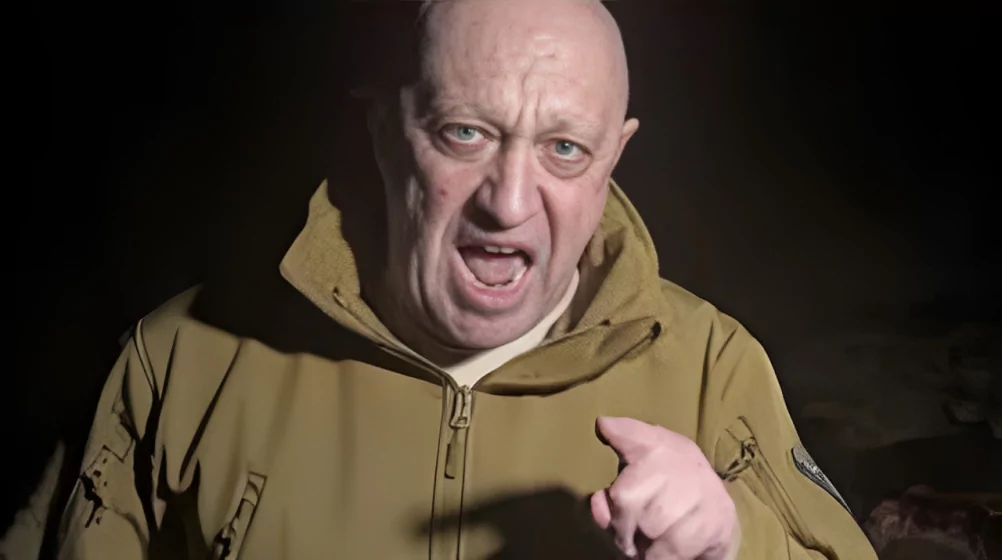
Prigozhin was told to address difficulties through the military command system, not the president or Kremlin. As it turned out, Putin underestimated Prigozhin and his temerity and autonomy following Russia’s full-scale invasion of Ukraine in 2022.
After the Wagner rebellion, the Kremlin accelerated its consolidation of the armed forces and “neutralized” all autonomous military chiefs. Putin was acting state-centrically, not eliminating Prigozhin sympathizers. He wanted to abolish the polycentricity of the military and depose all those who wanted independence.
General Sergei Surovikin was fired as chief of Russia’s aerospace forces for going too far, but he may not be charged. Prigozhin’s insurrection also empowered the FSB to target ultra-nationalists. The arrest of former Ukrainian rebel commander Igor Girkin (Strelkov) ended the Kremlin’s fear of confrontation with the army’s hardline critics.
Prigozhin’s suspected murder shows the Kremlin intended to display how it handles traitors. Whatever happened, the Russian elite will blame Wagner’s violent insurrection for the air accident. Conservatives will admire it as justice, while others will be afraid.
Many ultra-patriots were confused by the first mercy offered to Prigozhin and saw it as an indication of the state and Putin’s weakness. Of course, many wanted Prigozhin to try, especially for the Russian soldiers murdered in his insurrection.
Putin thought this more traditional method of justice was problematic since Prigozhin had many admirers, including ordinary Russians. Putin has never trusted public democracy either.
Even if Prigozhin’s death was an accident, the Kremlin will try to make it seem like vengeance. Putin considers this his contribution to Russian statehood.
Yevgeny Prigozhin, born on June 1, 1961, in Leningrad, Soviet Union (now Saint Petersburg, Russia), was a Russian mercenary leader and oligarch. Initially a close confidant of Russian President Vladimir Putin, he headed the Wagner Group, a private military company, until he initiated a rebellion in June 2023. Prigozhin accumulated wealth through personal connections with Putin, securing lucrative catering and construction contracts with the Russian government. Simultaneously, he built the Wagner mercenary force, utilizing it to clandestinely promote Russian interests in conflicts such as Ukraine and across Africa.
Notably, Prigozhin played a role in meddling with the 2016 US presidential election through the Internet Research Agency, a troll factory engaging in spreading misinformation and conducting information warfare against the United States. This support was directed toward Donald J. Trump’s presidential campaign. Following a mutiny against the Russian general staff, Prigozhin reportedly met his demise in a plane crash north of Moscow on August 23, 2023.
Yevgeny Prigozhin, born on June 1, 1961, in Leningrad, Soviet Union (now Saint Petersburg, Russia), was the only child of Violetta Kirovna Prigozhina, a hospital nurse, and Viktor Yevgenyevich Prigozhin, a mining engineer who passed away when Yevgeny was nine years old. His grandfather, Yevgeny Ilyich Prigozhin, played a significant role as a captain in the Red Army during World War II. Prigozhin’s father and stepfather are believed to be of Jewish descent, and his great-uncle was Soviet scientist Yefim Ilyich Prigozhin. Following the passing of his father, his mother and grandmother raised him.
In his twenties, Prigozhin spent nine years in a Soviet prison for robbery and fraud. Upon his release and the fall of the Soviet Union, he embarked on an entrepreneurial path. Starting with hot dog carts in his hometown, he gradually moved on to larger projects. Notably, he established a luxurious restaurant in St. Petersburg, which became a gathering place for Russian elites, including then-deputy mayor Vladimir Putin.
According to the search results, Yevgeny Prigozhin engaged in a number of criminal activities throughout his life. Here is a summary of these incidents:
- In 1979, Prigozhin was caught stealing, resulting in a suspended sentence of two years and six months. During this period, he served his sentence working at a chemical plant in Veliky Novgorod.
- Prigozhin spent nine years in detention for crimes such as robbery and fraud, ultimately being released in 1990.
- During his time in prison, Prigozhin reportedly violated the terms of his solitary confinement regularly.
- Exploiting his prison past, Prigozhin persuaded inmates to join the Wagner Group.
- Yevgeny Prigozhin‘s earlier conviction included charges of “involving minors in prostitution,” although this stemmed from a phrase in Article 210 of Soviet Russia’s Criminal Code. Other court documents suggest his conviction related to “drunkenness” and “attempted burglary.”
- As the head of the Wagner Group, a private military company, Prigozhin faced accusations of human rights abuses, war crimes, and mercenary activities in Ukraine and Africa.
- In June 2023, Yevgeny Prigozhin engaged in a mutiny against the Russian general staff, considered a criminal activity.
- The death of Prigozhin in a plane crash on August 23, 2023, has sparked rumors about possible motives, such as the possibility that he was a target of enemies or that Putin himself ordered the incident.
Yevgeny Prigozhin faced multiple prisons due to various criminal activities.
- In 1979, Yevgeny Prigozhin was apprehended for theft and received a suspended sentence of two years and six months in prison. During this time, he served his sentence working at a chemical plant in Veliky Novgorod.
- Yevgeny Prigozhin spent nine years in detention for crimes such as robbery and fraud, ultimately being released in 1990.
- During his time in prison, Yevgeny Prigozhin reportedly regularly violated the terms of his solitary confinement until his eventual release.
- Notably, Prigozhin later capitalized on his prison background to persuade inmates to join the Wagner Group.
- In June 2023, Yevgeny Prigozhin initiated a mutiny against the Russian general staff, an act that was deemed criminal activity.
Yevgeny Prigozhin served nine years in detention for various crimes, including robbery and fraud. During his imprisonment, he reportedly violated the terms of his solitary confinement regularly. Later on, Prigozhin used his prison background to recruit individuals for the Wagner Group.
While specific details about how prison shaped Prigozhin’s future are not available in the search results, there is a general understanding of how incarceration can impact a person’s personality and beliefs. According to a BBC Future article, the highly structured yet socially threatening environment of prison often leads to significant personality changes. The lack of cognitive challenges and autonomy in an impoverished prison setting can hinder rehabilitation and affect a person’s life after release.
However, the story of Nelson Mandela illustrates that prison time can also serve as a transformative period, allowing individuals to reflect, grow, and positively change. Therefore, it is conceivable that Prigozhin’s time in prison may have influenced his personality and beliefs in some way.
After his release from prison in 1990, Yevgeny Prigozhin embarked on a hot dog-selling venture with his mother and stepfather at Leningrad’s Apraksin Dvor open-air market. Subsequently, as outlined in a New York Times interview, he witnessed a rapid accumulation of rubles, surpassing his mother’s counting speed.
Between 1991 and 1997, Prigozhin delved into the grocery store business, becoming a 15% stakeholder and manager of Contrast, the inaugural grocery store chain in Saint Petersburg founded by his former classmate Boris Spektor. Simultaneously, he ventured into the gambling industry, assuming the role of CEO at Spectrum CJSC (Russian: ЗАО «Спектр»), which initiated the first casinos in Saint Petersburg. This period marked the collaborative establishment of various businesses across industries, possibly coinciding with Prigozhin’s initial encounter with Vladimir Putin, who had chaired the supervisory board for casinos and gambling since 1991.
In 1995, Yevgeny Prigozhin entered the restaurant business, opening his first establishment, the Old Customs House (Russian: Старая Таможня), in Saint Petersburg, followed by the renowned New Island, a floating restaurant, in 1997. The latter underwent a $400,000 transformation of a rusting boat on the Vyatka River, drawing inspiration from Parisian Seine-side dining. The shift towards upscale dining marked Prigozhin’s departure from earlier establishments featuring a striptease show. Notably, reports surfaced about Prigozhin using physical violence as a disciplinary measure for poor employee performance or misconduct.
In 2001, Prigozhin personally served food to Vladimir Putin and French President Jacques Chirac at New Island, hosting US President George W. Bush in 2002 and welcoming Putin for his birthday celebration in 2003.
Throughout the 2000s, Prigozhin’s proximity to Vladimir Putin strengthened, prompting his departure from business partners in 2003 to establish independent restaurants. Concord Catering, one of Prigozhin’s companies, secured numerous government contracts, including lucrative deals for supplying meals to school children, government workers, and the Russian military. In 2012, a contract worth US$1.2 billion for military meal supply allegedly contributed to funding the Internet Research Agency.
In 2012, Yevgeny Prigozhin‘s family relocated to a Saint Petersburg compound, showcasing a basketball court and a helicopter pad. His possessions included a private jet and a 115-foot yacht, along with ties to several aircraft, including Cessna 182s, Embraer Legacy 600, British Aerospace 125, and Hawker 800XP jets. The Anti-Corruption Foundation accused Prigozhin of corrupt practices, estimating his illegal wealth at over one billion rubles in 2017.
Alexei Navalny claimed that Prigozhin, who was associated with the business Moskovsky Shkolnik (Moscow Schoolboy), supplied subpar food to Moscow schools, causing a dysentery outbreak in 2019. In 2022, he earned the title of Corrupt Person of the Year from the Organized Crime and Corruption Reporting Project.
The Wagner Group, established in 2014, is a Russian state-funded private military company (PMC). Initially, it provided support to pro-Russian paramilitaries during the Donbas War in Ukraine and later played a significant role in Russia’s 2022 invasion of Ukraine. Additionally, the group extended its influence to support regimes aligned with Putin’s Russia in the Middle East and Africa.
Despite repeated denials of any association with the Wagner Group, Yevgeny Prigozhin, during the 2022 Russian invasion, personally traveled to Ukraine to oversee the group’s operations. He was photographed at the frontline wearing military fatigues alongside Russian Duma member Vitaly Milonov. In September 2022, Prigozhin admitted to founding Wagner in 2014 with the goal of “protecting the Russians” during the “genocide of the Russian population of Donbas.”
He claimed an active role from the beginning, stating that he personally located specialists and handled tasks like cleaning old weapons and sorting bulletproof vests. Prigozhin also acknowledged the group’s involvement in other countries aligned with Russian overseas interests, emphasizing the role of Wagner mercenaries in defending various populations.
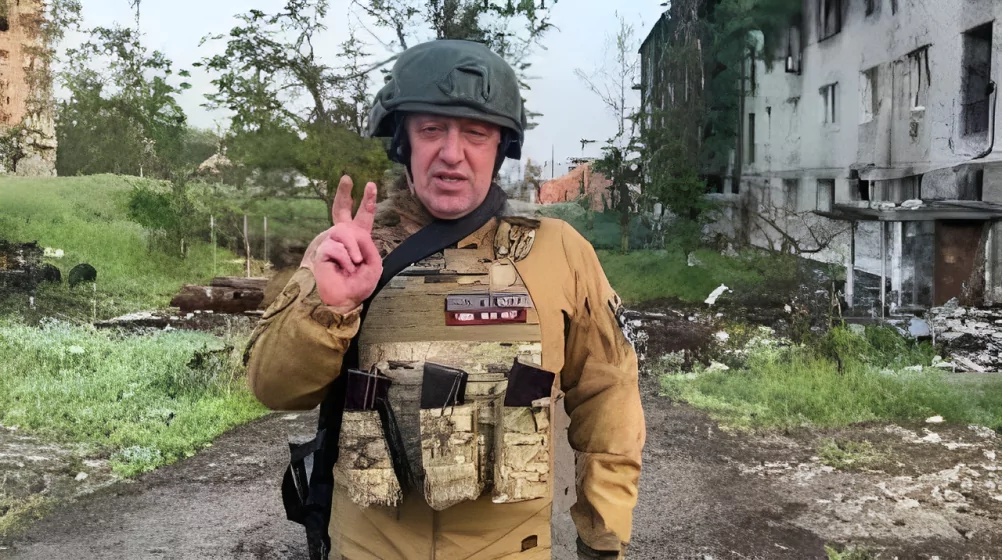
The goal of the Wagner Group’s establishment was to support Russian interests on a global scale and give the Russian government plausible deniability for military operations abroad. This strategy, spearheaded by Valery Gerasimov, Chief of the General Staff since 2012, involved assigning Prigozhin as the head of the company due to his existing service relationship with the Defense Ministry.
Yevgeny Prigozhin, with close ties to President Vladimir Putin, handled operational and logistical aspects. Despite initial reservations about the high-risk role, he could not refuse the task.
Dmitry Utkin, a Russian military veteran, was named a founder and commander of Wagner. Since Prigozhin lacked a military background, Utkin played a crucial role in overseeing the group’s military operations. Utkin, having previously served as head of security for Prigozhin and listed as the director-general of Concord Management, brought military expertise to Wagner’s leadership.
Yevgeny Prigozhin gained prominence during the 2022 Russian invasion of Ukraine as the leader of the Wagner private military group. This paramilitary organization achieved notable battlefield successes in Ukraine and briefly rebelled against Russia’s military leadership in June 2023.
Prigozhin’s mercenaries played a significant role in the conflict, engaging alongside the Russian army in battles against Ukrainian forces. Under Prigozhin’s command, the group played a pivotal role in the capture of Bakhmut, marking a substantial Russian advance in Ukraine.
The heightened visibility of Yevgeny Prigozhin led to speculation about potential political aspirations. In June 2023, he orchestrated an armed rebellion in Russia, posing a dramatic challenge to his former mentor, President Vladimir V. Putin. This event stood out as one of the most significant challenges to Putin’s rule in decades, with observers suggesting that Prigozhin’s betrayal was akin to a potential death sentence.
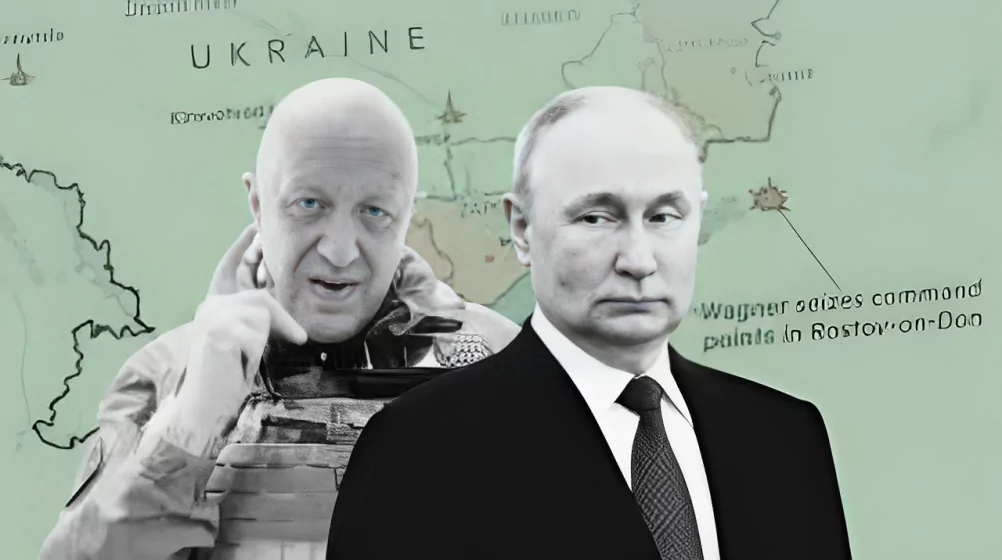
Tragically, Yevgeny Prigozhin met his demise in a plane crash north of Moscow on August 23, 2023. There is speculation about the circumstances of his death, with theories positing that he may have been the target of numerous enemies or even a Putin-directed act.
Yevgeny Prigozhin’s Wagner Group was a key player in the 2022 Russian invasion of Ukraine. Here are key aspects of the group’s involvement:
- Originating during the Donbas War in Ukraine from 2014 to 2015, the Wagner Group supported pro-Russian forces.
- During the full-scale invasion, Wagner, under Prigozhin’s leadership, recruited Russian prison inmates for frontline combat, growing from 1,000 to 20,000–50,000 by the end of 2022.
- In the Battle of Bakhmut, Wagner emerged as Russia’s primary assault force.
- Accusations against the group include human rights abuses, war crimes, and mercenary activities in Ukraine and across Africa.
- Prigozhin claimed to be the founder and head of Wagner, with his mercenaries becoming a significant force in the war, engaging alongside the Russian army in battles against Ukrainian forces.
- Wagner’s involvement began in February 2022, initially with commandos tasked with the alleged assassination of Ukrainian President Volodymyr Zelensky.
- The group’s prominence heightened in mid-2022 as its strength in Ukraine expanded significantly.
- Facing substantial casualties, Wagner initiated mass recruitment efforts, including drawing from Russian prisons, to replenish its forces.
Yevgeny Prigozhin solidified his authority and amassed resources during the Ukrainian conflict by leading the Wagner private military group, showcasing his entrepreneurial acumen, cultivating influential connections, and displaying a penchant for calculated risks. Here’s a breakdown of how he achieved this:
- Wagner Group Leadership and Military Success
- Prigozhin founded and directed the Wagner private military group, orchestrating notable battlefield successes in Ukraine. The group even staged a brief mutiny against Russia’s military leadership in June 2023.
- Mercenaries as a Significant Force
- Prigozhin’s mercenaries played a pivotal role in the conflict, engaging alongside the Russian army in intense battles against Ukrainian forces.
- Criminal Support for Business Ventures
- Prigozhin’s business endeavors received backing from the criminal underworld, gradually intertwining his interests with the affairs of the Russian Federation.
- Experience and Influential Acquaintances
- Leveraging his experience in managing large projects within the restaurant and gambling industries, Prigozhin developed influential connections that contributed to his rising influence.
- Opportunity Post-Crime Annexation
- Following the annexation of Crimea, Prigozhin seized a unique opportunity amidst conflicts in Donbas, Syria, and Russia’s standoff with the West. A market emerged for unconventional geopolitical tactics, allowing him to operate discreetly using mercenaries and media mechanisms like troll factories.
- Informal Tools of Influence
- Yevgeny Prigozhin pioneered the use of informal tools of influence, including mercenaries and media manipulation, providing Russia with covert strategies that evaded traditional scrutiny.
- Establishing Ties through Presidential Influence
- Through strategic means, Prigozhin managed to convey information about his initiatives directly to the president. If approved, the president informally directed corresponding organs to cooperate, enabling Prigozhin to forge ties at a lower level, albeit not without making adversaries.
- Speculation of Political Ambitions
- As Prigozhin gained prominence, speculations arose about his potential political aspirations, adding another layer to his evolving public persona.
- Mutiny Against Russian General Staff
- Prigozhin’s audacious mutiny against the Russian general staff in June 2023 posed a significant challenge to his former mentor, President Vladimir V. Putin, marking one of the most dramatic power struggles in decades.
- Death and Speculation
- On August 23, 2023, Yevgeny Prigozhin died in a plane crash north of Moscow, which sparked rumors of targeted attacks by numerous foes or even suggestions that Putin himself had ordered the action.
Yevgeny Prigozhin, often dubbed “Putin’s chef” due to his ownership of restaurants and catering businesses that served the Kremlin, had a complex and influential role in Russia’s political landscape. He led the Wagner Group, a private military company, and enjoyed a close relationship with Russian President Vladimir Putin until he launched a rebellion in June 2023. Prigozhin’s ties with the Kremlin spanned decades, with his involvement as a trusted government contractor and as the leader of the Wagner mercenary army, which was implicated in operations in Ukraine, Syria, and Africa.
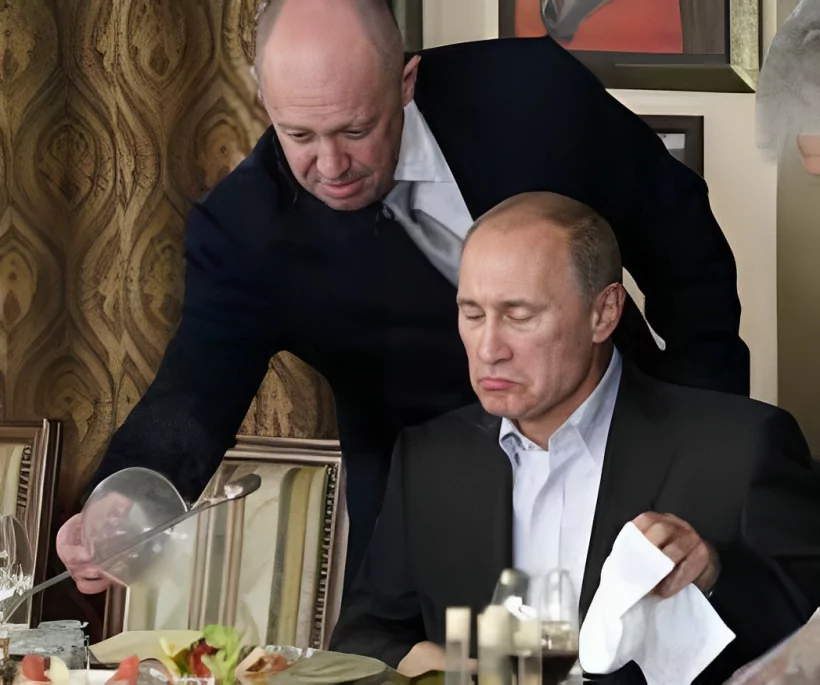
Throughout the 2000s, Prigozhin’s connection with Putin grew stronger. He established his own restaurants, including Concord Catering, which began winning numerous government contracts. These contracts amounted to hundreds of millions of dollars, covering services such as feeding schoolchildren and government workers. In 2012, he secured a staggering $1.2 billion contract to supply meals to the Russian military for a year. Subsequently, Prigozhin continued to win lucrative catering agreements, serving schools and the Russian armed forces.
Prigozhin’s interests extended beyond the culinary world. He displayed an unusual fascination with Nazi Germany, which had previously used the works of a 19th-century composer for propaganda. His ventures also encompassed media and a notorious internet “troll factory,” leading to his indictment in the U.S. for interfering in the 2016 presidential election. In a surprising turn of events, Prigozhin struck a deal with Putin and the leader of Belarus, securing a safe haven for himself and the individuals involved in the rebellion he initiated in June 2023.
In summary, Yevgeny Prigozhin, the enigmatic Russian oligarch and mercenary leader, earned the moniker “Putin’s chef” for his restaurant and catering enterprises that served the Kremlin. However, his multifaceted involvement with government contracts, mercenary operations, and intriguing interests painted a more intricate picture of his role in Russia’s political landscape.
1. Wagner Group’s Unofficial Authority
- Despite receiving increasing resources from the government, the Wagner Group lacked legal standing.
- Yevgeny Prigozhin, with no official position, gained international recognition, shedding his private life’s seclusion.
- Wagner started being viewed as Prigozhin’s personal army, operating beyond Russian legislation and military hierarchy, sparking conflicts with the Ministry of Defense.
2. Prigozhin’s Role in the Russian-Ukrainian Conflict
- During the Kharkiv counteroffensive in October 2022, Prigozhin criticized Russian army commanders and Putin-controlled parliament members.
- Prigozhin emerged as a rare voice criticizing Russian military leaders, according to The Washington Post.
- Tensions between Prigozhin and the Ministry of Defense escalated during the Russian Winter Offensive in February 2023, particularly in the Bakhmut direction.
3. Conflict Escalation and Accusations
- Yevgeny Prigozhin accused Defense Minister Sergei Shoigu’s family in February 2023, mocking their luxurious lifestyle amid the conflict.
- In May 2023, Prigozhin intensified accusations, alleging an artificial shortage of ammunition and criticizing military leaders for their detached lifestyles.
- He expressed frustration with the lack of support for his forces and launched a media campaign, #DayShellsToWagners, in protest.
4. Prigozhin’s Public Condemnation
- Prigozhin publicly condemned military commanders for their alleged neglect and criticized their lavish lifestyles amid the ongoing conflict.
- He highlighted the shortage of ammunition, blaming the military command and accusing them of jeopardizing the lives of his fighters.
- Prigozhin’s rhetoric intensified, culminating in public addresses and media campaigns against the Ministry of Defense.
5. Banning Recruitment and Public Confrontations
- Yevgeny Prigozhin revealed in May 2023 that he was banned from recruiting mercenaries from inmates, alleging it was due to envy and compensation for military failures.
- Accusations escalated, with Prigozhin claiming the military command stopped issuing awards and restricted the use of communications and transport aircraft.
- The conflict reached a public stage, with Prigozhin openly berating military leaders and using strong language to express his dissatisfaction.
6. Escalation and Threats
- Prigozhin accused the military command of betrayal, threatened withdrawal due to ammunition shortages, and criticized their focus on internal power struggles.
- The conflict intensified, with Prigozhin openly challenging military decisions and accusing the Ministry of Defense of prioritizing intrigue over actual combat efforts.
- On May 9, Prigozhin accused the regular Russian army of fleeing positions and threatened withdrawal if ammunition needs weren’t met, further straining the relationship with the Ministry of Defense.
In just a few months, Prigozhin underwent a transformation, casting himself as a “truth-teller” unafraid to voice harsh criticism against Russian leadership. Besides his disputes with the Ministry of Defense, he clashed with the leadership of the Chechen Republic, notably its Head, Ramzan Kadyrov.
By June 2023, Yevgeny Prigozhin sought the image of a “people’s hero” in the Special Military Operation. A May 2023 Russian opinion poll by Russian Field revealed Yevgeny Prigozhin actively gaining recognition and popularity both externally and internally. Russian sociologists and political scientists attributed his increased visibility to a mix of aggressive marketing and specific achievements, particularly the capture of Bakhmut, a significant victory for the Russian army.
In June 2023, Prigozhin began making statements that, if made by others, might lead to criminal charges. Despite this, his popularity surged, especially among nationalists. In a May survey by the Levada Center, Prigozhin unexpectedly entered the top ten list of most trusted politicians, signaling a notable shift in his public perception from a non-political to a political figure.
Dutch political scientist Cas Mudde labeled Yevgeny Prigozhin‘s approach as a radical populist movement. The movement’s core principles include a stark division of society into “good people” and a “bad elite,” a commitment to saving the nation, and the use of authoritarian methods to implement these ideals.
Prigozhin is often associated with the “war party” within Russia’s leadership—a faction of hardliners supporting the invasion of Ukraine but critical of what they perceive as the ineffective or incompetent prosecution of the war by the Russian government.
According to search results, Yevgeny Prigozhin attempted to overthrow President Vladimir Putin’s leadership in June 2023, posing a significant challenge. Here are key details of the rebellion:
- Prigozhin’s rebellion aimed to forcibly change the leadership of the Defense Ministry, but it was short-lived.
- Critical of Russian military leadership, Prigozhin had some autonomy in the war against Ukraine.
- The biggest threat to Putin’s 23-year rule came from Prigozhin, who believed that strong allies would stand by him.
- Questions arose about Yevgeny Prigozhin‘s support within the top ranks of the Russian military.
- U.S. officials suggested that Prigozhin wouldn’t have rebelled without expecting support from others in power.
- The rebellion failed due to ambitious impulsiveness and a failure to understand Putin’s inner circle.
- Russian security services warned Putin days in advance of Prigozhin’s possible rebellion.
- Putin initially appeared paralyzed during the rebellion’s early hours.
- The Russian government treated Prigozhin’s insurrection as a severe threat, filing criminal charges for “inciting an armed uprising.”
- Charges were dropped after Prigozhin halted the revolt, despite Putin initially branding him and his force as traitors.
Yevgeny Prigozhin’s rebellion in June 2023 posed a significant challenge to President Vladimir Putin’s power. Here are the key events during the rebellion:
- Yevgeny Prigozhin attempted to forcefully change the leadership of the Defense Ministry in a short-lived rebellion. He had been critical of the Russian military leadership and was granted a certain degree of autonomy in the war against Ukraine.
- On June 23, 2023, Prigozhin’s mercenaries staged a mutiny against the Russian military leadership, seeking greater control over the war in Ukraine. They seized a military base in southern Russia, taking several high-ranking military officials hostage.
- Prigozhin’s rebellion represented the most significant threat to Putin’s power in his 23-year rule. Intelligence assessments had warned Putin about Prigozhin’s possible rebellion at least two or three days ahead of time, leaving Putin seemingly paralyzed and unable to act in the initial hours of the uprising.
- The Russian government treated Prigozhin’s insurrection as a mortal threat, filing criminal charges of “inciting an armed uprising” against him. Military troops and police were deployed across Moscow in anticipation of the Wagner troops’ arrival.
- Prigozhin’s rebellion ultimately failed due to a combination of hot-headed ambition and his inability to gauge Putin’s inner circle accurately. The Federal Security Service dropped “armed mutiny” charges against Prigozhin and his forces after he halted the revolt, despite President Vladimir Putin initially branding them as traitors.
Yevgeny Prigozhin had significant interests in Africa, engaging in military, commercial, and propaganda activities across multiple countries. Here are some key aspects of Prigozhin’s involvement in Africa:
- Prigozhin’s Role as Russia’s Point Man in Africa:
- Prigozhin assumed a pivotal role for Russia in Africa when Wagner initiated operations on the continent in 2017.
- Advancing Russian Influence:
- Prigozhin worked to enhance Russian influence by supporting politically isolated and unpopular authoritarian leaders, making them indebted to Russian interests.
- Diverse Methods of Support:
- Prigozhin employed various unconventional channels to support authoritarian leaders, including deploying paramilitary forces, conducting targeted disinformation campaigns, interfering in elections, intimidating political opponents, and engaging in arms-for-resources deals.
- “The Orchestra” Influence Operations:
- Prigozhin orchestrated a comprehensive set of influence operations, collectively known as “The Orchestra.”
- Wagner Group’s Operations:
- Wagner’s activities ranged from reinforcing unstable military regimes and trading in valuable resources like diamonds, gold, and lumber to spreading disinformation and producing movies glorifying their exploits.
- Prigozhin’s Broader Interests:
- Prigozhin aimed to establish a foothold in North Africa and the Red Sea, diminish Western influence, normalize authoritarianism, and replace UN-based peacekeeping operations.
- Military Bases in Africa:
- Prigozhin sought to secure military bases in Africa, leveraging existing military cooperation agreements with 18 African countries.
- Support from African Leaders:
- Prigozhin’s interests received backing from African leaders aligned with Russia, who had become accustomed to dealing with him.
- Support from Individual Actors:
- Individual African actors, both state and non-state, benefited from Prigozhin’s presence, contributing to his interests in the region.
- Opposition from Some African Countries:
- Prigozhin’s interests faced opposition from certain African countries, including those abstaining or absent during the UN General Assembly Resolution condemning Russia’s illegal annexation of eastern Ukraine.
- Ambivalence from Other African Countries:
- Some African countries exhibited ambivalence towards Russia, posing challenges to Prigozhin’s interests in the region.
Yevgeny Prigozhin orchestrated the operations of a network of companies, including the Internet Research Agency Ltd. (Russian: ООО «Агентство интернет-исследований»), Concord Management and Consulting Company, and another related entity. These three companies face allegations of engaging in internet trolling and attempting to influence the 2016 United States presidential election, as well as other activities aimed at impacting political events beyond Russia.
Russian journalist Andrey Soshnikov revealed a direct connection between Alexey Soskovets, associated with the Russian youth political community, and the offices of the Internet Research Agency in Olgino. Soskovets’ company, North-Western Service Agency, secured 17 or 18 contracts (depending on sources) for organizing various events, including celebrations, forums, and sports competitions, for the authorities of Saint Petersburg. Notably, the agency was the sole participant in half of these bids. In the summer of 2013, the agency won a tender for providing freight services for participants in a Seliger camp.
In February 2023, Prigozhin openly admitted his role in founding the Internet Research Agency, stating, “I’ve never just been the financier of the Internet Research Agency. I invented it, I created it, I managed it for a long time.” This acknowledgment followed months after Prigozhin had already confessed to Russian interference in U.S. elections.
Spin-offs: Campaigns against opposition in 2013 involved Dmitry Bykov and the then-head of RIA Novosti, Svetlana Mironyuk. Additionally, a webpage purporting to combat fake news (Gazeta O Gazetah) was utilized to disseminate fabricated information.
In December 2016, the US Treasury Department sanctioned Prigozhin under E.O. 13661 for supporting senior Russian officials.
By June 2017, US sanctions targeted one of Prigozhin’s companies, Concord Management and Consulting, due to its involvement in the war in Eastern Ukraine.
In January 2018, Evro Polis Ltd, a Russian company linked to Prigozhin, faced US Treasury Department sanctions for its role in safeguarding Syrian oil fields in exchange for a 25 percent share in oil and gas production. Sanctions mandated the blocking of property or interests owned or controlled by designated persons within the US, with transactions involving them prohibited.
Three additional Prigozhin-associated companies – Autolex Transport, Beratex Group, and Linburg Industries – were sanctioned in September 2019 over Russian interference in the 2016 US election.
In February 2022, the European Union added the Internet Research Agency to its sanctions list for conducting disinformation campaigns and supporting actions undermining Ukraine’s territorial integrity. The US claims Prigozhin’s election interference extends to Asian and African countries.
Australia, the European Union, Canada, Japan, Switzerland, and the United Kingdom have imposed sanctions on Prigozhin. The FBI is offering a reward of up to $250,000 for information leading to his arrest.
Responding to New Zealand’s sanctions against him, Prigozhin made racist remarks in October 2022, targeting Māori people. He insulted Foreign Affairs Minister Nanaia Mahuta, using a derogatory term, and criticized her Māori tattoo. Mahuta’s spokesperson dismissed the comments as “petty vitriol.”
On February 16, 2018, US authorities indicted Yevgeny Prigozhin, the Internet Research Agency, Concord Management, and other Russian individuals with connections to interference in US political and electoral processes, including the 2016 presidential election. Prigozhin faced charges of funding and orchestrating these operations, along with identity theft and other offenses.
It’s worth noting that charges against Concord Management were formally dismissed on March 16, 2020.
Fast forward to February 2021, Prigozhin found himself on the Federal Bureau of Investigation’s (FBI) wanted list. This marked an ongoing pursuit of justice.
In February 2022, the United States took further action in response to the 2022 Russian invasion of Ukraine. Sanctions were imposed, which included visa restrictions and the freezing of assets belonging to Prigozhin and his family.
By July 2022, the US State Department announced a reward of up to $10 million for information leading to the apprehension of Prigozhin, the Internet Research Agency, and other entities associated with the interference in the 2016 US election.
On November 7, 2022, Prigozhin openly admitted to interfering in US elections and expressed his intent to continue such activities in the future.
In May 2019, Maria Butina, who had previously admitted guilt for acting as an unregistered agent of the Russian Federation in the United States, appealed for assistance in covering her legal fees. In February 2019, Valery Butin, Maria’s father, informed Izvestia that she owed her U.S. attorneys 40 million rubles, equivalent to approximately $659,000. Petr Bychkov’s Prigozhin’s Fund for the Protection of National Values received a donation of 5 million rubles to cover her defense attorney’s expenses.
Mikhail Prigozhin, the husband of Lyubov Valentinovna Prigozhina, is a well-known figure. Lyubov Valentinovna Prigozhina, a pharmacist and entrepreneur, owns a network of boutique stores under the name “Chocolate Museum” in Saint Petersburg. In 2012, she launched the “Crystal Spa & Lounge,” a day spa located on Zhukovsky Street in Saint Petersburg, which earned the third-place award for the “Perfect Urban Day Spa” in 2013.
She also owns a wellness center in the Leningrad region and a boutique hotel called “Crystal Spa & Residence,” which was awarded the “Perfect Spa Project” in 2013. Lyubov Valentinovna Prigozhina is the owner of “New Technologies SPA LLC,” located at plot 1, Granichnaya Street in Lakhta Park, Sestroretsk, Kurortny District, Saint Petersburg. Additionally, she is the proprietor of “Agat,” a part of the Concord group.
Mikhail Prigozhin and Lyubov Valentinovna Prigozhina have three children: Polina, born in 1992; Veronika, born in 2005; and Pavel, born in either 1996 or 1998. In 2004, Mikhail Prigozhin published a children’s picture book, with his children listed as co-authors.
This book was not made available for sale; instead, Prigozhin distributed it as a gift to friends and associates. Prior to the Ukraine invasion, Prigozhin’s children had the freedom to travel within the European Union. For instance, on February 20, 2022, Prigozhin’s daughter, Veronika, participated in equestrian competitions in Spain.
Mikhail Prigozhin’s mother, Violetta Prigozhina, is a former doctor and educator. She has been the legal owner of Concord Management and Consulting LLC since 2011, Etalon LLC since 2010, and Credo LLC since 2011.
It’s important to note that all family members mentioned above have been subject to sanctions imposed by the European Union, the United States, Ukraine, and various other countries due to Mikhail Prigozhin’s involvement in Russia’s invasion of Ukraine.
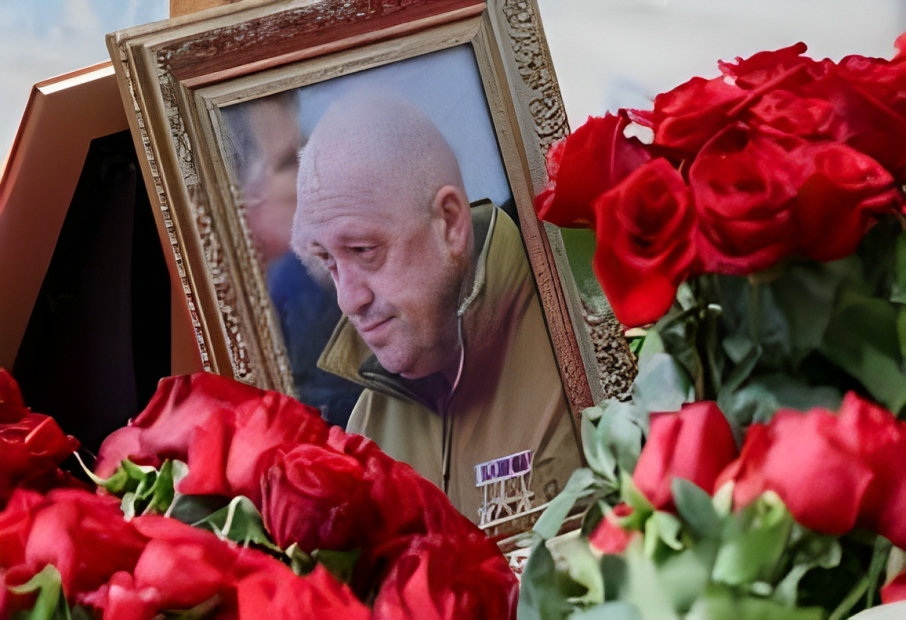
On August 23, 2023, Dmitry Prigozhin tragically lost his life in an airplane crash. The flight, traveling from Moscow to Saint Petersburg, met with disaster, resulting in the loss of all 10 passengers on board. Russian state-owned media agency TASS confirmed that Prigozhin was indeed among the passengers.
The Investigative Committee of Russia officially confirmed the passengers’ deaths on August 27, following genetic analysis of the remains recovered from the wreckage.
An associated Telegram channel linked to Wagner made a claim that Russian air defenses in Tver Oblast shot down the aircraft. However, this assertion faced scrutiny due to the absence of visible missile trails in the released footage.
 Aircraft involved in the crash in which Prigozhin died
According to preliminary intelligence reports from the U.S. and other Western officials, it is believed that an onboard explosion was the likely cause of the aircraft’s demise in Russia, resulting in the tragic loss of all passengers.
Memorials were set up in several cities to honor Prigozhin and Utkin, featuring candles, flowers, and Wagner flags. Videos showing emotional Wagner soldiers paying their respects at these memorials quickly went viral.
On August 29th, Prigozhin was laid to rest in a private ceremony at Porokhovskoe Cemetery in Saint Petersburg, next to his father’s grave.
However, on September 6th, the Ukrainian Main Directorate of Intelligence reported that they couldn’t definitively confirm the death of Yevgeny Prigozhin. It wasn’t until September 10th that Ukrainian President Volodymyr Zelenskyy officially confirmed Prigozhin’s passing, citing Putin’s alleged violation of an agreement with Prigozhin as one of the reasons for refusing negotiations with Russia under Putin’s leadership.
Prigozhin has received several Russian awards, including the prestigious title of Hero of the Russian Federation in 2022. Additionally, he was honored with Sudan’s Order of the Republic in 2018 and the Order of the Two Niles in 2020.
ANALYSIS
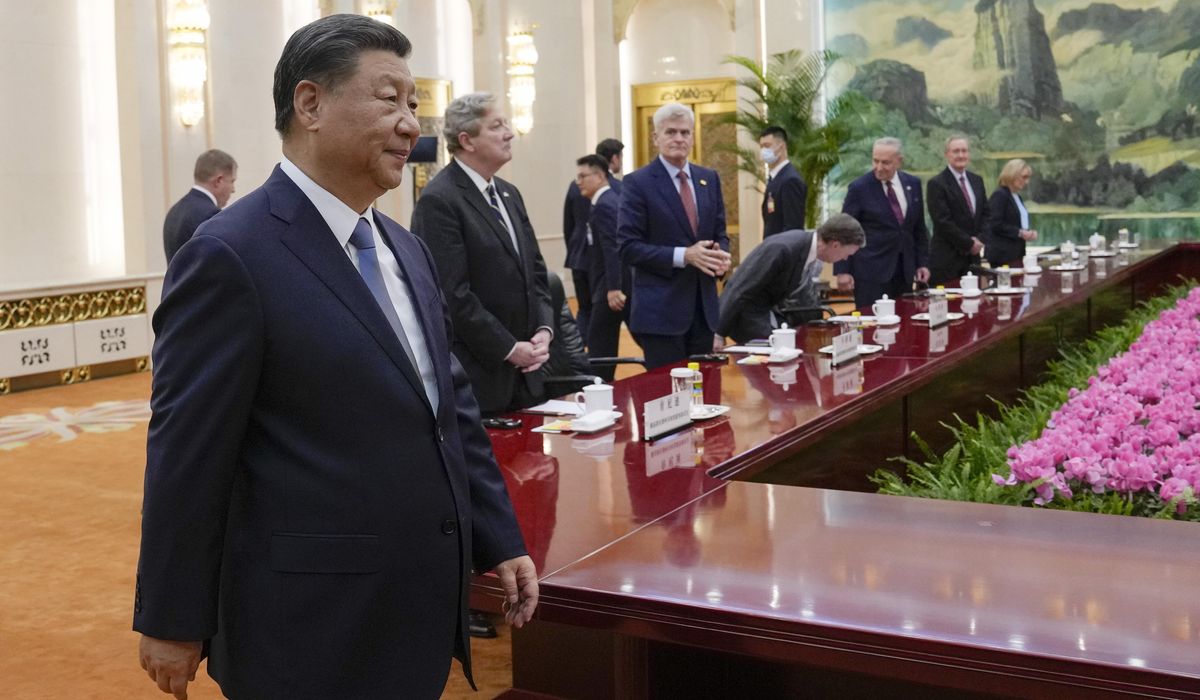
Chinese President Xi Jinping meets President Biden this week on the sidelines of an international economic summit in San Francisco seeking concessions from the United States on ideology, trade and exports, according to a review of Chinese state media ahead of the meeting.
A common theme of Chinese official accounts in the days leading up to the first meeting of the two presidents in a year is that bilateral relations with the U.S. should be based on three principles, starting with “mutual respect.” That reflects China’s demand that the U.S. not try to subvert Beijing‘s communist system, according to the official Xinhua news agency.
Mr. Biden and Mr. Xi are scheduled to meet Wednesday during the Asia Pacific Economic Cooperation. Mr. Xi also plans to deliver a speech in San Francisco on his proposals for deeper Asia-Pacific cooperation and regional and global growth.
The Chinese leader in recent months has raised questions with his mercurial conduct in two high-profile foreign appearances.
In August, while attending a meeting of developing nations in South Africa, Mr. Xi failed to show up for a scheduled speech. Then in September, he declined to take part in a meeting of G20 nations in India, amid tensions with Delhi over a border dispute.
Mr. Xi‘s “three principles” also include a demand for peaceful coexistence with the U.S. and “win-win” cooperation as preconditions for improved ties with Washington. But a growing number of U.S. defense and military officials have called into question that agenda, noting what they say is Beijing‘s increasingly aggressive military activities in the region.
Chinese forces in the South China Sea have clashed with Philippines vessels seeking to resupply a disputed island outpost in the South China Sea. China is increasing the tempo of military operations around Taiwan as pressure against what it views as “separatist” activities by the Taipei government.
Militarily, China sharply increased provocative and potentially dangerous aerial intercepts and warship encounters with the U.S. and its allies, officials have said.
The Xinhua commentary made clear that a primary goal for Mr. Xi in San Francisco is to make clear that the United States must “recognize and appreciate” differences between the U.S. and Chinese systems of government.
“There shouldn’t be any attempt to remake the other in its own image or change or sabotage the other’s system,” the commentary said. “The leadership of the Communist Party of China and China‘s socialist system are supported by all Chinese nationals and are the fundamental guarantee for China‘s development and stability.”
The commentary went on to call for an end to what it called the American “Cold War mentality,” code for U.S. anti-communism. This outlook is viewed by Mr. Xi and the ruling Chinese Communist Party as a plan to encircle and contain China’s rise as a global power, the article stated.
China’s 1.4 billion people are not represented by the estimated 98 million members of the ruling Chinese Communist Party, according to pro-democracy Chinese dissidents. That gap in system legitimacy is a source of party leadership uncertainty about its hold on power, regime critics say.
Chinese democracy activist Wei Jinsheng recently told Congress that the U.S. should indeed seek to change the Chinese system: “I wish the American people would consider changing to a new policy. … If you will not change China, then Xi Jinping will change you.”
A fear of color revolutions
Protecting the communist system from what Beijing has said are CIA-led “color revolutions” around the world has been a key demand of Chinese officials since the earliest days of the Biden administration.
Early on, Deputy Secretary of State Wendy Sherman traveled to China and was given two lists of multiple demands for re-setting relations between Washington and Beijing, in particular, that the United States not seek to undermine the Chinese system. A White House official said at the time the demand not to overthrow the Chinese system was not accepted.
However, Mr. Biden and Secretary of State Antony Blinken have since said the United States is not trying to undermine China’s system as it seeks to ease tensions between Washington and Beijing.
Miles Yu, a State Department policymaker on China during the Trump administration, said Mr. Xi‘s three principles are actually a coded demand that the United States tolerate “China’s disrespect for global order, rule of law, and belligerence toward its neighbors.”
China‘s Communist leadership is attempting to “hoodwink the world into thinking unprincipled engagement with the PRC can be mutually beneficial,” he said.
China “will never accept losing to its competitors, for that would mean the demise of the communist dictatorship,” said Mr. Yu, now director of the Hudson Institute’s China Center, said. “This is what Xi Jinping means when he repeatedly says that all aspects of the U.S.-China bilateral relationship are nothing but a matter of a life-or-death struggle.”
Seeking to shield China‘s system of government coincides with Mr. Xi’s renewed emphasis on spreading the socialist system known as “Marxism-Leninism with Chinese characteristics for a new era” – the new era dating from when Mr. Xi first took power in 2012. The shift represents a backing off from the market-oriented reforms that began in the 1980s as a reaction to many of the disastrous economic policies of Mao Zedong.
Retired Navy Capt. James Fanell, a former Pacific Fleet intelligence chief, said the Xinhua article offers a key to China‘s aggressive approach to the summit.
“First will be the lectures like this, then there will be the appearance of cordial relations with photos from the edges of APEC and the leader summit,” he predicted. “Then will come military intimidation. These are called ‘shaping operations’ in the military vernacular.”
The intended outcome of the effort is to “get your adversary to back down, break his will to resist, to collapse, to cave, to engage, and yes, to conduct ‘exchanges’ that further [China‘s] dominance,” Capt. Fanell said.
The White House said in a briefing for reporters that renewing frozen direct military exchanges between the Pentagon and the People’s Liberation Army will be a major goal for Mr. Biden in the talks. China cut off military talks and exchanges in August 2022 to protest the visit to Taiwan by then-House Speaker Nancy Pelosi.
“The president has been determined to take the necessary steps to restore what we believe are essential communications between the United States and China on the military side,” a senior administration official said, arguing they are vital to avoiding accidents and misunderstandings that could lead to a larger, unintended conflict.
Hardball
Hudson Institute scholar Thomas J. Duesterberg believes placating Mr. Xi will not change China’s behavior that is seeking to challenge American interests worldwide. Mr. Xi is expected to play hardball at the talks, taking advantage of the distraction in Washington, with two major wars in Ukraine and the Middle East sapping U.S. diplomatic and military resources.
Mr. Xi will likely pledge to cooperate on issues such as climate change and provide better access to Chinese markets if the United States reduces tariffs, export controls and investment restrictions, he wrote in an article in the Wall Street Journal
“Those will be empty promises, as in the past,” Mr. Duesterberg said. “Carrots have never worked with Beijing.”
The Hudson analyst noted that “fortunately, at least four sticks are available to Mr. Biden” as he and Mr. Xi sit down to talk.
The administration, he said, should sanction Chinese banks involved in illicit purchases of Iranian and Russian oil and ban the popular video app TikTok to demand reciprocity in China for U.S. social media apps, he said. Mr. Biden also should tell Mr. Xi that the United States will not provide Treasury or Federal Reserve dollar relief for China if its faltering financial system runs short.
The president should also inform Mr. Xi that he will expand investment restrictions preventing American companies from portfolio investments in sanctioned Chinese firms.
Mr. Duesterberg said such blunt talks at a time of growing Chinese domestic problems could prompt Mr. Xi to back off support for Russia and Iran. “It’s clear that concessions won’t do the job,” he said.
Mr. Duesterberg was responding to an article written by Treasury Secretary Janet Yellen, considered among the senior administration officials seeking closer China ties. Ms. Yellen wrote that U.S. policy toward China should be part of a pragmatic strategy to protect U.S. security while seeking “a stable and healthy economic relationship with Beijing.
China Daily, another Chinese outlet with close ties to the Communist Party, said normalized U.S.-China ties will only come as the result of American concessions, noting a reiteration of U.S. promises not to support Taiwan‘s independence or to seek a policy of “decoupling” economically from
“Both countries are engaged in primary-level dialogue and communication, but a lack of strategic mutual trust has prevented the two sides from reaching a consensus on any issue, especially because the U.S. is yet to take any substantial action to rebuild mutual trust,” China Daily stated. The news outlet also said the United States continues to “sow discord” in the South China Sea and imposed “illegal sanctions” on Chinese officials regarding human rights violations in Tibet.
Recent improved ties are the result of administration “tactical adjustments” in China policy, China Daily reported, in part because Washington needs Beijing’s support for resolving difficult problems like the Ukraine war and the opioid crisis.
“As long as the U.S. maintains its sense of superiority, its hegemonic mindset and its ideological biases toward China, it will not change its ‘China-containment’ strategy,” China Daily said.
The nationalist Global Times, which also is close to the Chinese Communist Party leadership, predicted that Mr. Xi will seek help from the United States to boost Beijing‘s ailing economy. China wants the United States to stop defining its policy toward Beijing as strategic competition, Global Times said, noting Beijing’s opposition to sanctions and trade restrictions.
China wants the United States to respect Chinese concerns and rights to development rather than “harming China‘s interests,” Global Times said, quoting a Foreign Ministry spokesman.
• Bill Gertz can be reached at bgertz@washingtontimes.com.