
Categories
Will Falcon be Egypt’s Wagner?
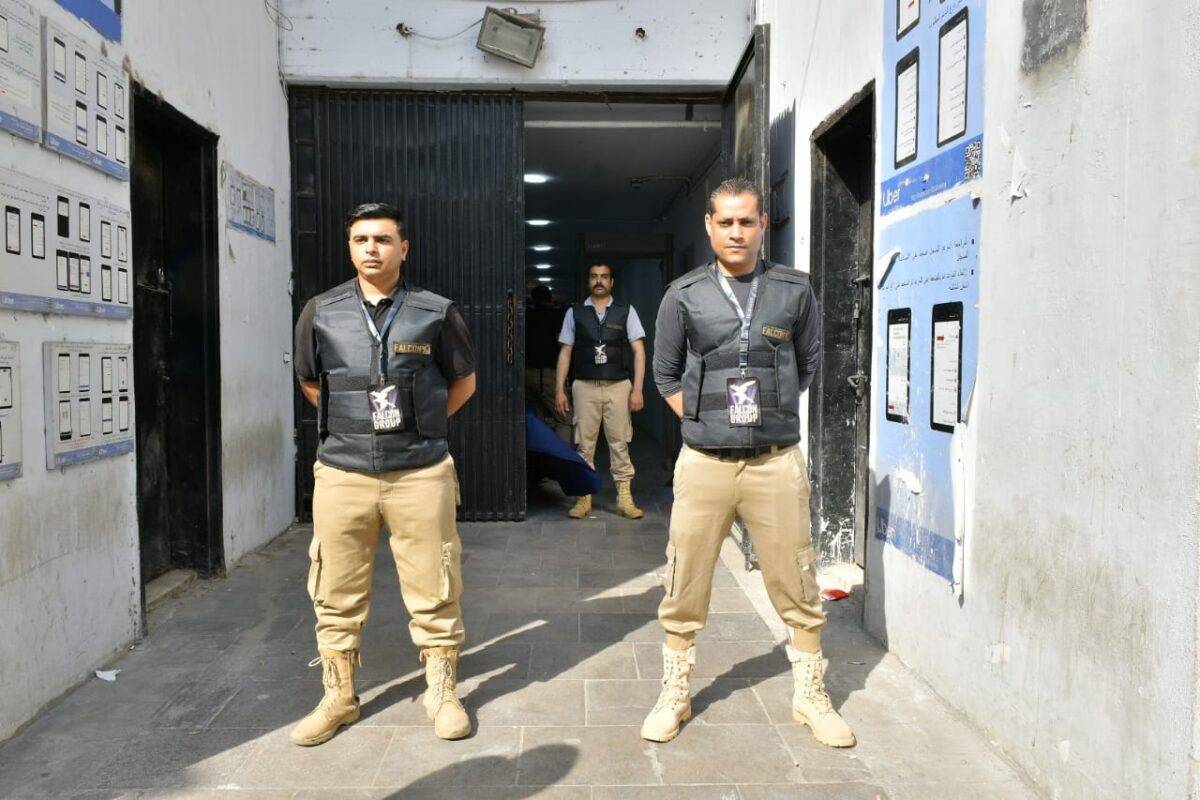
Threads are joining in Egypt, towards formulating new roles, which may be suspicious, for a major security company, with ties to the government, security and intelligence departments, amid great fears that dirty and secret tasks will be assigned to it in the coming period.
Questions have arisen about the nature of the tasks of the Falcon Security and Guarding Group, which explicitly announced its participation in the campaign to support and secure a third presidential term for the current president, Abdel Fattah Al-Sisi.
There are even more questions due to the ambiguity surrounding the company’s activities, working mechanisms, formations, financial accounts, the tasks assigned to it and the nature of those responsible for its management.
Rising role
The security group (which includes seven companies) is not new. It was established in 2006, but its role escalated after the military coup on 3 July 2013, which was carried out by Al-Sisi, who was the minister of defence at the time.
The group played a prominent role in suppressing Egyptian university demonstrations against the coup, and arresting hundreds of students, in addition to its role in securing public facilities, airports, clubs, foreign embassies, prominent officials and political, sporting and art events.
The company is considered the largest in the security field, with contracts totalling over two billion Egyptian pounds (about $65 million), and the most influential, given that a large number of retired army, intelligence and police generals and officers hold senior positions in it. The Chairman of the Board of Directors is former Undersecretary of the Intelligence Service, General Khaled Sharif.
According to an informed source who spoke to Middle East Monitor on condition of anonymity, the company is not listed on the stock exchange, is not subject to any financial or legal oversight and the extent or nature of its activities is not known.
According to the company’s website, Falcon’s services include facility protection, personal protection, rapid support and intervention, security consultations, public event security, industrial security, women’s security, guard dogs, and occupational safety and health training.
Pivotal situations
A more in-depth reading reveals four pivotal situations that are the most prominent in the company’s history. The first is the announcement in August 2014 of the launch of the “Rapid Support and Intervention Sector” under the pretext of confronting security chaos and riots, tasks originally entrusted to the Ministry of Interior. This means that there is a private security apparatus parallel to the police, in addition to granting it a licence allowing it to use weapons, according to Egyptian newspaper Al-Shorouk.
Having the right to deploy rapid intervention forces allows Falcon to deploy armed groups, vehicles and motorcycles at targeted security points, in addition to planting tracking, spying and surveillance devices.
The second pivotal situation relates to providing legal cover for the company, through the issuance of Law 86 of 2015 regarding facilities guarding and money transfer companies, which allowed them to obtain licences for several activities.
In December 2016, the controversial group took a third pivotal step, but this time on an international dimension, by establishing security partnerships with Russian, American and British companies, the most important of which was signing a contract with STC, to become the sole commercial agent of the Russian company in Egypt.
Suspicious deal
However, the fourth pivotal measure is considered the most prominent and influential in the group’s history, which is the sale of the company to Sabri Nakhnoukh, who was previously convicted of serious crimes, and who in May 2018 received a presidential pardon from Al-Sisi from his 28-year prison sentence on charges of bullying and the possession of weapons and drugs.
Egyptian Law number 86 of 2015 regarding companies guarding facilities and transferring funds stipulates that “the heads and members of security companies must not have previously been charged with a felony or misdemeanour and sentence with the deprivation of liberty, or a crime against honour or trust, unless they have been rehabilitated.”
Nakhnoukh has been labelled with many titles, such as Prince of Thugs, President of the Republic of Thugs, and Parallel Minister of the Interior, according to Monte Carlo Doualiya radio, which titled its coverage of the deal as “Sabri Nakhnoukh, President of the Republic of Thugs, has Become the Owner and Director of Falcon Group the biggest security company in Egypt.”
READ: Al-Sisi’s stark warning to Egyptian voters: it’s either me or chaos
Nakhnoukh owned offices to supply thugs, drugs and weapons in the capital, Cairo, and had previously been used to sabotage public facilities and prisons during the 25 January 2011, revolution in order to spread panic across Egyptian streets.
What made the deal more suspicion was the fact that the group, whose holds more than a 60 per cent share of the guarding and security service market in Egypt, was sold for just three million pounds (about $97,000) in addition to assuming the company’s debt of 120 million pounds (about $3.9 million).
Wagner’s Egyptianisation
The deal is becoming very dangerous, with the issuance of controversial statements by Al-Sisi about the possibility of destroying Egypt and spreading chaos in the country. He said a few days ago: “I can give a sheet of Tramadol (a narcotic substance) and 1,000 pounds (about $32) to 100,000 people whose circumstances are difficult and send them out for 10 weeks to create a situation. I can destroy the country with a billion pounds ($32 million).”
The picture becomes complete once these circumstances and statements are analysed in a manner that puts Egypt in front of a new model based on the Egyptianisation and cloning of the Russian Wagner group, which includes thousands of mercenaries and carries out dirty operations in various regions around the world.
Political expert Hamdi Al-Masry considered Nakhnoukh’s assumption of the presidency of the company a qualitative development in its security and political work, raising real concerns in the coming period. After the company’s recruits had been retirees from the army and workers with high security specifications and standards, those who join later will be thugs. They will secure voting centres in the upcoming presidential elections, paving the way for violent incidents against those suspected of voting for any candidate opposed to Al-Sisi.
Al-Masry noted that this task in the elections will be part of a broader right to deploy rapid intervention forces and armed groups at focal points under the pretext of confronting terrorism in coordination with the Ministry of Interior. This means that it will be an alternative to the regular security forces in confronting demonstrations and may commit human rights violations. This exempts the Egyptian ministry from any legal and international responsibility and criticism from abroad.
Al-Masry added that the development of the company’s activities and the nature of the recruitment of its members raises real fears of the emergence of an Egyptian version of the Russian Wagner Group in Egyptian cities, which may draw the attention of the UAE to assign foreign missions to it after the decline in the capacity of the Rapid Support Forces in Sudan to provide mercenaries for such missions, after its conflict with the Sudanese army.
It is worrying that the Emirati arm is actually present behind the scenes, with Alpha Oryx Limited, a subsidiary of the Abu Dhabi Investment Authority, acquiring 25 per cent of the shares of Commercial International Bank (CIB), the bank that owns Falcon, in addition to other partners.
Legitimising bullying
Without a doubt, Egypt now faces a very influential company with close ties to the security and military institutions in the country, and it may at some point operate as a parallel security apparatus, or militias that are supported and funded by Gulf parties such as the UAE to implement an external agenda if required.
An Egyptian political analyst, who preferred to remain anonymous, described assigning the company’s presidency to Nakhnoukh as “a means to legitimise thuggery and provide an official entity through which the thugs operate.” The official warned that the step is an indication of the expansion of Falcon’s role to carry out work to support the ruling regime in the future if the situation collapses or the official authorities stand against Al-Sisi.
Observers believe that Nakhnoukh is merely a front for the Egyptian version of Wagner, and that sovereign agencies are the ones who actually manage the group (the number of its members remains unknown), amid unofficial estimates that it has no less than 100,000 members.
The well-known diplomat, Mohamed Morsy, the former Egyptian ambassador to Doha, warned in a Facebook post that “the timing of Falcon’s sale to Nakhnoukh is inappropriate, and raises the idea, concept, and beginnings of forming private militias with different names, forms, and circumstances. Control over them may be lost as well as the tasks for which they were formed.”
The views expressed in this article belong to the author and do not necessarily reflect the editorial policy of Middle East Monitor.
Abstract The aim of this bachelor thesis is to introduce the personality and works of Karel Ladislav Kukla, an author who was sidelined, in today’s literary context. The thesis presents Kukla primarily as a Prague author at the turn of the 20th century, who dealt with the fate of people affected by social poverty, in his own words called “the Prague mud”, against a background of …

Nearly 500 people were killed in the explosion.
Washington:
US intelligence shows Israel was not to blame for a strike on a Gaza hospital, the White House said Wednesday, as President Joe Biden said it appeared to be the result of a misfired rocket fired by a “terrorist group”.
Biden has backed Israel’s insistence that it did not carry out Tuesday’s hospital strike that killed several hundred people. The Palestinian group Hamas says Israel was responsible.
“While we continue to collect information, our current assessment, based on analysis of overhead imagery, intercepts and open source information, is that Israel is not responsible for the explosion at the hospital in Gaza yesterday,” National Security Council spokeswoman Adrienne Watson said on social media.
The US intelligence included satellite and infrared data showing the launch of a projectile from the positions inside Gaza, the New York Times reported, citing US officials.
Israeli officials had supplied Washington with intercepted communications between Hamas officials, while US intelligence had also looked at open source video of the launch, it said.
Biden, in Tel Aviv during a short visit to show solidarity to Israel after the October 7 Hamas attacks, told Prime Minister Benjamin Netanyahu it seemed the strike was “done by the other team”.
The US president later gave a firmer attribution of blame, saying that “based on the information we’ve seen to date, it appears as a result of an errant rocket fired by a terrorist group in Gaza.”
He said the assessment relied on “data I was shown by my defense department.”
There was no immediate comment from the Pentagon.
The hospital strike killed 471 people, according to Gaza’s Hamas-controlled health ministry, and has sparked anger across the Arab and Muslim world.
Hamas said after the explosion on Tuesday that the cause was an Israeli air strike.
Israel has said the Islamic Jihad group had caused the explosion with a misfired rocket.
Israel has been carrying out a campaign of air and artillery strikes on Gaza since the Hamas attack when some 1,400 people were shot, stabbed or burnt to death, and 199 taken hostage.
Gaza health officials say more than 3,400 people have been killed in Israeli strikes on the enclave since the.
(Except for the headline, this story has not been edited by NDTV staff and is published from a syndicated feed.)

US officials investigating the explosion at a hospital in Gaza say information gathered so far indicates Israel is “not responsible” for the blast.
The White House National Security Council (NSC) says the “current assessment” was based on analysis of overhead imagery, intercepts and open source information.
“While we continue to collect information, our current assessment, based on analysis of overhead imagery, intercepts and open source information, is that Israel is not responsible for the explosion at the hospital in Gaza yesterday,” NSC spokesperson Adrienne Watson told NBC News.
It comes after Joe Biden said the explosion at the al Ahli hospital – which Hamas officials claimed killed hundreds of people and was caused by an Israeli air strike – appeared not to have been caused by Israel but “by the other team”.
Follow live: Middle East enters ‘dangerous moment’
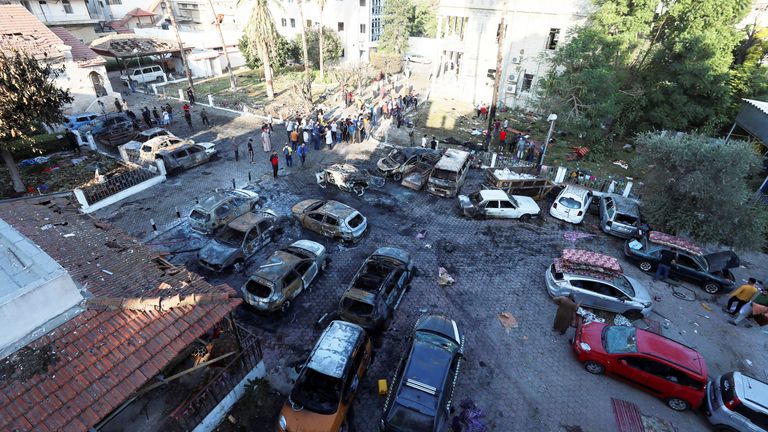
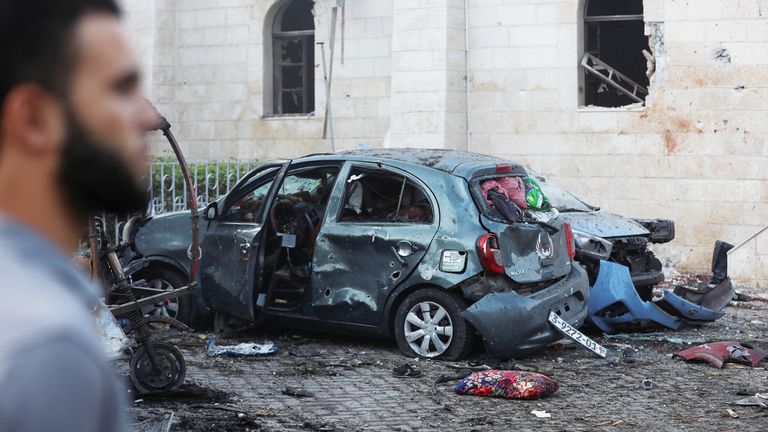
Image: The aftermath of the explosion at the al Ahli hospital in Gaza
The US president was speaking during a high-risk diplomatic mission to Israel – a day after the blast stoked tensions and sparked protest in the region.
Mr Biden held talks with Israeli Prime Minister Benjamin Netanyahu in Tel Aviv on Wednesday – trying to prevent the Israel-Hamas war from spiralling into a broader regional conflict.
Please use Chrome browser for a more accessible video player
 0:26
0:26
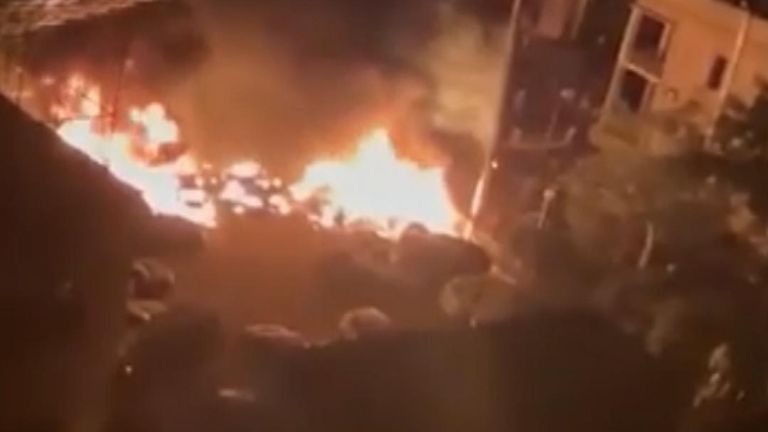
Gaza City hospital blast caught on camera
“Based on what I’ve seen, it appears as though it was done by the other team, not you,” Mr Biden said.
“But there’s a lot of people out there who are not sure, so we have got to overcome a lot of things.”
“The world is looking. Israel has a value set like the United States does, and other democracies, and they are looking to see what we are going to do,” he added.
Mr Biden said he was “sad and outraged” by the strike in Gaza which Hamas said killed up to 500 people at the al Ahli hospital – triggering worldwide protests.
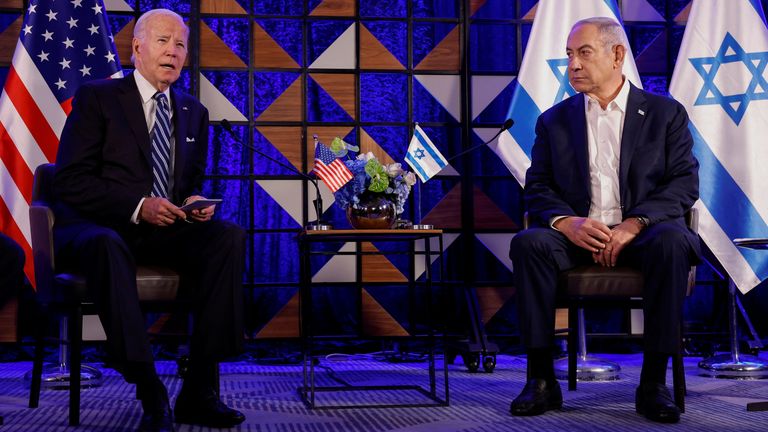
Image: US President Joe Biden with Israeli Prime Minister Benjamin Netanyahu in Tel Aviv
Hamas called the explosion a “crime of genocide” and has blamed it on Israel.
Israel has denied any involvement and said the blast was caused by a misfired rocket launched by the Palestinian Islamic Jihad (PIJ) group – an Islamist militant group based in Gaza which is smaller than Hamas but shares a similar ideology.
However, it too has rejected responsibility for the explosion.
UK intelligence also assessing explosion
Rishi Sunak, meanwhile, urged for a “calm and cool” approach in response to the blast and urged people: “Don’t rush to premature judgments.”
He told broadcasters: “It is important in this instance not to jump to conclusions, we have to establish the facts and premature speculation, I think, would be wrong, that’s not the right thing.
“This is a very heightened, sensitive situation, so we just need calm heads.”
Mr Sunak said UK intelligence was also assessing the explosion at the hospital.
The blast happened just before the US president arrived in Israel on Wednesday on a desperate diplomatic mission to prevent the Israel-Hamas war from spiralling into a broader regional conflict.
What we know about the al Ahli hospital blast
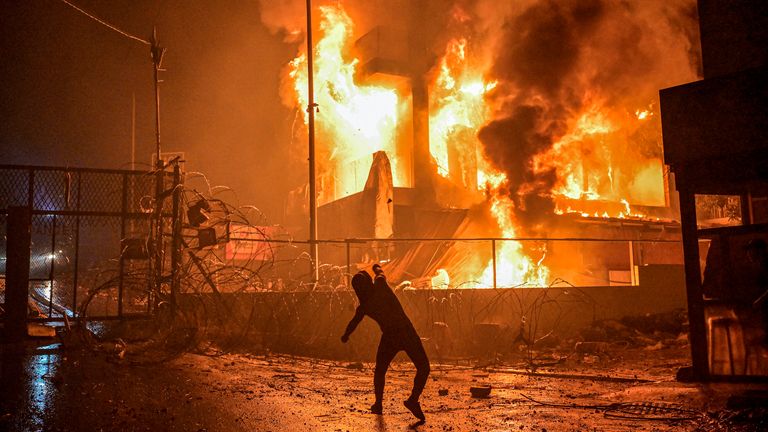
Image: A protester throws stones at a burning building outside the US embassy in Lebanon following the bombing of a Gaza hospital. Pic: DPA/AP
He said Washington would provide Israel with everything it needs to defend itself against the militant faction of Hamas.
In a press conference, he reiterated his government’s support for Israel and warned other pro-Hamas groups and nations in the region to stay out of the conflict.
He said: “My message to any state, or any other hostile actor, thinking about attacking Israel remains what it was a week ago: ‘Don’t, don’t, don’t’.”
Mr Biden also pledged $100m of new US funding for humanitarian aid to Gaza and the West Bank and said an agreement had been reached to allow aid to come into the Gaza Strip from Egypt.
Mr Netanyahu thanked his US counterpart for his “unequivocal support”.
The US leader is in Tel Aviv to show Israel the US’s support for its war against Hamas.
However, the second half of his visit to the Middle East – a summit between himself and Palestinian, Jordanian and Egyptian leaders in Amman, which would have focused on getting humanitarian assistance into Gaza while working towards calming tensions in the region – was cancelled following the bombing.
Read more:
Number of displaced in Gaza reaches new high
Rishi Sunak could visit Israel as soon as Thursday
The fireball that engulfed the hospital delivered some of the most harrowing images yet from the ongoing 12-day war.
About 350 casualties were rushed from the blast site to Gaza City’s main hospital, al Shifa, already overwhelmed with those injured from other strikes, said its director, Mohammed Abu Selmia.
Israel’s military released what it claimed was evidence – including drone footage and an intercepted conversation – which it said proves an Islamist militant group was responsible for the bombing and not an Israeli airstrike.
Spreaker This content is provided by Spreaker, which may be using cookies and other technologies. To show you this content, we need your permission to use cookies. You can use the buttons below to amend your preferences to enable Spreaker cookies or to allow those cookies just once. You can change your settings at any time via the Privacy Options. Unfortunately we have been unable to verify if you have consented to Spreaker cookies. To view this content you can use the button below to allow Spreaker cookies for this session only.
Click to subscribe to the Sky News Daily wherever you get your podcasts
It has not been possible to independently verify the audio recording published by the Israeli military of “communication between terrorists talking about rockets misfiring”.
It is the deadliest single event of the Israel-Hamas war so far.
After Mr Biden backed the Israeli account, other western leaders also called for caution.
Please use Chrome browser for a more accessible video player
 1:14
1:14
IDF release ‘hospital attack audio’
“Last night, too many jumped to conclusions around the tragic loss of life at Al Ahli hospital,” British Foreign Secretary James Cleverly wrote on X, formerly known as Twitter.
“Getting this wrong would put even more lives at risk. Wait for the facts, report them clearly and accurately.
“Cool heads must prevail,” he added.
Protests have ignited across the Middle East following the explosion, with hundreds of people taking to the streets in cities in Turkey, Jordan, Lebanon and in the West Bank – where there have been clashes with police.